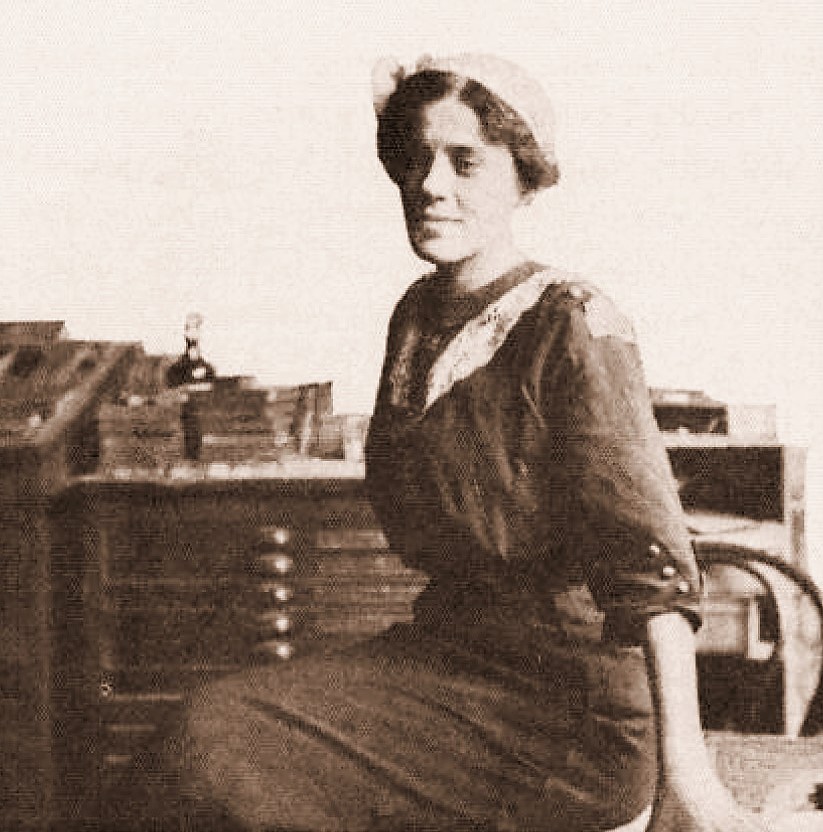
The second of Comrade Marcy’s insightful, empathic intelligence, and compelling, combative personality are on early and full display in her ‘Letter of a Pork Packer’s Stenographer.’ The letters would bring her to the attention of the Socialist movement she would help to define the following decade and a half. In 1902 Mary E. Marcy, then recently married and in her mid-20s, moved from Chicago to work as an assistant to the treasurer of the Armour meat-packing company in Kansas City. While there she began writing letters back home to her friend Katherine. Mary’s career was muckraking career exposing that industry’s dirty secrets was born as Charles H. Kerr printed Marcy’s letters over the following year. Gaining her national notoriety, the exposure, and her public testimony against her bosses at a Chicago grand jury, cost Mary her job in 1905. However, less than five years later Mary would be the editor International Socialist Review. The collected letters are a treasure.A n archive page with all of the letters here.
‘Letters of a Pork Packer’s Stenographer, No. II’ by Mary E. Marcy from the International Socialist Review. Vol. 5 No. 2. August, 1904.
Chicago, Ill., April 23, 190—.
My Dear Katherine:
Et tu, Brute! And will you join the stupid, clamoring multitude in maligning us? In pronouncing our late advance in prices exorbitant, and echoing a tune all the newspapers (not controlled by Papa Graham’s friends) are singing that-
“Beef has gone so high/ It has touched the sky!”
To begin with, why should our party lower the tariff on beef? It is not for this we have expended our money in legislation. And are they not sworn to “Protect us Infant Industries”? Would you have them recant the policies of fifteen years, and become the laughing stock of their opponents? Silly weather-cocks, as it were, making and unmaking their laws with every change in the affairs of men! What was good enough for our fathers, is surely good enough for us, and if the times have changed, it is no reason why the laws should!
Further, if you don’t like our prices, remember that you are living in the “Land of the Free,” and go without-you are always at liberty-to go without! Therefore, lend not your support to our nefarious machinations! Scorn, and spurn us! A vegetable diet is just as healthy anyway, and you can take a trip to California with the money!
And further, My Dear; lend me your ears. Have you not heard of the charming Sylvia Graham, daughter of our late honored partner, whose decease wrought such grief in the hearts of his countrymen, a few years ago, and who rightfully divides with her uncle John Graham—the love of her grateful employes, and the dividends of the corporation? The beautiful Sylvia has been educated in Paris, and is about to be married to a French nobleman, provided the necessary dot is forthcoming. From the beginning of medieval history, it was the People who were taxed for the entertainments and luxuries of Wealth and Beauty, and shall it be said in America that for want of a few paltry millions a count was lost!
Don’t grumble, My Dear, but offer your tribute gracefully, as the rest of us are doing.
I must add too, that you need not fear to grow feeble should you decide to save your money and dine beefless, as, by daily watching of the workmen who do the manual labor about the plant during their noon hour, I have perceived, that, without any exception, they seem to be vegetarians, as only bread, and sometimes pie, come forth from their dinner pails-doubtless, because they have discovered these to be more wholesome, and nourishing than meat, rather than through any dictates of economy.
I have been very busy all morning, writing our Branch House Managers to go through their letter books and destroy any evidences of our “understanding about prices with former competitors.” Mr. Graham and Mr. King had a long consultation with Mr. Robinson, the company’s chief attorney, which resulted in the following wire, which I dispatched to one of our Branch House Managers at a Southern point:
“Regarding summons reference Beef Trust investigation, have decided will all ignore same. Do not appear.”
“All,” of course, means the five companies in the combination; so you see, there ARE some real American Anarchists—if a rich man ever can be an anarchist. Father Graham was very keen about competition in those letters he wrote to Pierpont, but he was not so keen but that he buried the hatchet when he found he could make larger profits by a little understanding with his old enemies. You remember he said what he wanted “RESULTS.”
I wonder if you understand how omnipotent we really are! We represent the only market on which the farmer and stockman can dispose of his product, and on the other hand, we are the only people from whom the Public can buy. Of course, there is nothing monopolistic about this state of affairs. This is a “free” country. If the farmer is not satisfied with our offers, he can ship his poultry and eggs back home. The stockman can do likewise with his cattle, if he asks more than we care to pay. And the dear Public has always the privilege of doing without.
There is a crazy little man, of the name of Hayden, at Higginsville, Ill., who is running a small butcher shop in competition with our Retail Market there. He doesn’t know, of course, that the company he buys his meats of has opened a Parlor Market to compete with him, because it is not known as a Graham shop, but is run under the name of “The People’s Market.”
Mr. King wrote our Manager at that point to shade his prices a trifle to the consumer, and we have meanwhile raised our prices to Mr. Hayden, and Mr. King says this man ought not last two weeks.
It is only a question of time, Mr. Graham says, until we will completely do away with the middleman. There is no good reason why meat should pass through the hands of three or four men before it reaches the consumer; and he don’t intend that it shall.
It looks sensible on the face of it, to me. It seems as though if a certain amount of the work necessary to present production, and distribution could be eliminated, any intelligent society would want to make use of the means to bring about such a condition. For our object ought to be, not to see how long we can be at work, but to produce enough for everybody, in the least possible time. Of course we understand that in the disorganized state of society today, this would mean still greater production, by fewer men, and greater wealth for the benefit of a few, and that the men who did the work would not be the ones to reap the harvests there- of, because every workingman would be forced to more actively compete with his brothers for the decreasing number of jobs.
Now I am not turning communist, as you inferred in your last letter. Equal distribution of wealth, unequally produced, would be only a step better than unequally distributed wealth, unequally produced, as it is today. I would not call a society founded on Communism-even though you say Christ was a Communist-a just society, because I would only count it just when every man reaped according as he had sown; when his share in the distribution was equal to the wealth he had produced and every man starting with as nearly equal opportunities as possible. I might also add that a communist does not believe in private property, and I would very seriously object to the community using my brush, or my comb of even my poor little clothes. However, I agree with them in thinking that no man ought to own anything on which the lives of his fellowmen depend. But remember, My Dear, my theories are only in embryo.
Mr. King discharged two of our men today. One of them had been in the employ of the company for twenty-five years, and Mr. Graham said he was “too old”. The other was a young cashier, who is “nervous.” The moral of the story is, that you must not grow old, nor ill, if you want to hold your job. There is one thing upon which the World of Business is not founded, and that is Sentiment. It is absolutely swallowed up in the clatter of dollars and cents. And I am beginning to believe that the successful business men who are Christians are about as scarce as hens teeth. They may be Baptists, and Methodists, or Catholics, or Scientists, or Seventh Day Adventists, but it is dreadfully hard for them to be Christians. A man may want to be a Christian, but there are his children to be educated, and he decides that he would rather see his competitor’s little ones working in a factory than his own, and goes in for a “lawful’ or unlawful advantage.
And speaking of factories, reminds me of the manufacturer who launched me on the stenographic sea, and who grew rich hiring children and young girls to run his sewing machines, in manufacturing the dear, old fag, the “Star Spangled Banner,” which has come, alas! to mean just that—millions of men, and women and little children, toiling to make money-kings of a few! I might add also that one of the brothers in this company was on the Lincoln Park Board, and belonged to the Anti-Trust Association- also the Wire Rope Association (which was “formed for the purpose of upholding prices”)—which he cut behind their backs and evaded the $500 penalty for breaking the “contract.” He granted public favors, for value received, and said “I done,” and “you was,” and “fired” me because I told the boys in the office that the “Identity of Interest Between Employer and Employed” fable was all ROT! I argue the question no more, for he proved my assertion.
On the other hand, there was the lumber dealer for whom I worked, who treated every man as though he were his brother; who gave his customers what they purchased, and his employees what they earned, and who—failed! You see many of these men are forced to push their competitors down, in order to avoid sinking themselves; so I am not blaming the individual, but the system.
Teddy has moved down on the South Side, and rooms only three blocks from our place. He takes all his dinners with me, and comes over three or four evenings out of the week. He has been working on some articles for one of the city labor journals, this month, however, and is growing thinner every day. I mean to drag him away from all things serious occasionally, or he will break down.
Have just taken some more dictation, so no more for today. Write often and tell all about your studies.
From your loving MARY.
P.S. Today the City gave “us” (for private switching purposes) land valued at $80,000. Verily, verily! as David Harum says, Them that has, GITS!”
The International Socialist Review (ISR) was published monthly in Chicago from 1900 until 1918 by Charles H. Kerr and critically loyal to the Socialist Party of America. It is one of the essential publications in U.S. left history. During the editorship of A.M. Simons it was largely theoretical and moderate. In 1908, Charles H. Kerr took over as editor with strong influence from Mary E Marcy. The magazine became the foremost proponent of the SP’s left wing growing to tens of thousands of subscribers. It remained revolutionary in outlook and anti-militarist during World War One. It liberally used photographs and images, with news, theory, arts and organizing in its pages. It articles, reports and essays are an invaluable record of the U.S. class struggle and the development of Marxism in the decades before the Soviet experience. It was closed down in government repression in 1918.
PDF of full issue: https://www.marxists.org/history/usa/pubs/isr/v05n02-aug-1904-ISR-gog.pdf
 Revolution's Newsstand