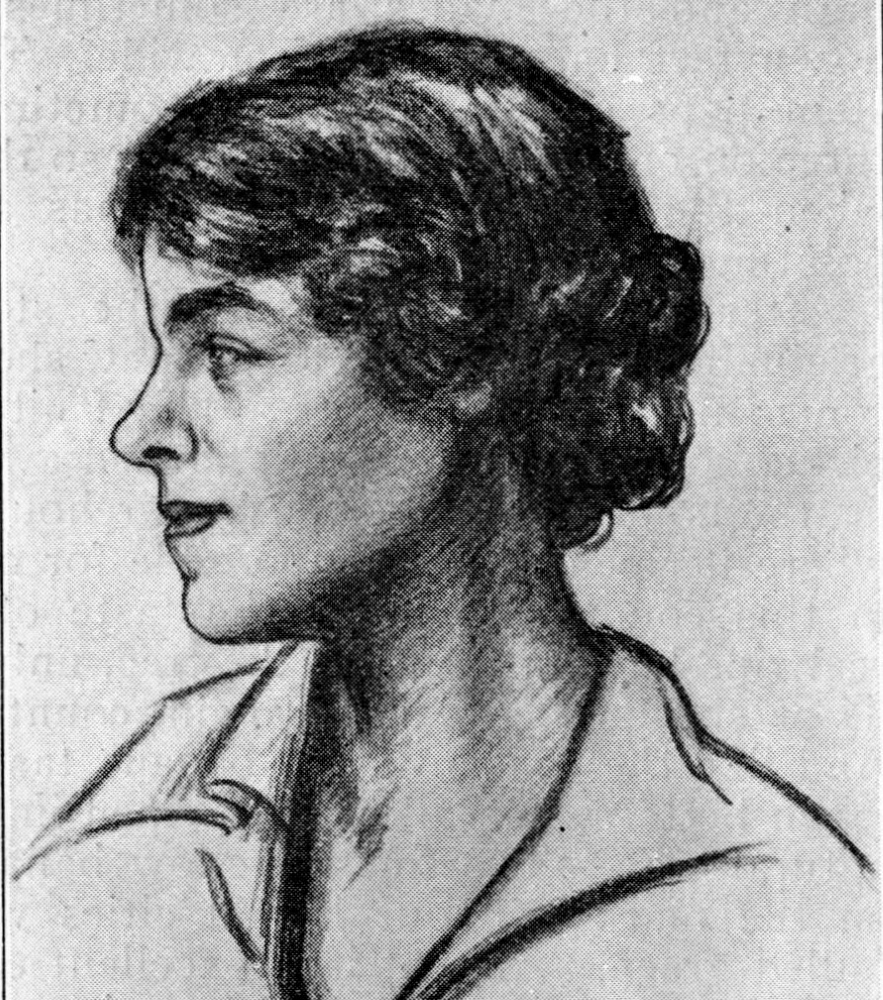
The sixth ‘Letter of a Pork Packer’s Stenographer’ from Mary Marcy. Comrade Marcy’s insightful, empathic intelligence, and compelling, combative personality are on early and full display in than her ‘Letter of a Pork Packer’s Stenographer.’ The letters would bring her to the attention of the Socialist movement she would help to define the following decade and a half. In 1902 Mary E. Marcy, then recently married and in her mid-20s, moved from Chicago to work as an assistant to the treasurer of the Armour meat-packing company in Kansas City. While there she began writing letters back home to her friend Katherine. Mary’s career was muckraking career exposing that industry’s dirty secrets was born as Charles H. Kerr printed Marcy’s letters over the following year. Gaining her national notoriety, the exposure, and her public testimony against her bosses at a Chicago grand jury, cost Mary her job in 1905. However, less than five years later Mary would be the editor International Socialist Review. The collected letters are a treasure. An archive page with all of the letters here.
‘Letters of a Pork Packer’s Stenographer, No VI’ by Mary E. Marcy from International Socialist Review. Vol. 5 No.6. December, 1904.
Chicago, Ill., May 8, 190–.
My Dearest Katy:
IT is Saturday evening and almost 12 o’clock, and I am in my little ten by ten room, very cosy and comfortable, determined to have a long, uninterrupted talk to you ; for this is the season in the week when I am pleased to fancy myself a young woman with leisure for thinking, with the open sesame to hear good music; with a library, and nothing to do but enjoy it; with frocks in my closet and money in the bank ; when Teddy takes me to the concert, or the theater, and we have a supper at the Bismarck, and I sit up very late writing to my friend with the delightful prospect of sleeping till nine in the morning ; when I forget my troubles at the packing house, and the discouragements of doctor bills; when I scorn my type-writer, and mock at the common-place when I pretend that I am free, and dream dreams 1 And O the luxury of a Sunday morning, when I waken at the usual hour to realize the joy of being able to turn over and go to sleep again! When I bribe the chamber-maid to bring up a cup of coffee, and a bit of toast, which I eat in the abandonment of laziness, in my robe de nuit! And then to snuggle back into my pillow for another half hour, believing, with utter content, that all good things must come, if I but work and wait! Were I an infidel, I think I could never wholly scorn a religion that has given to the workers one day of rest!
Teddy and I have been down to McVicker’s to see “The Land of Dixie.” We were too late to get tickets at Powers’, and having heard someone say (we can neither of us remember on whom to fasten the blame) that the play was “clever,” we dropped in.
We enjoyed ourselves, as usual, for it would take a pretty big cloud to darken our sky on Saturday night. The play was so very bad it was almost good, and so copiously did the ladies about us weep at the thrilling parts and the “Elizabeth crossing the ice music” that we were unable to control our risibilities.
It was truly a wonderful play! A knock-down and drag-out in the first act, the youthful Hero overcoming the mighty Villain— A robbery and murder in Act II, when the Hero appeared, unfortunately, just in time to be suspected, but a Little Girl, out in the storm (nobody knew why), witnessed the bloody deed, and where the Common Herd growled at the Hero at the close of the third act, and the Villain hissed, “And WHO can PROVE that YOU did not MURDER Gerald Bovowskyl” this dear Little Girl runs in, bawling, “I can!” She seems not to do it, however, because the World believes the word of the drunken Villain (who has led a wholly disreputable life) against the spirited assertions of the Hero (who was the Choirmaster in the Village Church), and He talks to the Heroine about the Past in the fourth act, with the blood-hounds poking their noses through the cracks in the sides of the barn; but just as the Sheriff and his Posse begin to batter down the barn door, she gives the Hero her horse, and he escapes in spite of shot and hound.
If anything could possibly be more exhilarating than Act IV, it was Act V, because all the clouds were dispelled, and the Sun shone so brightly that it lighted the whole theater. The Villain was dragged to the front of the stage bleeding copiously, and snarled and growled and finally confessed that the Little Girl, who had grown to be a charming young Lady during the Play, was the daughter of an Earl, and that he, and not the Hero, had committed the awful deed. Then the Aged Father wept bitterly because he had “fostered such base suspicions against his noble Boy,” and the Widow mourned because her husband had never returned from the War ; and the Heroine wailed because the Hero was “Out in the World alone.” But finally the Villain was hauled off the stage—to prison and the rope, and the Hero and the Widow’s Husband came stealing in “at the Garden Gate,” and the old Earl, by some fortunate chance, ran into the arms of his long-lost daughter. And the curtain went down with the Widow fainting on the breast of her spouse; the Hero gazing into the starry eyes of the Heroine, and the old Earl, showering upon his newly found child the wealth of his stored-up affection.
It reminded me very much of “The Duke’s Secret” we heard when we were little girls in the sixth grade, and “Prizes were presented to every Lady holding a Reserved Seat.”
But the American Drama has evolved a step or two since
those days, and is really on a much higher plane than American Literature. An interesting little French Professor has been added to the list of Mrs. Crosby’s guests, and we are favored in having him sit at our table. He was simply charmed with my views on French Literature, and I thought he would embrace me on the spot on learning that Balzac, Victor Hugo, de Maupassant, George Sand, Dumas, Rousseau, and his adored Emil Zola were among my favorites! He was so pleased and grateful indeed, that he hunted about in his memory for an American novelist, whom he could justly praise, but failing, the gallant little man apologized because he “knew so little about our great writers.” I made as much as I could of Hawthorne, and Washington Irving, and a few of our moderns like Mary E. Wilkins, and turned the conversation into an essay channel and dragged in Emerson and Thoreau, and finally—Walt Whitman—and I confess—I thanked the gods from the bottom of my heart—that this glorious singer was an American.
Mrs. K., a dear, foolish, useless little woman, who sat opposite, and considers herself a “great reader,” suggested “The Days of Chivalry,” “Lady Dorcas,” and “A Love Story of the French Revolution,” but I blushed to introduce him to historical novels, whose only local color consists in a few “Mahaps, Methinks,” and an old-fashioned gown or two. I wanted to suggest George Ade, which, had he been long among us, any Frenchman would delight in; but Mrs. K. said, that “Mr. Ah’day was funny; but not DEEP!” Mrs. K. is a “Parlor Intellectual,” and “deep” things are her strong suit.
Sometimes I think it odd that so few of our artists have appreciated the choicest bits of coloring, the truest picture, the greatest sacrifice, the deepest pain, here in America, and that nearly all of them have had to dig in the far-away-ages of the Past, in order to find romance, interest, plot and tragedy.
Was there ever a Mistress of Kings who commanded more servants, wore costlier jewels, finer gowns, or who ruled over more establishments than do our American heiresses today! Or King more potent than our monied masters, who own the things on which our lives depend! Or slave more bound than we, who bargain with them for a chance to work and live! Is there any tragedy, I wonder, to equal the life of a young girl, whose wages are four, and whose expenses six dollars a week!
If I had the tongue of angels, I would sing the story of the Working People!
I note, by your letter, how much you like Prof. Hadley’s course on the Trusts, and I have read, with a great deal of interest, your brief review of his viewpoint. And, as far as he goes, I most emphatically agree with him. What IS the use of having ten factories when two will accomplish the necessary work, or a Middle-man, when it is .a saving of labor to do away with the Middle-man. Combination certainly DOES do away with the useless—useless labor, useless establishments, useless waste, useless everything, save the profit-drawing, useless Sylvias. Trusts do also regulate the supply. They produce all that is necessary and no more—which is another sensible feature.
But here is where your University Professor stops, and here is just where I go on. He may SEE further, but self-preservation probably dictates that he say nothing to offend the so-called University Benefactors. There was once a University Professor who taught the truth, and offended the man who held the pocketbook; and he lost his job. Perhaps he stands as an example to those who remain.
If, instead of the present form of the private Trust, all the working-men of the world united to do the necessary work of the world in the best possible manner, in the least possible time, each worker to receive the fruits of his individual effort, I think this form of combination would be beneficial to everybody. It seems to me, that if Justice prevailed in a land of “Over production,” everybody who worked would have enough.
But the Trusts, as they exist to-day, are not formed for the
purpose of lowering the market price of any commodity, nor for shortening the working hours of labor, or raising the wages of labor. They are formed for the purpose of cutting down the “cost of production;” gaining control of the market, and finally —and entirely—for making larger profits for the benefit of a Few.
And I want to say right here that there is only one item that can possibly enter into the “cost of production,” and that this item is Labor. Labor, from the miners, who wrest the treasured from the earth, and gave them value, from the Lumbermen, who fell the trees, from the men who build, run (and do NOT own) the Railroads, on through the factory, where other bands of workers mold the metal, or carve the timber, or dress the cattle, for the use of the World. It is Labor only that produces wealth, and the “cost of production” is the wages paid to Labor for the wealth it has produced. The cost of production (wages paid to Labor) plus the profits, equals the market price of a commodity.
Profits are what a man’s employes earn, and do not receive; or what his customers purchase, and do not procure. If the employer rendered unto his customers the full value of their money, or unto his employes the full value of their work, he would have no profits, and the world would be minus its millionaire Sylvias.
When a customer pays my employer $5.00 for work that I have done, and for which I have received only $1.00, it is obvious that either the customer is being cheated, or else, I am.
We know very well that the Trusts of to-day, having secured control of the market, make their own prices. And we see the price of all Trust-made commodities going steadily skyward, in spite of the fact that the cost of production has greatly decreased.
Take the Beef Trust for an example. We represent the only market in which the farmer and stockman can dispose of their produce, cattle and hogs. We represent the only market on which the People can buy. A few representatives of the Trust convene every morning to decide upon the market price of the cattle we buy, and the market price of the beef we sell. And I only ask you to note, that cattle were never so low, nor beef so high.
We read a lot in the papers about the prosperity of the working-man, about his glorious increase in wages, and his enviable condition all around ; but we forget that during the past five years, the cost of living has almost doubled, and that a man’s wage is not the amount of money he receives, but what that money will buy. It takes nearly two dollars to-day to buy what one dollar would have bought a few years ago.
I think our “understanding about prices” with former competitors, is another of Pierpont’s innings, and that he tipped it off to Papa Graham that while it did pay better to advertise than to keep expensive salesmen on the road, it would pay still better to join hands with the big four and control the market. And so Old John is able to “milk the critter coming and going, and milk her DRY,” as he wrote Pierpont, in those letters, he wanted to do. And the critter, of course, is the Public.
It seems to me that combination is only another step in the evolution of society; but I believe that the benefits should be reaped by you and me, and all the workers, as well as Sylvia, or by you and me rather than Sylvia, because we are useful, while she is merely an ornamental, member of society.
The Packing Company contracted for a new sausage machine today, which will enable them to turn off half the men employed in that department. It will—in the usual way—materially lessen the cost of production, but having a monopoly, they will not need to lower their selling prices.
After all, what benefit has Labor ever received from the “labor saving” inventions? I cannot recall a single instance where the full benefit has not been reaped by the drones alone.
That disagreeable Mr. Edison has invented another labor-displacing Machine! This time it is an automatic typewriter that will accomplish the work of ten stenographers. I would enjoy seeing one of them write Mr. King’s dictation, and I would love to see the Branch House Managers trying to make out what Mr. King was talking about. It takes a clairvoyant to be able to please Mr. King.
If Mr. Edison lives long enough, it will only be a question of years until all the unpleasant drudgery of the world’s work can be done by machinery, and we, useful people, will be minus our jobs. The country is ever, by the aid of these new inventions, growing more productive. By and by, I suppose, a few overworked workingmen, with the aid of these machines, will be able to produce enough to supply the whole world, and the condition of the working man and woman will be much worse than it is now, because the total wages paid to them for producing all the wealth of the world will be so low that they will be able to buy back only a very small percentage of their product ; and society will be in a constant state of panic.
We boast about our scientific age, and strut about telling of our wonderful machinery, and brag about the productiveness of America, but I wish we could have a chance to be proud because every citizen of America—and every citizen of the world—owned his own home, was sure of his job, and had plenty to eat and wear. The prosperity of a country does not depend upon the goods we export; nor the size of our standing army, nor the millionaires to whom we pay tribute, but upon the wealth that is produced, and the justice with which it is distributed among the workers who have produced it.
In another ten years, I suppose the Packing Company will have overhead chutes from Texas to Chicago, into which steers as tough as cactus roots can be stimulated to march northward by the aid of gently administered electric shocks, being fed on the way by the farmer’s latest harvest, so that by the time they have walked to the Packing House, they will be corn-fed, and ready to be killed.
Transportation can be saved on the corn and on the cattle. Aman will sit upon the top of the Packing House and watch the process through a telescope, and guide the feeding of nations by the pressing of a button—or, very likely, they will have a little boy, or even a little girl, the younger, the cheaper. Automatic typewriters and accountants will be in use. A man in Georgia will drop a five dollar bill in a slot when he wants a porterhouse steak, which will be shot to him through a compressed air tube from Chicago—and we—where will we be!
I have been helping out on some special work in the Fertilizer Department to-day. When I found their attitude toward their customers promissory, solicitous, and conciliating, I knew there was a reason, and a good reason for this unusual courtesy on the part of the Packing Company, but I think you will agree with me that the reason is obvious. Fertilizer is not a necessity, and meat is. You have to have your meat, and so you come to the only people who have it, but it is an altogether different proposition when we come to unload our fertilizer on a customer.
Not so very many years ago, what we now use for fertilizer was thrown away, but we have learned to make all things result in the glory and profit of Graham & Company. A very little labor spent upon a former waste, nets us many thousands of dollars yearly. A land-owning farmer is always good, so we unload our fertilizer on him in the fall, and take his notes, payable the following autumn, at 8 per cent, and 8 per cent upon refuse that nobody else wants, is a pretty good investment, and we always get our money in the end.
I wrote a letter for Mr. Diedrich, head of the Fertilizer Department, to-day, extending the time on half a dozen farmers’ notes 30 days, in answer to a letter from one of our Agents, advising us that these farmers had not made enough on their wheat crop to pay for the fertilizer, and wanted a little more time to fatten, and bring their hogs to market.
The clock is just striking two, and I must say Goodnight. Write often, and tell me all about your studies, and don’t neglect to say what impression Charlie Watson has succeeded in producing upon a certain stony-hearted little chit at the University. Take my advice, Catherine, and guide your affections into a feathered nest. Since you are still fancy free, seek to rivet your happiness by falling in love with a man who has a reasonable bank account, and a possible future. Steer clear of the rock on which your Mary fell, for Teddy hasn’t the slightest prospects of ever earning more than $65.00 a month. And little Teddies, and little Marys, on $65.00 a month, is too much for your worldly-wise Mary. And who can tell! Though her heart has stranded, her wits have not, and she proposes to hope on, and work on, until bookkeepers become scarce, or employers just—or Utopia arrives, and young men earn enough to get married on. So I am cautioning my Kate to beware of hidden shoals before it is too late. Love is a very beautiful thing; but love united with comfort, and a few of the other pleasures of life, is a much more substantial and enduring emotion.
But whatever may be your lot, dear, I can never wish you greater happiness than to find such a friend as Teddy has been, as, step by step, he has guided my feet in the paths of intellectual progress, with broadening horizon, and an endless road.
Goodnight again, and pleasant dreams, to my dearest friend,
From your own Mary.
The International Socialist Review (ISR) was published monthly in Chicago from 1900 until 1918 by Charles H. Kerr and critically loyal to the Socialist Party of America. It is one of the essential publications in U.S. left history. During the editorship of A.M. Simons it was largely theoretical and moderate. In 1908, Charles H. Kerr took over as editor with strong influence from Mary E Marcy. The magazine became the foremost proponent of the SP’s left wing growing to tens of thousands of subscribers. It remained revolutionary in outlook and anti-militarist during World War One. It liberally used photographs and images, with news, theory, arts and organizing in its pages. It articles, reports and essays are an invaluable record of the U.S. class struggle and the development of Marxism in the decades before the Soviet experience. It was closed down in government repression in 1918.
PDF of full issue: https://www.marxists.org/history/usa/pubs/isr/v05n06-dec-1904-ISR-gog.pdf
 Revolution's Newsstand