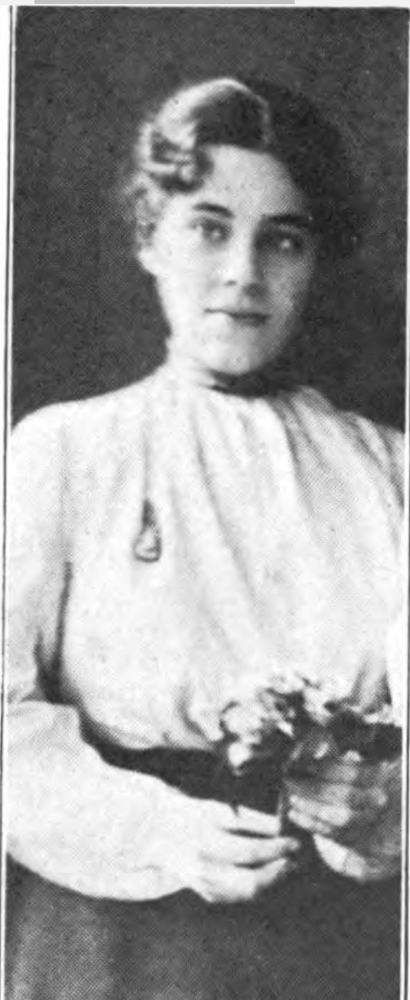
The seventh and final ‘Letter of a Pork Packer’s Stenographer’ from Mary Marcy. Comrade Marcy’s insightful, empathic intelligence, and compelling, combative personality are on early and full display in her ‘Letter of a Pork Packer’s Stenographer.’ The letters would bring her to the attention of the Socialist movement she would help to define the following decade and a half. In 1902 Mary E. Marcy, then recently married and in her mid-20s, moved from Chicago to work as an assistant to the treasurer of the Armour meat-packing company in Kansas City. While there she began writing letters back home to her friend Katherine. Mary’s career was muckraking career exposing that industry’s dirty secrets was born as Charles H. Kerr printed Marcy’s letters over the following year. Gaining her national notoriety, the exposure, and her public testimony against her bosses at a Chicago grand jury, cost Mary her job in 1905. However, less than five years later Mary would be the editor International Socialist Review. The collected letters are a treasure. An archive page with all of the letters here.
‘Letters of a Pork Packer’s Stenographer, No VII’ by Mary E. Marcy from International Socialist Review. Vol. 5 No. 7. January 1905.
My Dearest Katherine:
Your letter came this morning, and it has set me thinking all the day, for alas! You speak truly, when you say I am changed. That dear little‘ letter was the one link to bind me to the past, the one bright spot amid the wrecks of my illusions; for it represents the friend who loves me for the things I have been, for the things I am now, and who, though I break every one of the Ten Commandments, though I mock at the mistaken ideals of men, and put my trust in the things they call evil, will continue to love me till the end.
It was a welcome letter, my Kate, for it gave me one tried cord to cling to, at a time when I find the teachings of my mother, the beliefs of the Church, and all the vaunted intellects of the college, irreconcilably opposed to the deductions that Truth, and Reason, and Experience dictate. I find myself alone, facing the new and untried, the way to growth and progress, against the old, which represents all that the world has trusted and believed in the past.
I am no longer the little girl who stole from her crib and crept down the stairs one Christmas eve sixteen years ago, with the hope of discovering the St. Nicholas of childish fancy, and nursery lore—to lose—her first illusion. Nor the school-girl, who boasted of her American birth, and worshipped her Sons’ of War, who honored where honor was net due, and blamed where she should have given praise. Nor a Christian, in a land where men compete, with each other for the means of existence, and count it noble. No longer the idealist who believes in appealing to the sentiment—the humanity in man.
I am the woman of twenty-three who has buried her illusions, who has outgrown the shell of her past beliefs, who respects the old, only because it has made possible the new, who has seen sentiment fail, and Christianity stagnate, and who believes the only programme calculated to benefit the man and woman of the future, must be, as it has been in the past, founded upon the never-failing stimuli, of personal benefit—self-interest, as a Christ’s teachings of a brotherhood in this world were founded upon a personal reward to be reaped in Heaven; as many manufacturers in the North, forty years ago, became abolitionists, and worked for the freedom of the negroes, in order that Northern manufacturers might be able to compete with the Southern markets; as cannibalism died away, when it became apparent to the ancient tribes that they could better use their enemies by making slaves of, than by eating, them; as society has ever progressed through the constant seeking of every individual for his own personal happiness.
I have come to believe that self-interest, and not self-sacrifice, is the law of progress, for no matter how ideal may be a man’s aims, how altruistic his motives, or how loving his soul, he has first to supply the needs of his own body, ere the work moves on.
Until of late, however, in spite of my lagging faith in the truth of the Church, my waning respect for college intellect, and my new conception of Man, I had still belief in the laws and institutions of our country—that they were formed for the purpose of protecting the innocent from the guilty—and stood for justice and equality toward all. But again, I say, I have buried another one of my illusions.
I am awakened more fully every day to the fact that the laws are made nowadays more to protect the guilty from the innocent, than to uphold the virtuous; rather to help the strong to become stronger, and to protect the colossal robber in picking the pockets of the poor. I have been reading the morning paper and the trial of the boodlers in Missouri. I see that the Packing Companies are going to “Legally” combine. So, while they were punished (in Missouri, a paltry fine of $5,000) for combining—in May —they are combining, according to Law—in June.
Trusts buy, where they cannot defy—and it is only the poor man who obeys the laws. If the new anti-anarchist laws were put into effect, I think some of us would be surprised at our friends who would be transported.
It seems to me that it is mockery to talk of Liberty when half a dozen men own the resources on which the lives of the whole nation depend! And that we are only suffering a new kind of slavery, where our backs and our stomachs scourge us onward, and bid us yield homage to the kings, as did the lash of the master’s whip, in the days of old! And the hand that holds the job rules the world!
But in spite of the loss of my old beliefs, I have found one rock of truth amid the new. Human nature is ever the same. It has always been the same, and doubtless it will continue so. And human nature is selfish. It seeketh its own. It is compelled ta seek its own in order to live. On this fact, and on this fact alone, must the Future build. On this fact has History built, and it is this great natural law, that will eventually bring greater happiness, greater liberty, greater knowledge, and broader life, to all men. Utopia must come as the Republic came—not founded upon the sands of sentiment, or religion—but upon the natural and eternal law of self-interest.
I suppose you have seen in the papers that the fortunate Sylvia has at last succeeded in landing her Count. The Tribune calls him an imbecile, the News says he has $500,000 bad debts, while the American proclaims that he has a club-foot and has suffered from rickets since his childhood. But no matter how rickety he is, nor how foolish or wicked he may be, he is a Count for all that (just as Pierpont Graham would have been ever increasingly a millionaire, if he had been born an idiot), and even if Sylvia has to have him shut up in an asylum, she will still be the Countess of Know-nothing-at-all-and-never-did-a-lick. I believe John Graham, himself, is not much taken with the idea of having a Count in the family. But whether it is more praiseworthy to get rich by working the people who do the work, or by marrying a bank ac- count, would be a question somewhat difficult of answer. Perhaps the Count will prove a good spender—Counts usually know that much, anyway—and thus keep the custodians of Sylvia’s wealth from going crazy trying to look after her money.
Mrs. Graham, it seems, warmly approves of the match, and has expressed herself by presenting her niece with a country place in England, worth over a million dollars, fof a wedding present. Hundreds of workmen have been dispatched to the de Souci Gardens to rebuild the ancient palace that belonged to the fathers of the Count, which the papers tell us he has been able to redeem on the strength of Sylvia’s millions. They are also having built the finest yacht that ever sailed the seas, in which this modest pair, a score of friends and twice as many servants, are to spend their honeymoon. It is to be hoped, with Sylvia’s place in Santa Barbara, her mansion in New York, her home in Denver, her farm in Massachusetts, and her cottage at Newport, that this humble, hard-working pair may never lack a spot to lay their heads.
It is said they will own the finest stables in the world; that the harness worn by the horses, of the Countess-elect, is worked with real gold and studded with jewels, and that her favorite saddle horse would set up Teddy and me for life.
And have you read the daily descriptions of my lady’s trousseau? Thirty sets of underwear, woven by hand so skillful, and of thread so fine as almost to rival the gossamer cob-web in texture! Such wonders of real lace, and embroidered hose, such marvels of Parisian dressmakers’ skill, such treasures from the Orient, such curios from the Occident, such silks and jewels, such a wealth of costly gifts showered upon a young bride, was never known before in the “Land of Equality!’ Never known any- where since the days of Louis the XIV, or the merry-mad times of old Rome!
Sylvia and her maids, and the Count and his men, are being féted from palace to castle, from noon until morning, and the celebrated Dr. L., is afraid Sylvia will be unable to endure the strain of so many teas, breakfasts, dinners, dances, so many glovemakers, dressmakers, bootmakers and milliners. Did you read about the dinner given in this young lady’s honor at Arlington Palace, last week, by the Duchess of M? Where the walls were hung with garlands of American Beauty roses, and hyacinths, and birds and fishes sported in the artificial lake and amid the tropical plants arranged in the center of the tables; where the favors were ivory boutonnieres, worked with gold and inlaid with pearls and rubies? So much wealth is enough to intoxicate any woman into belief in the divine rights of money!
Mr. Mac says this is just so much money thrown into circulation, and we ought to be thankful to the rich; and Doctor Hughes, whom I heard at Church last Sunday evening, says we owe all our pleasures, and even our lives, to the kind and brotherly capitalist. It is just such sermons as this that make me stay at home, or go to the theater on Sunday evening. I never heard a minister preach anything but contentment and endurance with society as it exists to-day, and from all I can learn, it has been their attitude in all time past, and at their present rate of progress, it seems to me this will continue to be their stand in the future. God is always pleased with the existing state of society, and to oppose such a condition would be to oppose the will of God himself, is the teaching we generally hear from the pulpit. It is the reason progressive thinkers go another way. Anything that retards progress should be set aside, and so they ought to go another way. But we find that most ministers, like all other men, form their opinions largely at the source from which they draw their salaries (the wealthy parishioners of the diocese).
All these ecclesiastical theories on endurance, and these college philosophies founded on property, are enough to make anybody sad-hearted. It is not charity we want, but justice; not to be told to endure, when there is a cure; nor to render thanks when we have been the givers of gifts; nor to wait for justice in Heaven, amid injustice here! And it isn’t a just Government that permits one child to be born a millionaire, and another a pauper!
I must tell you what I did last night, Kate. After reading the foregoing portion of my letter, you will be surprised—and I am myself surprised, that the young woman who could write such thoughts, should have so narrow a scope of self-satisfaction as to think more of her own shirtwaists than of the sorrows of a child-laborer. For, while I believe that self-interest, self-seeking, is the law both of life and progress, yet there is selfishness, and selfishness. There is Miss Katherine Wallace, who denies her stomach for the sake of her mind, because she prefers to do it; and the mother who goes hungry herself, because she would rather her children be fed; the man who dies for his brother, because it satisfies his soul to give up his life for another; and the man who rejoices in his physical pains, because he hopes, and believes to be made happier in the world to come. All selfish, all self-satisfying, all appealing to the strongest appetite in the in dividual; but I had hoped and believed that I was beyond thinking only of my own troubles, and could take my pleasure in giving other people pleasure. But I will tell you about it.
I have exactly four shirtwaists that I can wear at the office, and three of them were in the wash, which Mrs. Flynn, who has been my tried and steady laundress, called for some ten days ago. But this time she failed to reappear on Friday with my clean clothes, as was her custom, nor did she come during the week which followed, and by the time I had soiled my best white waists, I decided to hunt her up, and see if I could not get something to wear, And so, last night, promptly after dinner, I took a car, and after riding over an hour, through the darkest, dirtiest, most wretched looking, and most offensive smelling, district in the city, and after much wandering through interminable alleys, I finally found the little house, in the basement of which dwelt Mrs. Flynn, her husband and four children. Ten or twelve ragged and dirty urchins played noisily about the steps that led down to Mrs. Flynn’s abode; a woman sat nursing her baby on the narrow front porch, and a drunken bricklayer (I heard her say) was playing football with his family in the room above. And mark you: I, a strong young woman of twenty-three—I, who have earned my daily bread for half a dozen years, and who know the meaning of the struggle for life—I was AFRAID, in the community where Mrs. Flynn’s little children are GROWING UP.
I found Mrs, Flynn sick, lying in a legless bed upon the floor, in her little room in the basement, while Sarah, aged eight, the eldest of the little quartette, walked wearily to and fro in a vain endeavor to silence the wailings of six months’ old Theodore Roosevelt. She wore a gored skirt, made for a woman and cut off at the knees, a pair worn boys’ shoes, and alas! one of the missing shirtwaists, which I recognized at a glance. When she saw me she scurried back of the cook stove, baby and all, in a wild effort – to conceal her attire, while I gave Mrs. Flynn a Sunday School discourse on honesty, and the rights of private property.
She told me that Pat was a pig-sticker at the plant of Graham & Company, and made $2.00 a day, when there was work, but he was seldom needed more than three or four days out of the week. Of late, she said, the Packing Company had been putting foreign workmen, who were either willing, or forced to work for lower wages, in the places of the old men, and she, herself, had been taken sick, and obliged to give up the weekly washings, and scrubbing with which she had sought to eke out their slender income. Little Sarah was taken out of school, and obtained a place as cash- girl in one of the big department stores. And, being without one whole garment to her back, they had ‘borrowed” from my washing to enable her to go to work.
Mrs. Flynn did not acquit herself as I have here, and as Teddy acquitted her, when I found him waiting for me on my return home, and told him the story. By the time she had finished, however, I was trying to retract gracefully, and made little Sarah a present of the waist, etc., etc., etc. And Teddy (when was he ever unsympathetic to the poor) has promised to get Pat a place on the shipping force in the yards; so I can really begin to feel comfortable about them again.
Poor little Sarah! It will not be long before she loses the gentleness from her voice; the childish dimples, and the dance in her feet, in the sighing, and striving, and ceaseless endeavor of solving the problems of dinner and rent!
Teddy says that Necessity has forced her into her first petty theft, and that while Society has not an “ounce” to save her now, it will condemn her, and expend its “pounds” in prisons, and policemen, to punish her, if beaten by the winds and rain, she stumble by the wayside; for it is only among men that we demand barren soil to yield forth fruit, and weeds to blossom into flowers!
You must read Teddy’s last verses in McClure’s, They are on “A Weed,” and I think he had children like Sarah in mind when he wrote them. A thousand kisses, and a heart full of love, from, Your own Mary.
The International Socialist Review (ISR) was published monthly in Chicago from 1900 until 1918 by Charles H. Kerr and critically loyal to the Socialist Party of America. It is one of the essential publications in U.S. left history. During the editorship of A.M. Simons it was largely theoretical and moderate. In 1908, Charles H. Kerr took over as editor with strong influence from Mary E Marcy. The magazine became the foremost proponent of the SP’s left wing growing to tens of thousands of subscribers. It remained revolutionary in outlook and anti-militarist during World War One. It liberally used photographs and images, with news, theory, arts and organizing in its pages. It articles, reports and essays are an invaluable record of the U.S. class struggle and the development of Marxism in the decades before the Soviet experience. It was closed down in government repression in 1918.
PDF of full issue: https://www.marxists.org/history/usa/pubs/isr/v05n07-jan-1905-ISR-gog.pdf
 Revolution's Newsstand