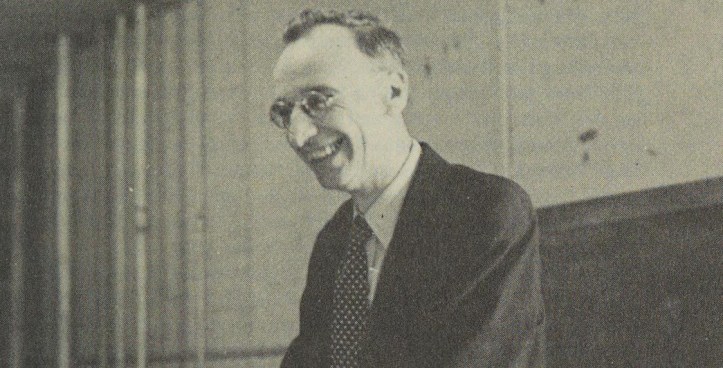
The first of a valuable six-part series by A.J. Muste on the mechanics and personalities of labor organizing based on the work of the Brookwood Labor College. In this essay, Muste looks at what type of person should be a union organizer, and what training they should receive. Great stuff. Part two here.
‘Who’s Your Organizer?’ Brookwood Series on Organizing Methods by A.J. Muste from Labor Age. Vol. 16 No. 10. October, 1927.
(With this number we are beginning on the Brookwood page a series of articles dealing with organizing methods and tactics. While the author is alone responsible for the material presented in this series, much of it was inspired or directly suggested by discussion at the Brookwood Summer Institute and grateful acknowledgment is made to the contributions made by labor men and women from the ranks of electrical workers, machinists, locomotive engineers, printing tradesmen, garment workers and others who took part in these discussions.—A.J.M.)
IN this article we shall discuss briefly two questions; What type of man does a union want for an organizer? What kind of training should an organizer receive?
We realize that the term organizer as used by different unions does not always mean the same thing. We are using it in this article in the sense of the union official or active worker whose job is not primarily an office job, or an administrative job of carrying on the routine work of an established organization, or a negotiator’s job such as a business agent’s is likely to be, but who is engaged mainly in the work of winning new members into the union or extending the control of the union into unorganized territory.
In our discussions at Brookwood this summer we asked a group of trade unionists to list the qualities which in their opinion should be prominent in an organizer. Doubtless the list is not complete, but it is certainly suggestive. First of all, they said, an organizer must have plenty of energy, he must be able and willing to work hard, “a glutton for work”. But his energy must not be a spasmodic, intermittent affair— work hard for a week, then loaf for a week. He must not be a good starter merely, but a finisher. In other words, an organizer must be patient, able to stand up under defeat and disappointment, and he must be persistent, plugging ahead all the time. In the next place, it was urged that an organizer must be a “good mixer”. His work is with human beings directly, and if he is the kind that would rather crawl into his own shell, he would better find another job. He must have the quality variously described as magnetism, personality, “sex appeal”, which enables him to approach people and to hold them. Along with this we should ordinarily expect in an organizer the ability to speak effectively. A man who is a “spell-binder” and nothing else will certainly have only a limited usefulness, but for a man who has other qualities as well, oratorical ability, the ability to express himself clearly, forcefully, persuasively, is a great asset.

A Fighter
Turning to a different side of the organizer’s make-up, he needs to be a fighter. Needless to say that this does not mean that he must be a Gene Tunney or Jack Dempsey. But he must be the fighting type, courageous, confident, not afraid to meet opposition, not yellow in the face of danger. On the other hand, he must have a quality that we name variously as good judgment, common sense, a “good head on him”. It usually means, for one thing, that he must have some ability to plan his work, to grasp the various angles of a situation, to distinguish between what is important and what is unimportant, and for another thing, that he must have some ability in sizing up people so that he may approach workers effectively, pick out trustworthy assistants, deal with employers, police, newspaper men and others in a way that will get the best results. Finally, cur summer institute members held that an organizer must have a fairly thick skin, must be able to take criticism, must at all times keep his nerve and his head.
Round Pegs in Square Holes
The reader will recognize that these traits pretty well describe what is known as the “promoter type” of per- son as distinguished from the engineer, the artist, the office man, the administrator. Corporations that have to hire thousands of persons are making more and more use of intelligence and psychological tests to pick out the right man for the right job, and seem to think that these vocational tests are an improvement on the old methods for picking out men for jobs. We may admit that there is no way at present for using such tests in unions even if it were clearly desirable, and yet recognize that the movement needs to pay more attention than it has to picking out the right kind of men for various positions, to avoid putting round pegs into square holes.
What kind of training shall the organizer be given? Along what lines should he be equipped? At the outset, it should be laid down that it will not do to take boys and girls who have been through college or have taken a course in salesmanship and set them to “selling trade unionism” just as you might set them to selling life insurance. If a man is to organize skilled workers, he must, save in the rarest instances, be himself a skilled mechanic at the particular trade. He must know his own craft from first hand experience. If he is to organize unskilled workers, he must have had actual experience as an industrial worker and in most cases some inside experience in the particular industry to be organized. Beyond this an organizer should get the best possible training along the following lines:

1. The constitution, laws, agreements, working rules and history of his own union.
2. Acquaintance with union procedure including the proper conduct of committee meetings, etc., and also the methods by which agreements are negotiated with employers, grievances settled in union shops, etc.
3. The economics of his own industry, condition of the trade, tendencies, such as introduction of new machinery, growth or decline of. the market, etc., which affect organization work. So far ag possible this should be backed up with a foundation of general economics, knowledge of how the business system as a whole works,
4, History, theory and aims of the labor movement. The more an organizer knows practically and theoretically about the movement as a whole, the more efficient he will be in his own field.
5. Public speaking.
6. An elementary acquaintance with bookkeeping, keeping minutes, filing records, etc., often necessary in starting new locals.
7. Some training in teaching others what he himself knows, since an important part of the work of many organizers is to get new locals under way, and this often involves showing wholly inexperienced local officers how to go about their work.
7. Psychology, the science of the human mind and how it works. An organizer needs to know himself and to know others.
9, Organization methods, use of publicity, of advertising, making contacts with religious, fraternal and other organizations that may be helpful, approaching individuals, house-to-house canvassing, use of social at- tractions, work around mill gates, getting up meetings, etc.
Trained Man Wins
Some one may be exclaiming by this time that a man trained in all these lines would be a “heavy intellectual”. That is certainly not what is wanted. It is true, moreover, that there have been some very effective organizers who have been mighty ignorant along some of the lines mentioned. For all that, it remains true that most good organizers have somehow picked up a rough and ready training along the above lines, and that in this day when conditions grow increasingly complex and the employer makes use of highly trained men, the unions will make light of the training of their organizers and other officials at their own risk. Other things being equal, the untrained man is a helpless toy in the trained man’s hands.

How is a man to get this training we describe? We may suggest three important ways. First, he can get it by means of actual experience, much of his technique an organizer can get in no other way. The way to learn to organize is to organize. But this is not all. A trained swimming instructor can save a learner much time and can teach most people certain things that they would never learn if left to experiment by themselves. In the second place, then, an organizer can get his training by conference and consultation with his fellow organizers. A certain amount of this sort of thing, of course, goes on all the time in every union Sometimes one finds an old hand who is very generous and effective in passing on his knowledge to younger men. Any one, however, who has a slight acquaintance with the
attention given by business houses and corporations to teaching younger men, to conferences of various departments where notes are compared and plans made, realizes that for the most part our unions are still far behind in this respect. How about some union, or group of unions, or labor college experimenting with a Conference or Institute on Organization Methods at which most of the talking would be done by organizers relating their actual experiences, with perhaps some sympathetic psychologists, economists, newspaper and publicity men sitting in to give the benefit of expert knowledge along specific lines and to help the practical workers to understand and interpret their experiences so that in future they may benefit by the mistakes and shortcomings of the past?
Finally, organizers may get some of their training in formal classes conducted either by non-resident labor colleges in the evening or by resident colleges such as the W.T.U.L. Training School in Chicago or Brook- wood. The idea of training an organizer or business agent in a college is of course new, and so there are plenty of people to greet it with a loud guffaw. There are still a few people who laugh at training business executives in college, but only a few! Let that be an eye- opener to the unions. Also, of course, the labor colleges are not yet doing a perfect job. Is that a sufficient rea- son for putting them out of business?
Picked Men and Women

Progressive and constructive unions are already picking out young men and women who have shown some ability, initiative and judgment in their shops or mines and in local unions and sending them to a labor college for a couple of years to get some general training along the lines indicated above, training which must, of course, be supplemented by practical experience exactly as a man’s course in the medical school is supplemented by experience in hospital and clinic before he is turned loose on you and me, but training which has its place in the development of the organizer, business agent, secretary, active worker in the union, as all unions that care to live and grow will presently realize.
All this suggests a closing observation of real importance to workers’ education. A school must have something to teach. But what schools have to teach along any line is simply the past experience of human beings in that particular line. The only thing a labor college can teach about organization work is the past experience of the labor movement with such work. That experience has not for the most part been written down anywhere. It is in the heads of labor officials, business agents, organizers, committee members, active workers of the rank and file. It would be a great service to the labor movement if those who have had experience and are able to write it down would do so, and if those who have not the knack of writing themselves would tell their experiences to others, so that we might have for use in labor colleges and classes, in organization conferences, in text-books and manuals for organizers, a systematic, complete body of knowledge about effective organization methods. Send in your own experiences to Brookwood or Labor Age.

Labor Age was a left-labor monthly magazine with origins in Socialist Review, journal of the Intercollegiate Socialist Society. Published by the Labor Publication Society from 1921-1933 aligned with the League for Industrial Democracy of left-wing trade unionists across industries. During 1929-33 the magazine was affiliated with the Conference for Progressive Labor Action (CPLA) led by A. J. Muste. James Maurer, Harry W. Laidler, and Louis Budenz were also writers. The orientation of the magazine was industrial unionism, planning, nationalization, and was illustrated with photos and cartoons. With its stress on worker education, social unionism and rank and file activism, it is one of the essential journals of the radical US labor socialist movement of its time.
PDF of full issue: https://www.marxists.org/history/usa/pubs/laborage/v16n10-oct-1927-LA.pdf
 Revolution's Newsstand