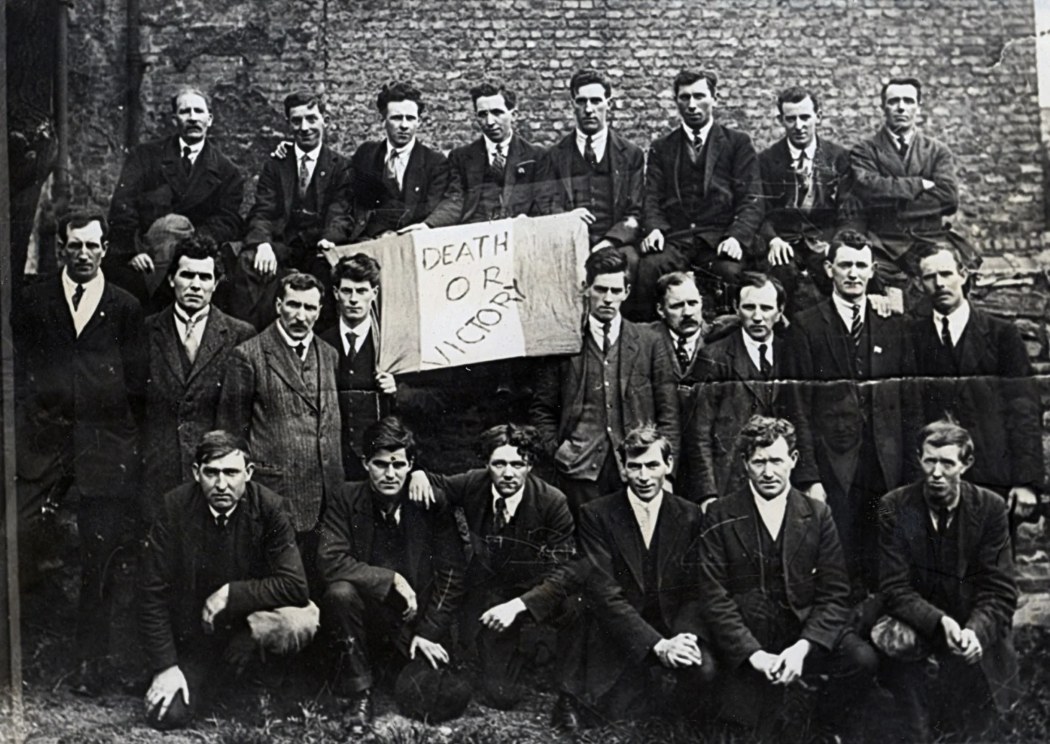
The A.B.B.’s Cyril Briggs praises and finds inspiration in ‘little’ Ireland’s war of liberation against Britain’s empire.
‘Heroic Ireland’ by Cyril V. Briggs from The Crusader (African Blood Brotherhood). Vol. 3 No. 6. February, 1921.
THE spectacle of a Little People intrepidly and tirelessly opposing the might of the world’s greatest Empire and Oppressor, is one that must thrill all lovers of liberty and give birth to aspirations of freedom and emulation of daring deeds in the breasts of all the oppressed peoples of the world.
The Irish fight for liberty is the greatest Epic of Modern History. It is a struggle that should have the sympathy and active support of every lover of liberty – of every member of an oppressed group.
The Negro in particular should be interested in the Irish struggle, for while it is patent that Ireland can never escape from the menace of ‘the overshadowing empire’ so long as England is able to maintain her grip on the riches and manpower of India and Africa, it is also clear that those suffering together under the heel of British imperialism must learn to CO-ORDINATE THEIR EFFORTS before they can HOPE TO BE FREE. The mighty tyrant is not to be toppled over by an unaided Ireland, however courageously her valiant sons may fight, nor yet by an Africa or India unaided. England menaced in ONLY ONE QUARTER AT THE SAME TIME can successfully defend her ill-gotten spoils and her bleeding conquests-can easily maintain her grave-yard peace–her boasted pax Britannica. But England menaced on many quarters AT THE SAME TIME, faced by the determined bayonets of ALL her ‘subject peoples’ would be an England AT THE END OF ROPE. And until England is brought to the end of her rope there will be no freedom for Ireland, India or Africa.
Coordination of efforts will win the day, but preceding co-ordination there must be understanding and appreciation of the aims and aspirations of each other. The British are now trying to embarrass the Irish fight for freedom as well as to justify their own Hunnishness in Ireland by the belated publication of papers pertaining to prove Irish collusion with “the enemy” during the recent war. There is so little proof of this given in the British “papers” that their publication has failed to raise a ripple of interest even in England. But suppose there had been collusion between the Irish and the Germans. Who, from the Irish standpoint, was the enemy? The Germans who, have not had the opportunity, even though possibly possessed of the inclination, had not murdered Irish men, women and children, burned Irish cities to the ground, destroyed Irish creameries and factories, and in a thousand and one atrocious ways made war upon the Irish people –or the English who have both the opportunity and the inclination had done (and are still doing) these thing?
In shocked tones they tell us of “wanton Sinn Fein attacks on constituted authority” in the shape of British soldiers and officials in Ireland. But by what right are British soldiers and officials maintained on Irish soil in direct violation of the plebiscite by which more than nine-tenths of the Irish people declared themselves in favor of an independent republic and elected their own constituted authorities. When Englishmen complain of attacks on their mercenaries stationed in Ireland and brand such attacks as “murderous” and speaks of their casualties in battle as “murder,” it is time to ask by what divine decree is British rule established in Ireland that it is to be considered as inviolate and unchanged.
It should be easily possible for Negro to sympathize with the Irish fight against tyranny and oppression, and vice-versa, since both are in the same boat and both the victims of the same Anglo-Saxon race-albeit the Negro suffers in the New World as well as in the Old World, in Africa as well as in the United States.
The Crusader was published in New York City between 1918 and 1922, becoming the paper of the The African Blood Brotherhood for African Liberation and Redemption and the earliest Black Communist publication in the US. Founded by Cyril V Briggs, who had arrived to the city from the Caribbean in 1905, at first it was the journal of the Hamitic League of the World, a Pan-African group led by George Well Parker. Increasingly in sympathy with the Russian Revolution and new Communist International, in October 1919 the paper announced the African Blood Brotherhood and its adherence to Marxism. In June 1921, The Crusader officially became the journal of the ABB and the Black publication of the US Communist movement. Antipathy with Marcus Garvey’s movement led the Communist Party, at the insistence of Claude McKay, to withdraw support and Its last issue was in January, 1922. The African Blood Brotherhood with dissolve into the Workers Party of America with many activists joining the American Negro Labor Congress in 1925.
PDF of full issue: https://www.marxists.org/history/usa/pubs/crusader/v3n06-feb-1921-crusader-r.pdf
 Revolution's Newsstand