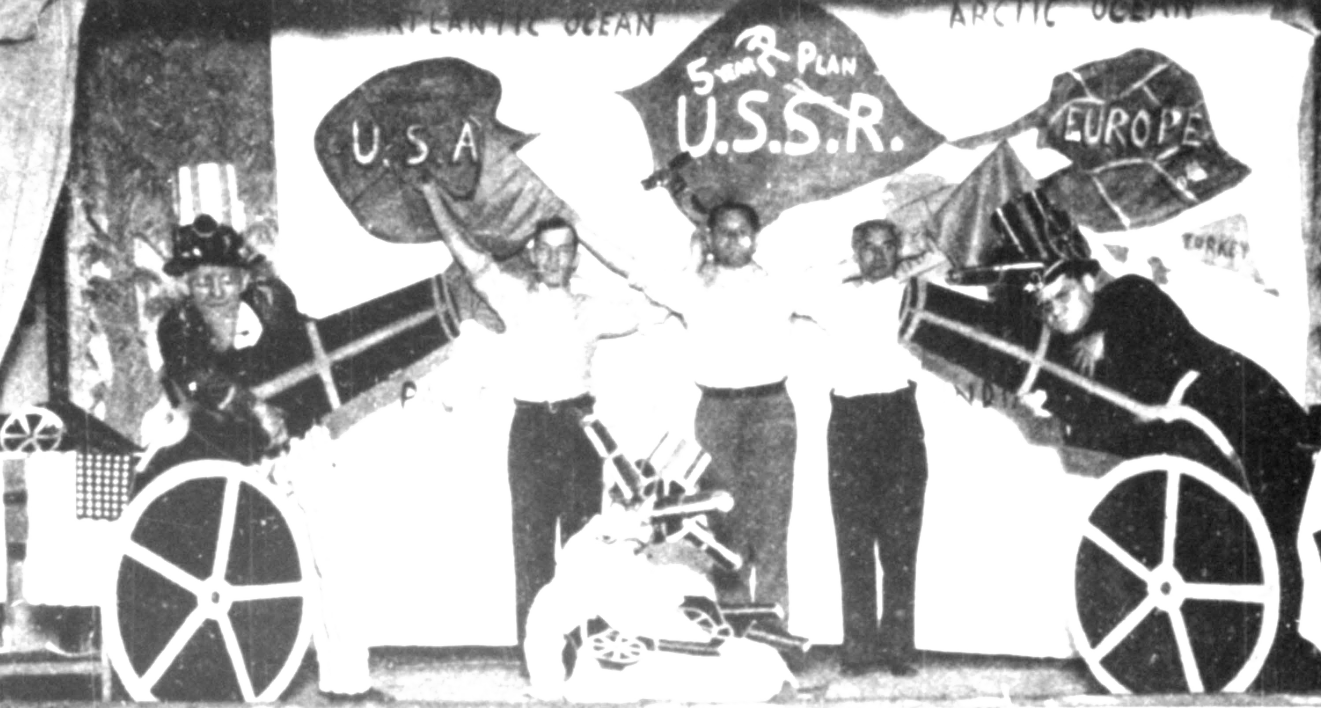
Reports from many of the participants in the First National Conference of Workers’ Theatres and Spartakiade held at the Manhattan Lyceum on April 16-17. The Spartakiade was a judged competition of performances from local and regional troupes of gathered for the National Conference. Winners of the Spartakiade were: First place- German Proletbuehne for their “15 Minute Red Revue”; Second place-Jack London group of Newark for their play called “Charity”; Third place-John Reed group of Philadelphia for a play called “We Demand”. The International Spartakiade was held in Germany that October. Below are contributions published in ‘Workers Theatre’ the following months from the Artef, International Workers Order, Chicago Blue Blouses, Hungarian Workers’ Dramatic Section, Vanguard Youth Players, South Philadelphia Pioneers, Newark Jack London Dramatic Group, Brighton Beach Dram Group, New York Workers’ Cultural Federation, John Reed Dramatic Club of Detroit, Detroit Jewish Workers Dramatic Section, Harlem Progressive Youth Players, and the Los Angeles Blue Blouse and Rebel Players. The current left could do a lot worse than to revive the tradition of workers theater.
‘Reports to the First National Conference of Workers’ Theatres and Spartakiade’ from Workers Theatre. Vol. 2 No. 5 August, 1932.
SPARTAKIADE REPORTS CITY CLUB COMMITTEE OF JEWISH DRAMATIC GROUPS Reported by Comrade Zucker.
When about two years ago we decided to build dramatic groups in our clubs we were faced with the following difficulties: 1. We knew almost nothing about such work; 2. There was no group we could turn to for help and guidance; 3. There was no material for us to start producing; 4. The organizations that should have given us the benefit of their experience and ability did not, and still do not, offer us any guidance. The Jewish Writers’ Federation did not consider our project sufficiently important for them to bother with. The Artef was an isolated group that existed solely for the development of its own talent and art. Realizing this, we concentrated on the development of our talent. Our slogans were- Write your own plays- Build your own cadres of dramatic workers.
The latter part of last year we arranged A COURSE IN DRAMATICS UNDER THE SUPERVISION AND TUTELAGE OF THE ARTEF. There were many reasons for the failure of the class. The main weakness was that THE MATERIAL WAS UNSUTED FOR OUR SIMPLE, AGITPROP TYPE OF PLAY. The Artef instruction was of a too professional nature. When the Dram council was organized, we immediately affiliated ourselves with it. The immediate benefit derived by us from the council was the realization that we should re-orientate our repertory. In the past six months we translated and produced eight agit-prop plays. Organizationally the dram council is weak in that it LACKS THE FACILITIES FOR SUPPLYING PRACTICAL GUIDANCE THROUGH INSTRUCTORS.
What is the result of our work of two years? We now have SIXTEEN dramatic groups out of a total of twenty-three clubs affiliated with our central body. Four of these groups have been organized in the past six months. These groups have given two hundred performances, to audiences totaling about thirty thousand workers.. As a result of our concentration on the writing of our own plays, we wrote and produced twenty-five plays. All of these plays were CONCRETELY LINKED UP WITH SOME CURRENT CAMPAIGN IN THE WORKERS MOVEMENT. At a recent conference we also decided to affiliate with the Artef. We hope that this new affiliation will facilitate the establishment of our dram groups on a better basis, and help us to more quickly develop talent within our own ranks.
DRAMATIC SECTION OF THE I.W.O. Reported by Comrade Pevzner. The main feature of the cultural work of the Youth Section of the International Workers Order has been dramatics. DRAMATICS HAS BUILT MORE BRANCHES FOR THE I.W.O. THAN ANY OTHER ACTIVITY. It has also rebuilt more branches.
CHICAGO BLUE BLOUSES. Reported byBen Sager. There is no necessity for dramatics, the district organizations said in Chicago when the organization of such a group was mentioned. The first thing was said to get members who are interested in dramatics. We got a group together of about ten and began to work on something by Ernst Toller. We bad no capable person to direct us, so finally we decided to get someone from the outside, but he wanted to do three-act plays with scenery, etc., so we found ourselves without a director. We started with a mass chant and also attempted to put on The Belt by Paul Sifton. Our group was called upon to perform for the John Reed Club, and it was a big success. Since then we have been very much in demand. At present time we have one group of 28 members, 7 OF WHOM ARE NEGROES. The comrades who are in other dramatic groups in the foreign languages would not cooperate with us, saying that they were professionals and we were just a bunch of amateurs. However, with the beginning of the conference, I trust that all these problems will be solved.
HUNGARIAN WORKERS’ DRAMATIC SECTION Reported by Comrade W. Weinberg. Hungarian workers’ dramatic groups, located in big and small cities throughout the country, are under the leadership of the Hungarian revolutionary press, and have been established about 15 years. Productions of these groups are along the lines of these done by the Artef, long plays, suitable for the stationary theatre. By producing such plays, the Hungarian dramatic groups can reach a ten times larger autience than if they produced small agit-prop plays. Hungarian comrades are in this country mostly concentrated in the heavy industries, and are uneducated. Agit-prop plays do not go over with such workers. Such workers must have simple plays, melodramatic plays which are taken out of their own lives and which show them how to get out of their suffering. (Editor’s note- The comrade reporting for the Hungarian workers’ clubs made the foregoing remarks mainly in answer to the criticism of the judges at the Spartakiade that the play presented by the Hungarian section was not suitable for agit-prop work. In this we are with the judges. We also believe that the Hungarian comrade underestimates the willingness of workers to listen to plays that speak out boldly and simply the message of the workers’ struggles against the bosses. Try it, comrade. The workers’ theatre must LEAD the workers, not drag at the tail end.)
DRAMATIC CLUB OF THE SOUTH PHILADELPHIA PIONEERS. The group was organized at the beginning of April. A secretary was elected. Good short sketches were worked out for a preliminary meeting on war. The cooperation of the John Reed Club was arranged for. Comrade Glass of the John Reed Club was sent as director. There are at present twelve regular members, INCLUDING NEGRO CHILDREN. This children’s workers’ theatre bas already put on a play, having participated at the preliminary Spartakiade in Philadelphia on the occasion of the 19th anniversary of the Young Communist League. A translation of “First Fight” will be presented at an open air demonstration in South Philadelphia. Comrade Katz (a boy of about 13) emphasized the importance of enlisting the Young Pioneers in the workers theatre movement. The young workers, he pointed out, will constitute the WORKERS’ THEATRE OF THE FUTURE. Young pioneer dramatic groups help TO BRING IN OUTSIDE CHILDREN and “start them off right”, he said. He reported that it was the purpose of the South Philadelphia dramatic group to spread the workers’ theatre movement to pioneer groups in all parts of Philadelphia. He concluded with praise of the Black and White solidarity dance presented at the Spartakiade because of the great importance of uniting black and white workers to fight their common class enemy.
THE VANGUARD YOUTH PLAYERS recently organized at 2800 Bronx Park East is giving its first performance July 23rd. The group is growing rapidly and has every intention of leading in the workers’ children’s theatre movement. The play now in production is “Helping the Strike”, an adaption from “Milk for Miners’ Children.”
JACK LONDON DRAMATIC GROUP, NEWARK Comrade Daniels. Last June, in 1931, three members decided to organize a cultural group. Now more than 100 members are included in the group, with 75 engaged in active work. THE GROUP NOW HAS A MAGAZINE, a debating team and a glee club. Open forums are conducted Sunday afternoons. Meetings are held Tuesday afternoon, to which outside speakers are invited, and at which floor discussions give each member a chance to speak. Until December 20, 1931, the group had no place to meet, and had to call meetings in homes of members. Half the members are unemployed and have no funds. “Mr. God is Not In” was the first play to be produced in December. It was given four times. From then on the group became very active in agit-prop work. Two of the plays produced were written by members of the group: “Women’s Solidarity” and “Paris Commune”. Other plays produced were: Scottsboro, given 9 times; Step on It, 8, Lenin Calls, 7; Liberty in U.S.A., 2; Charity (2nd half original),1. The group has performed in Newark AND IN THE SURROUNDING TOWNS, Elizabeth, Stelton, and Linden. Linden. Plans are now going ahead for summer activities. The director has taken a two months’ vacation, and in the meantime will start another group. New members are now being drawn in. Two semiprofessional actresses will help in the May Day celebration.
JOHN REED DRAMATIC GROUP, DETROIT Reported by Comrade Beverly. This group had much difficulty in getting started. The group was organized last October. The first attempt along dramatic lines was made with the cooperation of the Jewish Dram Group of Detroit, in connection with Lenin Memorial Day. After that the group gave its own productions. “Box, Knox, and Fox” was given several times. “liberty in U.S.A.”, “Help the Miners” and “Madame Liberty” were also produced. A performance at a Tom Mooney demonstration was produced at the largest high school in the city. Another Tom Mooney skit, written by the members themselves, was also produced. The John Reed Dramatic Group is one of six groups in the city. The groups help each other with whatever assistance is needed. Most of the members of this group go to college or high school. It includes a great many teachers who naturally cannot appear in public, but who do their share in many other departments of the theatre. One member is secretary to an official of the American Legion. PLANS ARE BEING DRAWN UP FOR WORK WITH THE YOUNG COMMUNIST LEAGUE, which has been asking for aid and material. The Detroit group also has one dance group made up of high school students. ·The group has been working with the Communist Party in preparation for May Day celebration.
BRIGHTON BEACH DRAM GROUP has 14 members now. The group gave two performances last month, including the Scottsboro mass recitation in Yiddish. The next production will be the Yiddish translation of “Vote Communist.”
JEWISH WORKERS’ DRAMATIC SECTION OF DETROIT OF THE JOHN REED CLUB by Comrade Lewis. This group began by being a bourgeois literary group and gradually found its way out. It is now an organization of 24 active members. It was really WORKERS THEATRE that helped us last year. It is necessary now to find a way to approach all the other groups that do not know about the work going on, otherwise half of our work will remain undone.
WORKERS’ CULTURAL FEDERATION OF NEW YORK by Comrade Pullman. The National Spartakiade, coming at a time of the decadence of bourgeois culture, was a great and effective demonstration of the vitality of the rising workers’ culture. The Spartakiade showed the importance of agitprop plays in bringing the knowledge of the class struggle to the workers and in building up a proletarian culture. VAUDEVILLE WORK. However, there are other weapons of the theatre that must not be ignored if we wish to reach the great masses of workers who are not yet class-conscious. One of the most effective of these weapons is the vaudeville stage. Recently the Workers’ Cultural Federation took a definite step in that direction. A Vaudeville Workers’ Club has been organized, with the aim of bringing the unemployed vaudeville workers into the ranks of the workers’ theatre. A workers’ Vaudeville show is being prepared for about the middle of June. In this show will be a magician’s act, marionette shows, and dance recitals. Every one of these acts will be used to put the message of the workers’ struggles over to the audience. SERVICE AT STRIKES. The Workers’ Cultural Federation has been busy in other ways. In the recent New York dressmakers’ strike, the Federation mobilized workers’ theatre forces to perform at the strikers’ meetings and thus help to keep the strikers’ ranks solid. About 25 afternoons to two hours each were devoted to this work. The medium employed was in general American vaudeville. DANCE COUNCIL. The Federation has also organized a dance council. A May Day mass dance is being prepared in which about 22 dancers will participate. Music recitals are also being prepared. The aim of the Workers’ Cultural Federation is to assemble all the workers’ cultural forces for the use of the working class.
HARLEM PROGRESSIVE YOUTH CLUB has developed a very active dram section during the last few months. There are now 15 members in the group. They have given performances before several different language organizations. On their repertory are such plays as “Scottsboro”, “Liberty in U.S.A.”, “Tempo, Tempo”, “China Wakes”, “Step On It” and “Charity”. The group, as a whole, has decided to participate in street and agit-prop work for the coming election.
LOS ANGELES REBEL PLAYERS BLUE BLOUSE. Our Blue Blouse group has been functioning in Los Angeles for approximately five months. This group was organized when the Rebel Players, a workers’ theatre group, found it impossible to fully supply the need for a workers’ theatre. The need of a group which could be handled easily, whose members were disciplined, and who could quickly give dramatic expression to the daily struggles of the workers, had long been felt. In the short time of its existence the Blue Blouse group has become so popular that at the present time it is difficult for it to keep pace with the demands made upon it for performances. The group consists of eleven members selected from the most active of the Rebel Player members. Plain blue shirts and blue jeans is the uniform which has been adopted both for the boys and the girls. It was felt that such a costume would best portray the nature of the group and also serve as a distinguishing mark. Characters in our skits are portrayed symbolically, and we have found this method to be very effective in a group of this nature. Many times the Blue Blouses have appeared at workers gatherings with practically no preparation. The ease with which the group can be assembled, together with the enthusiasm of the members has made the Blue Blouses the mobile workers dramatic group, assigning to the Rebel Players the role of a mere or less stationary workers theatre. Aside from its dramatic work, the Blue Blouses hold regular weekly meetings where political and technical education is stressed. At all of our meetings we devote a short time to singing revolutionary songs since in this way we can pep up many of the meetings where we perform. So successful has this group become that another group is being organized, and still there is more work to be done than there are comrades to do it. Prospect of Blue Blouse membership has created enthusiasm among many comrades and activized other capable members. Our group has appeared before all types of workers gatherings and in many different parts of the city. The coming election campaign is an opportunity and a challenge to a group such as the Blue Blouses is, and we intend to make the most of this opportunity to get before more masses of workers.
The New Theater continued Workers Theater. Workers Theater began in New York City in 1931 as the publication of The Workers Laboratory Theater collective, an agitprop group associated with Workers International Relief, becoming the League of Workers Theaters, section of the International Union of Revolutionary Theater of the Comintern. The rough production values of the first years were replaced by a color magazine as it became primarily associated with the New Theater. It contains a wealth of left cultural history and ideas. Published roughly monthly were Workers Theater from April 1931-July/Aug 1933, New Theater from Sept/Oct 1933-November 1937, New Theater and Film from April and March of 1937, (only two issues).
 Revolution's Newsstand