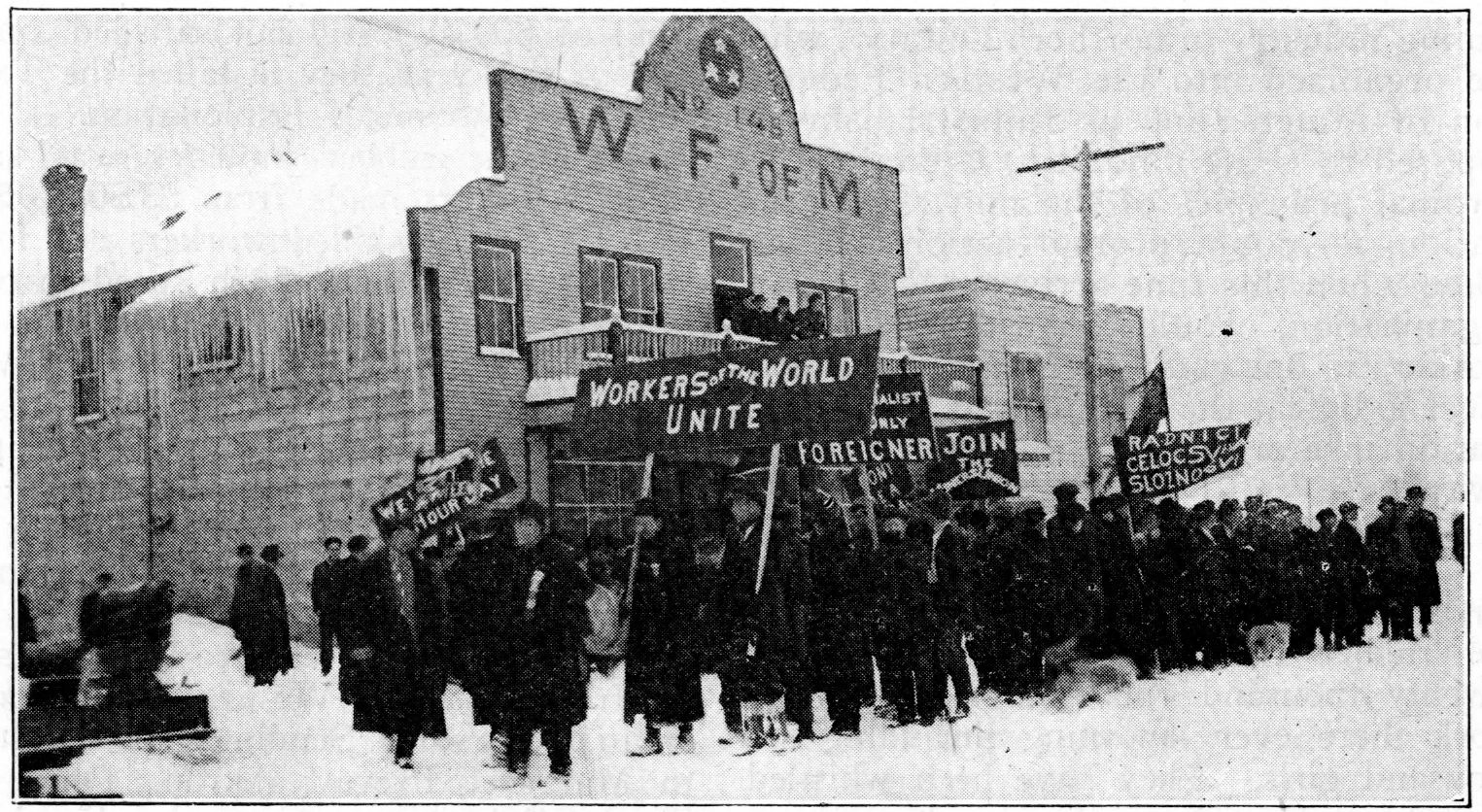
A winter strike by the Western Federation of Miners against the gold pits in Northern Ontario.
‘The Porcupine Miners of Ontario’ by J.D. Barry from The International Socialist Review. Vol. 13 No. 8. February, 1913.
TНЕ Porcupine Miners’ Union, No. 145, of the Western Federation of Miners is on strike at Porcupine, Ontario, against a reduction of wages and an increase in hours.
On August first, when the mining companies posted a notice of the wage reduction, the local organization of the miners protested and applied to the Minister of Labor to appoint a Board of Conciliation under the Industrial Disputes Investigation Act. The mine companies altogether disregard this law which provides a 30-day notice must be given of any change in wages or working hours.
As the miners showed an intention to fight, the companies postponed the cut till September first and a board was appointed to investigate. The board (as has been the way of arbitration or investigation boards from time immemorial) dawdled and dallied for about two months.) The mine owners got their report promptly, but the union boys got theirs ten days later, when the companies posted notices that the reduction would take place at once. As usual the “Uninterested” third party was in the service of the Bosses.
The miners held a mass meeting and resolved to demand the union scale of wages and the adoption of an eight hour work day and decided to strike. Not only did the boys affected walk out, but every miner in the whole camp joined them and made the tie-up complete.
Immediately the mine owners wired for Thiele detective agents and these thugs began to appear with guns and clubs prepared to beat the strikers regardless of methods. Fortunately they soon overplayed their hands and the general public refused to stomach the rowdies who were on trouble bent. Also the Ontario police held aloof. They were not only disgusted but jealous of these bragging looters who were kicking in on their own graft. So the plug-uglies abandoned the field and the police took to scab herding, and are saving the mining companies a lot of money there by and placing the burden upon the tax payers who have no interest in the struggle between the bosses and the men.
The mining companies not affected by the findings of the board, are entering proceedings against any of their ex-employees that they can reach for ILLEGALLY QUITTING WORK, also against the active members of the Union for “inciting others to go on strike.”
All of the forces of the government, except the military, are now lined up against us. It is easy to distinguish friend and foe. The Porcupine boys, who speak in a dozen different tongues, are standing together as one man. After five weeks of strike, their ranks still remain unbroken. The mining companies have scoured all over eastern Canada and the adjoining states, but have been unable to get competent men to fill the places of the strikers.
The line-up of all the existing social institutions against the workers is showing the boys the class character of society better than a million words could have done. Strikes are wonderful eye-openers and this is going to be a great benefit to the strikers when the final conflict comes.
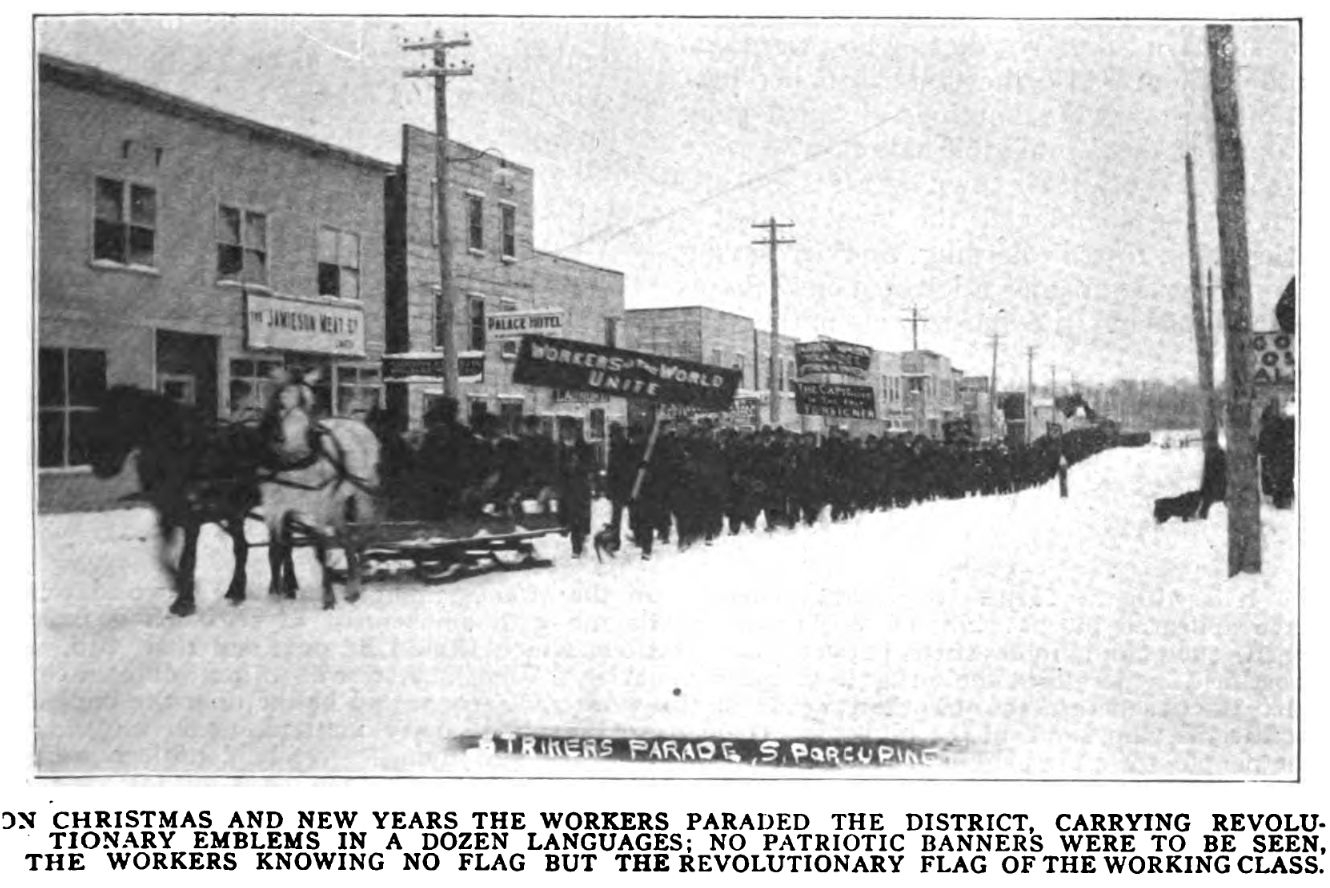
‘At Porcupine’ by J.D. Barry from The International Socialist Review. Vol. 13 No. 9. March, 1913.
On January 21, Wm. Holowatsky, organizer for the Western Federation of Miners, and Peter Cleary, member of the Local Union were convicted of a charge of inciting the employees of the Hollinger Mining Co. to go on strike in violation of the “Industrial Disputes Investigation Act,” and sentenced to pay a fine of $500 or three months in Sudbury jail at hard labor. Percy Croft was convicted on a charge of going on strike November 15, 1912, and sentenced to pay a fine of $50 or sixty days in Sudbury prison at hard labor.
On January 23, these fellow workers were taken from this district apparently to be landed in Sudbury prison, but on investigation we find that they were not taken to Sudbury, but to another prison at North Bay. Sudbury is a mining camp, the home of the Canadian Copper Co., whose proud boast has been that no organizer for the Western Federation of Miners could remain in the camp. Apparently they were afraid to even have one locked in the district jail on account of the demoralizing effect it might have on the wage slaves.
An appeal has been taken in the cases of Cleary, Holowalsky and Croft, but they are being held in close. confinement in North Bay jail pending the result of the appeal. No bail would be accepted in their cases. According to Canadian justice, men guilty of exchanging ideas with their fellow-workers on how to better their condition and men who quit work without first begging permission of the boss are such heinous criminals that they cannot be liberated on bail, pending an appeal of their cases.
There are summons out for some 350 ex-employees of the Hollinger Mining Company for quitting work without first asking the boss if he has sufficient supply of scabs to take their places—going on strike in violation of the “Industrial Disputes Investigation Act” is the way the legal sharks put it.
The workers of Canada are beginning to realize that this so-called “Conciliation Act” is one of the most deadly weapons in the arsenal of the master class. ‘It can be used against them whenever they show signs of rebelling against the conditions imposed on them. The imprisonment of these fellow-workers will assist in getting the iniquitous measures wiped off the statute books of the Dominion.
The Ontario police are still active on the job as scab herders, having almost entirely displaced the Thiele gun men. They have proved by far more efficient for the bosses than the Thiele plug-uglies and cost the mining companies nothing for their maintenance.
The strike situation is unchanged; the companies are unable to get strike breakers. Intimidation by the police as well as their attempts to disrupt the workers on race lines, have failed. The Legislature of the Province of Ontario is in session with an eight-hour day in the mining industry as one of the most important pieces of legislation to be considered. The solidarity of the workers on the industrial field has forced the politicians to act.
It may be necessary before the fight is over to call out all of the workers in the mining industry of northern Ontario, who are organized into the Western Federation of Miners, and as Industrialism as opposed to Craft unionism, 15 one of the cardinal principles of the miners’ organization, no doubt prompt action will be taken when this time arrives. We, as an organization, would not stand for the workers in one camp digging out the war chest to defeat the members of the organization in a sister local only a few miles away.
The International Socialist Review (ISR) was published monthly in Chicago from 1900 until 1918 by Charles H. Kerr and critically loyal to the Socialist Party of America. It is one of the essential publications in U.S. left history. During the editorship of A.M. Simons it was largely theoretical and moderate. In 1908, Charles H. Kerr took over as editor with strong influence from Mary E Marcy. The magazine became the foremost proponent of the SP’s left wing growing to tens of thousands of subscribers. It remained revolutionary in outlook and anti-militarist during World War One. It liberally used photographs and images, with news, theory, arts and organizing in its pages. It articles, reports and essays are an invaluable record of the U.S. class struggle and the development of Marxism in the decades before the Soviet experience. It was closed down in government repression in 1918.
 Revolution's Newsstand