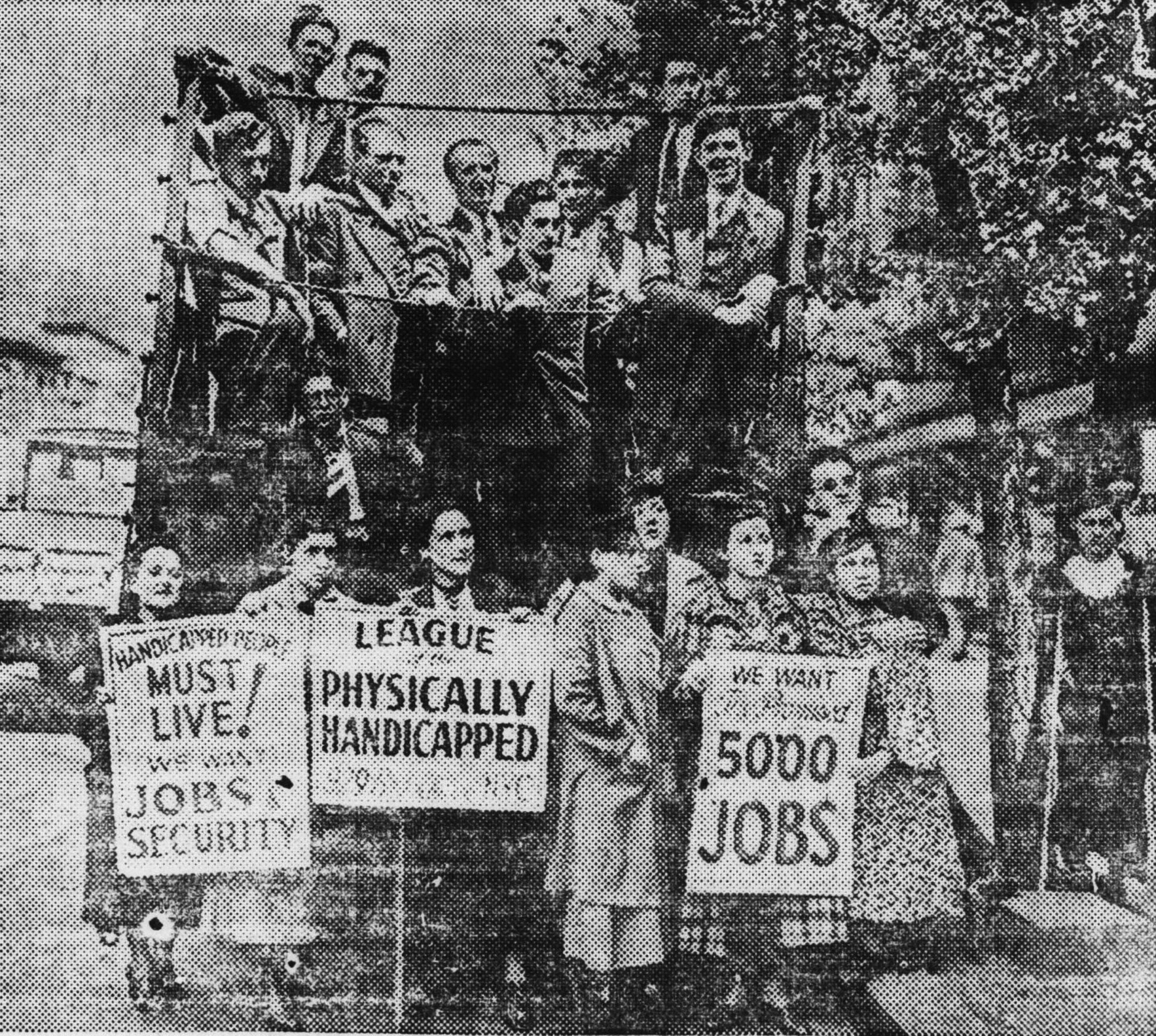
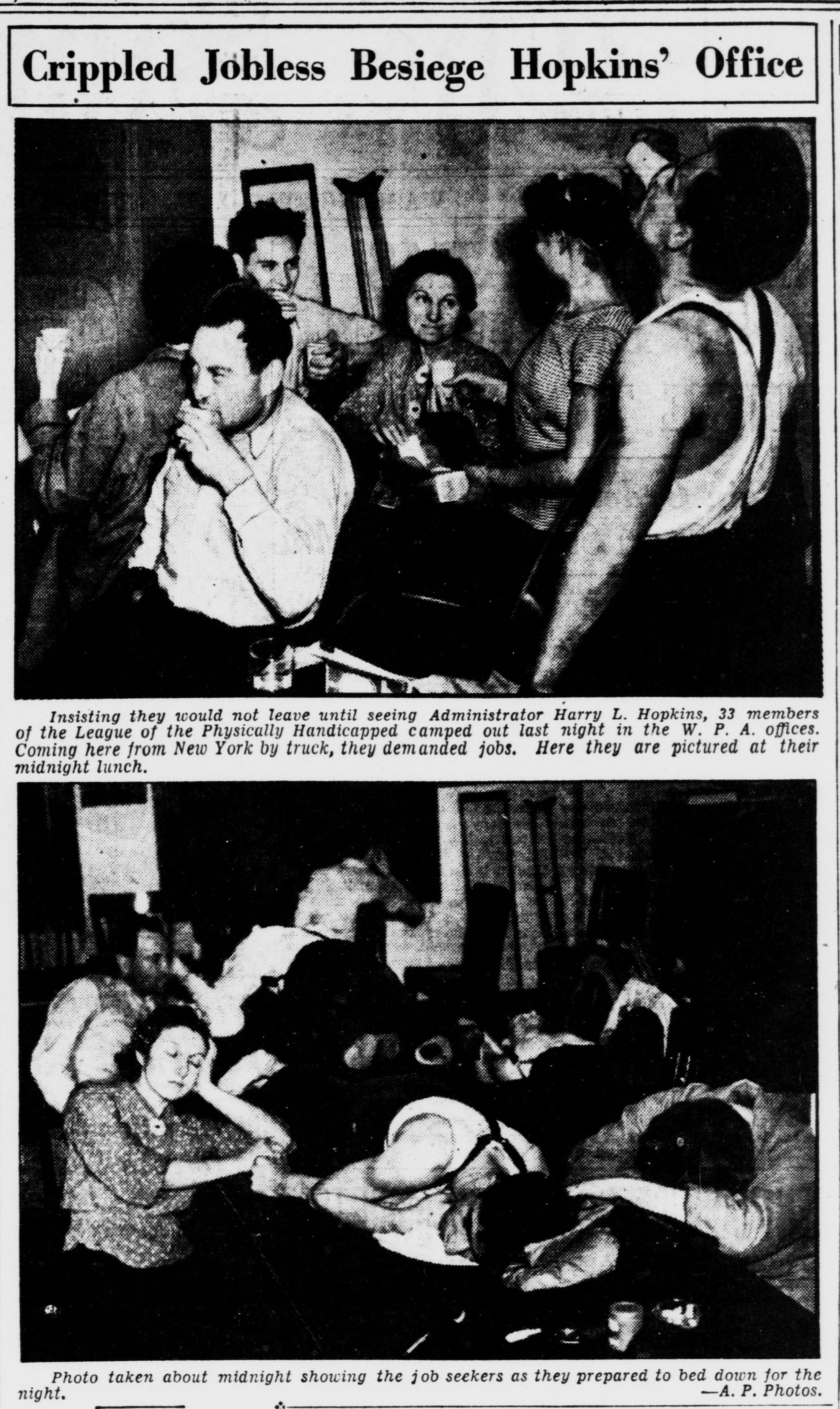
Do not be put off by the archaic language, this historic article by Communist Bob Brown on New York City’s League for the Physically Handicapped, formed in 1935 to protest discrimination in New Deal programs, marks one of the first left articles devoted to the issue, is serious and devoid of paternalism. The League engaged in direct action throughout that summer and fall; occupying offices, picketing and sitting in, winning a number of their demands and laying the basis for future disability rights’ movements.
‘March of the Cripples’ by Bob Brown from New Masses. Vol. 17 No. 9. November 26, 1935.
PAGE that hardy old artist, Hogarth! Call Goya back through the suffering centuries. To revivify our Art, languishing under incipient fascism. Take them to the Northwest corner of Eighth Avenue and Fifteenth Street and point out the devastating sight on Jimmy Walker’s danceless West Side sidewalks of today. Show these old pictorial satirists the medieval sight of the picket line of the League of the Physically Handicapped and ask them outright, “Even in your dark eras of oppression did you ever see any demonstration as biting as this? Yet we call it Civilization.”
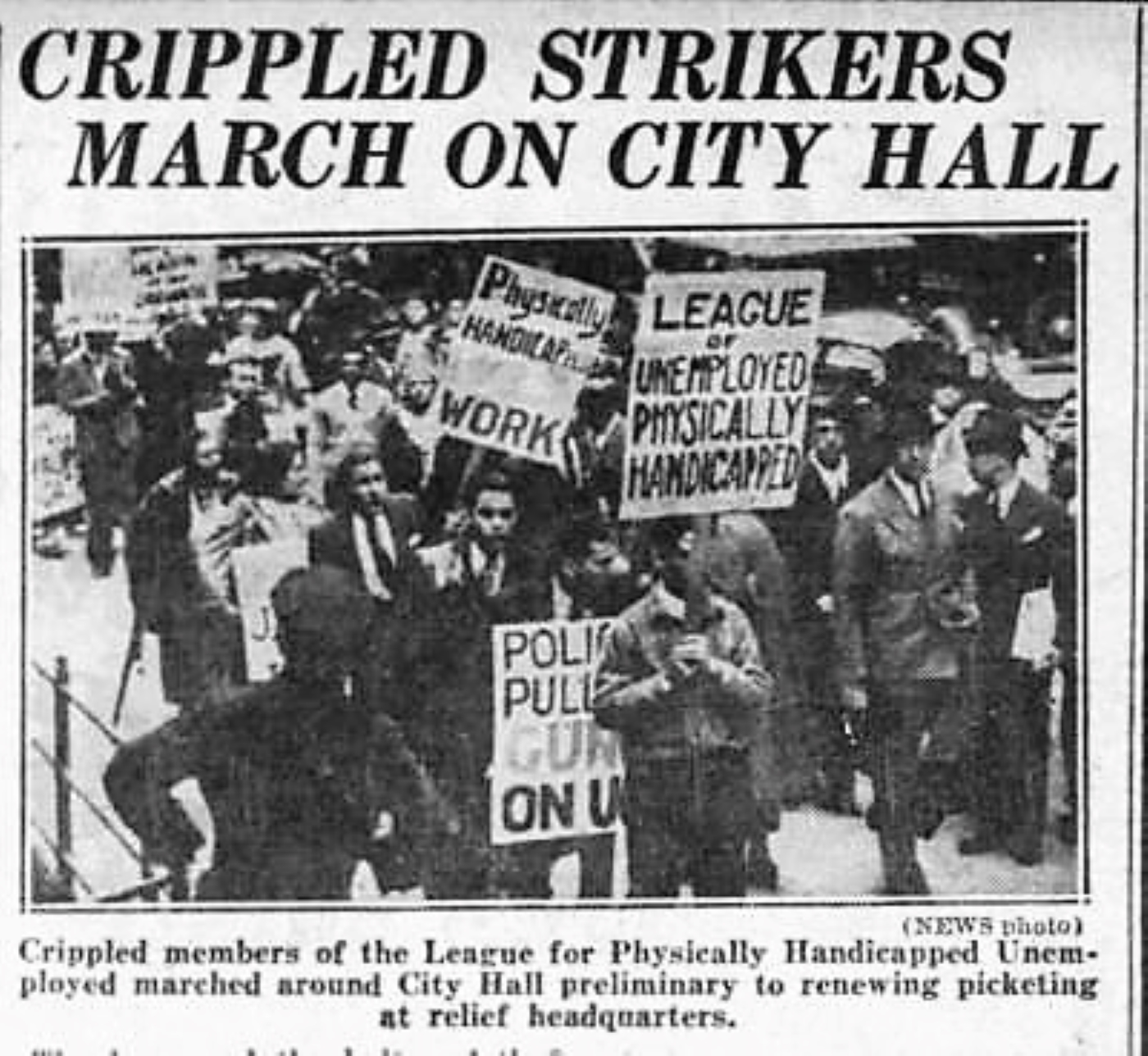
There they hobble, wobble and gasp on the line, victims. of infantile paralysis, sufferers from occupational diseases, consumptives, cardiacs, orthopedics, paralytics, one gassed vet, one jingling human skeleton with diseased bones riveted together with silver wire (“I’ve got enough silver in me to take us all to the circus,” he growls, although we have been taught to believe that all cripples are cheery and sunny, from having to grin and bear it, from having to take it, still, on life-twisted jaws). A six-foot one-footer leads this heroic and historic picket line; his left leg was chopped off at the hip after an industrial accident. The lame leading the lame. Hearty red slogans go up to the stratosphere, shouted defiantly, in spite of Mayor La Guardia’s Anti-Noise edict. Around and around they go, defying authority at the very door of the Port of Authority. (“They’ve sent out word not to arrest us,” one of them explains, “but they’ll have to come to it sooner or later, no matter what the public sentiment.”)
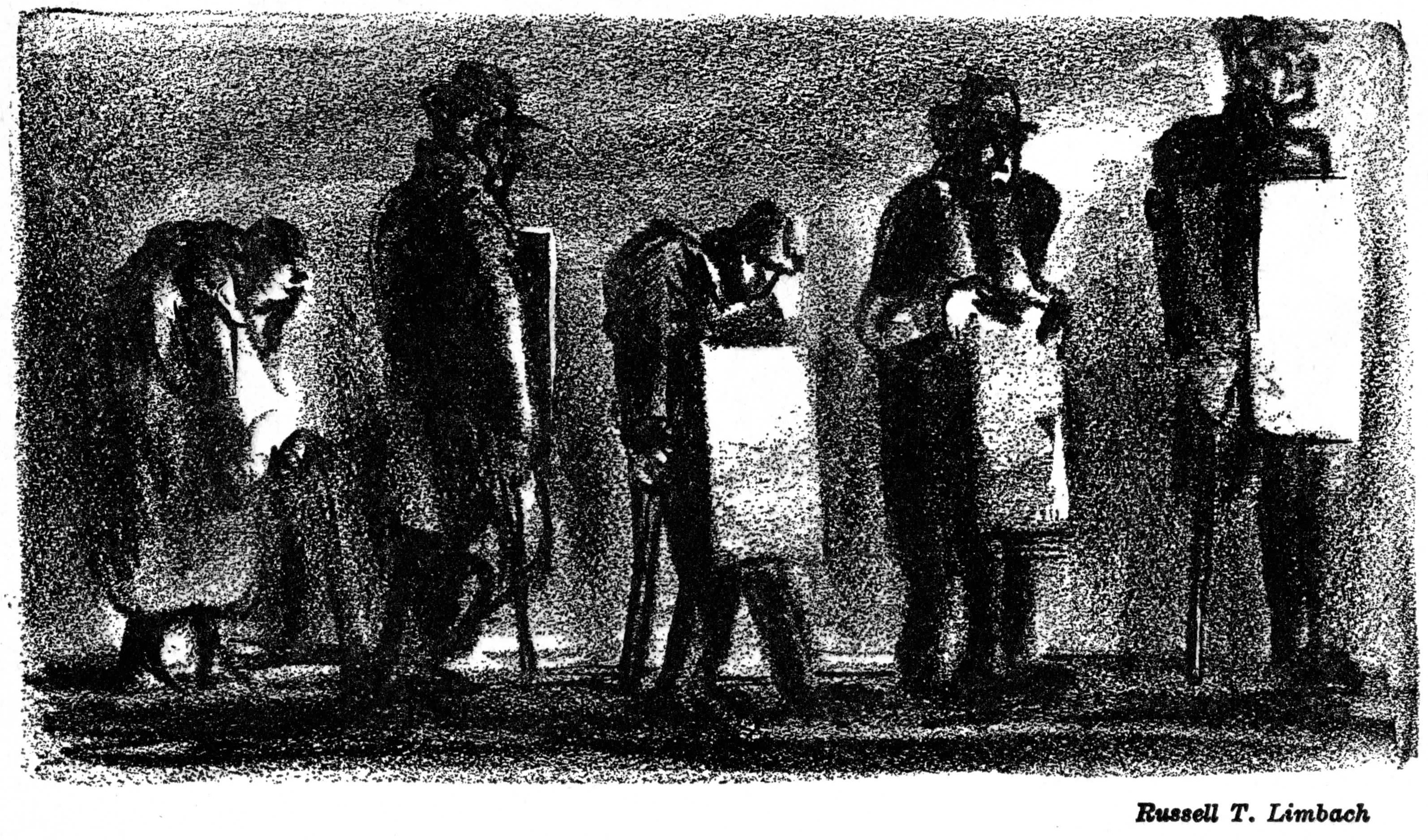
Old Pop, 66 now, was set to washing lead type in a Boston print shop when he was 12. As a direct result, in middle age he was stricken down with lead poisoning that still gnaws his old bones. He can hardly put one foot before the other, but he’s out on the line every day in all weathers, lips set stiff with thirty years of suffering, he serves as constant inspiration to the softer young. Unshed “tears of glass” gleam from this picket line and muffled “groans of lead” escape as the twenty handicapped pick their hop-skip-and-jump steps. Painfully they jerk and switch past, too close to the sidewalk for human comfort. Faces pale as Madame Tussaud’s wax works, a crippled Coxey’s Army, they mill round and round, sandwiched between their lettered slogans:
UNEMPLOYMENT BREEDS TUBERCULOSIS-WE DEMAND JOBS-WE DON’T WANT THE RUN-AROUND-WE WANT JOBS-WE PROTEST THE PAUPER’S OATH-WE HAVE NOT BEEN FORGOTTEN WE’VE BEEN IGNORED
They look like a tattered battalion of vets retreating from Hoover’s one-sided Battle of Anacostia. But they aren’t defeated. In spite of the fact that their struggle is a double one, that they are sensitive sufferers, averse to exhibiting their infirmities for the jibes and jeers. “But it’s gone too far now,” Jack Isaacs, their leader, says. “We’ve been pushed so far down we’ve just naturally got to rise again. Our backs are so close against the wall we can’t go any farther back, so we’re going forward.” This is a finish fight for the rights of man, even crippled man. “We demand the right to live. We Want Jobs!”
WE DON’T WANT TIN CUPS!
Malformed hips in pants and skirts switch by in patient protest, paralytic lips twitch, there is a brave break in the voices that shout:
Protest to Mr. Ridder! Support our demands!
Mr. Ridder, lame himself, now scuttles in and out of the mouth of his Port of Authority where the demonstration seems to have got him down, since it’s gone on from 11 A.M. till 5:30 ever since Nov. 9. It’s expected that on Dec. 1 Ridder will turn his job over to that super-cop Grover Whalen, who is hard-boiled and can take it. Ridder now scuttles through the line with his 1builtup shoe throwing him off balance, making him wobble. He’s scared and jumpy, like the little boy in the Bronx whose father asked if he wanted to be taken to the Zoo. “No, Pop,” the boy replied. “If they want me, they’ll have to come and get me.”
Ironically the street-corner wind whips and whistles the favorite Ridder slogan around, contorting it to “Protest to Mr. Ridder, that poor lousy man.”
Passersby react according to their background and development. About half and half they cry “Shame” on the pickets and “Shame” on the Relief Administration. A few Hearst readers mutter “Communist rats,” but though the pickets aren’t in the Party yet they are getting great training, a growing in class-conscious conviction and courage. A few fellow cripples with jobs are incensed by the ugly display of physical infirmities; deformed themselves, they feel it is a personal reflection and construe it as exhibitionism, when it is exactly the reverse. “Why don’t they go out and hunt for jobs, like we did, instead of wasting all that time and breath.”
A picket on another permanent line has grown almost chummy with one of the cops stationed before the portals of the Port of Authority. The other day the cop burst out:
“They ought to string up the whole bunch on telegraph poles.”
“Better soft pedal that,” the picket advised, “or they’ll be stringing up you flat feet.”
An avalanche of emotional pity and gutter abuse from the sidelines, while the crippled body goes marching on, with time out for those who drop exhausted on the running boards of ritzy W.P.A. Cadillacs and Chryslers, idling at the curb with uniformed Negro and white chauffeurs, awaiting their masters who confer in treachery, sitting in sullen servitude while the white big shots of the relief racket hold windy double-cross conferences with the Boss Himself upstairs. What damning contrasts in this crippled America, in our era of the survival of the Unfittest!
A pretty picture, my masters, worn crutches resting against speckless auto fenders, worn pickets, young and old, snatching rest and risking arrest, gasping for new breath on the running boards of classy cars exclusively reserved for politicians. Picket-line twisted bodies collapsed on streamline Fisher bodies. A mad mess you’ve made of it, my masters.
The watchful cop toddles up, “Here, you can’t do that!”·
“But why not?”
“Well, it’s State property.”
“And who’s the State, if it isn’t you and me and everybody else?”
“Now, none of that red lip-stick!”
So next day, hobble and scuffle, shuffle and skip, the handicapped battalion of the unemployed lugs along a couple of orange crates, together with its other burdens and impedimenta. Luckily there is one consumptive among them who is otherwise able-bodied, so hedoes the bulk of the running and toting. The less lucky, quickly exhausted from clumping on sticks, wooden legs, orthopedic shoes and steel arches, drop out of the ricocheting line, take turns squatting on the crates, tucking whipping coattails around withered limbs, their finger-tips bitten by touching the cold metal of leg-braces.
Yet history doesn’t have to go on repeating such inhumanities. None of us needs a tin cup, not one of us need whine “Alms for the love of Roosevelt, Mr. Ridder, alms.” The ancient lowly would have prayed “From such relief relieve us,” but this picket line makes demands and will win its relief direct, as its own divine right and without prayer:
Our League demands that handicapped people receive a just share of the millions of jobs being given out by the government.
We also demand that handicapped people be given preference on the 10 percent of the jobs allotted to persons not on relief.
The Handicapped still are discriminated against by Private Industry. It is because of this discrimination that we demand the government recognize its obligation to make adequate provisions for handicapped people in the Works Relief Program.
Fight for the adequate completion of the W.P.A.!
Fight the discrimination against the handicapped!
We Demand a job for every Unemployed Person!
What now, old satirist Hogarth, and you, fighting Goya, who put down the truth of your own epochs in screaming lines, shivering and pulsing naked. You who depicted. Excruciating portraits of the physically handicapped in your own dim day- both of you great art rebels, painfully aware of the anachronism of this human holocaust of 1935, in a day when one-sixth of the world makes seven-league strides with full employment under socialism. One-sixth on the up-and-up, against five-sixths on the down-and-out. You who see everything, blink your eyes open today in this city of empty skyscrapers, this self-elected government of empty promises, this lousy metropolis where Jimmy Walker once danced in the West Side streets, not a bull-throw from the Cripple Picket Line. Observe this flowering thistle of civilization nodding on its bayoneted stem. Then take yourself to the nearest relief office, get a job on some artist project and do a mural on federal pay. Paint a collective picture of our collapse, never forgetting the upspringing beams of socialist light that show the way out. Make lithographs, drawings, engravings, etched inspiration for the masses. Dig your etching tools deep into the armored steel plate of unemployment for profit, dip your gravers into the biting acid, the poison of a decayed system that elects a cripple to the Presidency, appoints a cripple to administer relief in what, before socialism, was the most modern city in the world.
Show Ridder riding a crutch through this medieval picket line of 1935, depict his leering stool-pigeons trying to scare the crippled unemployed and hovering in the background, a gaga goofy ghost with jerky legs and a pepsodent smile soaring like a vulture over his White, White House. Make it biting. Make it- FUNNY AS A CRUTCH.
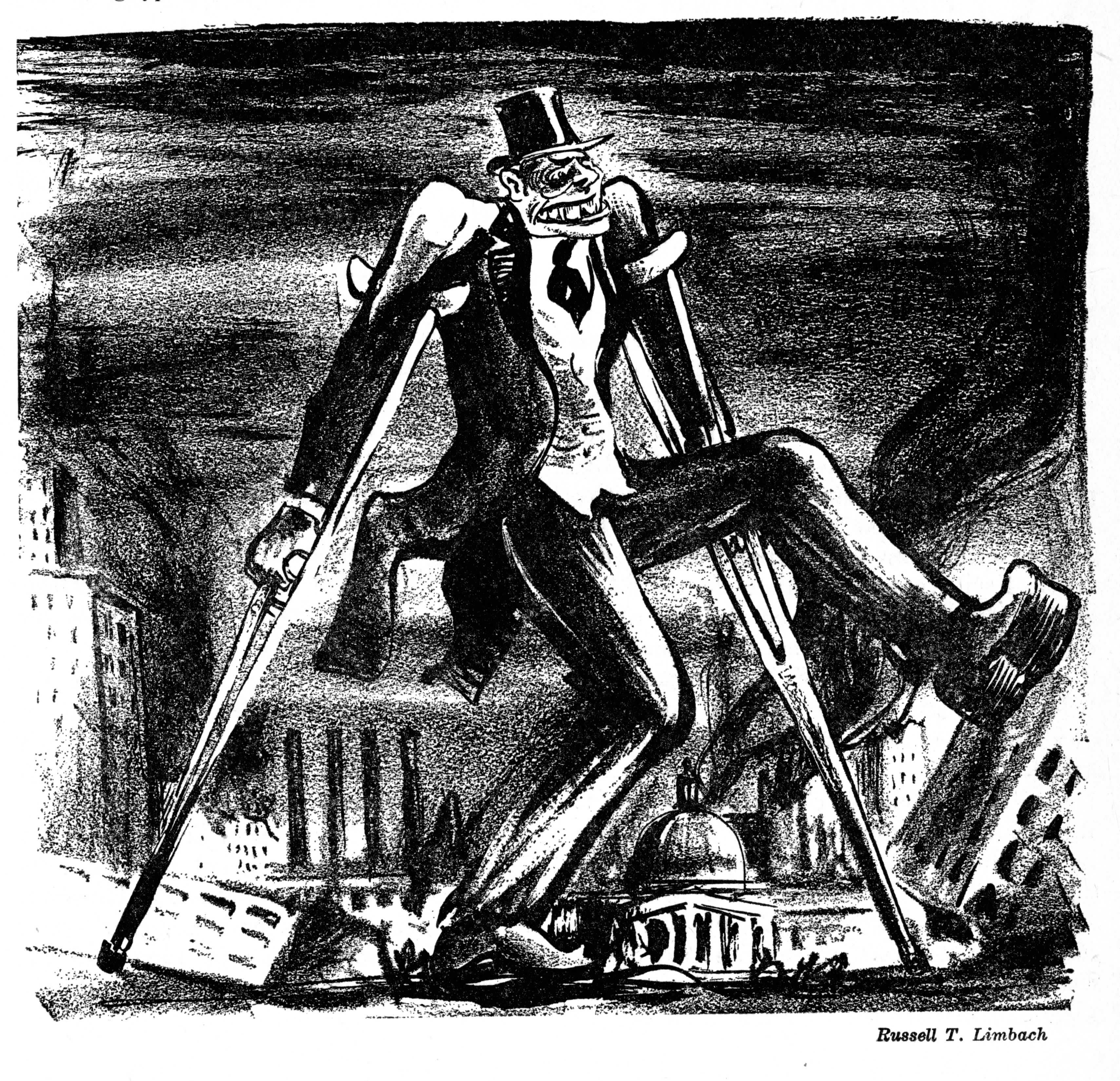
And show also the hobbling boys and girls brought up alongside privileged but ailing Mayors such as La Guardia and Walker. Hate them now in December just as they did last May.
Here are some colorful facts for you to put in your picture, artists Goya and Hogarth:
Three Port of Authority Pickets crippled in industry:
1. Francois Porlier, born in Boston, 1869. Printer’s apprentice at age of 12. Got lead poison from washing type. At 38 dislocated hip lifting heavy type case. The lead infection located there. For 23 years after that he limped painfully at work. Never could afford hospital, had to be on the job. Took to using a cane at work, but bosses wouldn’t hire a lame man. So he gave up the cane, and the thing got worse. But he was a good lithographer and offset pressman, so he got $50 a week in good times. Five years out of work now and can scarcely drag around, but his legs work better when he’s out on the picket line.
2. Alex Soloma, sailor, working on sub-contract dredging job in East River, let by N.Y. City. In lifting a buoy mounting-stone the chain slipped and Saloma’s leg was badly bruised by the barnacles stuck to the cement block. Next day he couldn’t get out of bed. Friend called a cop, cop thought Soloma drunk because he was delirious with fever. Taken to Bellevue on a stretcher. Blood poison from barnacle bruises and riverbottom slime. Five operations, 18 months in hospital. Finally the doctor punched a gold wire through the spongy thigh bone and Soloma let him take it off at the hip. Although assigned to the Rehabilitation Bureau for temporary pension while learning new trade, Saloma was let out after twenty weeks at $10 a week. Because the contract was sub-let he can’t sue the city, so he leads the Unemployed Picket Line.
3. A veteran in the allied army. Railroaded from 1923 to 1931, broke down at work. Sent to Bellevue. Diagnosis, T.B. from exposure on job. Railroad gave him light work for a year, then put him on a pick-and-shovel job and fired him when he collapsed. When he objected the doctor told him, “You got wages when you were working. What more do you expect?” This company doctor lost his job soon afterward, when economy cuts came along.
A pretty case of discrimination: in 1927 Jack Isaacs got $15 a week as a linotyper because his legs were crippled, but not his hands. He worked alongside men getting $45 a week and turned out just as much work as they.
The Physically Handicapped of America are not eligible for Civil Service. They cannot get regular jobs as teachers or librarians in New York State. In the Soviet, however, there is no discrimination against the Physically Handicapped. They do light work, any kind they prefer.
The New York State Employment Agency has a separate division for the physically handicapped. They use them as strike-breakers by sending them to scab jobs.
Even a typist must pass a physical examination.
In private business the Physically Handicapped invariably are discriminated against. They work harder for less wages, on the theory that nobody likes to have a cripple around. Yet shrewd businessmen advise their Babbitt sons: “If you want to get ahead, my lad, hire a hunchback or some kind of a cripple for your secretary, preferably a woman, because they’re more dependable and faithful. Cripples stick because it isn’t so easy for them to get jobs, and the best thing about it is, you can pay them a lot less and they’ll never squawk.”
But this all began to change, dating from May 29 this year when a small group of the Physically Handicapped put on their vivid job-demanding demonstration before Oswald Knauth’s Broadway Relief office. For eight days they stuck it out, sleeping on tables in the relief offices, kept without food; although their friends brought plenty it wasn’t delivered. The yellow press called it a hunger strike, though actually they were being officially starved. By June 6 only three of them were left, Pauline Portugalo, Hyman Atbramowitz and Morris Dolinsky. They were carried out on stretchers and the cops started a riot with their sympathizers on the street, resulting in the clubbing of cripples and their arrest on the charge of assaulting the police. One was said to have thrown away his crutches to fight a cop, but since he couldn’t stand up without his crutches nobody swallowed this story but the Hearst press, which came out next day with “Cripples Throw Away Crutches and Pummel Cops.”
Ever since then the fight has been going on. The government is now cutting off the unemployed, ordering them back to panhandling. It expects us to live on Rooseveltian private charity alone, in other words, to get by by begging from each other. Every one of us is nearer to the beggar’s tin cup than ever before. And because the Physically Handicapped know best the bitter taste of that cup they are putting up the hardest fight.
The New Masses was the continuation of Workers Monthly which began publishing in 1924 as a merger of the ‘Liberator’, the Trade Union Educational League magazine ‘Labor Herald’, and Friends of Soviet Russia’s monthly ‘Soviet Russia Pictorial’ as an explicitly Communist Party publication, but drawing in a wide range of contributors and sympathizers. In 1927 Workers Monthly ceased and The New Masses began. A major left cultural magazine of the late 1920s and early 1940s, the early editors of The New Masses included Hugo Gellert, John F. Sloan, Max Eastman, Mike Gold, and Joseph Freeman. Writers included William Carlos Williams, Theodore Dreiser, John Dos Passos, Upton Sinclair, Richard Wright, Ralph Ellison, Dorothy Parker, Dorothy Day, John Breecher, Langston Hughes, Eugene O’Neill, Rex Stout and Ernest Hemingway. Artists included Hugo Gellert, Stuart Davis, Boardman Robinson, Wanda Gag, William Gropper and Otto Soglow. Over time, the New Masses became narrower politically and the articles more commentary than comment. However, particularly in it first years, New Masses was the epitome of the era’s finest revolutionary cultural and artistic traditions.
PDF of full issue: https://www.marxists.org/history/usa/pubs/new-masses/1935/v17n09-nov-26-1935-NM.pdf
 Revolution's Newsstand