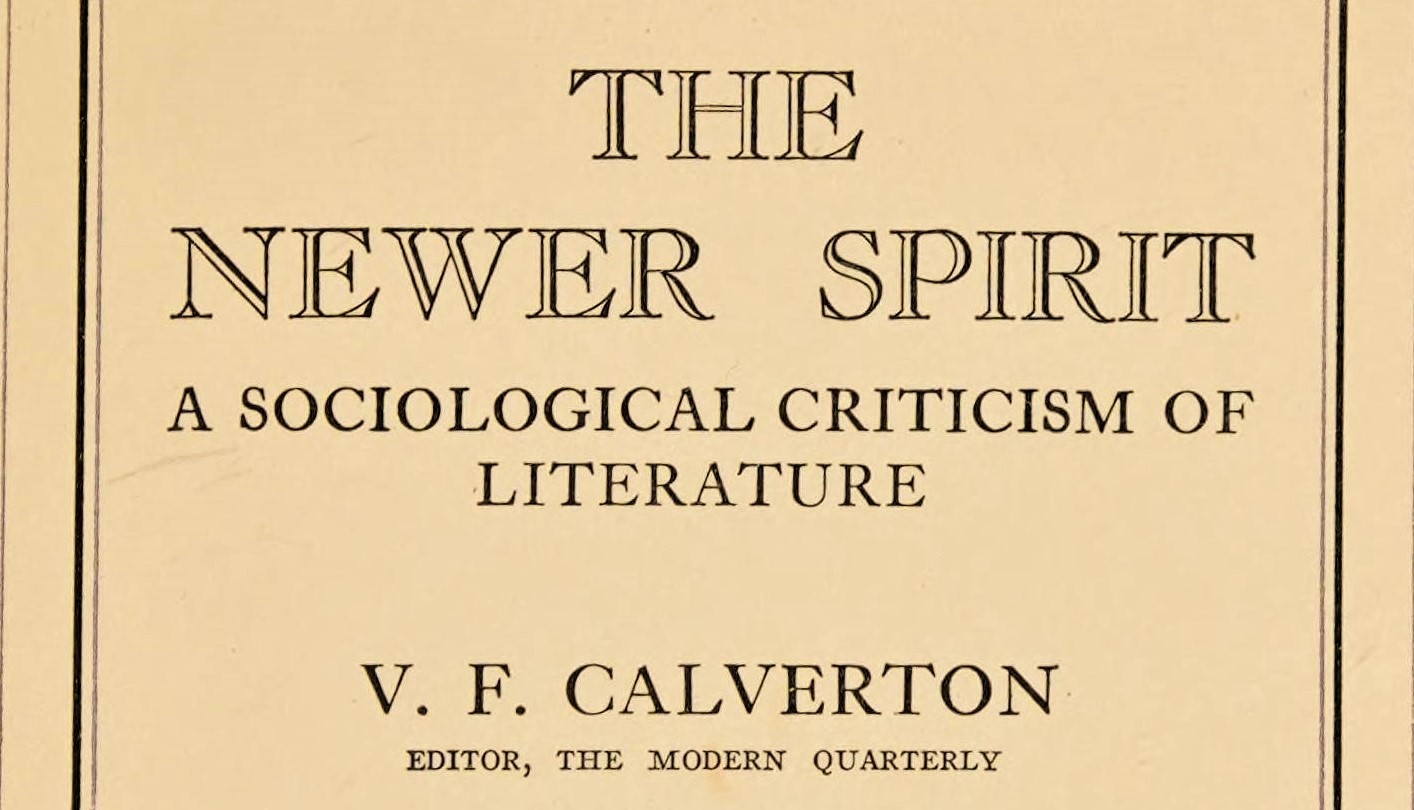
Pioneering Marxist cultural critic V.F. Calverton with a stimulating essay on the histories of working class literature in the United States, what constitutes proletarian art (this is not an intervention on the ‘prolecult’ debate), and the social forces behind trends in American literature.
‘Proletarian Art’ by V.F. Calverton from The Newer Spirit: A Sociological Criticism of Literature. Boni and Liveright, New York. 1925.
THE proletarian motif has introduced a new psychological element into art. Artistic substance becomes imbued with a freshness and a universality that classical art could never attain. The interwoven dependence of one form of life upon another, the collective unity of the human race, become realities pregnant with esthetic as well as social significance. The distinction of caste, a vestigial characteristic of contemporary civilization, is already fading with the progress of the proletarian concept. In clear and definite contrast, bourgeois concepts are starting to shake and totter as the civilization which created them is gradually approaching its destruction. The uncertainties and irrational strangeness of modern art, the wild, frenetic and unrhythmical flow of line, color, and verse, the distortionate visions of the modern mystic, are all unequivocal manifestations of the moribund state of the prevailing bourgeois society and culture. The febrile revolt against the slavishly acquisitive economics of the bourgeois system, its hypocrisies of political principle, its stultifying puritanic ethics, headed by a wing of the bourgeois itself, as well as by the fuglemen of the proletariat, are further illustrations of just how this trend is shaping itself in literature and philosophy. The superficiality of this anti-bourgeois criticism, fostered in America by men like Mencken and Babbitt, does not obscure its importance as an index to our social disintegration. It is no less signal than the cry of the small bourgeois, caught in the vice of a rapidly centralizing society, against the oppression of their rights and the usurpation of their enterprise by the higher strata of their own class. All point inevitably in the same direction.
“Hatred of the bourgeoisie is the beginning of virtue,” the Flaubertian proclamation of the nineteenth century, vigorously expresses the rebellious attitude of at least two generations. With the present generation the meaning of the proclamation has become more clarified; social concentration has given it a more crystallized form, a sharp, forceful definiteness, and an expression clearer if not more refined, subtler if not more powerful. Professor Sherman, the W.D. Howells of our generation, in his essay “The National Genius,” has contended that contemporary divergences from the bourgeois conceptions are but the manifestations of a recalcitrant youth—futile “bucking of the national genius.” ‘This is a blind and shallow evasion. The violent anti-bourgeois attack of men like Dreiser and Anderson in America, Joyce in Ireland, Verhaeren in Belgium, Toller in Germany, not to mention a host of others, does not express the vaporous eccentricity of the immature or the undefined aspirations of the utopian. There is a social-consciousness, imperceptible perhaps to the artists themselves, present in the works of these men that is more moving than the anemic art of the fading bourgeois. The soft, purring music of an Emily Dickinson could no more express the spirit of our age than the staccato rhythms, the vivid literalities, the rhymeless clamorings of a Sandburg could have expressed the attitude of hers. The Lizette Reeses, gentle, one-stringed artists of an evanescing genre, are retreating before the rushing cadences of a changing civilization.
It is not the function of a critic to declare the poetry of a Lizette Reese infinitesimal in value because it is unsucculent of the spirit of the rising generation, but to point out that it should be studied in relation to its own class, of which it is a part, and evaluated in accordance with the type of art it represents. But it is as risibly fallacious of the Shermans to maintain that we must cling to this type of lyzicism, this moody sequestration of impulse and vain shadowing of reality, as it was of Rousseau to argue that salvation was to be secured only by a return to the primeval. However, it is true that every state of society must have its conservative, “reminiscent” element, devoted to a perpetuation of the status quo, with an additional craving for the “finer” gold of yesterday, and Professor Sherman, with his compeers, Professors Moore and Babbitt, are but a vital exemplification of this attitude. No matter how inevitable, this approach is a viciously undermining influence. It is far more to be deplored than the sciolistic strictures of a Henry Mencken or the vorticistic ejaculations of an Ezra Pound. Yet it is this polluted type of criticism that is propagated by our educators throughout the country, in the institutions of California, the Mid-West, and the fringe of the Atlantic. In fact, it is devastatingly unubiquitous. It is only the birth of a literature which represents the proletarian concept that gives promise of an enduring opposition. The poetry of Sandburg and Masters, the dramas of Eugene O’Neill, the fiction of Anderson, Dreiser, and, to an extent, that of Willa Cather and Sinclair Lewis, are evidences of this new trend. Whitman was perhaps the first to voice it in America, and Frank Norris, Stephen Crane, and, to a lesser degree, Graham Phillips were its continuators. Since the war it has had a rapid, intensively poignant growth. It is at this point that we must indicate more exactly the features of the proletarian concept as distinct from the bourgeois and aristocratic. We discover with proletarian art the growth of a new esthetic. The clash of class-psychologies has precipitated a revolution in art values and criteria. In literature, for instance, the working man, as distinguished from the noble, the merchant and the magister, becomes a figure essential to its evolution; tragedies formerly spun about the episodic futilities of royalty, the failures of gamesters and business men, now include the disasters of the proletariat. The proletarian is visualized as no less a hero than the knight or financier. The ethics of the bourgeois, by the very process of social antithesis, so adequately illustrated by Hegel and Plechanoff, are repudiated by the evolving proletariat. Virtues like honesty and chastity, denuded of their verbal veneer and deceptive duality of application, no longer become the embodiment of greatness in character and the source of profound emotional appeal. The novels of Flaubert, Zola, Hamsun, Anderson, Dreiser, Willa Cather, all have successfully abandoned such motifs. The esthetic apotheosis of such virtues belonged to the day of the bourgeois novel, the day of The Scarlet Letter and Adam Blair. The attitude toward the whole problem of sex, in line with the same trend of social antithesis, has become unfettered of bourgeois prejudice and is seeking out toward a more living and comprehensive expression. The sermonical novel, so dominant and widely in vogue during the heyday of the Victorians, with the rise of the proletariat has become obsolescent. The bourgeois attitude toward the obliquities and perversities of human action, the reverse of intelligent and generous, becomes understandable and magnanimous when transformed into the proletarian. 1 Crime is conceived as a product of conditions and not of the innate wickedness of human nature. Condemnation is turned into pity, and punishment into treatment.2, A Draco becomes a Ferri, and a judge becomes a physician. Evil in characters is pictured without the attempt to make them hideous, but to reveal the injustice of a social system or the iniquity of circumstance. The Heeps, Murdstones, Draculas, Dunsey Casses, Judases, and their antitheses the Evangelines, Agneses, Pauls, and Virginias, are transmogrified into creations that are less despicable or less perfect but more convincing and real. The whole proletarian trend is toward a deeper realism, pruned of ornamental trappings, rugged almost with its undecorated exterior and uncurved sharpness of delineation, and fully cognizant of the social origin and meaning of action.
This realism toward which proletarian art is driving in its annihilation of class-distinctions possesses a comprehensiveness of content, singularly communistic in its development. Contrary to the usual belief there is no unilaterality in the attitude, considered in its fullness, no puffery of a single group at the expense of others except as an immediate situation in society might necessitate—as at the present time—but the promise of a complete synthesis of them all. Its philosophy aims toward a universality, but not uniformity, of substance. Its appeal is exclusive of no nation, no race, no class. Whitman expressed this sentiment eloquently:
“Literature is big only in one way—when used as an aid in the growth of the humanities—a furthering of the cause of the masses—a means whereby men may be revealed to each other as brothers.”
His poems are mellifluous with the same strain: “One’s Self I sing—a simple, separate Person; Yet utter the word Democratic, the word En Masse.”
Of the greatness of the destiny of the mass he sings, incessantly, audaciously. Their sufferings become part of his own, their protest is his protest; their failures his failures—he is “the hounded slave that flags in the race, leans by the fence, blowing, covered with sweat,” he the “mashed fireman with breast-bone broken,” “the youngster taken for larceny,” “the common prostitute.” There is a kind of mystical mergence of impulse in these verses, a romantic projection of self, that is a vivid reflection of the creeping spirit of the proletariat during the latter half of the nineteenth century. Of the coming of equality, the unconscious aim of the approaching upheaval of classes, he writes with courageous enthusiasm:
“In all people I see myself—none more, and not a barleycorn less, And the good or bad I say of myself I say of them. Oh, strongly reflect all except Democracy! … Oh, to build for that which builds for mania (a Pompey Oh, workmen and workwomen forever for me! Oh, farmers and sailors! Oh, drivers of horses forever for me! Oh, equality! Oh, organic compacts! I am come to be your born poet.”
Were we to become in our sociology as idealistic as Tugan-Baranovsky we might say that this poetry of Whitman’s is a “spiritual” building upon the economic structure, but it is far more accurate though prosaic to use the words of Plechanoff and to state that it is simply the expression of a mind that grasped, through a favorable collocation of stimuli, “the meaning of the new generating social relations.”
If for a moment we turn to the works of Emerson, the American apostle of the 1830’s, 40’s, and 50’s, we shall discover an illuminating contrast. 3 Emerson wrote when capitalism was just beginning to stretch its vast tentacles across the country; the railroads were undeveloped, communication was slight, the West was still uninvaded by the countless hordes that swept across its heart following the gold rush of ’49, and the promise of Eldorados continued to gleam like beguiling will-o’-the-wisps.. Industry had scarcely begun to centralize, cities had yet to thicken and reek with the dun smoke of multiplying factories, and individual enterprise had still the chance of temporary survival and success. The individual, therefore, had greater opportunity, greater freedom. The limitation and oppression of an interwoven industrial system had yet to encompass him. The necessary interdependence of individuals had yet to be emphasized. Hegiras like that of Thoreau did not seem egregious anomalies. The philosophic attitude, as a consequence, was logically individualistic. Emerson’s works are a reflection of this early, almost golden, age of capitalism—capitalism fresh with the hope of an unending spring. His preachings of “self-reliance,” the virtue of isolation, the strength of individual principle, all infused with a transcendental essence, are the accurate manifestations of the sociology of this period. The “Trust thyself” motto, the sesame of the Emersonian metaphysic, is but the same idea differently phrased.
“It is only as a man puts off all foreign support and stands alone that I see him to be strong and to prevail. He is weaker by every recruit to his banner. Is not a man better than a town? Ask nothing of men, and, in the endless mutation, thou only firm column must presently appear the upholder of all that surrounds thee.” 4
There is not the kind of democracy in Emerson that there is in Whitman. They represent different generations, different economic and social epochs, different phases of class evolution. Emerson is the idolater of great men, not the genuine lover of the “prostitute” and “carpenter.” He is the herald of individual not social development. The importance of the socialization of labor, the sime qua non of the later stages of capitalism, he did not see and hence could not appreciate. During the period of his apogee the proletariat was undefined, a groping, unsettled group. White slavery had just disappeared in 1831.
“The poor and low find some amends to their immense moral capacity, for their acquiescence in a political and social inferiority. They are content to be brushed like flies from the path of a great person, so that justice shall be done by him to that common nature which it is the dearest desire of all to see enlarged and glorified. They sun themselves in the great man’s light, and feel it to be their own element.”
This, the song of the bourgeois, was unchallenged until the few feverish years preceding the Civil War. It was Whitman whose rhythms rose in protest. It was Whitman, but fifteen years younger than Emerson, who put the muffled music of the swelling proletariat into poetry. He was expressing another phase of capitalism, another generation, another class. His poetry marked the rise of our proletariat, the first coming of our proletarian art. Its divergence from the bourgeois trend is apparent without further description. It is the dividing line of a literary epoch.
In Whitman there remained but few of the vestiges of the earlier concept, and these too are passing with the intensification of the proletariat and the gradual refinement of proletarian art. In Germany and Russia the plunge into the new art has been preternaturally violent and rapid. At times this art has possessed a ferocity verging on madness. Toller, Hasenclever, Libedinsky—these are its stars. But they are its promise, not its fulfillment.
1. This does not mean that certain exigencies do not demand rigid, often brutal, tactics of an uncrystallized proletariat, but that the understanding and magnanimity noted are the necessary social consequents of the approaching change in our economic structure. The temporary defection from such an attitude, occasioned by a political revolution or economic emergency, in this stage of social evolution, is no argument against the reality of the trend and the unmistakable nature of its final direction.
2. See Ferri’s Criminal Sociology, and Blatchford’s Not Guilty.
3. Although Emerson lived until 1882, the 30’s, 40’s, and 50’s were the formative years of his life, the years that determined the nature of his philosophy.
4. Essay on Self-Reliance.
A volume of pioneering Marxist(sh) literary criticism from the editor of Modern Quarterly, V.F. Calverton. Modern Quarterly began in 1923 by V. F. Calverton. Calverton, born George Goetz (1900–1940), was a radical writer, literary critic and publisher.
The Newer Spirit: A Sociological Criticism of Literature by By V. F. Calverton. Boni and Liveright, New York. 1925.
Contents: Author’s Preface, introduction by Ernest Boyd, Sociological Criticism of Literature, Sherwood Anderson A Study in Sociological Criticism, The Impermanency of Esthetic Values, Proletarian Art, Fragments from a Critique of American Criticism, The Wisdom of Three Critics: Woodberry Spingarn Sherman, The Vaudeville Critic H.L. Mencken, Morals and Determinism, The Great Man Illusion, The Rise of Objective Psychology, Art Science and the Quantitative Conception, Reflections on the Trend of Modern Psychology as Exemplified by Four Psychologists. 284 pages.Based in Baltimore, Modern Quarterly was an unaligned socialist discussion magazine, and dominated by its editor. Calverton’s interest in and support for Black liberation opened the pages of MQ to a host of the most important Black writers and debates of the 1920s and 30s, enough to make it an important historic US left journal. In addition, MQ covered sexual topics rarely openly discussed as well as the arts and literature, and had considerable attention from left intellectuals in the 1920s and early 1930s. From 1933 until Calverton’s early death from alcoholism in 1940 Modern Quarterly continued as The Modern Monthly. Increasingly involved in bitter polemics with the Communist Party-aligned writers, Modern Monthly became more overtly ‘Anti-Stalinist’ in the mid-1930s Calverton, very much an iconoclast and often accused of dilettantism, also opposed entry into World War Two which put him and his journal at odds with much of left and progressive thinking of the later 1930s, further leading to the journal’s isolation.PDF of book: https://archive.org/download/newerspirit0000vfca/newerspirit0000vfca.pdf
 Revolution's Newsstand