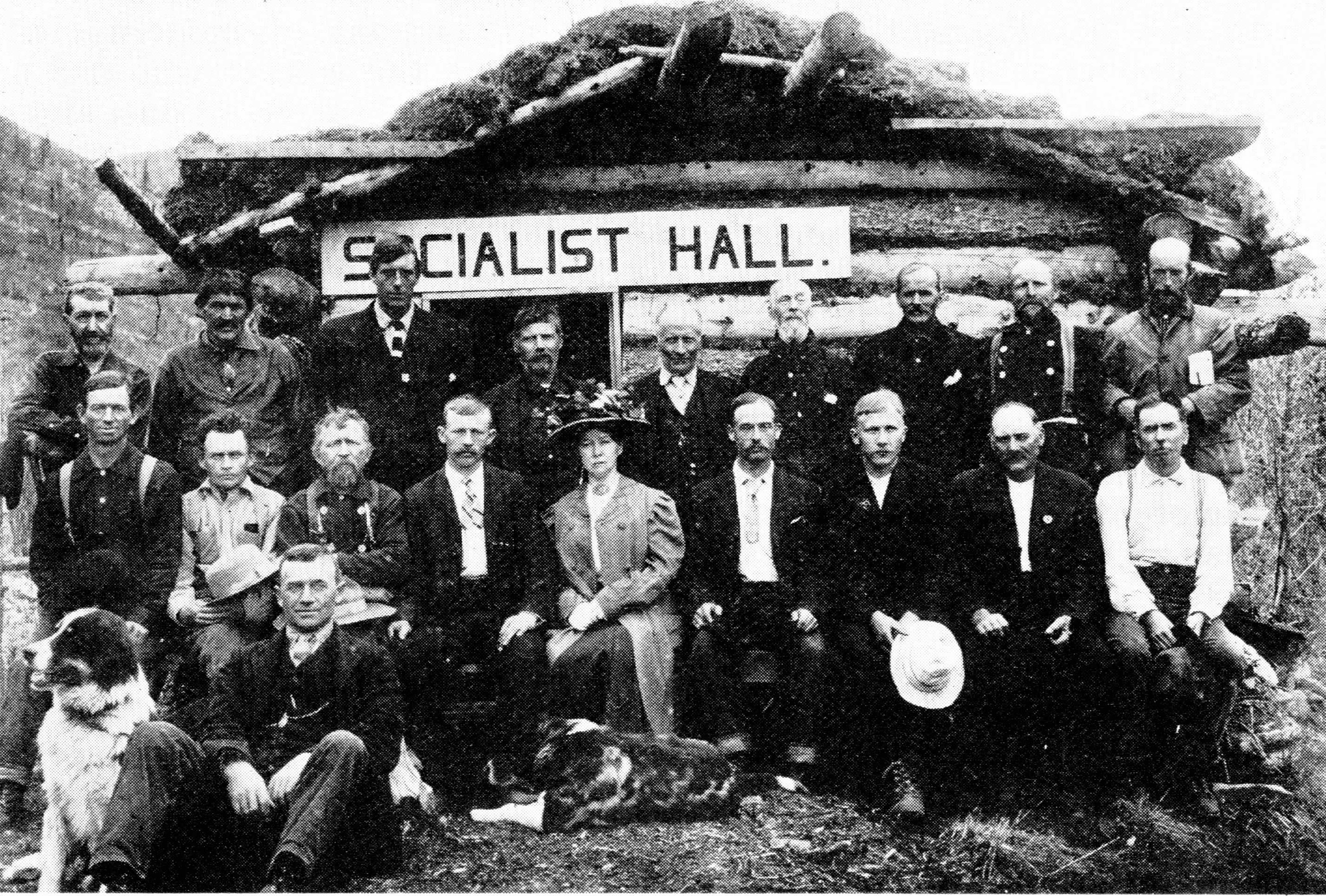
‘The Growth of Socialist Sentiment in Alaska’ by An Alaskan Miner from International Socialist Review. Vol. 12 No. 7. January, 1912.
THE average Socialist looks on Alaska as a place where there is little or no industrial development and consequently a poor field for the Socialist lecturer and organizer; a place where Socialist talent and money would be practically a total loss. I shall endeavor to show that such is by no means the case.
It is perfectly true that the industrial development, thought by so many of the comrades to be absolutely necessary to the growth of Socialist sentiment, is lacking here, but there is more intellectual freedom here than I believe is to be found in any other section of America.
We speak of countries being “ripe for Socialism.” We mean that these countries are so well developed industrially that machine production has reached a high stage; that the national resources of these countries are controlled by comparatively few of the people, and that the masses are so tightly held in the bondage of wage-slavery that they will gladly listen to what Socialists have to say and Jump at our doctrines as offering the only means of relief.
If industrial development is really all that is necessary to the rapid growth of Socialist sentiment, why is England not in the lead in Socialism? She is surely ripe”; at least I don’t think anyone will be willing to go so far as to call her “green.” I think the answer is that the ruling class of Great Britain is wise to its own interest, and that the ruling class of other countries cannot teach them anything regarding the control of the workers.
Along with the development of the machinery of production—the machine with which they shear the workers—they have caused to be developed almost equally a machine to hold the workers still while the shearing process is under way; a machine so gentle in its grip that the average worker does not feel it, does not know he is being held at all. I refer to the pulpit, the press, the public schools and all the other means employed to keep the Englishman quiet, to keep his mind in bondage, a more effective way of controlling him than all the other means they could possibly use. What is true regarding England is largely true when we speak of the United States.
Many Socialists employed in the big centers of industry think that it is impossible for a person to become a real class-conscious revolutionist anywhere else. Their idea seems to be that to become a real Socialist it is necessary to work at some job in a big factory. No doubt this is often true, but not always. While the worker in the city and factory is learning that there is a class-struggle, he is also where he is likely to have his mind befuddled by “reformers,” “labor fakers,” capitalist preachers and all the dishonest horde of lackeys of the system that is exploiting him.
It may be urged that this is good for him, that it develops him, makes him keen, and that the man who is not subject to these things will necessarily be dull and slow to see anything that is directly in front of him. Maybe some comrades can’t imagine how men who have lived ten or fifteen years in this undeveloped country can become Socialists, not having had the pressure of a highly developed industrial life to drive them to it.
The Socialists here, as a rule, take very few capitalist papers or magazines. Many of them are prospecting a part of the time, often being alone for days, weeks or even months without seeing anything in the shape of a human animal.
Men so situated do a great deal of thinking, and if it is not possible for such men to rid their brains of the accumulated rubbish of early teaching, I think there is less hope of the city wage worker ever accomplishing it, surrounded as he is by all the distractions of modern civilization. I think the worker who has managed to clear his “garret” of dust and cob-webs is likely to “take” Socialism, if exposed to it, whether he is roaming the mountains in this northern solitude or working amid the whirr and rattle of machinery in a Massachusetts factory.
The Socialist here is more in the position of an onlooker than an active participant in the industrial struggle. He is far enough off not to be blinded by the smoke or deafened by the noise of the conflict. From his position here on “the top of the earth” he watches earnestly the battle rage around the world and contributes his mite toward the “cause.” Alaska may not be industrially “ripe,” but I believe the people that live here are mentally “ripe.”
As evidence of the kind of Socialists we have here I will state that since the INTERNATIONAL SOCIALIST Review changed from being a record of the “hairsplitting” matches of the “intellectuals” and developed into a real workingman’s magazine, filled with articles couched in language that the worker can easily understand— articles dealing with subjects of vital interest to him—I have heard not one word of complaint regarding the magazine. I think that is sufficient to show that we are not “half-baked,” but that we are class-conscious and revolutionary. I don’t know, but I imagine the milk-and-water, kind don’t appreciate the I.S.R. in its present form.
If more of our papers followed the lead of the Review and printed less matter that is pleasing to craft unions and advocated industrial unionism, I believe the time would not be far distant when we would no longer have as a reminder that the workers are not united, the discouraging “spectacle” of union trainmen hauling scabs, soldiers and thugs to defeat workingmen who are striking for better conditions in some other branch of industry; a more inexcusable, shameful and traitorous act on the part of so-called union men it is impossible to find.
The International Socialist Review (ISR) was published monthly in Chicago from 1900 until 1918 by AM Simons and later Charles H. Kerr and loyal to the Socialist Party of America and is one of the essential publications in US left history. During the editorship of A.M. Simons it was largely theoretical and moderate. In 1908, Charles H. Kerr took over as editor with strong influence from Mary E Marcy. The magazine became the foremost proponent of the SP’s left wing growing to tens of thousands of subscribers. It remained revolutionary in outlook and anti-militarist during World War One. It liberally used photographs and images, with news, theory, arts and organizing in its pages. It was closed down in government repression in 1918.
PDF of full issue: https://www.marxists.org/history/usa/pubs/isr/v12n07-jan-1912-ISR-riaz-ocr.pdf
 Revolution's Newsstand