
A fantastic snapshot of wobbly activities during Pennsylvania’s Bethlehem steel strike of 1910 from organizer Joseph E. Ettor.
‘The Strike Situation at Bethlehem’ by Joseph Ettor from Industrial Worker. Vol. 1 No. 51. March 12, 1910.
Schmidt started from here on last Wednesday evening. He was instructed to go there, size up the situation and if same warranted it, he should immediately notify me and I would proceed there at once.
I left Friday afternoon I received two telegrams from him urging that I start for the strike scene immediately.

I left here on Friday night and reached South Bethlehem Saturday morning. There had been a meeting arranged to be addressed by both Schmidt and myself to be held Sunday night In the Old City Hall where the proposition of urging the other different trades to go out would be advised.
All day Saturday we spent in either distribution of circulars of which we had ten thousand printed in three languages, namely, English, Polish and Slavish, and in investigating the situation, I had a conference with the leader of the strike, D. Williams, a member of the Socialist Party local In Allentown, From what I could learn from him. It became immediately noticeable that they were not very anxious that the I. W. W. should bother with the American Machinists who were then the only strikers, but that we should use our influence with the Slavs and Poles.
Sunday was spent In a house to house canvass with circulars and leaflets. Sunday, as you will see by the enclosed clipping, we had a splendid meeting. I found that all through the strikers were rather sympathetic with the I. W. W, and on all sides the men admitted that the A. F. of L. organizers had run the revolt into the ground. Many expressed the feeling that it was really too bad that we were not on the ground the first day of the big walk out.

I attended with Schmidt the strikers mass meeting that was held on Saturday afternoon where Sammy’s organizers spoke to the men about their craft unions, the worst kind of rot, no advice to do any picket duty but the same old rot that if the men took out craft union cards they would beat the bosses.
On Sunday night in my speech I made the position of the I. W. W. clear to the men and the same was accepted by a show of hand vote of the meeting, to-wit: the I. W. W. had nothing in common whatever with the A. F. of L., but we were confronted with a strike and the name should be made a success. We were willing for the time being to bury the hatchet so to speak and go ahead with the proposition of getting the rest of the men to quit work and fight out the fight for the purpose of winning; that the I. W. W. would be willing to leave the matter of which organization the men should join till after the strike, providing that the organizers of the A. F. of L. would be willing to do the name.

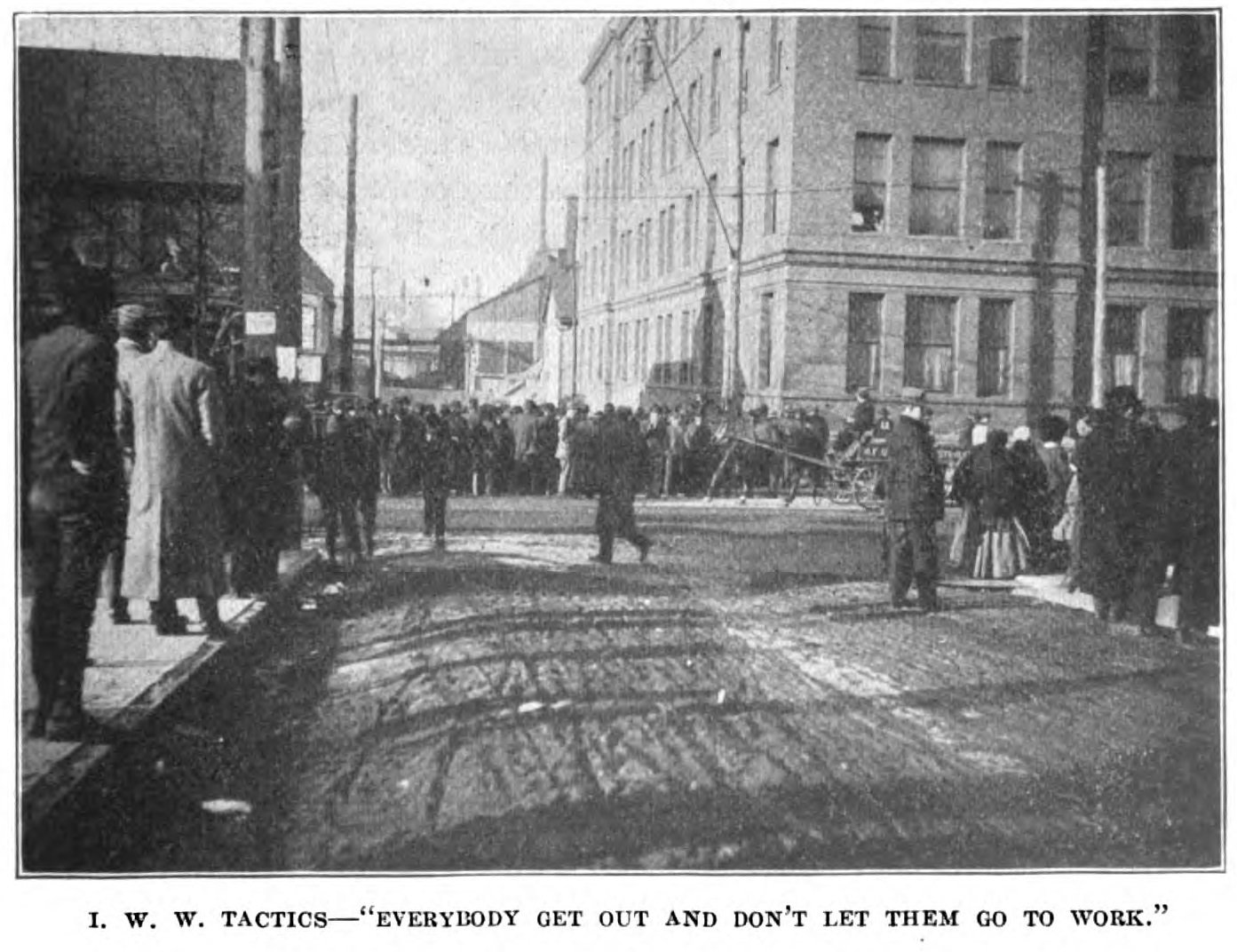
The next morning, the three of us, Petroff of Pottsvllle. Schmidt and I, were out in the rain at 6 o’clock doing picket duty with about fifty Hungarians and about twenty of the striking machinists.
Through the roasting that I had given the moulders on Sunday for having gone back to work and by the picket work in the morning, about 10 o’clock that morning about three hundred moulders of one of the shops and 115 crane men walked out. We had succeeded in getting a bunch of Slavs and Poles to go to work, with the promise that at the opportune moment they should lead a stampede through the shop and try and get the five thousand or more of their countrymen to walk out.
What Americans came that morning to the picket line saw that we meant business and they were outspoken about the matter and argued that it was the only way to fight. It was arranged that at the strike meeting at 10 o’clock that morning both Schmidt and I would be asked by the men to speak, and that after we got done a motion would be made that all men and officers Interested in the strike should go on picket duty in the morning, instead of sleeping till 10 o’clock.
At the meeting the stage was filled with all the organizers of the A. F. of L. that could be scraped. They all spoke and advised the men to at once start to register so that they could be organized into their respective craft unions.
When they had got done one of the striking machinists made a motion that I be Invited to address the meeting. The motion was seconded from different parts of the house.
But the leaders offered objections and in order to try and kill the proposition they stuck up a Hungarian speaker to address the Maygar workers. Meanwhile some of the’ strikers jumped on the stage and demanded the reason as to why I could not speak: They offered all kinds of silly excuses. Finally Williams, the strike leader, told Petroff and others that he was willing that I should speak but that the chief of police from whom they get the City Hall gratis had warned them that if they allowed me to speak, that I would be immediately arrested and the hall taken away from them. The committee of the men from the door reported his remarks to me and I replied that if they wanted that the chief of police should act as censor, on what should be said in the meetings, he could govern them and for all I cared they may just as well appoint him and the rest of the police force as the strike committee, but that for my part I would not talk any different than I would under any other circumstances.
When Petroff took my answer to them, they immediately tried to compromise the matter by allowing Schmidt to talk in Slavish and Polish. To that I yelled from the floor that if the I. W. W. representatives could not be heard in English because the language was too radical, that it was the same thing in any other language and we would not be used as prostitutes by any damn committee. The meeting began to break up notwithstanding all the frantic appeals of the leaders of the A. F. of L.

Bunches of men gathered around to discuss the matter and all agreed that the whole matter was raw, and that I should be allowed to speak. Seizing my opportunity I again called attention to them of the proposition that I had made at Sunday night’s meeting. I told all present that I could see the whole proposition clear—the craft union leaders were anxious that we should stay on the ground and lead the Slavs and Hungarians, that we should spend our money and energies but that at the end a pact would be made with Schwab whereby the mechanics would be given some concessions and the vast mass of laborers—the Hunkies— would be left in the cold as usually is the case.
I told Williams that he could forget the Idea as he had remarked, that we would eventually start a row with the A. F. of L. and thus disrupt the strike. That we would wash our hands with the whole proposition and leave the field clear for him and his A. F. of L; that I fully understood the situation; that they figured in using “the foreigners” in pulling the chestnut out of the fire for the mechanics but that the I. W. W. would not be a party to the sacrifice. Petroff. Schmidt and I went to the Hotel and considered the whole matter and we decided that taking everything in consideration the bent thing that we could do to keep the confidence Of the men would be to withdraw from the whole proposition.
We came to this conclusion from the following facts:
First—The strike had been broken by the Organizers of the A. F. of L., who had run the sentiment of a general strike of all the employees into the ground, by the fact that they had from the start advised the men to be peaceful, to stay home Instead of doing picket duty, that Instead of the different crafts walking out altogether with the rest they had been advised to remain at work, organize Into craft unions and their present their demands for increase in wages from the institution. This advice had been followed by some of the trades and as in the case of the electrical workers had resulted that the management had raised their wages and they remained at work.
The fakers had decreased the fighting number of the men by the fact that they had all along advised the men to leave the place in search of other jobs. This advice had been followed and the result was that out of a total number of five thousand strikers there was only about a thousand left in the town.

We reasoned that if we tried hard we would have very little trouble in getting the Slavs to walk out, but that if we did we would have to run the strike in two different ways. There would be one army in one hall and one in another. As long as the fight goes on the plan that it is at present, there will be no excitement and an appeal for funds would bring in very little, but if the Slavs walked out there would soon be some excitement and money would come in. and since the A. F. of L. has already sent out its appeals we would simply be pumping water to run their mill.
Taking all these things into consideration we decided that the best that we could do would be to wash our hands of the. whole matter, that the A. F. of L. had run the strike Into the ground and they may as well finish it themselves and have the blame for it, rather than they make the failure, but because we butted in they would say that the strike was lost due to the Interference of the I. W. W.
So Schmidt remained to address the meeting that was called for Monday night and explain to the Slavs and Poles the whole situation as it looked to us and advise them to use their own judgment in the matter of walking out. JOS. J. ETTOR.
The Industrial Union Bulletin, and the Industrial Worker were newspapers published by the Industrial Workers of the World (IWW) from 1907 until 1913. First printed in Joliet, Illinois, IUB incorporated The Voice of Labor, the newspaper of the American Labor Union which had joined the IWW, and another IWW affiliate, International Metal Worker.The Trautmann-DeLeon faction issued its weekly from March 1907. Soon after, De Leon would be expelled and Trautmann would continue IUB until March 1909. It was edited by A. S. Edwards. 1909, production moved to Spokane, Washington and became The Industrial Worker, “the voice of revolutionary industrial unionism.”
PDF of full issue: https://www.marxists.org/history/usa/pubs/industrialworker/iw/v1n51-mar-12-1910-IW.pdf
 Revolution's Newsstand