
‘Cultural Work in the Ranks of the Red Army’ from Soviet Russia (New York). Vol. 3 No. 1 July 3, 1920.
THE Red Army is victorious on all fronts. At the same time the Soviet Government has also gained victories in the ranks of its own army, victories which are of great significance in the cause of Socialism — victories over illiteracy, prejudice, and ignorance of the peasant Red Army soldiers.
The tremendous successes of cultural work in the whole country and especially in the ranks of the Bed Army are so conspicuous that on many occasions they were the subject of the Kolchak and Denikin newspapers which commented with envy and impotent rage on these successes, setting them up as an example for their own unpretentious “propagandists” and “agitators.” The comments of the White Guards on these successes are franker still in unofficial documents. As an instance, we quote the following report of August, 1919, of the Chief of the Scouting Division of the Headquarters of Kolchak’s Third Army — Colonel Shokov.
Agitation and propaganda in Soviet Russia is brilliantly organized. Propaganda classes have been established in every government town, which have already turned out a number of trained agitators. The ideas of Bolshevism are disseminated in simple, comprehensible, and convincing language and forms. The whole country is literally flooded with appeals, placards, newspapers, and colored pictures.
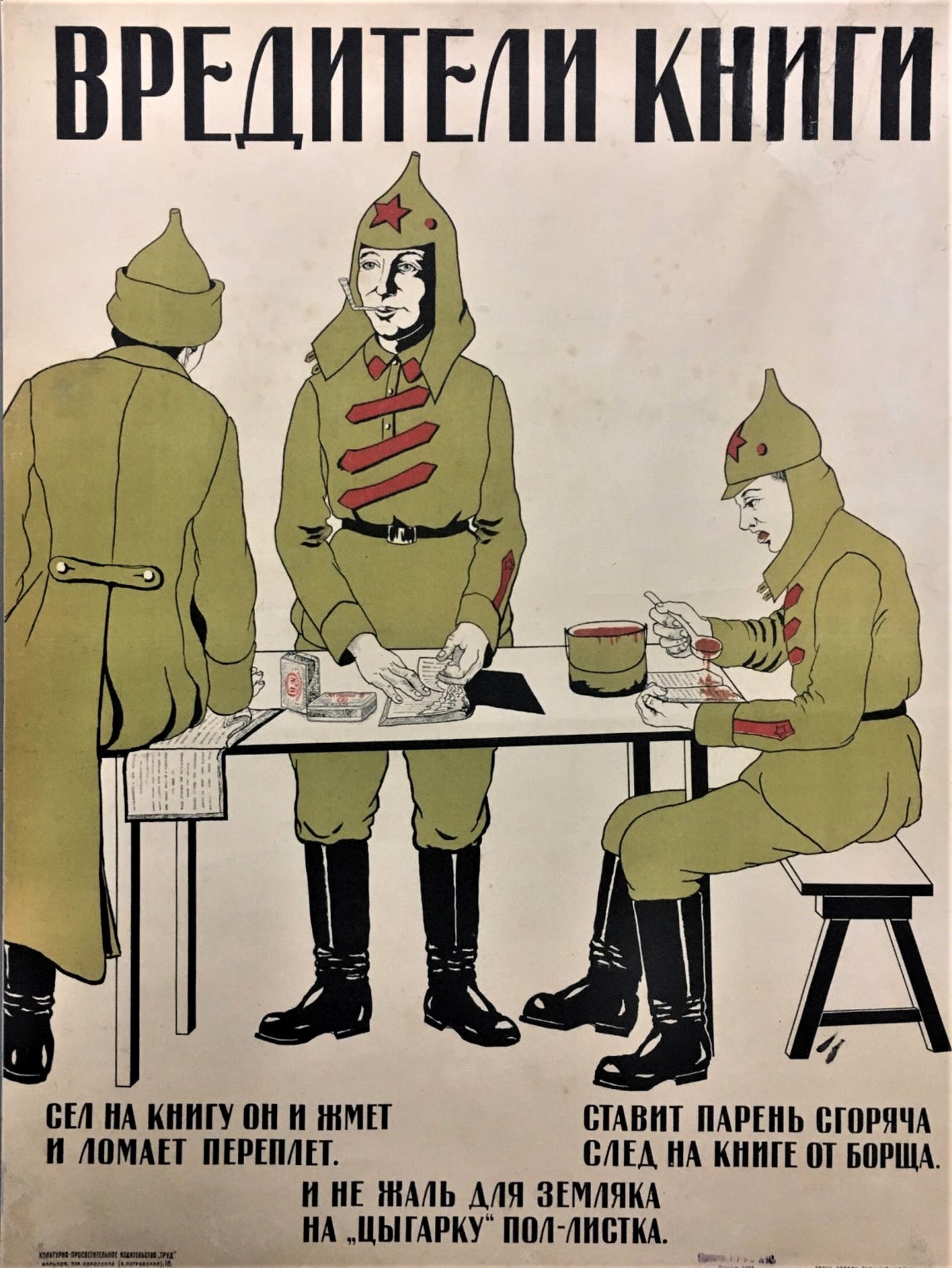
At the front the Bolsheviks have made propaganda a weapon as mighty as artillery, aviation, and tanks.
The report of the Literary Publication Department of the Political Administration of the Revolutionary War Council of the Republic for the period of June 1 to November 1 gives a clear idea of the extent of cultural work performed in the Red Army.
The following were issued during the five months :
“The Red Soldiers” magazine (No. 3-9), 1,004,000 copies; the magazine “Svetoch,” for White soldiers, 40,000 copies; 241,000 pamphlets. The following leaflets were published: for the Red Army, 1,810,000 copies; for the Whites, 1,075,000 copies; 1,130,584 colored pictures; 45,000 graphic tables.
By the 1st of December 487,000 pamphlets were issued; 1,000,000 leaflets; 500,000 copies of the “Red Soldiers”; 600,000 open letters; 628,000 placards and colored pictures, and 92,000 graphic tables.
The whole of this tremendous work was carried out solely by the Central Political Administration. A perfect conception of the colossal cultural work, organized for the Red Army, will be formed if we carry in mind the fact that the political departments of all fronts as well as the Red Army Divisions publish a great amount of printed matter.
The whole of this agitational and cultural literature is written in the most popular style, comprehensible to the intelligence of the meanest peasants of the most remote corner of illimitable Russia. The gist of all the placards, pictures, and cartoons is easily grasped even by such of the peasants who have never had occasion to turn the pages of an illustrated magazine.
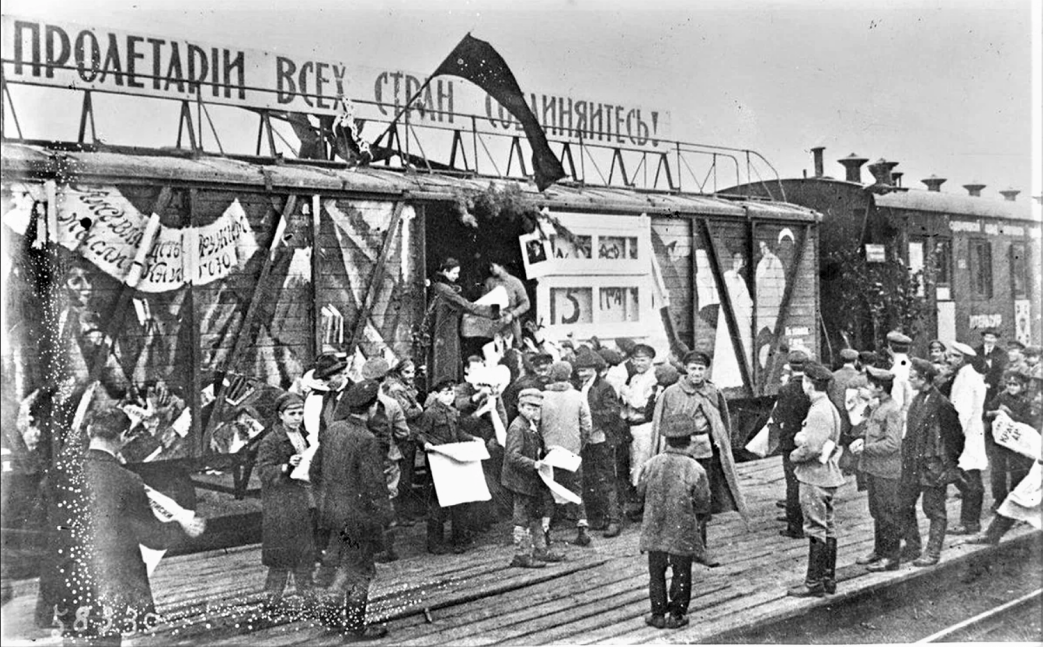
The distribution of literature is not the only form of cultural activity among the Red Army soldiers. Another form of this activity is expressed in the organization of schools, libraries, clubs, and theatres. In this direction the results achieved were also quite brilliant. By the 1st of November 3,800 schools had been established for the Red Army soldiers; there are 2,392 circulating libraries and 1,315 clubs. There is a theatre with almost every club. There are fifty-two Red Army soldiers’ theatres in Moscow alone.
The Red Army soldiers attend their schools eagerly. In the Yaroslav garrison attendance rose to 90-95 per cent of the illiterate. At times special measures are taken towards the instruction of the illiterate. Thus, for instance, at Kazan, all the illiterate of the Artillery Depot are exempted from all service for three weeks on the condition that they attend school every day.
The following is a description of the successful development of the Red Army theatre. The Cultural Department of the Red Army at Samara has at its disposal two troupes of professional actors. In the garrison hospitals, Red Army clubs, and town theatres, the following performances were given to the Red Army soldiers: In August 24 plays, 14 concerts, and 129 cinematograph shows; in September, five performances, 41 concerts, and 40 cinematograph shows ; in October, 8 plays, 54 concerts, and 60 cinematograph shows. All performances are free to the soldiers. The following are the figures of attendance: In August, 79,240 Red Army soldiers attended; in September, 76,860; in October, 76,860. The total number of spectators amounted to 291,920 soldiers. During this period besides the professional troops 35 dramatic Red Army circles were established and worked in the army; by November 1, the number of plays and concerts given by these amounted to 235.
The amateur Red Army dramatic circles very often put on the stage plays which were written by Red Army soldiers themselves. These plays are not pretentious, they cannot be said to be striking for their aesthetic qualities; their great advantage lies however in the fact that dealing as they do with vital questions and realistic problems of the day they find a ready appeal in the hearts of the workers and peasants, whom circumstances have temporarily turned into soldiers.

Cultural work is as equally intense in the rear as it is at the front. It is understood that the conditions at the front create a great number of obstacles in the normal development of this kind of activity. Where, however, the communist circles are at their height, this work with the assistance of the Red Army soldiers who are eagerly striving towards knowledge, is often successful. As an example we may give the activity of the clubs at the front. At a certain club organized in one brigade, within three weeks were given four plays, a review, and three cinematograph performances; a lecture was read by the lecturer of the political Army Department on the Origin of Man; the lecture was illustrated by slides and proved, of the greatest interest to the soldier-audience. There is a library and reading room at the club, a small string orchestra, courses for the illiterate daily filled with soldiers, who — to repeat the expression of a Red Army soldier-correspondent — seek to obtain at their temple of art not only mental rest but also knowledge.
Thus we see that in its cultural activity in the ranks of the Red Army the Soviet Government strives to satisfy the spiritual demands of the Red Army soldiers. The task of the revolutionary socialist education does not consist in raising the spirit of the Red Army when faced by the enemy; it is much broader than that. Compelled by unfortunate circumstances to take the peasant from his plough and the workman from his bench, the Soviet Government strives, at the same time, to utilize the period of the soldiers’ service in the interest of his spiritual development, and to make him a worthy citizen of the Socialist State. With the return from the front to his remote village the Red Army soldier will not only take a vital and intelligent interest in his surroundings and in political events, but will, in his turn, become the bearer of socialist education and enlightenment to the dark masses of peasantry who as yet have failed to shake off the traces of an age-old slavery.
Soviet Russia began in the summer of 1919, published by the Bureau of Information of Soviet Russia and replaced The Weekly Bulletin of the Bureau of Information of Soviet Russia. In lieu of an Embassy the Russian Soviet Government Bureau was the official voice of the Soviets in the US. Soviet Russia was published as the official organ of the RSGB until February 1922 when Soviet Russia became to the official organ of The Friends of Soviet Russia, becoming Soviet Russia Pictorial in 1923. There is no better US-published source for information on the Soviet state at this time, and includes official statements, articles by prominent Bolsheviks, data on the Soviet economy, weekly reports on the wars for survival the Soviets were engaged in, as well as efforts to in the US to lift the blockade and begin trade with the emerging Soviet Union.
PDF of full issue: https://www.marxists.org/history/usa/pubs/srp/v3n08-aug-21-1920-soviet-russia.pdf
 Revolution's Newsstand