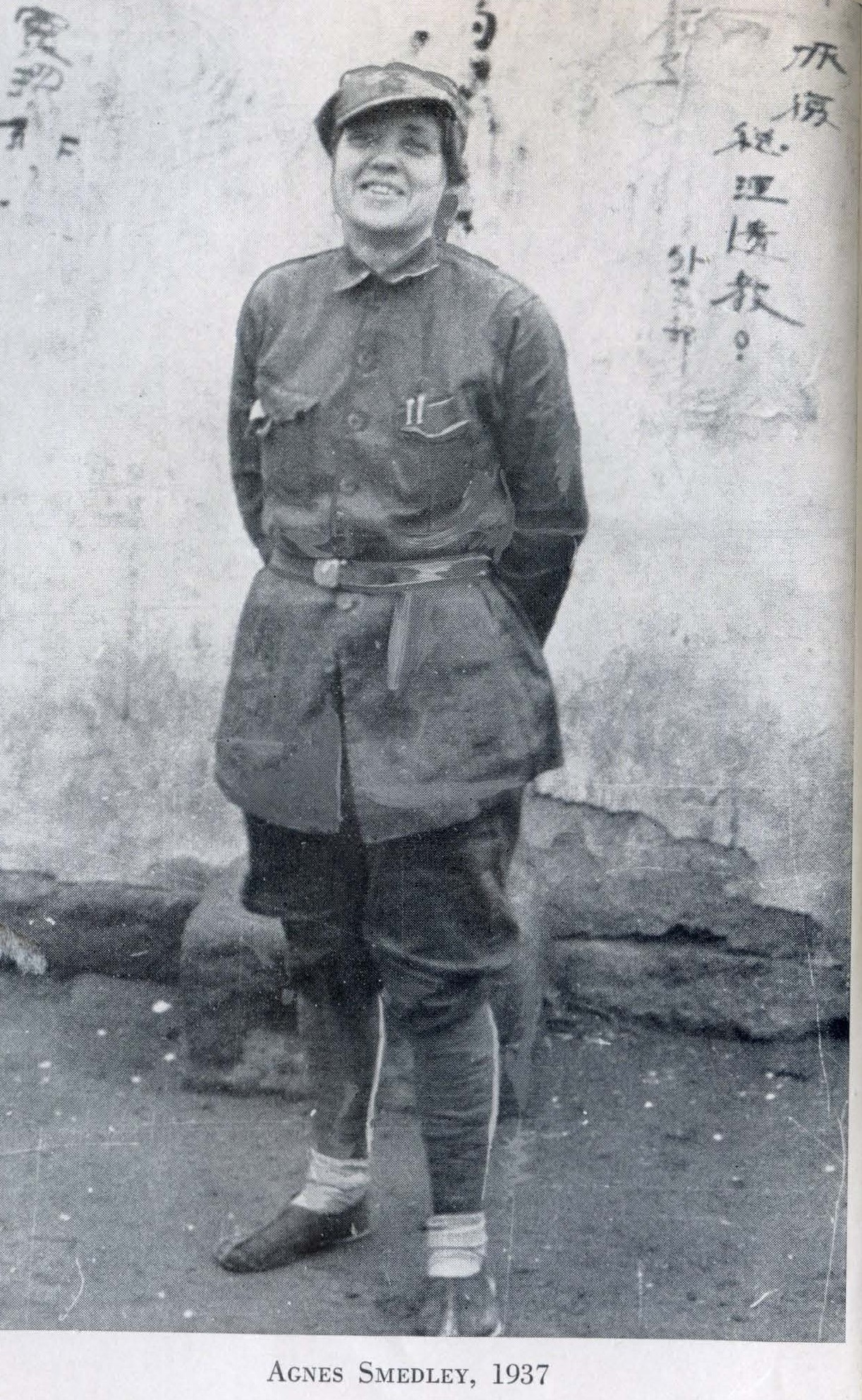
A thrilling story from Agnes Smedley of the defense of a Chinese village by Red peasants against the KMT’s White Armies in the autumn of 1934.
‘A Red Village Is Occupied’ by Agnes Smedley from the New Masses. Vol. 21 No. 12. December 15, 1936.
The Fifth White Division prepared to attack; with the Chinese Red Army absent, the peasantry acted.
THE autumn had come and the fields of ripening rice would soon be ready for the sickle. For the sickle-or for the burning torch. For this time, as in the spring and in the autumn of the year before, the war had also been fought around the crops. What the White troops failed to reap for their own food, they burned. They needed the food for two reasons: to starve the peasants into their old servitude under the landlords, and to feed themselves. The peasants would sell them no rice, and not one vegetable or one bit of fruit. All the food for the White soldiers had to be transported from the big White cities such as Nanchang. There was not enough of it to feed them. And so the order had gone out from the White stronghold that the soldiers must conquer the villages and feed themselves.
The Whites held the cities and big towns. But down in the villages the Soviets still existed and the common people ruled themselves. Some savage power had been engendered in them. This power the Whites did not understand, but they understood that until it was broken the landlords could never return, “The return of prosperity sure makes a big difference.”
White tax-collectors could never be carried in sedan chairs over the country, pawnshops could never reopen, opium could never be sold-that “civilization” could not show itself in the villages. The Whites called it “civilization.” But to the peasants the old order meant serfdom, slavery; it meant hunger, rags, the whip, anguish of body and mind.
Still the order went out from Nanchang: “Conquer the villages; build blockhouses to hold them; feed yourselves.”
It was the autumn of 1934 and the Red armies fought on all fronts in Kiangsi. The odds were heavy against them- the whole imperialist world against them. Yet they fought on. Up in the northeast of Kiangsi the Whites had occupied the town of Kweiki. They looked northward into the villages, toward the fields of ripening grain.
The Fifth White Division in Kweiki drew up its plan. It would take the market town of Chowfang to the north, build a blockhouse, and dominate the many villages that formed a sort of network around it.
The peasants of Chowfang and the villages about soon learned of the plot against them. The Tenth Red Army Corps was fighting on many fronts and could not come to their rescue. Every young, able-bodied man in the region was with the Red army. In the town and the surrounding villages remained the older men, young boys, the women and girls, and a number of crippled Red army men. All the good weapons were with the Red army also. The people were armed with hand grenades, though not enough. The peasants manufactured mines in their own homes, and with these blew up many enemy positions, or mined the roads leading into the Soviet regions. But of these also there were not enough to stop the pressure of the well-armed Whites. In Chowfang and thereabouts were a few old muzzle-loading shot guns that could knock a man out for a few days, but their chief value was in the noise they made.
The peasants of the Chowfang region gathered together, sat down, and began to think. They thought for a long time, and almost everyone had something to say. Then this is what they did.
First, they evacuated every living soul from Chowfang, leaving behind a few things to give the appearance of occupation, such as chairs, benches, rice jars, beds. In the rice jars, under the doors, connected with the benches, stools, beds, were concealed mines that would explode at a touch. When doors were opened, a mine would explode.
The streets were mined, as were the paths and the road leading to Chowfang, but these mines could be set off from a distance when some hidden person pulled a wire.
This work went on at night, while hundreds of other women, children, and old men sat whittling bamboo sticks down to sharp, needle-like spikes at both ends. They made tens of thousands of these spikes, and when they were finished they began driving them into the earth all around Chowfang, then covering them lightly with earth. In a big circle extending for hundreds of yards around Chowfang, the earth became a hidden bed of sharp bamboo spikes. If stepped upon they would drive straight through the softsoled shoes worn by all Chinese soldiers. Only the paths were free of these spikes.
Then, around the fields of spikes, the people dug trenches and covered them with weeds, branches, and leaves. They turned gravemounds into dugouts. In these would lie the men and women who would set off the mines when it was necessary; in them would be concealed the men with the old shotguns and the few hand-grenades.

This complete, the peasants poisoned the wells, left a few jars of poisoned water in the buildings, and departed from Chowfang.
They did not have more than a few hours to wait after their labor was finished. Peasants brought news from Kweiki that a column of about five hundred White soldiers had already left and was approaching Chowfang. They had sent men in advance with long bamboo poles to jab the paths wherever a soft spot was seen; they were trying to discover buried mines. The Whites, said the peasants, were not bringing much food-they were going to reap the harvests and live off the country. They also did not have much ammunition, which showed they were going to build blockhouses and hide in them. They knew the peasants had no guns and they thought they would not need much ammunition. The peasants had also learned that two rich landlords, who used to own Chowfang and the land about, were guides for the White column. Men and women took up their positions in the dugouts and trenches, and thousands of others, filled with exultant curiosity, lay concealed behind bowlders, trees, and along the hills.
When the first streaks of dawn appeared the next morning the advance guard of the Whites could be seen approaching. Then came the others. All marched with fixed bayonets, ready for attack. They were ready to take Chowfang by surprise, capture people and force them to build the first blockhouse.
Nothing disturbed them as they approached. Not a soul stirred, not a sound was heard. Chowfang seemed to be sunk in sleep. They turned down the main path and began to move more rapidly. They entered the town, leaving guards at the entrance. The watching hills, trees, and grave-mounds could see the landlords instructing the officers where to station men. All exits to the town were at last guarded. Nobody could get past such sentries. From a hill a few dozen pairs of eyes could see right down the street on which one landlord’s old palatial home was located. It had been a Soviet school. One man in a long gown, certainly the former owner, led a body of men into this house. Other houses were also being entered, soldiers using the butts of their rifles or pistols. Some soldiers kicked in the doors without ceremony.
THE HILLS and the grave-mounds stirred as Chowfang began to explode. The opened or kicked-in doors flew back and hit the kickers in the face, and old iron, glass, nails drove their way into the bodies of men. The landlord’s former home had admitted the landlord and the officers without the door exploding, but from the interior came a series of explosions. Two or three men ran out screaming in agony. Chowfang was turned into a madhouse.
The silent listeners heard the commands of officers rallying their men. Then small units moved through the streets, hurling hand grenades against the doors of the houses to break them in and explode the mines within. This done, they grew brave and entered. Then from within came the sound of explosions. The soldiers had moved a bench or a stool, a bed or a rice-jar. Wounded and dead men lay in the streets everywhere.
Not a sound came from beyond the village, but the Whites began placing machine-guns in position and from behind buildings their heads could be seen peering in all directions. Their machine-guns began to rattle to scare the people if any there be, or to draw a reply. Silence was their answer. Then, from behind the machine-guns, small units of soldiers were sent dashing from the village toward all places in which people might hide-toward bowlders, grave-mounds. They dashed with bayonets ready and with savage yells designed to strike terror to the hearts of the peasants. Their yells were soon turned into shrieks of agony, or they sank unconscious in their tracks, impaled on the bamboo spikes. There, around Chowfang, lay dozens of White soldiers. Yet their officers drove more forward, through new positions, only to learn that they were surrounded by a field of spikes.
The Whites stood in terrified little groups in the town. A street bomb went off beneath a group of them.

Some houses were cleared of bombs and in these the Whites took shelter. Others continued to smash in doors with hand grenades. All day long this continued, and all day long mines concealed in the most unexpected places exploded, wounding, killing, blowing men to pieces. The Whites brought water for the wounded, and drank to cool their own racing blood. The wounded cried for water for the last time, and the men seeking to cool their racing blood no longer needed it. Their blood was cooling of itself. But before they could get word to all the men that the water was poisoned, dozens had drunk it.
The Whites disappeared into the cleared houses and waited for the night. Nothing moved in the trenches and the grave-mounds. But the doomed men within the town knew that there were people in the neighborhood. What fiends the Reds are, they told each other. What right had these people to act like devils when all the government troops wanted was to take their crops and starve them into subjection again? Who did these people think they were, anyway, to deny the right of the old landlords to return and rule them as they saw fit, to whip them when necessary, and to loan them money at 100 percent or more interest per year if they considered them worthy and respectably inclined? The common White soldiers sat listening to the exchange of moral phrases, wishing only that they were out of it and the landlords for whom they were fighting were at the bottom of the sea. But still they squatted in the shadow of the landlords and officers about them.
When night deepened, the Whites prepared to escape from the town. The watchers could see their dark figures skulking against the houses, they heard them begin to march, heard the clink of steel, and saw their dark figures start rapidly down the main road. The listeners and watchers waited. Then a dozen mines along the road exploded with a deafening blast, the ranks of the marchers were shattered, and those in the rear turned and fled back into the town.
Some hours passed, and the Whites began digging. They were digging shallow trenches right out through the fields of buried spikes. They were going to dig their way out. They had no more than begun when the besiegers showed themselves for the first time: from the trenches and grave-mounds their old shotguns blared, making a fearful noise. They hurled a few hand-grenades. The Whites fought back with hand-grenades, but they had used most of their supply blowing in the doors.
The next day the siege continued, and the next and the next. The mines continued to explode in the town sporadically, now and then one blew up a part of the street. The besiegers knew that the Whites had food for a few days only and no water save that in their own flasks. Each night small groups of them tried to escape along the paths, but they were driven back or killed by the peasants. The besiegers provoked the Whites to fights that they might use up ammunition.
On the last night, a few White soldiers, officers, and one landlord threw away their guns, threw away everything except the clothing on their backs, and made their last desperate attempt to escape. To avoid detection, the landlord had clad himself in the uniform of a private soldier.
The Whites separated in small groups of two or three and started. But the peasants saw them creeping and running in desperation, and began exploding mines and hurling hand grenades. Of all of them, three escaped alive, and these were captured. One was an officer, one his orderly, and the other the landlord in a private’s uniform. The orderly was already half dead and the peasants let him die. But for the remaining two- they brought a rifle and some cartridges abandoned in Chowfang and, before the sun arose, shot them.
On the next day the people went into Chowfang to bring out the mines as yet unexploded. They would need them later, and many of them they began planting on the road leading to Kweiki, to greet any White reenforcements that might come that way. They buried the White dead, taking first their weapons and the little ammunition left. But the town was almost ruined and the water poisoned. The peasants thought of it as a deserted battlefield. A few people returned to occupy buildings on the outskirts, but there were few of these.
The rice turned to a golden yellow and the peasants reaped and threshed, then carried it to hidden places. A large part of it they put aside and this, with the rifles of the dead, they began carrying inland to the Tenth Red Army Corps in which their sons, brothers, and husbands fought.
No more Whites ventured into the villages around Chowfang that autumn and winter. The Nanking generals decided to wait for more foreign airplanes and more foreign pilots, and to take the villages later. They contented themselves with swift raids into Soviet regions.
In Nanchang, the stronghold of the Nanking generals and the imperialists, White propagandists sent atrocity tales out to the gaping reactionary press of China and, the world. The Red army, these tales reiterated, was hated by the peasants because it burned their homes, murdered them, destroying all they had. Wherever the Nanking armies went they were received as deliverers. But with it all the landlords wandered around Nanchang and Shanghai, wailing. The wind often caught in their silk, fur-lined gowns, and spread them out like the broken wings of a buzzard.
The New Masses was the continuation of Workers Monthly which began publishing in 1924 as a merger of the ‘Liberator’, the Trade Union Educational League magazine ‘Labor Herald’, and Friends of Soviet Russia’s monthly ‘Soviet Russia Pictorial’ as an explicitly Communist Party publication, but drawing in a wide range of contributors and sympathizers. In 1927 Workers Monthly ceased and The New Masses began. A major left cultural magazine of the late 1920s and early 1940s, the early editors of The New Masses included Hugo Gellert, John F. Sloan, Max Eastman, Mike Gold, and Joseph Freeman. Writers included William Carlos Williams, Theodore Dreiser, John Dos Passos, Upton Sinclair, Richard Wright, Ralph Ellison, Dorothy Parker, Dorothy Day, John Breecher, Langston Hughes, Eugene O’Neill, Rex Stout and Ernest Hemingway. Artists included Hugo Gellert, Stuart Davis, Boardman Robinson, Wanda Gag, William Gropper and Otto Soglow. Over time, the New Masses became narrower politically and the articles more commentary than comment. However, particularly in it first years, New Masses was the epitome of the era’s finest revolutionary cultural and artistic traditions.
PDF of full issue: https://www.marxists.org/history/usa/pubs/new-masses/1936/v21n12-dec-15-1936-NM.pdf
 Revolution's Newsstand