
A marvelous look at the internationalist atmosphere of revolutionary Moscow as Agnes Smedley makes her first trip to Russia in the Summer of 1921, where the Soviet capital was host to a number of international gatherings.
‘The Parliament of Man’ by Agnes Smedley from The Liberator. Vol. 4 No. 10. October, 1921.
MOSCOW is the center of the class-conscious world. From the four winds of the earth the revolutionaries are gathering here. Men and women of every language, of every color, of every race, are assembling for one united purpose, for the Congresses whose aims are to overthrow world capitalism and introduce international communism.
Every train that steams into Moscow carries its loads of delegates, – from across Siberia, from the Mohammedan countries to the south, from the north, from Western Europe, and from Africa and Asia and America. They come from Russia and from practically every foreign country. The All Russian Trade Union Congress ended the last week in May, and the All Russian Congress of Soviets has just closed. The International Conference of Communist Women starts on June 9th, International Youth immediately following. The Red Trade Union International starts in July, and the Seamen’s Congress on August 1. Fully three thousand delegates have already arrived, and train loads of others are on their way.
This is perhaps the most critical moment in the history of the working class, the moment when a world proletariat, more conscious than ever before throughout the ages, is starting, or in many places has already started, the uncompromising conflict which can end only in victory. The moment is all the more critical, because Japan has begun to carry out the orders of the British Empire to initiate a war against Soviet Russia from the Siberian Side, under the leadership of another Czarist general, and because the British are starting an indirect attack upon Russia and Russia’s growing influence and strength in the near and Middle East, by blockading Turkey and by using Greek forces in a war against Kemal Pasha’s army. Britain has chosen the most critical moment to attack Russia from two sides, the period before the harvesting of the crops, when a whole section of the country is starving, and when the demobilized Red Army is needed for peaceful agricultural labor. The suspicion is all the more justified that Britain signed the Anglo-Russian Trade Agreement only to work from the inside of Russia for the overthrow of the workers’ government.

Despite all these tragic forebodings, the pilgrims to the Mecca of the proletarian revolution keep arriving, one day thirty, another seventy, another three hundred. In meeting the delegates, one comes to the conclusion that the world today can be roughly divided into three revolutionary groupings, representing three stages of development. The first is the Scandinavian group, Norway leading, then Sweden and Denmark, a well-organized, highly educated, cultured working class, enjoying a high standard of living. In these countries the Communist Parties work openly, with little or no persecution. The Scandinavians, very naive and honest folk, seem to understand little of intrigue or secret work. They expect that the establishment of Soviet Republics in their countries will be comparatively easy, accompanied by little or no bloodshed, unless the Entente, led by the British Empire, starts its bloody work-of blockade and invasion.
The second grouping is the one which holds the center of the stage at the present moment,-the western European proletariat. There, an industrial, bourgeois-educated proletariat is repeatedly hurling itself against the huge, highly organized bourgeois class which mercilessly beats it back time and again. It is generally recognized that this struggle will be a long and bitter one, and that before it is ended the economic life of Europe will be laid prostrate.
Then there is the third group, the reverse of the Scandinavian picture,-that great, submerged revolutionary group to which the West, and even Russia, is comparatively blind, a group which, because of its very unpreparedness, its lack of organization, and fortunately because of its lack of bourgeois education and psychology, presents the most staggering possible revolutionary problem in the world. This is Asia, and particularly India, a country similar to Russia in economic conditions and social and political outlook. Revolutionary clouds are thickening over India, India which indeed has nothing on earth to lose but its chains,-and is therefore prepared for revolution. A master hand-but the hand of an Indian only-can guide that revolution, and out of the chaos which will ensue, anything may be born, even the sublime. In Sweden and the other Scandinavian countries, it is the masses that are conscious and educated; in India it would take a thousand years to achieve that result under the present system. Therefore, today India needs a few trained leaders, educated in the most idealistic and advanced ideas of the times, men of impeccable character, men who have purged themselves of all personal ambitions, men of trained intellect. The writer of these lines is convinced that these men exist, a few in India, a number outside of India in exile.
Taken all in all, the delegates gathering here in Moscow are undoubtedly among the most intelligent, the most conscious, and the most clear thinking of their respective groups at home. Many from Asia are “intelligentsia,” who must necessarily be the forerunners in the movement. Those from Europe range from the ordinary worker to the holders of degrees in the leading European universities. Norway has reached the period when she can send a college professor and a street car conductor as delegates.
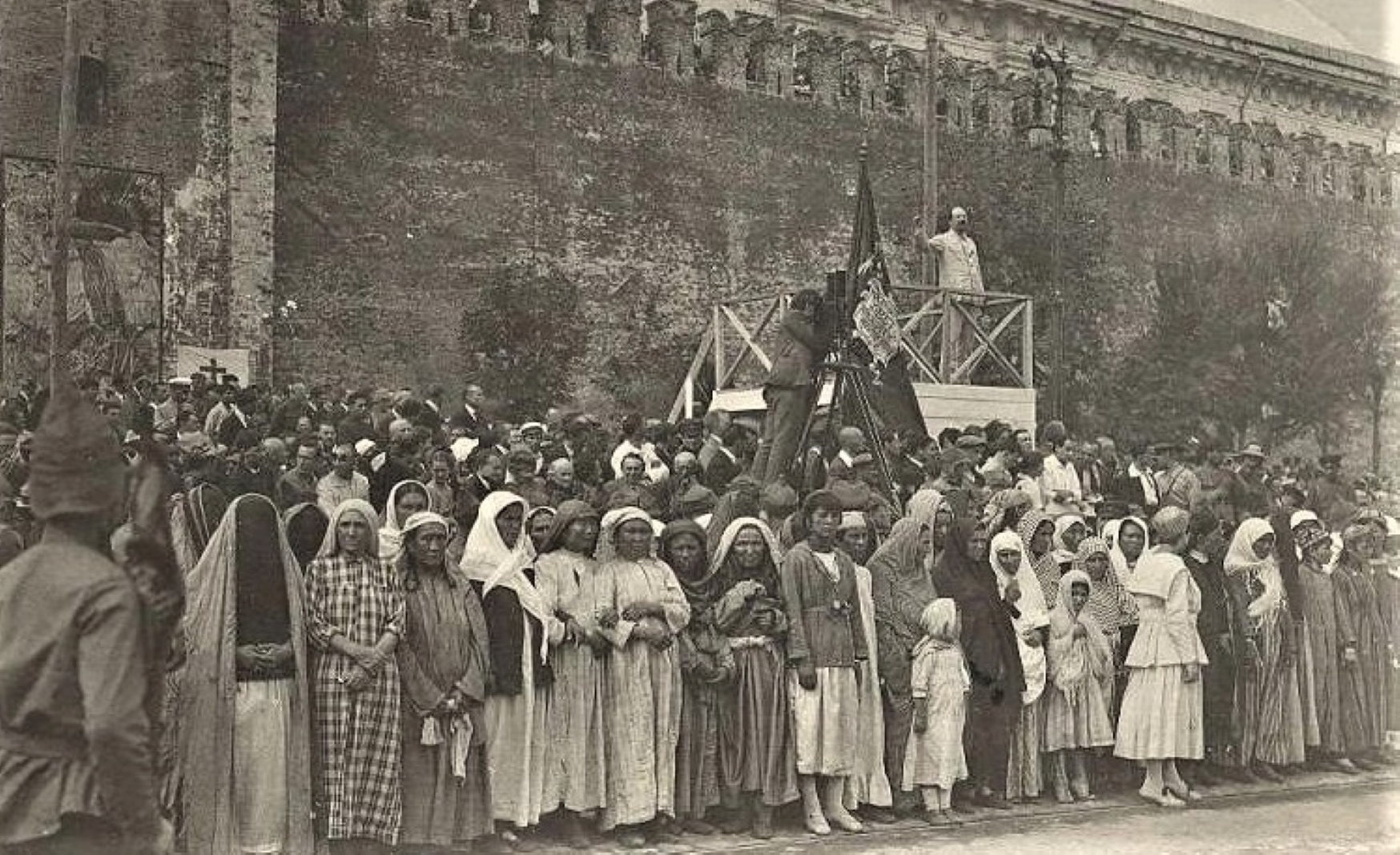
The Chinese and the other delegates from the Far East have been coming in, in small batches, some robed in their long gowns, dressed in their peasant costumes much resembling the Russian, or the more educated, dressed in modern European clothes and speaking English and Russian. In five huge Mongolians-four men and one woman -who came in today, one sees the descendants of these ancient hosts who built the Chinese wall. The quick, enthusiastic Japanese delegates, speaking English and German, are very anxious to show that they intend to help in every way the Korean nationalists and communists. The Koreans watch and wait.
The Turkish delegates have come, although eighteen of their leading workers were recently stoned to death and then sunk in the Black Sea. They are thin, dark, unsmiling men, replying with unanswerable logic to those who question their sincerity and tactics, One of them recently defended his position in these words:
“We have declared that we shall support with all our might the struggle of the nations against world imperialism…By undertaking this ‘task and carrying it out, we acted in absolute conformity with our communist convictions, for surely we need not mind if among those who were fighting imperialism, which must perish that we should live, there were men who do not profess to be communists…Our comrades should understand at least that in a country like Turkey which for centuries knew Europe only from its worst side, as the land of those who exploited and betrayed Turkey, the masses have an insurmountable prejudice against all persons and things that come from abroad and that consequently the noblest ideas, the ideas which correspond most with the interests of the masses, can only be spread by individuals which belong to the people and share with the latter its hardships and sufferings, and that only an organization which has deep roots in the country itself will be in a state to carry out with success the work of social transformation and to join Europe and the East on the basis of labor and liberty.”
A number of Persian delegates have come, gentle, sincere men, who meet upon their ‘arrival the news that the British have again occupied their country. Their viewpoint is much the same as that of the Turks. To them, communist tactics must be different in the countries subjected to imperialistic nations, from the tactics in the independent western countries.
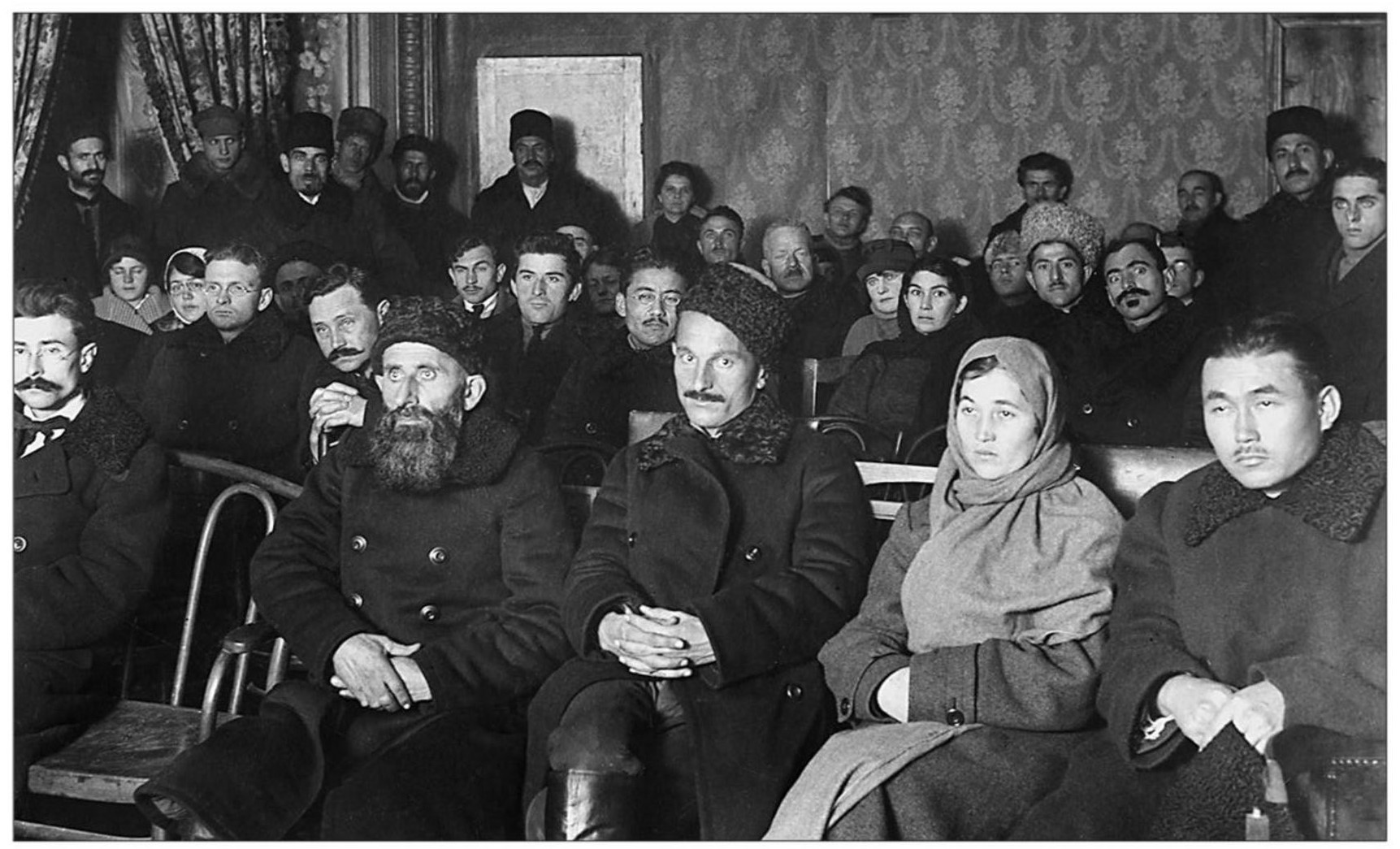
Delegates from the Soviet Republics of the Ukraine, Bokhara, Khiva, Georgia, Azerbaijan and Armenia are here. Four of the Armenian delegates are dark young women, who without shoes or stockings, and with nothing but old skirts and sweaters on their bodies, have come to Moscow after five months of ceaseless labor in the far districts of their own country. One of the representatives from Azerbaijan is a beautiful young Mohammedan woman, her head draped in a thin purple shawl. She speaks in Turkish, emphasizing her statements with a slender forefinger instead of the closed fist, as she tells of the subjection of her sex under the old regime, and of the present movement among them which has led to the discarding of the veil.
One of the Georgian delegates is an old bearded man, one a Cossack in fur headdress and decorated garments. His precious knife is carved and decorated, his shirt cut across by a cartridge belt containing long, business-like bullets.
The representatives of the Kirghiz, the Bashkirs, the Tartars and the Turcomans are here,-men and women of Mongolian,. feature and Russian dress. One wears bright red trousers and a gold embroidered skull cap. One wears a huge fur turban and carries a gun and a knife on his hip.
Then there are some twenty Indian revolutionaries from Western Europe and from the Indian frontier. They are unsmiling men, a few of them young men, a number who have been exiles and revolutionaries for from five to twenty years. They watch with keenness the tendency to place all faith in western Europe. At the same time they watch the British preparations against Soviet Russia, and they recall that the condition upon which the British Government would sign the Anglo-Russian Trade Agreement was that all help should be withdrawn from them. This, they know, means that India is the most important center of the British Empire.
There are two Indian groups. One is the small Communist group, the other the larger Indian revolutionary group. The latter, in matters of policy, take their stand squarely with the Persians and the Turks, the former with the British Communists. The Indian revolutionaries emphatically distrust all Englishmen, imperialists or communists. The English proletariat, they state, vis a vis of India, is in the same position as the English bourgeoisie. The British delegates state that neither they individually nor their party will work with any Indian group unless it is composed of simon-pure Communists. The Indian revolutionaries come back with the charge that in that respect the British Communist policy has the same effect as the policy of the British Government, since such an attitude means that the British communists are absolved from doing any work in India. For which the Indians declare that they are very glad, since the position is clear, and all Englishmen are untrustworthy in a crisis. As one Indian tersely stated when the British delegates called a “British Colonial Conference,” “Years ago the British imperialists managed India; then when this became too hot for them, the British liberals took charge of the situation. When the British liberals were discredited, the British Labor Party undertook to manage the Indian revolution and keep it within bounds; now that the British Labor Party is losing its grip, the British Communist Party thinks it can manage us!”
One is convinced here that Asia has been hardly touched by Communist propaganda emanating from Russia. Nevertheless, Asia is largely communistic in thought, social customs and philosophy. As one of the Indians said, “The Russian folk music is exactly like our own; these singing women might be Indian women singing as they grind their corn. Their language is strangely familiar and near. I can often understand entire sentences, and the language is filled with words identical with our own. My study of languages has given me a strongly developed linguistic Aryan consciousness, and I often feel here that I am living through the history of my race.”

The delegates from western Europe are here in great numbers. The two German Communist parties are represented by about one hundred delegates, all fresh from the fields of actual proletarian warfare. The Communist Labor Party of Germany refuses to adopt parliamentary tactics, or to enter the trade unions, while the United Communist Party accept these measures for propaganda.
Practically the entire Finnish Red Government of some time past has come. To some of us uneducated ones from America it is news that they belong to the same race and linguistic group as the Esthonians, Hungarians and the Turks, – the Uzro-Altaic language group. There is undoubtedly close relationship between the economic conditions and the temperament which created a red Finnish Government and a red Hungarian Government.
Thirty huge, blonde Swedish men and women delegates have arrived, representing a party of 45,000 out of a total population of five millions. The Norwegians, huge, handsome “blonde beasts” Like the Swedes, confidently state that Norway is the next Soviet Republic in order. They have an organized disciplined party of 97,000, out of a total population of three millions. Before the split caused by the 21 Demands, their party numbered 130,000. In many respects, they appear here to be the elite of the world’s working class.
The Icelanders,-a pure Aryan type, descendants of the original Vikings, are here, representing six thousand peasant Iceland Communists, out of a total island population of one hundred thousand. They tell us in passing that. The bourgeoisie of their independent little island now harbors imperialist designs against the Greenlanders, most of whom are Eskimo!
All the Western European and American delegates have not yet arrived. The French are here, true revolutionaries. An Algerian expert on the colonial question has accompanied them. A few Poles have crept in, despite the terror against their party in Poland. Delegates from the Baltic States are here. An Albanian in picturesque pantaloons and an expansive bent, has put in an appearance. The Red Hungarian Government is, of course, here, including Bela Kun. The Bulgarian delegates, as one other delegate stated, “look like majestic, bearded Barcelona anarchists,” but instead they are the most uncompromising Marxists, who are said to hold the key to the entire Balkan situation. Austria has sent among others a splendid girl from Vienna, and Spain is represented by a flashing Spanish girl and two blonde men. Italy is well represented, and Seratti is said to be coming with his unitarian communism; the prospects are that the Italian situation will be discussed with tropical heat. It remains to be seen how Clara Zetkin, whose age seems not to have dimmed her revolutionary fire, will stand on the Seratti question.
Canadians and Australians and South Africans have come. An Irishman is here, occasionally overhearing phrases from the English delegates which he calls the “unconscious imperialism of the Englishman.” Recently, when some films were taken of delegates, it was proposed that Great Britain and Ireland should pose together. The English delegates responded, but the Irishmen-two Communists and one Sinn Feiner, -withdrew and sat together beneath a cannon which was conveniently near.

True to their national speed, many Americans were the first on the scene. Some are a little over-fed! After addressing a Russian peasant audience on conditions of the working class in America, one of them was confronted by a little Russian boy, who said, “I don’t believe things are so bad in America, otherwise you would not be so fat.” Another American, -a thin I.W.W.-remarked, “Bill, hereafter you must not speak; the social revolution is more important than your stomach.”
The Americans come from the east, the middle west and the far west, as is shown by their accent and phrasedlogy. Some of them are political refugees, one a half American Indian, who has crept into the country with nothing but the clothes on his back,-seeking refuge from the land of the free!
Of course, the inevitable spies are here. One wonders how many British and American spies have come as delegates,. and how many Japanese agents there are among the Koreans and Chinese. Or how many of the Americans, the Japanese, or the Koreans themselves are British spies.
Most of the delegates are making their initial trip to Russia. The Red Flag of the Soviet Republic waves triumphantly on the frontier, and there are many dimmed eyes among the most sophisticated when the courier trains, carrying the delegates, roll slowly across the border. At such a moment, there is generally the spontaneous singing of The International in a dozen different tongues.
Passing under the Red Flag, a new life begins. The Red Soldier becomes a reality. Everywhere the emblems of Soviet Russia, the sickle and the hammer, or the Soviet Star, are seen on caps of soldiers, on the hats of men and women everywhere. Here is the beginning of racial and political internationalism. The inhumanity of the industrial West ends, and the slowness and patience which have made, and are winning a revolution, begins.
Here the American delegate who says,
“Say, this is great! But what you need here is scientific management of industry, what you need is efficiency, what you need is a thousand lumberjacks from the northwest, what-” is met with the reply,
“Yes, we know that. But what you need is a revolution.”
The Liberator was published monthly from 1918, first established by Max Eastman and his sister Crystal Eastman continuing The Masses, was shut down by the US Government during World War One. Like The Masses, The Liberator contained some of the best radical journalism of its, or any, day. It combined political coverage with the arts, culture, and a commitment to revolutionary politics. Increasingly, The Liberator oriented to the Communist movement and by late 1922 was a de facto publication of the Party. In 1924, The Liberator merged with Labor Herald and Soviet Russia Pictorial into Workers Monthly. An essential magazine of the US left.
PDF of full issue: https://www.marxists.org/history/usa/culture/pubs/liberator/1921/10/v04n10-w43-oct-1921-liberator-hr.pdf
 Revolution's Newsstand