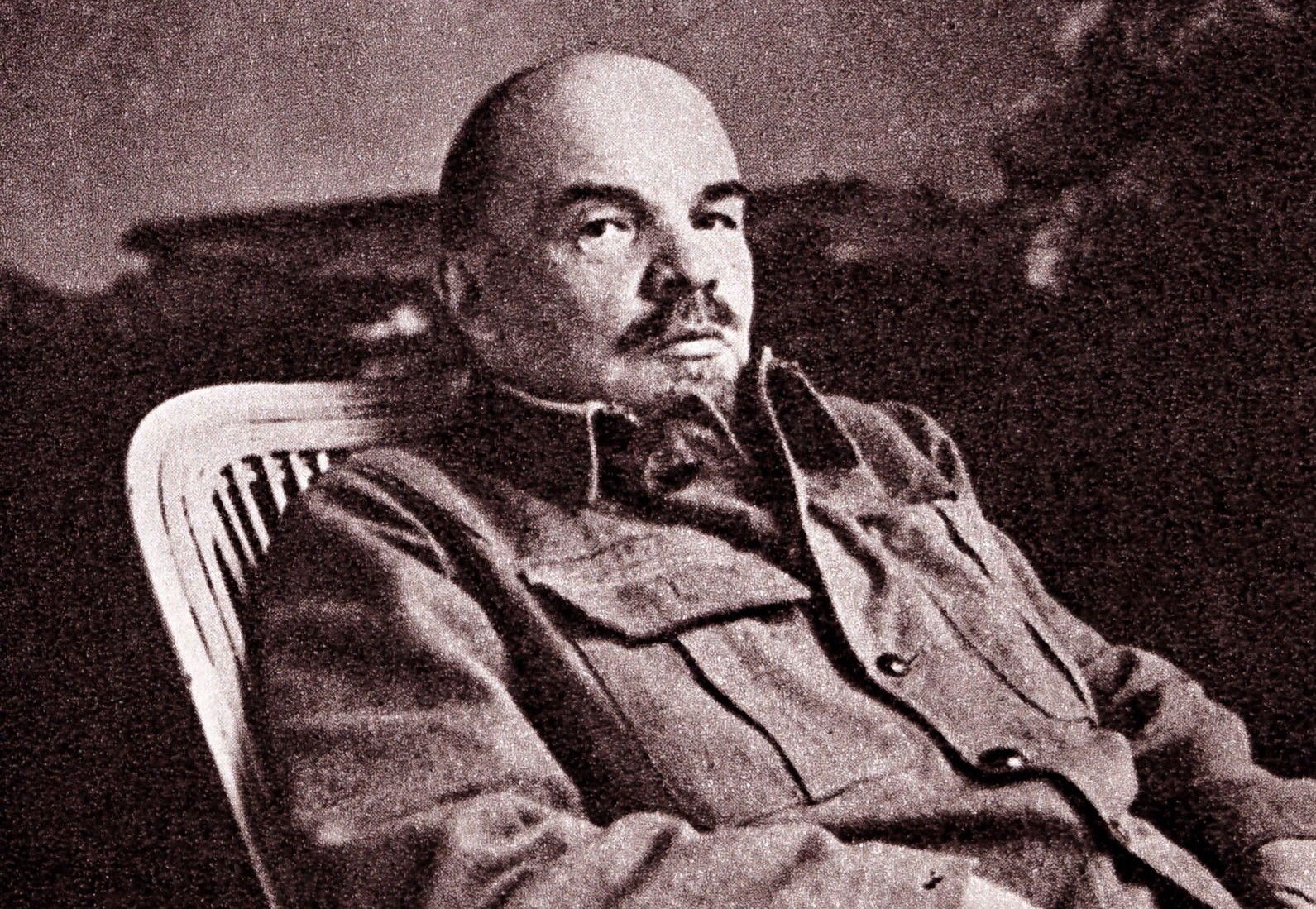
The original translation of the final document written by Lenin before his last incapacitation, and published in English within weeks. First printed in Pravda on March 4, 1923 this document is here titled ‘How Do We Hold On’ and constitutes the last statement of Lenin’s recommendations to the Twelfth Party Congress, widely known as ‘Better Fewer, But Better.’ Short and profound, Lenin surveys the situation the Soviets found themselves in with the end of the Civil War and the New Economic Policy, and argues that the present task to do the utmost to retain workers’ power, to reduce state bureaucracy, and place those resources into industrialization, until the next wave of revolution, this time in the East, brought aid to the beleaguered country. While its differences with the later translation are largely semantic, there are several key passages that read quite differently.
‘How Do We Hold On’ by N. Lenin from International Press Correspondence. Vol. 3 No. 31. April 4, 1923.
The general character of our present situation may be described as follows: we have destroyed capitalist industry, we have exerted every endeavour to entirely destroy that institution of the middle ages; large landownership, we have replaced this institution by small and very small holdings, thereby creating a peasantry which now follows the proletariat, trusting in the results of its revolutionary work. It will, however, not be easy for us to retain the faith of the peasantry until socialist revolution has won the victory in the most progressive countries, particularly under the new economic policy – and this was an economic necessity – the proceeds of work are still very small in Russia.
And in this respect Russia is also backwards in international relations: the proceeds gained by are on the whole considerably less than before the war. The capitalist powers of Western Europe have done their utmost, in part consciously, to take advantage of the civil war and throw us back economically. They derived great advantage from the issue of imperialist war: if we cannot destroy the revolutionary order in Russia, at least we can retard its development to Socialism. This they thought and it was inevitable they should think so. All they have accomplished is a half solution to their problem. They could not overthrow the order created by the revolution, but they did prevented us from taking that step forwards which would have justified the predictions of the socialists, which would have given us the opportunity of developing production with the greatest rapidity, and of awakening into life all the forces capable of co-operating in the constitution of socialism- in a word they prevented us from giving actual proof of the gigantic forces latent in Socialism, and of its ability to raise humanity to a new stage of evolution, rich in unlimited possibilities.
In Europe international relations have assumed such a form that one state, Germany, is enslaved by several victor countries. Several states, and among them the oldest of the occident, have been placed by the war in a position enabling them to make some concessions to the exploited classes, whereby the revolutionary movement is pacified for the time being, and a certain appearance of social peace maintained. At the same time various countries of the orient, as India, China, etc., have been completely thrown out of their old orbits by the imperialist war; their development has taken a decided turn towards capitalism of the European kind, and the same fermentation as we have in Europe has begun. It is perfectly evident that these lands have entered a stage of development bound to lead to a crisis of world capitalism.
Thus we are faced by the following question at the present time: will we be in a position – considering the state of our agricultural production, and considering our poverty – to maintain ourselves until the capitalist states of Western Europe are ripe for socialism? They are not developing as we had hoped, for their evolution is not determined merely by the growth of socialism within the states themselves, but also by the exploitation of the most important vanquished state in the great war; to this must be added the exploitation of the orient. On the other hand, it is precisely due to the first imperialist war, that the orient has been drawn into the revolutionary movement.
What tactics should we pursue in this situation? Obviously the following: we must do our utmost to hold our workers’ power, and to maintain the small and very small holding peasantry under its authority guidance. The whole world is now entering upon a period of preparation for the social revolution, and this is the one point in our favor, but we are put at a disadvantage by another circumstance – that the imperialists have been clever enough to divide the world into two hostile camps, a division further enhanced by the difficulties thrown in the way of the recovery of Germany, a country possessing a really advanced capitalist culture. All the capitalist powers of the West are plundering Germany. While on the other side there is the orient with its hundred of millions of exploited human beings living in such conditions of abject misery that their physical and material forces bear no comparison with the physical, material and military forces of any single West European state.
Can avoid future collisions with these imperialist states? Have we any hope that the internal contradictions, conflicts of the imperialist states of the occident among themselves and with the developing imperialist states of the orient, will again grant us such a breathing space as we gained when the campaigns of European counter-revolution in favor of Russian counter-revolution became entangled in the contradictions between the counter-revolutionary exploiters of the East and of the West, of American and Japan?
I seems to me that this question can only be answered by the consideration of the great number of factors upon which its decision is dependent. The issue of the struggle can only be predicted from the following general consideration – that the great majority of the population of the earth is being prepared for and driven into the struggle by capitalism itself. The issue of the struggle depends now mainly on the fact that Russia, India, China, and other oppressed countries constitute the great majority of the earth’s population. In the course of the past year the majority of humanity has entered with extraordinary determination into the struggle for its emancipation. There is now shadow of a doubt as to the final result of this world struggle; regarded in this light, the final victory of socialism is secured absolutely and beyond all doubt.
But at the present juncture our main interest is not the final victory of socialism. What is more important for us at the moment is to know what tactics we are to employ, we, the Communist Party of Russia, we, the Soviet power, in order to avoid annihilation at the hands of the counter-revolutionary states of Western Europe, in order to secure our existence until the future collision between the counter-revolution Imperialism of the occident and the nationalist and revolutionary orient. Between the civilized states of the West and the states of the East, which, though backward in a way, comprise the majority of the earth’s population.
In the meantime, this majority of humanity must endeavour to become civilized. We ourselves to do possess enough civilization for the direct transition to Socialism, although in our case the political prerequisites are here. This conclusion shows us the line of tactics we are to follow, the policy we must pursue for our maintenance: we must endeavour to create a state where the workers hold the reins of government and possess the confidence to the peasant masses, and at the same time we must exercise the greatest possible economy in all public institutions. Our state apparatus must be reduced to the minimum prescribed by necessity; we must banish every residue bequeathed to it by Czarist Russia and capitalist bureaucracy. Do we thereby run the danger of bringing about the rule of peasant retrogression? No. So long as we of the working class retain the leadership of the peasant masses, we shall be able to use the results of our strict economy to develop heavy industry, for the electrification of water power, and for the completion of electric plants already under construction, as in Volchva, etc. Herein lies are sole hope of being able, speaking figuratively, to replace the miserable rustic vehicle of a ruined agrarian country by the electric road (?) to industry – the aim of the proletariat.
Hence, in my opinion we must devote our main attention to our labor inspection, and to ensure that our state apparatus is free from all superfluous elements. If we succeed in abolishing everything which is not absolutely necessary, we are certain of being able to hold our position as a country of small agricultural undertakings, as a land of agrarian backwardness, but as a country striding irresistibly forward – towards large industry.
International Press Correspondence, widely known as”Inprecor” was published by the Executive Committee of the Communist International (ECCI) regularly in German and English, occasionally in many other languages, beginning in 1921 and lasting in English until 1938. Inprecor’s role was to supply translated articles to the English-speaking press of the International from the Comintern’s different sections, as well as news and statements from the ECCI. Many ‘Daily Worker’ and ‘Communist’ articles originated in Inprecor, and it also published articles by American comrades for use in other countries. It was published at least weekly, and often thrice weekly. The ECCI also published the magazine ‘Communist International’ edited by Zinoviev and Karl Radek from 1919 until 1926 monthly in German, French, Russian, and English. Unlike, Inprecor, CI contained long-form articles by the leading figures of the International as well as proceedings, statements, and notices of the Comintern. No complete run of Communist International is available in English. Both were largely published outside of Soviet territory, with Communist International printed in London, to facilitate distribution and both were major contributors to the Communist press in the U.S. Communist International and Inprecor are an invaluable English-language source on the history of the Communist International and its sections.
PDF of full issue: https://www.marxists.org/history/international/comintern/inprecor/1923/v03n31%5B13%5D-apr-05-Inprecor-loc.pdf
 Revolution's Newsstand