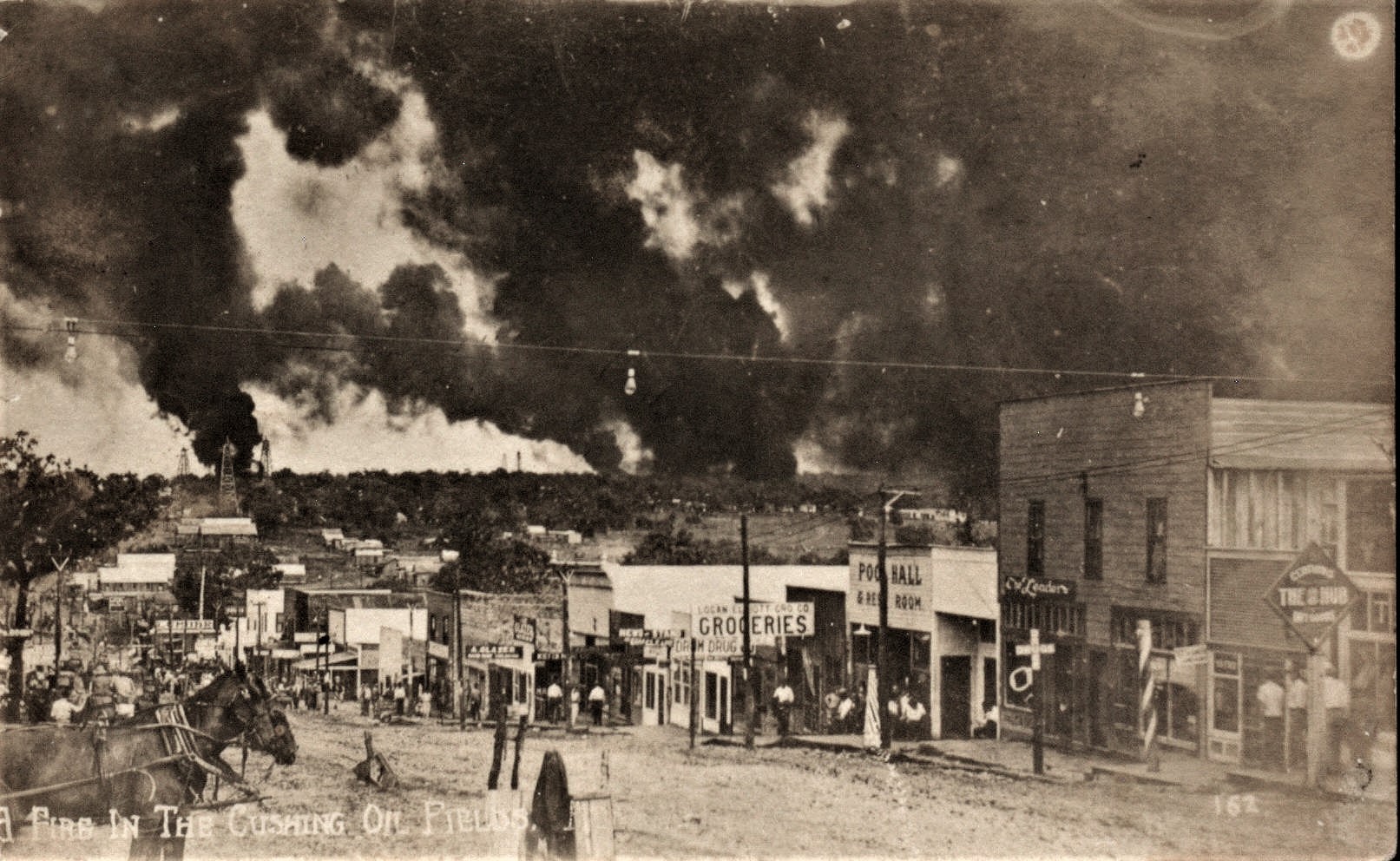
Fellow worker A.W. Rockwell of Industrial Oil Workers Local 586 urges footloose rebels to make their way to Oklahoma to organize the booming oil fields of the I.W.W. in 1914.
‘Organizing the Oklahoma Oil Fields’ by A.W. Rockwell from Voice of the People (New Orleans). Vol. 3 No. 23. June 4, 1914.
Drumright, Oka., May 26, 1914.
In the center of the largest oil field in the United States is located Industrial Oil Workers Local 586 of the I.W.W., and out upon the street corner every. Wednesday, Saturday and Sunday nights appear their orators to try and drill into the heads of the oil workers the benefit to be derived from an industrial organization.
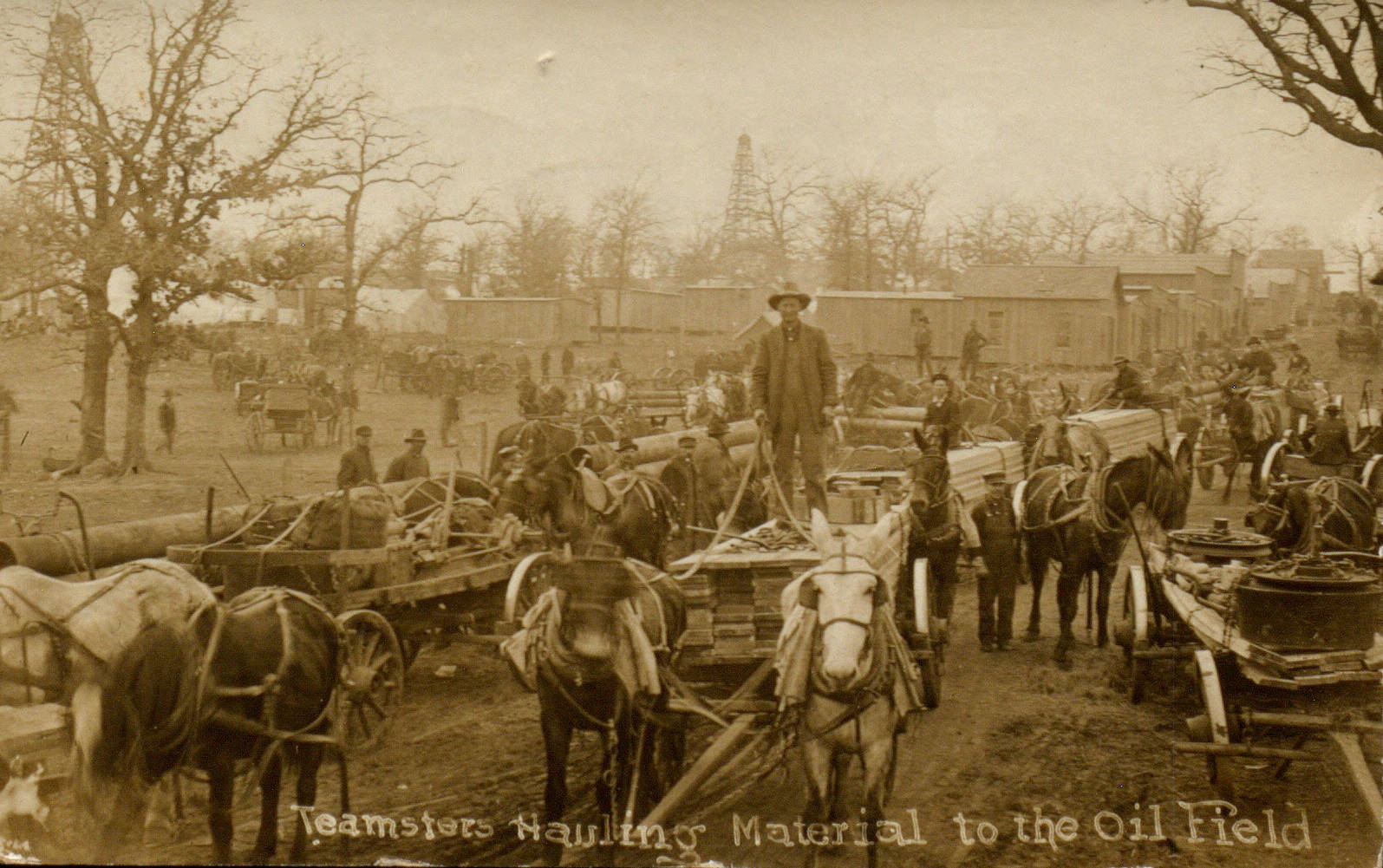
Conditions here are bad and from one end of the oil field to the other there is a cry of oppression; everywhere there is a spirit of discontent manifested among the workers. The wages are small Teamsters, of which there are more than one thousand, receive for a ten-mile trip from Cushon, Okla. to Drumright, $60 a month. Board is $5.25 a week. Hours of work from 14 to 18 hours a days Bull gang laborers $2.50 a day for eight hours work; board and room in town $1.00 a day, in the camps $5.25 a week Teamsters in the grading camps $2.25 to $2.50 per dayof 10 hours, with board $5.00 to $7.00 per week. Some pipe line gangs receive $2.50 a day, but most of the work is $3.00, and it seems the custom of each gang to outstrip any other gang in the field. It is a case of drill, drill, drill, with a big flannel-mouth boss looking for evermore down the slaves’ neck and speeding him up to his very limit.
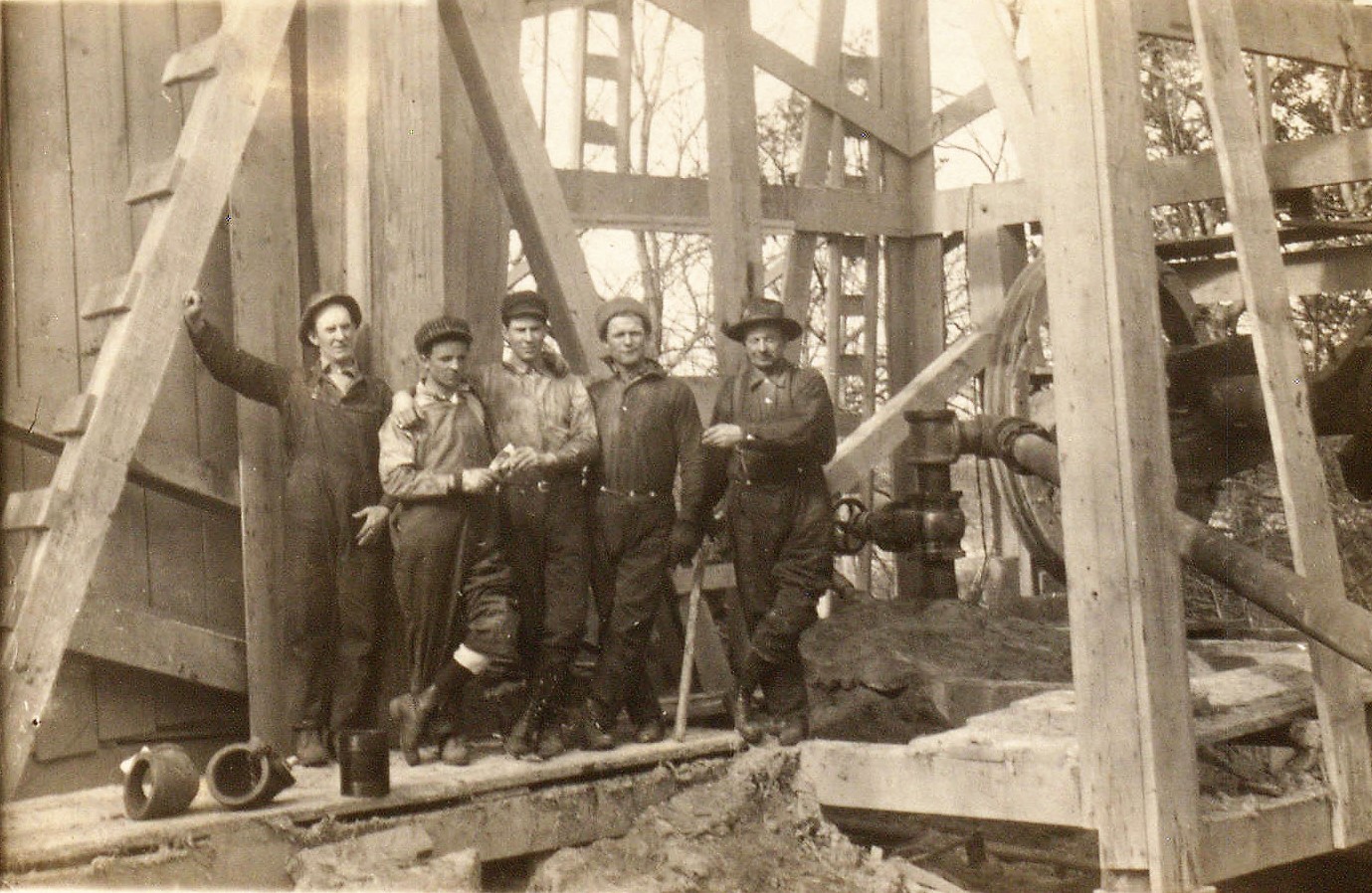
Local 586 is telling the slaves that a shorter work day means better pay and that labor is entitled to all it produces and we have fairly good success and have hopes of making this a banner Local, but what we need here is good soap boxers and job agitators. This is a big field and every lease is virtually a town. So come on, you Rebels, and help make this the second Goldfield. Here is the chance for the ONE BIG UNION. Here is the chance to even up the score labor owes to your Uncle John D. Don’t let the opportunity pass. Let every foot-loose Rebel respond to the call. Get here, get on the job. There is work to be done and the Rebels here will see that the boys will be placed where they can do the most good.
Saturday while Rockwell was speaking a policeman came up said that as the candidate for Governor was going to speak on the next corner he was requested to ask the I.W.W. to give way. Rockwell told the crowd: You have just seen the Bull stopping me; well, he says, that there is a guy who is looking for a job as Governor of this State, so go and hear him, and tomorrow night F.H. Little will answer him. The following night Little spoke to a big crowd.
There is also being circulated by the capitalist press of this State, backed up by Charles L. Daugherty, an A. F. of L. labor skinner, now State labor commissioner, an appeal for harvest hands. Now, I want to tell the workers through The Voice that IT IS A FAKE OF THE WORST KIND. The notice is sent out to flood the State and get wages down. There are enough idle men here in this State right now to harvest a crop ten times the size of this year’s crop. The men are up here starving while that well-fed lickspittle Daugherty is calling for more, while up in Kansas they are nabbing “tramps” for use in wheat harvest.
Think of it, you working men, being called “tramps” and arrested and put on the rock pile until harvest time, then turned over to a sizzorsbill to be exploited in the harvest field. Get next to yourself, and let the cry be: “Three dollars, 8 hours, or no wheat cut!” Stop off in Drumright, get a red book, and be a MAN. Do something. Don’t let George do it all. Now is the time. This is the place.
A.W. ROCKWVELL, Secretary
The Voice of the People continued The Lumberjack. The Lumberjack began in January 1913 as the weekly voice of the Brotherhood of Timber Workers strike in Merryville, Louisiana. Published by the Southern District of the National Industrial Union of Forest and Lumber Workers, affiliated with the Industrial Workers of the World, the weekly paper was edited by Covington Hall of the Socialist Party in New Orleans. In July, 1913 the name was changed to Voice of the People and the printing home briefly moved to Portland, Oregon. It ran until late 1914.
PDF of full issue: https://www.marxists.org/history/usa/pubs/lumberjack/140604-voiceofthepeople-v3n23w074.pdf
 Revolution's Newsstand