
William D. Haywood remembers 1919’s so-called Centralia Massacre in which I.W.W. members heroically defended their hall against American Legion Black Hundreds resulting in the deaths of fives of the thugs, and the subsequent lynching of I.W.W. activist, and fellow veteran, Wesley Everest, as well as long jail terms for his comrades and innocent bystanders.
‘The Centralia Tragedy’ by William D. Haywood from Labor Defender. Vol. 4 No. 3. March, 1929.
WE WERE now to learn some facts about the war. Woodrow Wilson, who was then President, said: “This is an industrial and commercial war.” He might have added that the stake won by the United States in this war was $30,000,000,000.
The press and the politicians were telling the people that it was a “war to make the world safe for democracy”. It was a war that made a $6,000,000,000 debtor nation into a $20,000,000,000 creditor nation. It was a “war to end war”, but the Wall Street birds of prey had hatched out a big flock of war millionaires, who are preparing for another war.
The Armistice did not settle the war in the United States.
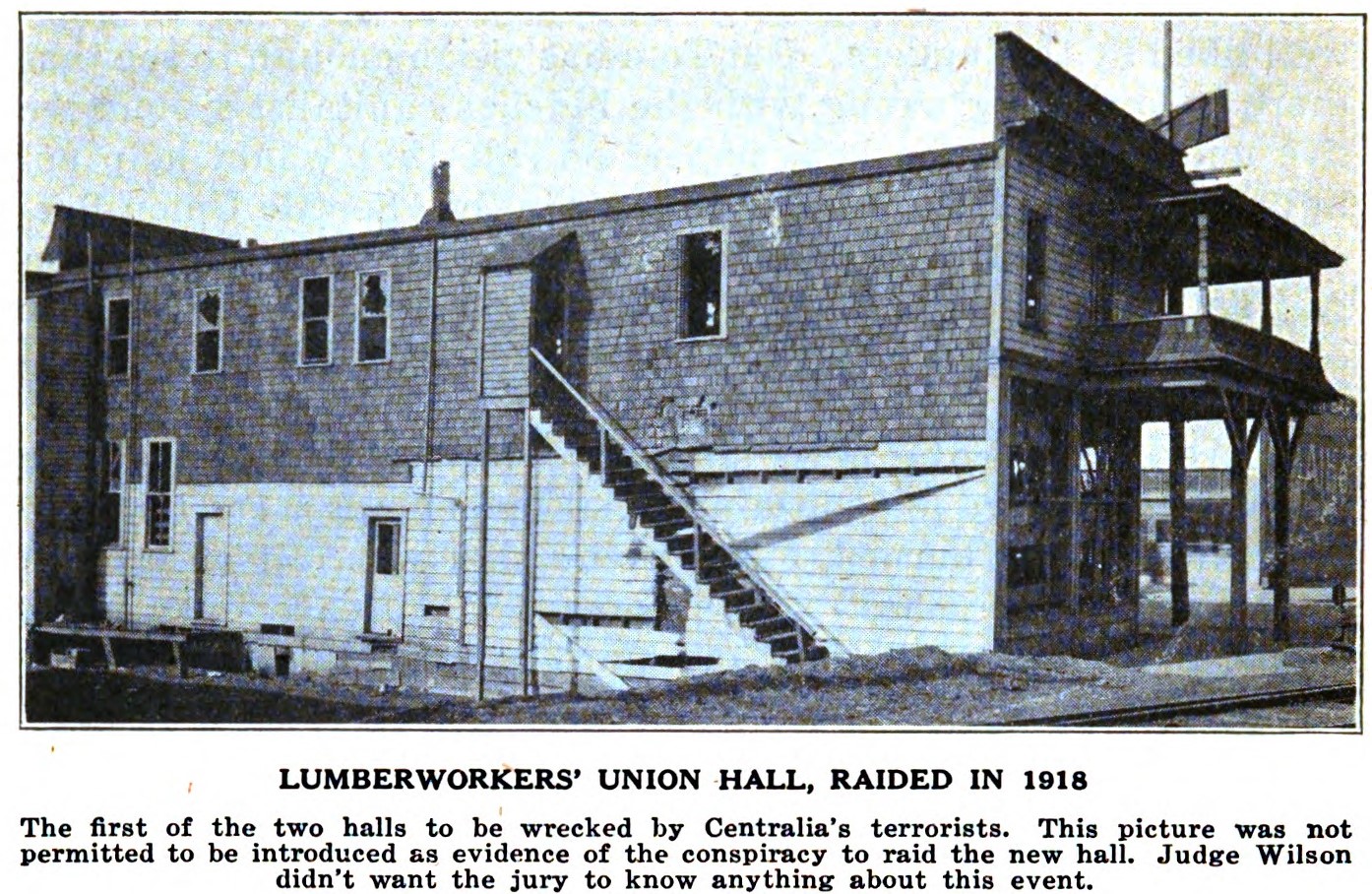
This knowledge was violently hammered into the I.W.W. by the tragedy at Centralia, Washington, on Armistice Day. November 11th, 1919 ….
The Lumber Workers’ Industrial Union had not been crushed. It was growing stronger. The Employers’ Association of Washington likewise redoubled its efforts, and continued a bitter campaign against the organization.
Among the men in the Centralia union was Wesley Everest, an overseas veteran of remarkable courage, who was said to have won more medals for valor in France than Sergeant York. He had returned to the work he was interested in as a lumber worker, organizing and educating his fellow workmen.

On November 11th, 1919, a parade of American Legion men and assorted patriots was held. At a meeting to “deal with the I.W.W.” a secret plot was concocted among the Lumber Trust leaders to mob the I.W.W. Hall, leading the paraders into the attack.
At the moment agreed upon, the leaders cried out upon signal from a man on horseback, “Let’s go-o-o ! At’em, boys!” and the door of the hall was smashed in, some entering, when a rain of bullets came from within, halting the attack and leaving two attackers dead and several wounded. Some of the mob carried ropes, evidently ready to lynch the union men. One fellow who died said before he cashed out, “It served me right”. That was Warren Grimm.
But the hall was surrounded and the attackers gained entrance in force, seizing the few workers there, with the exception of one man, Wesley Everest. Leaving the hall by the rear door he broke through the mob and made for the river, rifle bullets of his prepared assassins ripping around him. With little ammunition, he stopped to reload, reached the river and tried to ford it. Failing because of its depth, he came back to shore and shouted his readiness to surrender to any constituted authority.
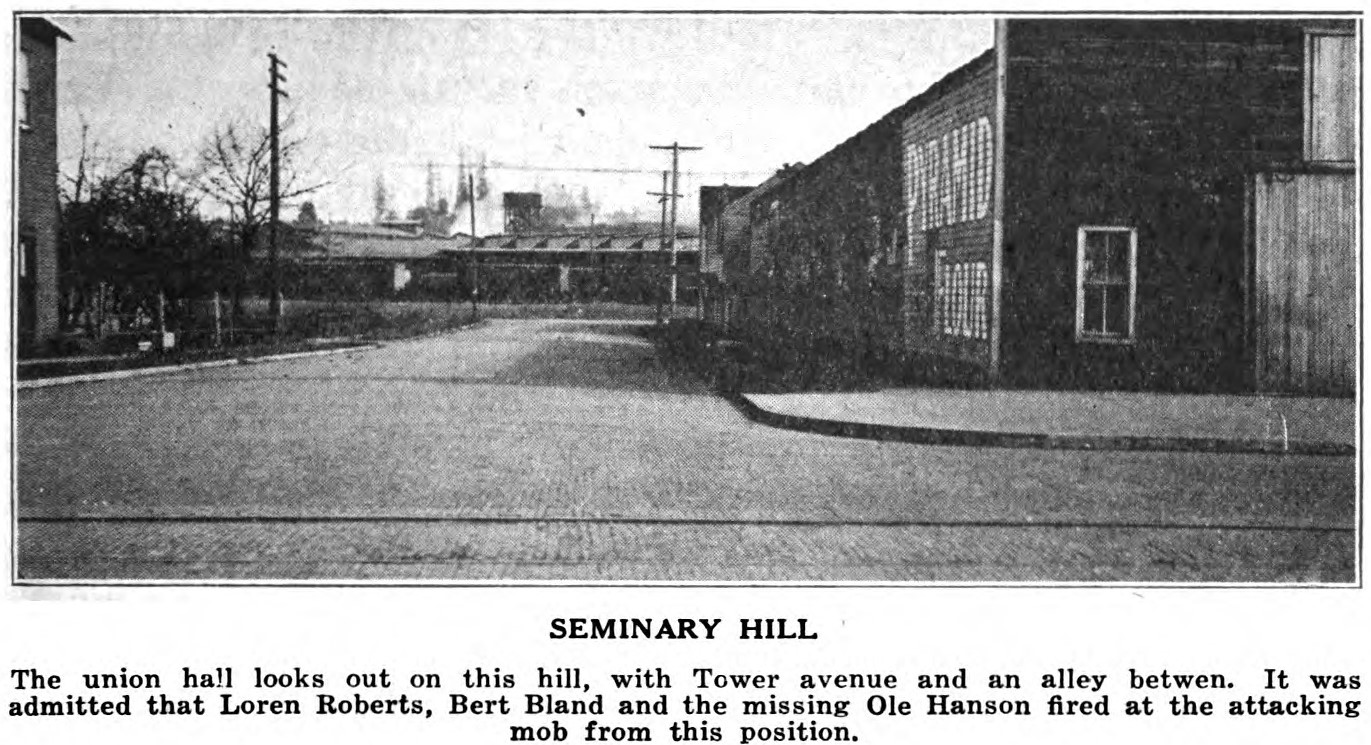
The mob paid no attention and came on, firing as they came, until Everest saw there was no hope of ceasing the fight and resumed firing. This halted the mob but one man came on, armed and firing. With his last cartridge Everest shot this fellow, Dale Hubbard, nephew of the chief conspirator. Everest was seized by the mob.
On the way to jail he was beaten, kicked and cursed. With a rifle-butt his front teeth were knocked out. A rope was thrown around his neck, but with characteristic defiance he told them, “You haven’t got the guts to lynch a man in the daytime”.
Night came. Maimed and bleeding in a cell next to his fellow workers, lay Everest. At a late hour the lights of the city suddenly were extinguished. The jail door was smashed. No one tried to stop the lynchers. Staggering erect, Everest said to the other prisoners; “Tell the boys I died for my class.”

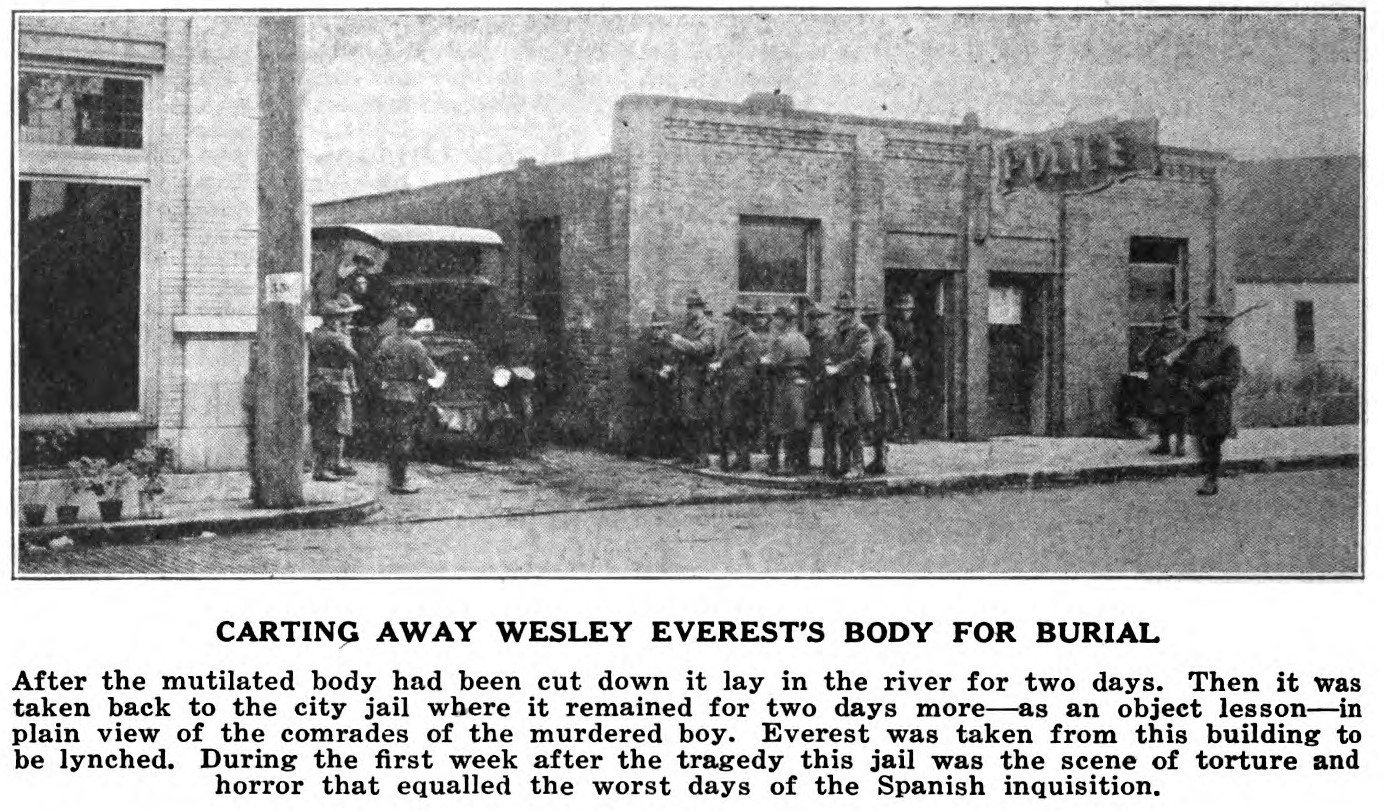
A brief struggle. Many blows. A sound of dragging. The purring of high-powered cars. Again the lights came on. The autos reached the bridge over the Chehalis River. A rope was tied to the steel frame-work and Everest, with a noose around his neck, was brutally kicked from the bridge. After a pause he was hauled up, and it being found that he had some life left, a longer rope was used and the brutal process repeated. Again hauled up, the ghouls again flung the body over. An auto headlight was trained on the body, disclosing that some sadist, more degenerate than the rest, had ripped Everest’s sexual organs almost loose from his body with some sharp instrument during the auto trip to the bridge. Finally, after riddling the body with bullets, it was cut loose and let fall in the river, later to be found, a sodden ghastly thing, taken back to the jail where it was placed in view of Everest’s friends in the prison and at last buried in an unmarked grave.
Four union loggers were taken out of jail to do the work of burial under a heavy guard of soldiers. Some kind of a farcical inquest was held.
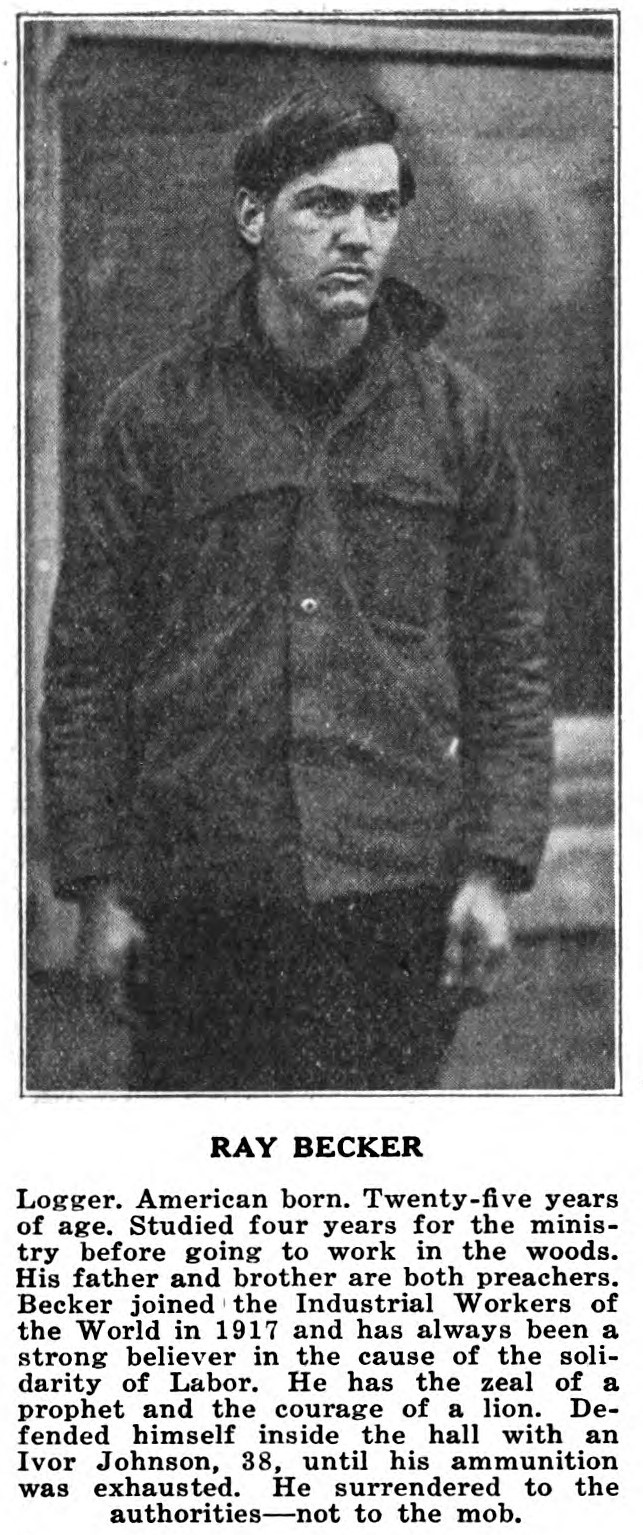
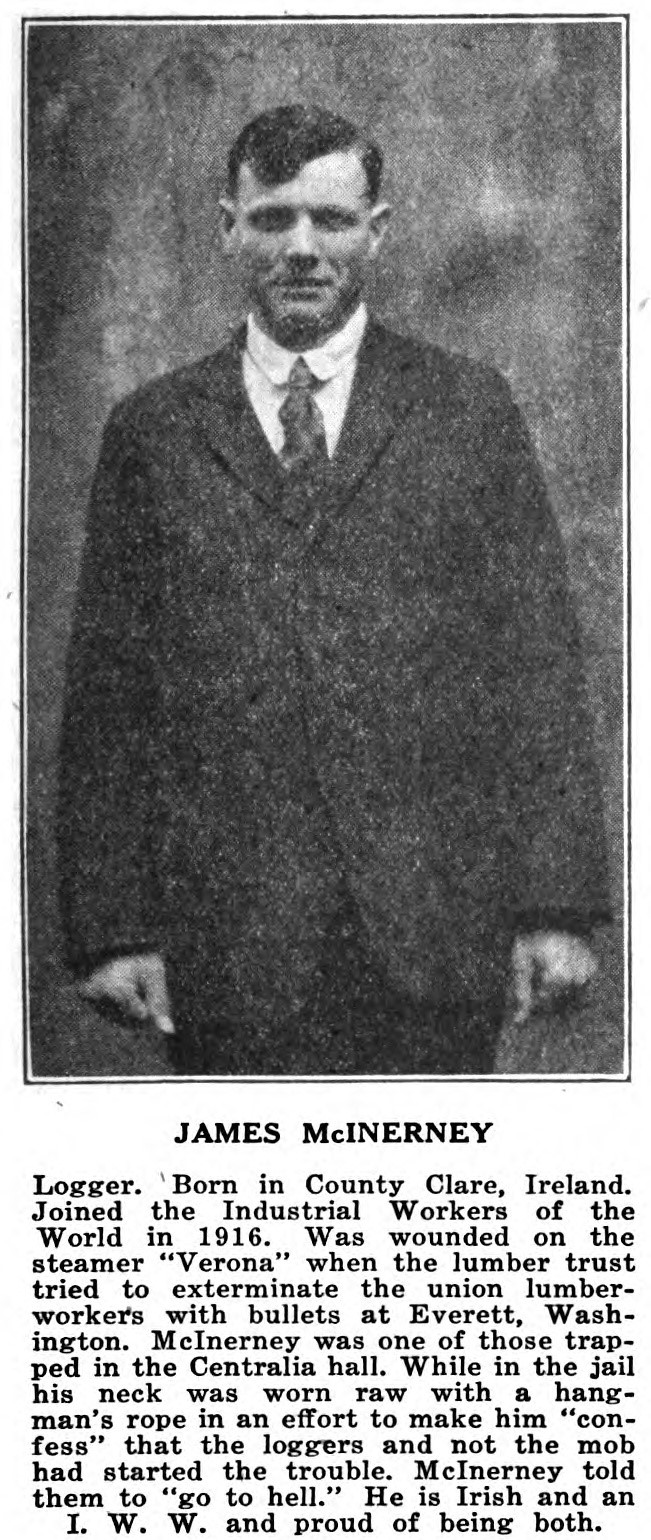
In the hall that day, besides Everest, were Bert Faulkner, Roy Becker, Britt Smith, Mike Sheehan, James Mcinerney and Morgan. The latter broke down under the torture all were put through. The terror continued for nine days. Loren Roberts, 19 years old, was driven insane.
A reign of terror existed throughout the Northwest. More than a thousand men and women were arrested in the State of Washington alone. Union halls were closed labor papers suppressed, and many men were given sentences of from one to fourteen years for having in their possession copies of papers that contained the truth about the Centralia tragedy…
Lewis County and the Lumber and Employers’ Associations had provided special prosecutors for this trial. There was a heavy array of these mouthpieces of capitalism and they were backed up by all the authority of the State. The Governor had sent the militia to the town of Montesano where the trial was held, and the Congressman had sent word that the members of the American Legion who were employed as deputy sheriffs, could wear their uniforms in the court room with a red chevron to designate past service in the army. Against this force which the timber wolves had employed, George F. Vanderveer stood alone. He was a lawyer with a heart, as dangerous as a workingman with brains.



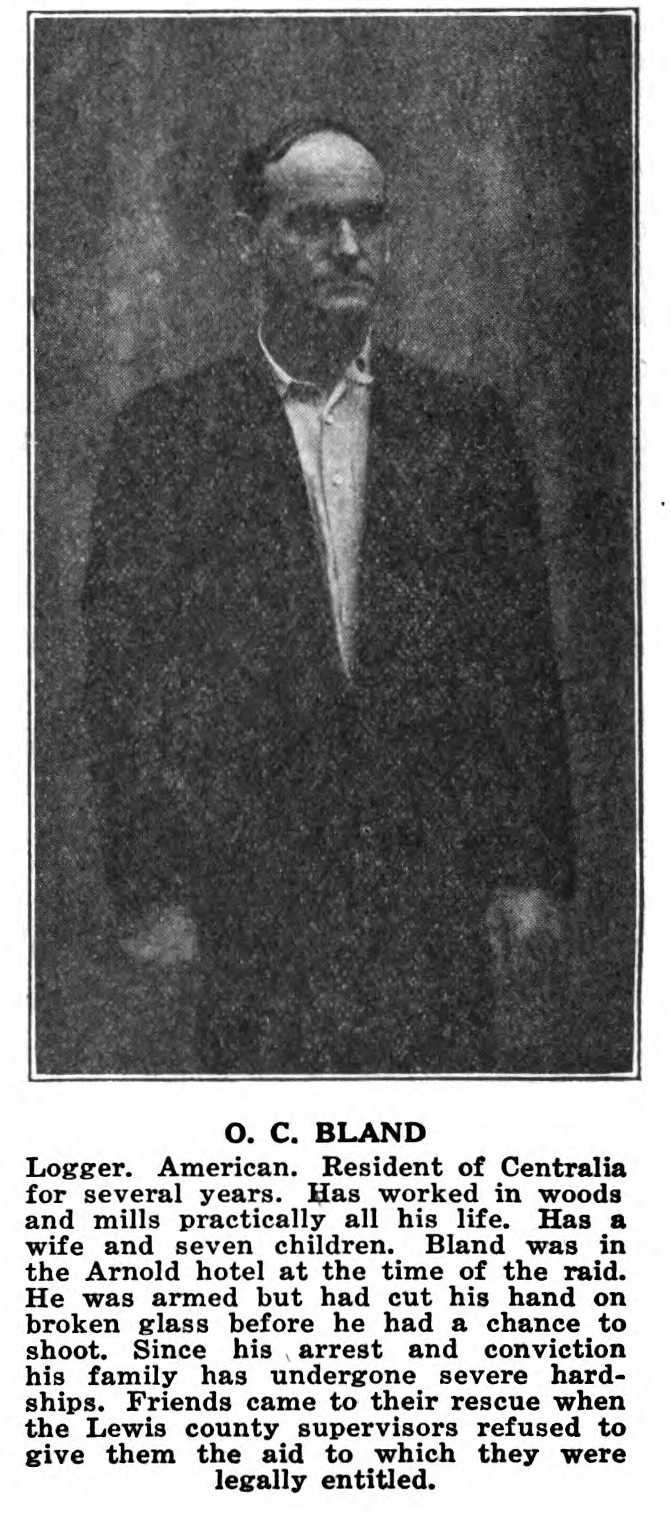
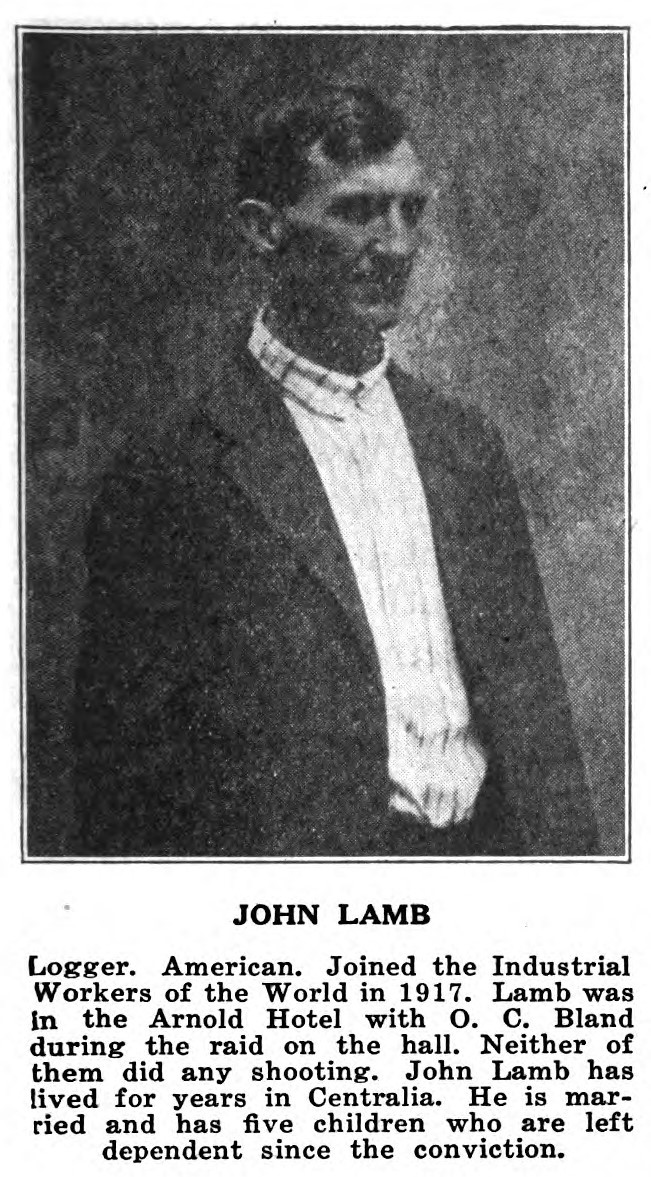

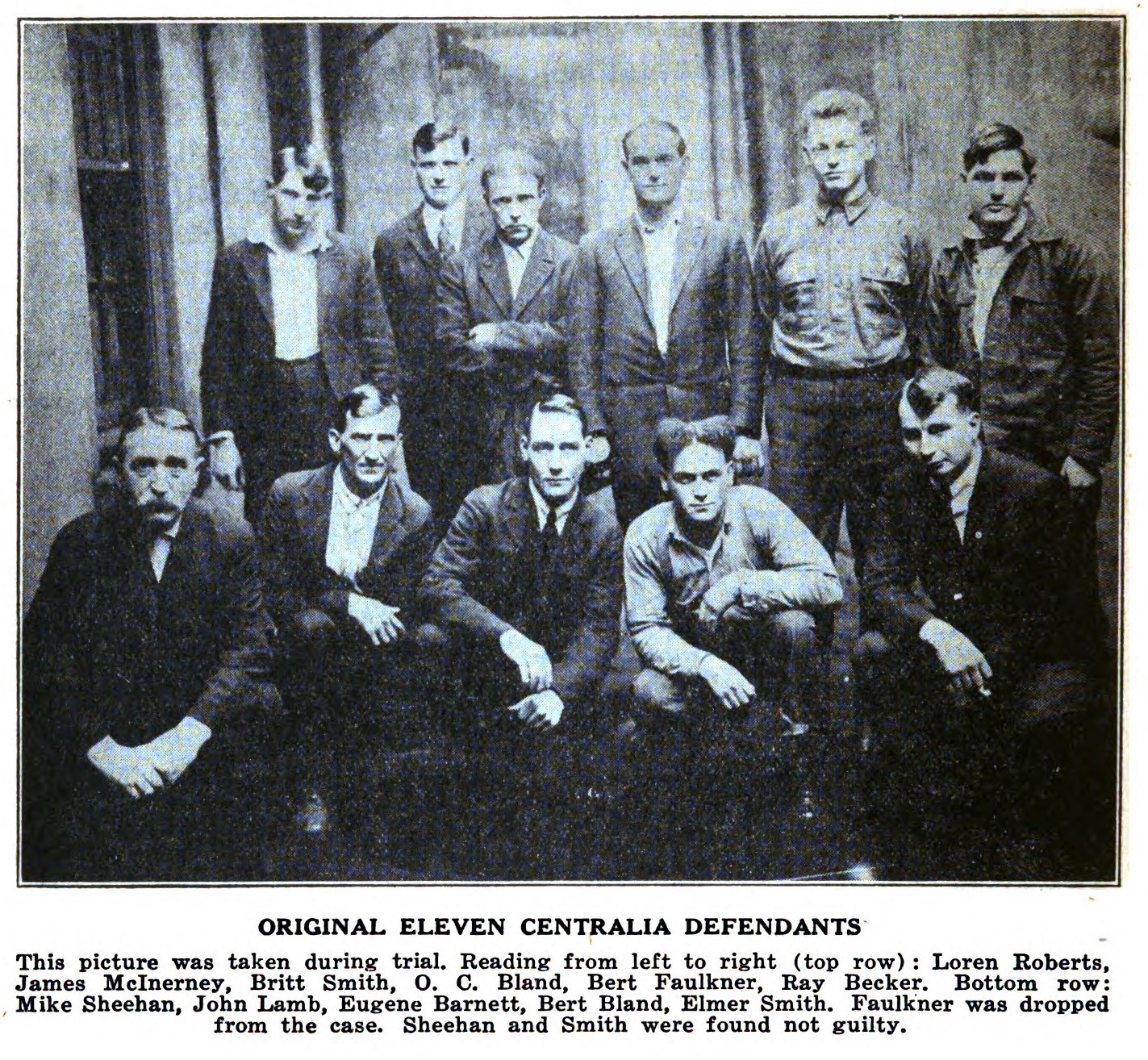
With everything against them, witnesses intimidated, the court room packed with soldiers in uniform and every possible thing done, even to threaten the defense attorneys with death, and jurymen overawed, the verdict was a foregone conclusion.
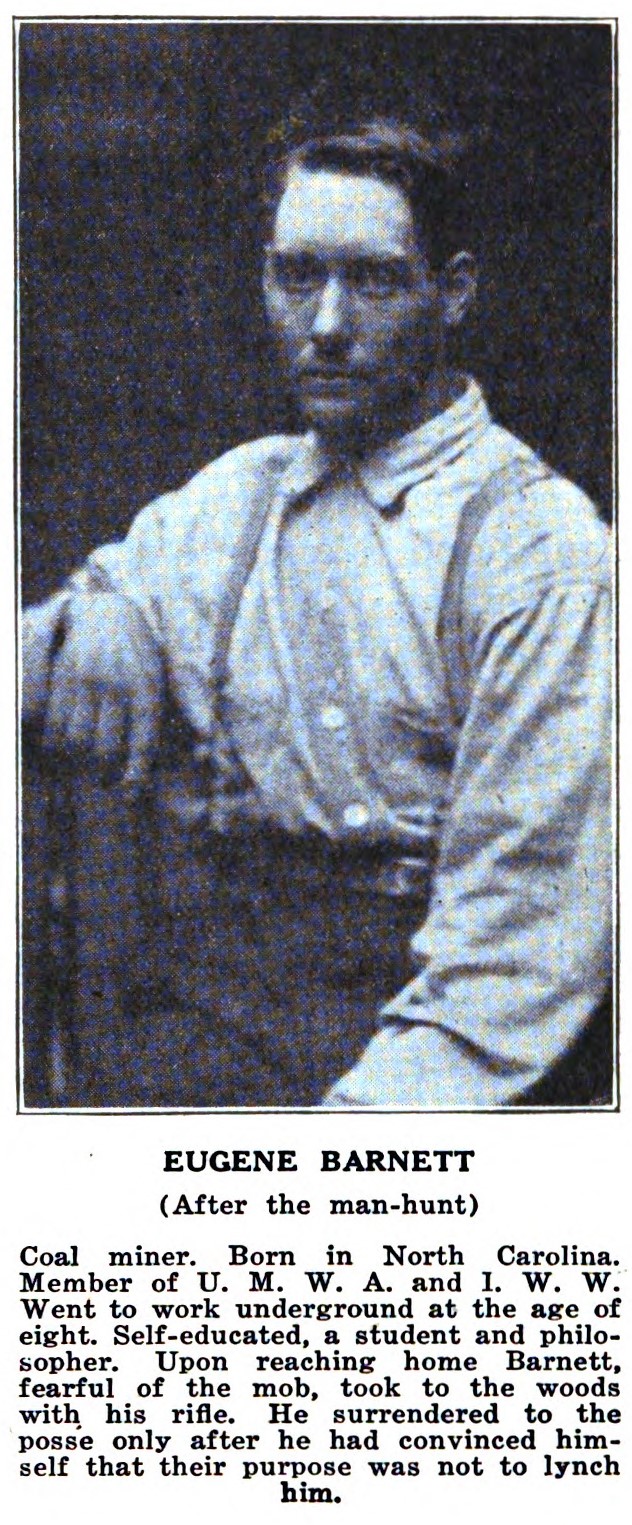
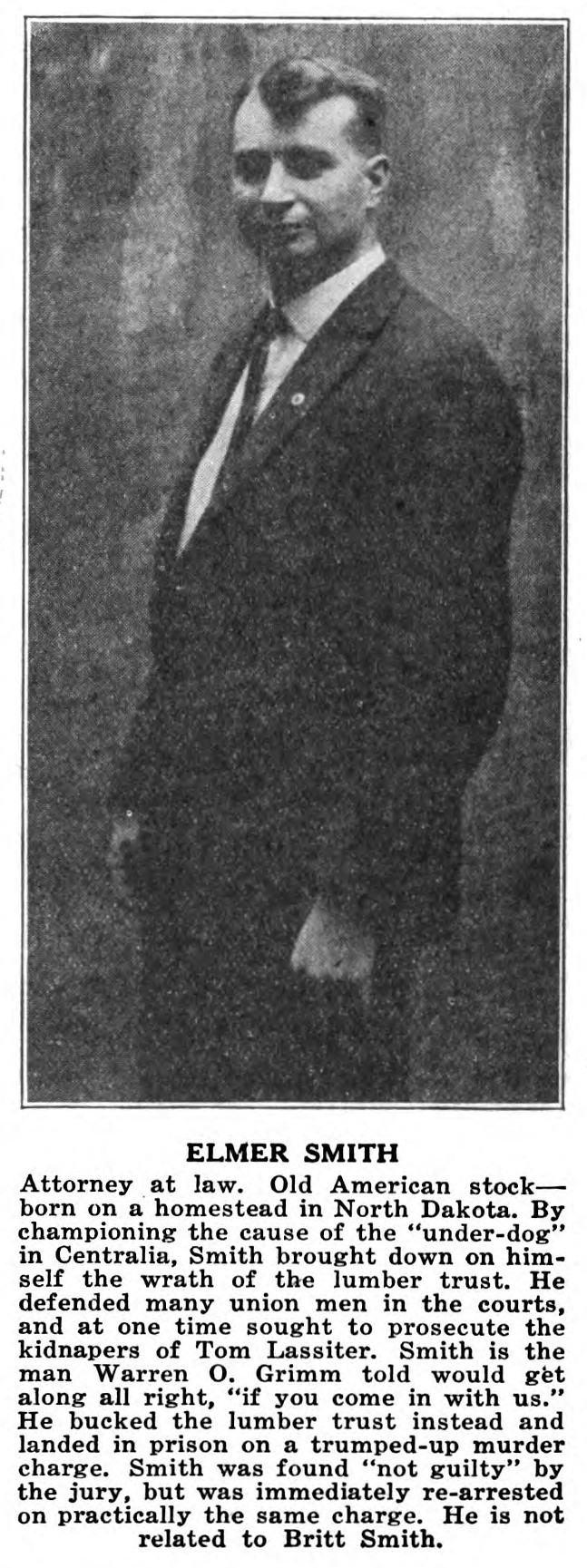
The jury was out a total of 22 hours and 20 minutes. In their verdict, Eugene Barnett and John Lamb were found guilty of manslaughter, or murder in the third degree. The Judge refused to accept this verdict, and sent the jury back to change it, and the final verdict was “guilty of murder in the second degree-Eugene Barnett, John Lamb, Britt Smith, Bert Bland, Commodore Blank, Roy Becker and John McInerney. Acquitted: Mike Sheehan and Elmer Stewart Smith”.
They judged Loren Roberts insane and irresponsible.
Bert Faulkner was released during the trial.
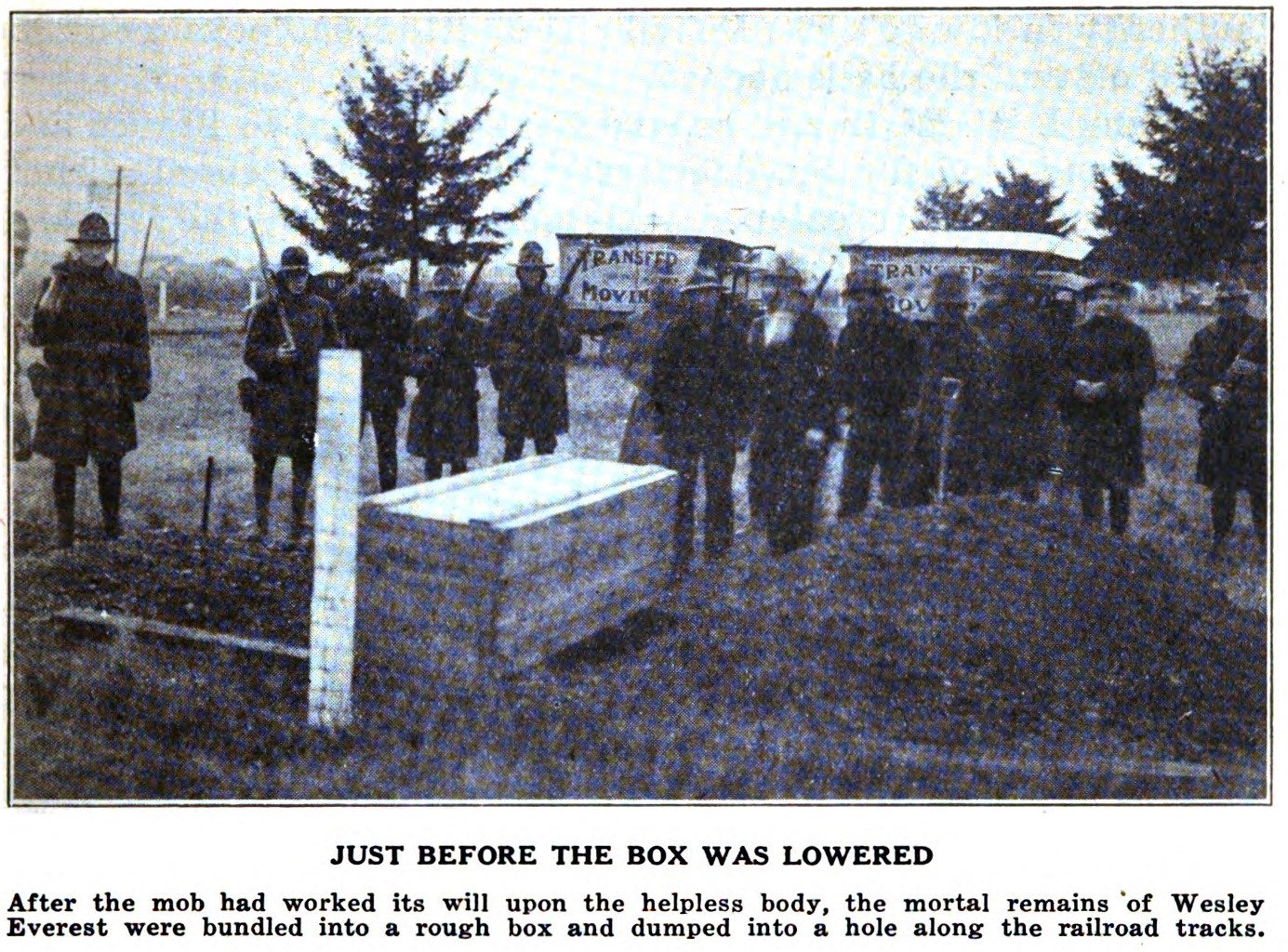
Judge John M. Wilson sentenced the seven convicted men to terms of from 25 to 40 years in the Walla Walla penitentiary. Though the jury had asked for leniency, the Judge gave the men the limit of the law. These men are still in prison and there is a movement on foot for their release.
Five of the regular jurymen have since sworn to affidavits saying that the verdict was unjust. One told of a preliminary ballot unanimously for acquittal.
(From Haywood’s Autobiography, Int., Publishers).
Labor Defender was published monthly from 1926 until 1937 by the International Labor Defense (ILD), a Workers Party of America, and later Communist Party-led, non-partisan defense organization founded by James Cannon and William Haywood while in Moscow, 1925 to support prisoners of the class war, victims of racism and imperialism, and the struggle against fascism. It included, poetry, letters from prisoners, and was heavily illustrated with photos, images, and cartoons. Labor Defender was the central organ of the Scottsboro and Sacco and Vanzetti defense campaigns. Not only were these among the most successful campaigns by Communists, they were among the most important of the period and the urgency and activity is duly reflected in its pages. Editors included T. J. O’ Flaherty, Max Shactman, Karl Reeve, J. Louis Engdahl, William L. Patterson, Sasha Small, and Sender Garlin.
PDF of full issue: https://www.marxists.org/history/usa/pubs/labordefender/1929/v04n03-mar-1929-LD.pdf
 Revolution's Newsstand