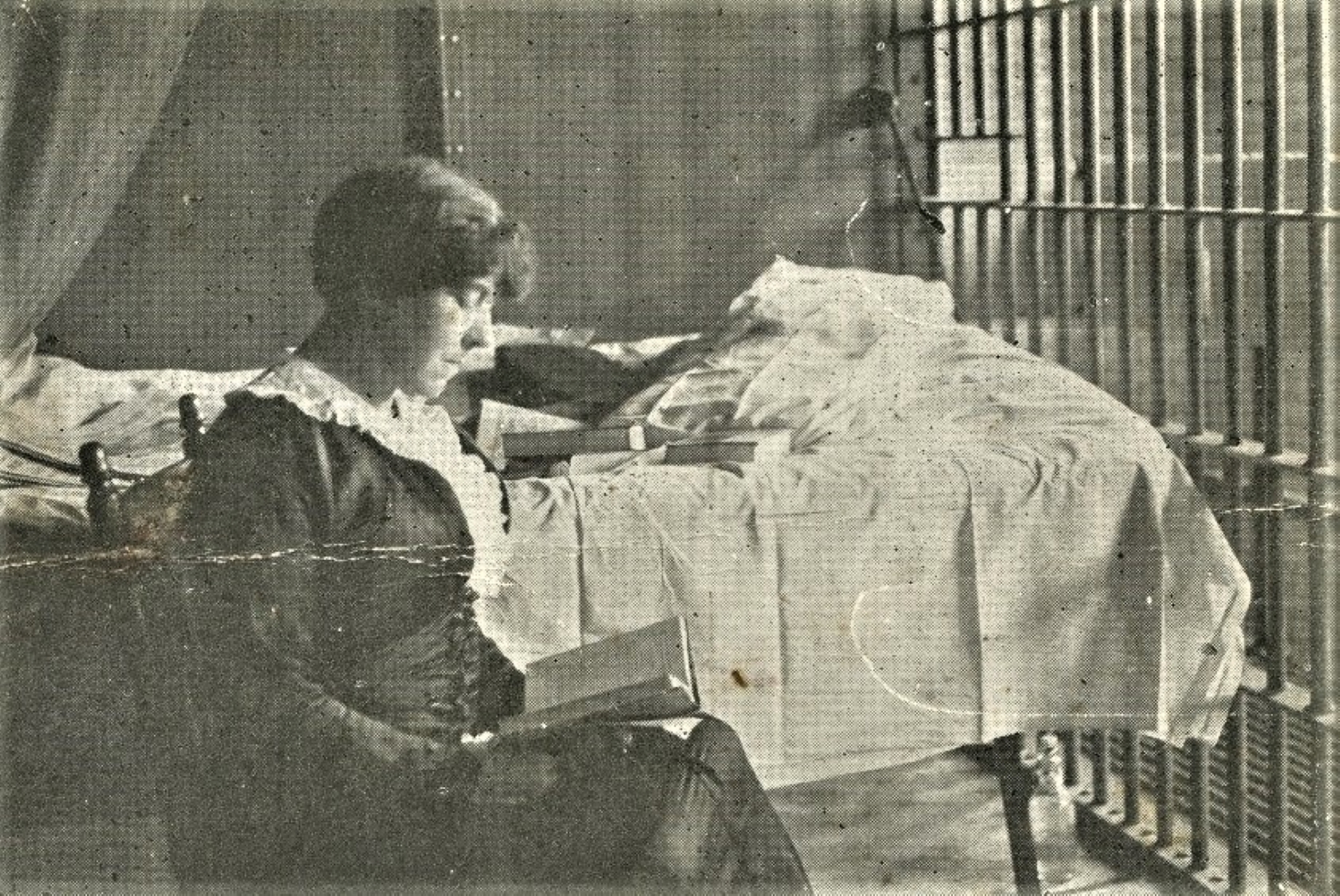
A heroic martyr of our class, long before she was killed Fannie Sellins was fighting for workers. 1913 found her in West Virginia as an organizer for the U.M.W.A. during the Cabin Creek War when she was jailed without charge for her activities. This enraged editorial from the West Virginia Socialist Party’s ‘Labor Star,’ voice of militant miners, makes no idle threat in demanding her freedom. Five years after this, Sellins was in Pennsylvania leading strikers when on August 26, 1919 she intervened to stop the police beating of striker Joseph Starzeleski to death and was laid low by four cop bullets, her body desecrated.
‘Fannie Sellins: A Living Sacrifice to the Gods of Greed’ from the Labor Star (Huntington, West Virginia). Vol. 3 No. 3. June 19, 1914.
Fannie Sellins is confine to her cell in a filthy jail, serving a six month sentence imposed on her by that Judicial proud Judge Dayton. This woman has committed no crime and is not even charged with crime, but because Judge Dayton issued an order at the request of the coal barons, denying her rights as an American citizen to go the public highways, near the sacred property of the coal barons. and she refused to obey the orders of Judge Dayton and surrender her blood bought rights to the prostituted tools of the privileged pirates and political prostitutes. Fannie Sellins was sentenced to serve six months in the Fairmont jail. Judge Dayton is a tool of the capitalist interest. Fannie Sellins championed the cause of the workers and was deprived of her rights and robbed of her liberty and sentenced to jail by this tool of capitalism because he had the power, and these same workers for whom Fannie Sellins went to jail, delegated to Dayton the power to send her there. Several others besides Fannie Sellins were sentenced to jail by this same court, but her case is one that calls for immediate action on the part of the working class of West Virginia. Fannie Sellins is a member of the working class and a refined and cultured woman, yet she was thrown into a crowded jail with scores of blackguards and criminals of every type; just the one lone woman in this den of thieves subjected to the blackguarding of brutes and the insults of degenerated criminals. Think Mr. Working Man, what if your sister, wife, daughter or mother were placed in such a position and subject to such treatment, what would you do? This woman is your sister, she belongs to your class, she is where she is on your account, she was lighting for your rights. Are you going to see her pay the penalty for your ignorance and cowardice? Are you going to offer this woman as a living sacrifice to appease the wrath of the gods of greed? If the working class of West Virginia had the red blood of their forefathers in their veins, they would raise such a protest that it would shake the state from Cantis to Circumferance, and if that failed to open the prison doors to Fannie Sellins, they would go in a body to that thug ridden city of Fairmont and batter down the prison walls and tear out the iron bars that holds her a prisoner. The working class built that jail and it is the working class who goes to jail: but there is nothing that the working class has built that they can’t tear down. Let the working class of West Virginia meet in mass meeting and serve notice on the responsible authorities, that if Fannie Sellins is not released by them at once that by the Eternal Gods, she would be released by the working class if they had to walk over dead bodies of friends and foes to accomplish it.
Begun in 1912, the Socialist and Labor Star (later just Labor Star) was published in Huntington, West Virginia as “the official organ of the Socialist Party and of the Huntington Trades & Labor Assembly” and edited by Wyatt Thompson, West Virginian and former coal miner then printer’s apprentice. Labor issues, including the UMWA strike in Paint and Cabin Creeks, as well as US foreign policy, religion, and local political affair were features of the paper. It was often at odds with both the leadership of the Socialist party and of the UMWA. In the beginning of 1915, the Socialist and Labor Star merged with the Charleston Labor Argus to form the Argus Star, Thompson continued to serve as editor of the Argus Star.
Access to full issue: https://chroniclingamerica.loc.gov/lccn/sn85059765/1914-06-19/ed-1/seq-1/
 Revolution's Newsstand