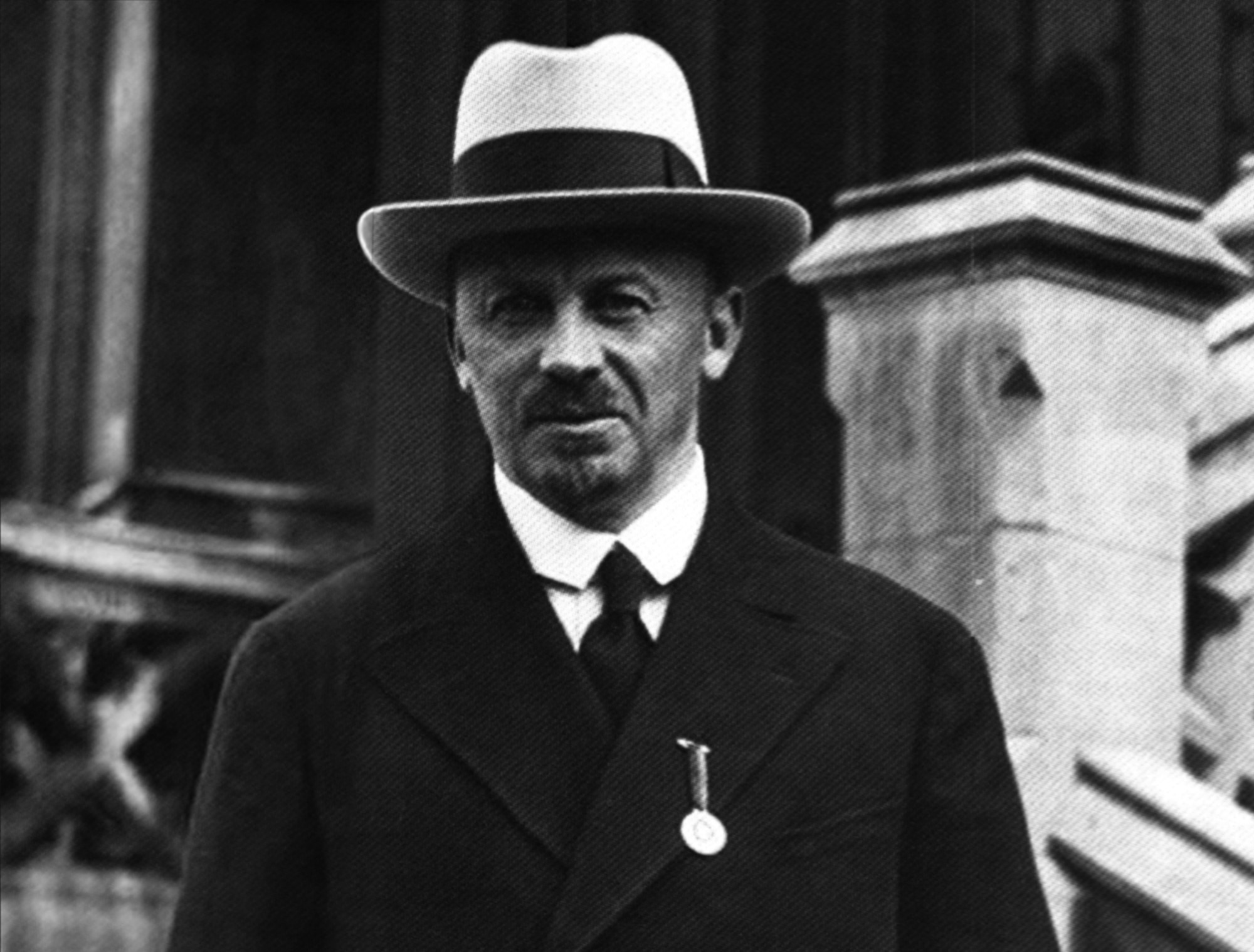
An essay by Bukharin on the culture of fascism and the degenerate bourgeois well from which it sprang in three parts: The ‘Paradox’ of Fascism, The Crisis and Fascist Ideology, The Crisis in Bourgeois Ideas. The article would shortly appear as the last (?) work by Bukharin published by the Communist Party as the pamphlet ‘Culture in Two Worlds,’ which included an essay on culture in the Soviet Union.
‘Crisis of Capitalist Culture’ by Nikolai Bukharin from New Masses. Vol. 13 No. 10. December, 1934.
I: The ‘Paradox’ of Fascism
It is now generally admitted that we are living in a period of very great historical cataclysms, of violent upheavals in all social life, of the most radical changes, and of the crash of old systems of material existence and the old outlook on life. Wars, revolutions, the crisis, the dictatorship of the proletariat, Fascism, the threat of new wars, the heroic struggle of the Austrian workers – all these facts are extremely ominous for capitalism, which might say, with Horatio:
In what particular thought to work I know not; But, in the gross and scope of my opinion, This bodes some strange eruption to our state.
The strain of the contradictions which are under constant pressure in the unbearably stuffy atmosphere of the capitalist world may at any moment end in some new catastrophe quite unexpected in its form.
However, we can trace a basic historical ‘tendency of development’ through the cinematographic swiftness and motley change of events. This tendency is expressed first and foremost in the unusually intensive process of the polarisation of the classes – the great differentiation in all social forces and ideologies – the sharpening of the struggle between Fascism and Communism, as two class camps – two doctrines – two cultures. If we were to characterise the entire historical situation briefly from this point of view, we might say that great class forces are forming in military array for coming battles – for the battles which will be really final (in the world-historic sense) and really decisive.
For this reason, Fascism must be subjected to thoughtful study in all its aspects, from its economics down to its philosophy. And all these already exist; for the bourgeois ranks are being reorganised with enormous swiftness, both in the form of so-called ‘national revolutions’ and in the form of ‘plain Fascism’. These forms vary greatly, but one cannot doubt their common historical tendency and the common root of their social and political class significance.
A long time ago, before the series of bourgeois revolutions, feudalism gave birth to the absolute monarchy. The czars, emperors and kings, in alliance with the petty land-owning nobility, and with the support of the towns, crushed some of the big feudal lords – and by doing this, strange as it may seem, put off the historical date of the end of feudalism. They strengthened feudalism and centralised its basic forces under the absolute monarchy, which was overthrown by the bourgeois revolution.
Another world-historic paradox is now being enacted on the historical stage, under entirely different conditions and in an entirely different manner. In the ‘national revolutions’, finance capital and the Junkers – supported by the petty-bourgeoisie, a section of the intelligentsia, and even certain groups of duped workers – advance anti-capitalist slogans, preach ‘National-Socialism’, and even sacrifice a section of their class colleagues (Jewish capital and ‘non-Aryans’ in general), while at the same time they strengthen capitalism – or, rather, attempt to strengthen it – by gathering all their forces for the defence of capital, and by declaring a preventive war on the working class, on Communism, and on Marxism.
Fascist ‘order’ is the ‘order’ of military, political and economic barracks; it is the military capitalist system of a state of ‘emergency’. This expresses itself in a number of most important facts: in the tendency towards state capitalism; in the ‘common national’, ‘corporate’, etc, dictatorship, with the suppression of a number of internal contradictions; in the establishment of various ‘mono’ systems – ‘mono-nation’, ‘mono-party’, ‘mono-state’ (’totalitarian state’), etc; in the organisation of mass human reserves – petty-bourgeois and, in part, working class; in a whole ‘incorporated’ ideology, attuned to the basic interests of finance capital; and, finally, in the creation of a material and ideological war base.
The so-called Fascist ‘national revolutions’, with their anti-capitalist slogans, are really in essence but a speedy reorganisation of the bourgeois ranks, eliminating parliamentary changes and the system of competing parties, introducing uniform military discipline all along the line, and organising mass reserves.
The petty-bourgeois Philistines of the ‘centre’ will say: ‘But you Communists also do many of these things.’ Or, as the Social-Democratic petty-bourgeois phrase it: ‘There is dictatorship here and dictatorship there, both equally abominable.’ Or: ‘There is “Left” Bolshevism and there is “Right” Bolshevism; and there is no difference in principle between them.’
These miserable people, who receive blows both from the left and from the right, do not understand that the formal side of the matter alone (‘dictatorship’ in general), which they understood incorrectly at that, does not decide anything: the important thing is its class meaning; its content – material and ideological; the dynamics of its development; its relationship with the general current of world historical development. Only imbeciles can fail to understand that the dictatorship of the proletariat and the dictatorship of the capitalists are polar opposites, and that their content and historical significance are entirely different. Those who cannot – or will not – understand this will inevitably be crushed and plunged into the inglorious refuse of history.
II: The Crisis and Fascist Ideology
Thus Fascism, in its essence, is a product of the general crisis of capitalism – as Joseph Stalin has emphasised. But from this it follows that the coming of Fascism, in creating something new (reactionarily new) in the capitalist ways of living and thinking that had been formed before its coming, could not but bring with it a profound crisis in certain important bourgeois orientations. It should be stated that not all aspects of this complex reorientation are of the same depth or of the same stability: doubtless, many aspects are changing and will change – depending to a great extent on the curve of the economic cycle. But many aspects, of course, will remain, until the development and conclusion of the class struggle puts forward problems of an entirely different nature.
If we are to speak of the Fascist bourgeoisie’s political and economic platforms and guiding ideas, we must note facts of this sort.
1) The crisis in the orientation towards swift technical progress. There was especially profound pessimism in this field during the years of the greatest decline in the cyclical curve. It is well known that all the leading technical publications – Machine Building, American Machinist and hundreds of others – were full of discussion on the question: Is technology beneficial or harmful? Engineer Heilmich wrote in Machine Building that ‘there is an enormous army of writers who take a negative attitude towards technology, and even wish for or predict its death’. The economic journals strongly recommend a decrease in the rate of technical development.
The bourgeois philosophers began to chant melancholy tunes in a discordant chorus about the soullessness of machine civilisation in general. The Keyserlings, our Berdyaevs and Co (who are suspiciously close to the Fascist staffs), and the inevitable ‘dean of philosophy’, Oswald Spengler, who preaches the doom of Europe and of Bismarck’s ‘Socialism’, have all begun to criticise technique as such: not the capitalist application of technique (that would be a criticism of the very foundations of capitalism and capitalist exploitation), but technique itself.
The machine, Spengler affirms, is beginning to hinder the human being (the multitude of automobiles in the streets): ‘In Argentina, Java and other places, the small land-owner’s simple plough is superior to big motors, and is beginning to drive them out.’ [1] The end of modern machine culture is inevitable. ‘This machine technology’, he writes, ‘will end with the Faustian human being, and will some fine day be destroyed and forgotten; railroads and ships – like the Roman roads and the Chinese wall; our giant cities and their skyscrapers – like old Memphis and Babylon.’
Such funereal reactionary tunes have become the ideological fashion. The great optimism that was formerly felt concerning technological progress has undoubtedly disappeared. ‘Faith’ in it has been undermined by the whole trend of the general crisis of capitalism.
2) The crisis in the orientation towards further industrialisation is very closely connected with the above. If technological progress is stopped, the productive forces will inevitably decline or come to a standstill. This is assisted by the search for guarantees of safety against the ‘plague of the proletariat’, the ‘back to the land’ propaganda, the doctrine of the patriarchal bond with ‘mother-earth’, and the return to the land. Whence ‘re-agrarianisation’!

Hitler’s slogan is: ‘The land above all; it gives stability; it is the source of conservatism.’ The experiences of the Fascist movement in Italy, in Germany, and in Austria (the rich peasants of the Tyrol, the Italian agrarian bourgeoisie, the Catholic Church – especially in the agrarian districts, etc), oblige the Fascists to turn decisively towards ‘the land’ – which, of course, is far from hindering the rule of finance capital. The problem of ‘internal colonisation’, of moving the population from the cities to the countryside in the struggle against unemployment (the Siedlungsproblem), is one of the essential questions of the German internal policy.
T. Hielscher has expressed the coming ideological superstructure with classic clarity in his book The Empire: [2] ‘Becoming more rural will mean becoming poorer and more primitive, and perhaps wilder and more barbarous; but, on the other hand, it will mean becoming more Germanic. Barbarism carries its own justification.’ Sapienti sat. Comment would surely be superfluous.
3) The crisis in the orientation towards the world market. The tendency which had previously flourished in this field with the old optimistic laissez-faire theory is being replaced by the doctrine of a decided autarchy – that is, a confined, ‘self-sufficient’ economy, almost independent of world economy. Certain governments which are becoming Fascist, or are already Fascist – especially Germany – show this process very clearly.
It is not difficult to see the basic economic roots of this tendency and this policy. I am referring to the militant economic and military preparations, to ‘independence’ from imports which are not guaranteed during war, and the consequent corresponding decline in the proportion of exports.
The obliging economists have already deduced a whole ‘law of decreasing world connections’. The Japanese Social-Fascists justify annexation by the necessity of having ‘enough of everything’ for the building of Socialism (!!) under the rule of the Mikado. The German Fascists formulate the problem as the problem of ‘the greatest possible economic independence’.
Ferdinand Fried puts this question very clearly indeed in his book Autarchy, [3] in which he gives the ‘lofty ideology’ of this autarchy: the ‘Autarchy’ of self-sufficiency and the ‘Autarchy’ of self-government – that is, political independence.
‘The nation’, he declares, ‘which is now being born in the German revolution [this refers to the Fascist ‘revolution’ – NB] has gone through an intensive internal survey, and wants to be self-sufficient and rule itself through itself… The French Revolution will produce social nationalism… The field of social nationalism is not the world, but the nation, the people, the human being.’
This, of course, is utter nonsense, as far as the ‘field’ is concerned. There is no talk of the Fascist states refusing to go out into the world ‘field’. The race for armaments and the foreign policies of these states do not permit us to accuse them of provincialism. But it is precisely for the purpose of struggle on the world field that they are breaking down the ideology of a world of free-trading connections. The continuous growth of nationalism and the military character of its entire ideology form the appropriate superstructure for the imperialist-Fascist autarchy.
4) The crisis of the liberal bourgeois-parliamentary state is one of the outstanding manifestations of the military and political preparation of the bourgeoisie. So is its transition to dictatorship through the destruction of bourgeois democracy and the organisation of an open dictatorship, with one party and a complete terrorist government apparatus, from the armed forces down to the university chairs and the art academics.
Here we must point out that the so-called ‘corporate state’ is trying to draw the basic links of economy into its own hands on the basis of state capitalism, and is speeding up the process of the centralisation of capital in every possible way. It is obvious that the building of ‘planned capitalism’, which they preach under the name of ‘National-Socialism’ is a Fascist Utopia. But there is no doubt whatsoever of the fact that in leaning for support mainly on heavy industry the Fascists are tightening and militarising certain important links in their economy, thus greatly increasing the pressure of state power.
One of the leading Italian Fascists, M Benni formulates the matter thus: ‘The rule of economic nationalism emphasises this necessity, for all nationalism undertakes a political function first and foremost and adapts or subordinates to it all other social functions.’ [4]
The representation of ‘corporations’ (Italy) and of ‘estates’ (Germany) is fictitious; for the ‘lower classes’ are ‘represented’ by members of the Fascist staff – by ‘state imposed chiefs’, so to speak, of one or another ‘front’. The essence of it lies in the direct rule of capital itself, of the Thyssens, the Krupps, [the trusts, the banks, etc, on the basis of a centralised and operative ‘complete’ power.
According to Mussolini, this system overcomes both capitalism and Socialism. [5] According to Fried, it is the embodiment of ‘the Prussian idea of order’ and of Prussian ‘Socialism’. [6]
Higher ideological structures develop on this basis into a whole philosophy of the ‘totalitarian’ state, of the cooperation of all, of the leadership of the elect, in whom lies the spirit of god, of the realisation of metaphysical values, etc.
In any case, the old liberal orientation has been broken completely; we have at present a transition to the operative, ‘complete’ dictatorship of finance capital – a terrorist dictatorship, which has absorbed a number of mass Fascist organisations.
III: The Crisis in Bourgeois Ideas
This sharp turn in the sphere of material culture and the ideological spheres closest to it finds its appropriate expression and reflection on the higher rungs of the ideological ladder. Here also a swift reorientation is taking place, and the customary categories are turning out to be unsuitable for the new period. We have a profound crisis in all bourgeois ‘spiritual’ culture, which says a great deal. We shall dwell here on certain especially clear manifestations of this crisis.
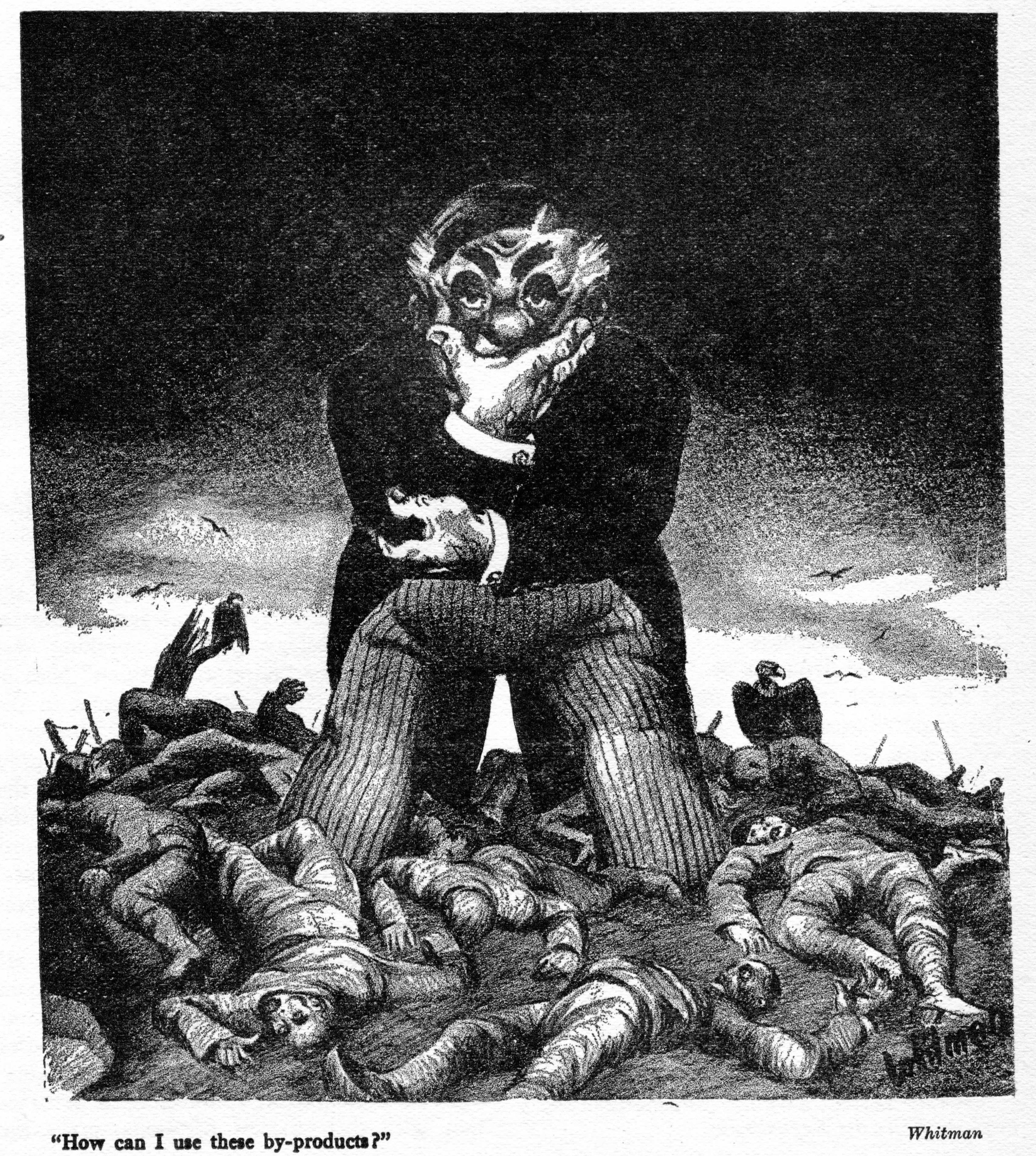
1) The crisis in ideas of evolution has developed on the basis of disillusionment about the progressive movement of capitalism. This disillusionment is growing and taking logical shape on a universal scale. The first stage is summed up very well by Walter Eucken: [7]
‘Marx thought’, he tells us, ‘that the vital law of capitalism lies in ever-developing dynamics, and that the end of capitalist development would mean the end of capitalism itself… Modern political economy has shown that Marx’s theoretical arguments on the necessity of these dynamics are false.’
The second stage, the universal spread of the negative attitude towards the idea of development, is found in the ‘universalist’ Othmar Spann. In his Science of Categories, [8] this professor proclaims certain remarkable truths: ‘Darwin and Marx’, he writes, ‘did a terrible injury to our culture by their mechanical [!] understanding of evolution. For their understanding of evolution robs all activity of its value, as each day is conquered by the next day. And this gave rise to the utilitarianism, materialism and nihilism which characterise our times.’
In other words: Only the conventional ‘dynamics’ of simply grinding water in a mortar is of any value. As to real, successful struggle, and actually changing the world – that arouses human pride and turns men away from God, and is therefore criminal. What formerly made up the fervour of the progressive bourgeoisie – what Bacon formulated, with restrained passion, as the flowering of mankind – is now crushed under the Fascist heel of the gloomy servants of God. The bourgeoisie whose path to further development has been blocked, cries: ‘Down with development! Down with the very idea of development!’
2) The crisis in the ideology of Christian and liberal ‘humanism’. The period of liberalism corresponded to the rosy dream of ‘normal human relationships’ raised to the ethical standard of Kant’s categorical imperative. This ideology, generally speaking, was very suitable for ‘fairer competition’ both in the field of internal relationships and in the field of international trade. ‘Honesty’, ‘equality’, ‘respect’, etc, with their wordy halo of hypocritical ‘humaneness’, were the official ethical doctrines connected with the real conduct of the people: and the word ‘people’ formally included the lower classes.
The semi-feudal romanticists and philosophers of reaction – in speaking of modern times, we must mention Nietzsche, first of all – began to undermine this ideology. ‘Whom do I detest most, among the modern scoundrels? The Socialist scoundrels – the apostles of the mob, who intrigue against the workers’ instinct, contentment and feeling of satisfaction with their modest life – who make the workers envious, and teach them revenge.’ [9]
Socialism ‘is for the most part a symptom of the fact that we are treating the lower classes too humanely, so that they get a taste of the happiness forbidden to them… It is not hunger that causes revolution; it is the fact that when the people begin to eat they acquire larger appetites.’ [10]
The modern bourgeois ideologists, who on the wings of their thoughts are flying straight back to the Middle Ages, are raising aloft all their animal hatred for other nations, in essence, for the lower classes. The actual facts of this are universally known.
Mme Omer de Guelle, the queen of adventuresses, whose memoirs came out recently, might well envy the pathological sadistic passions of the Fascists.
But the interesting thing is that all this finds open, acknowledged, valued, almost ‘philosophical’ expression. Spengler’s analogy of the beast of prey is well known. It is worth our while to cite once more the tirade, expressive of his ‘cultural perception’, in which this philosopher praises the gorilla-like ‘primitive man’. Herr Spengler is touched:
The soul of this strong Solitary [!] is thoroughly militant, mistrustful and jealous of his own power and gains. He throbs with emotion when his knife cuts into the flesh of an enemy – groans and the odour of blood raise his feeling of triumph. Every real man, even in modern cultural cities, sometimes feels within him the smouldering fire of this primitive soul.
The Fascist dramatist, Herr Johst, calls for priests ‘who will spill blood, more blood, and still more blood’, and declares: ‘When I hear of culture, I get my Browning ready.’
Herr Herbert Blank [11] believes that in Bismarck’s Thoughts and Reminiscences there is more philosophy than in hundreds of works of university faculties, and that the development of character should be completed in the barracks. Frederick the Great, the officers’ corps and the barracks form the ideal trinity of his ‘philosophy’.
A nationalist fury is raging; ‘humane’ passages are crossed out even in the ‘New Testament’, as ‘Eastern influences’. The Christian names are crossed out of the calendar and replaced by Teutonic ones (‘Back to Wotan’ is the password). The ‘race theory’, with its analysis of ‘blood and sperm’, is being elevated to the level of a ‘scientific’ doctrine, and is the basis of all policies. Alfred Rosenberg even explains the entire October Revolution by saying that ‘Mongolian forces’ got the upper hand of the ‘tall, shapely’ light-haired people of German origin. [12] The liberal Christian orientation has been replaced by frantic anti-Semitism and incredible contempt for the colonial peoples (see Hitler’s Mein Kampf). This, however, while it causes the priests to revolt, does not prevent the Vatican from blessing the above-mentioned ‘things and processes’.
3) The crisis in the idea of formal equality. From the very backwaters of reaction – from Joseph de Maistre and Co – they have fished out the idea of hierarchy – eternal hierarchy – not as a temporary historical phenomenon, but as a general and universal law of nature. (See M Berdyaev’s book The Philosophy of Inequality, written quite a long time ago.) Hitler speaks openly and plainly of the rule of the aristocratic idea in nature and in society. M Araki, in his famous speech ‘The Tasks of Japan in the Siowa Period’, brings forward amusing ‘philosophical’ arguments which are supposed to prove the age-old superiority of the Japanese race. (He compares human beings with various breeds of dogs, destined for different purposes.)
Herr Spann, the philosopher of Austro-German Fascism (he is also their sociologist, their economist, etc), builds up a whole theory of society and government on the basis of a hierarchical demarcation between ‘well-born’ and ‘low-born’ members of society, returning to and theologising old biological theories.
The idea of hierarchy (gerarchia) is given exactly the same determining role by the Italian Fascists (see Gentile). Rocco, one of the leading ideologists of Italian Fascism, has created a whole theory of government and rights (‘reflected rights’). It is a well-knit theory of the serfdom of the low-born castes, who are in bondage to a corporate state, headed by the ‘élite’ – the ‘select’ – the ‘illustrious’: the trust-owners, the bankers, the ‘excellencies’, and their spiritual and worldly servants.
The idea of formal equality has broken down all along the line. The banners of the bourgeoisie now bear the legend: Hierarchy (read: the rule of capital).
4) The crisis in rational thinking. Disillusionment in the expediency of technical progress inevitably brought about disillusionment concerning the power of rational thinking. This is a subject worthy of detailed treatment.
In order that the reader may immediately feel the ‘aroma’ of the new positions on this question, we shall quote here the above-mentioned Herbert Blank. In his controversial work he asks directly: Of what use ‘to the German people is the science of Darwin, Virchow, Dubois-Raymond, Haeckel, Planck and Einstein, which has broken the tie between the soul and God…’? And he answers: ‘We are more for the creed which is reviled as barbarism; for, I must remark, we consider the slogan “Back to barbarism!” which has come up during the last few years, as one of the best of battle-cries.’
Science and rational thinking are replaced by theological and teleological metaphysics, mystical ravings, wild ‘intuitions’, occultism, telepathy, astrology, etc. The content of the new literature is simply incredible: Vitalism and Jeans’ ‘mathematical god’ are harmless toys when compared with the scholastic and mystical nonsense that is printed in the capitalist countries nowadays. Truly, it seems as though heavy giant lizards, dinosaurs and iguanodons had again begun to crawl along the surface of the primitive earth.
Such is, in rough outline, the picture of the cultural crisis in capitalist countries. This picture is far from complete; it is very ‘poor’ compared with reality. But its basis is clear. It has been very well expressed by Spengler:
It is our duty to hold on to the end to a lost position, without hope, without salvation. To hold on to the end, like the Roman soldier whose bones were discovered before the gates of Pompeii, who perished because during the eruption of the Vesuvius he was not relieved from his watch. That is glory, that is the valour of a race. That honourable end is the only thing a man cannot he deprived of.
Such is the intimate side of Fascist ideology in all its glory. Moreover, the ‘knight’ in a wild beast’s skin is doing anything but ‘standing watch’. He is making considerable use of his club. But he will not prove the victor; as proved, among other things, by our growing, Socialist culture.
Notes
- Oswald Spengler, Man and Technics: A Contribution to a Philosophy of Life (New York, 1932).
- Friedrich Hielscher, Das Reich (Berlin, 1931).
- Ferdinand Fried, Autarkie (Jena, 1932(.
- Ignazio Silone, Der Faschismus. Seine Entstehung und seine Entwicklung (Zürich, 1934), p 224.
- ibid. p 526.
- Fried, Autarkie, p 45. Spengler says the same.
- Walter Eucken: Staatliche Strukturwandlungen und die Krise des Kapitalismus (Jena, 1932).
- Othmar Spann, Kategorienlehre (Jena, 1924).
- Friedrich Nietzsche, The Will To Power: An Attempted Transvaluation of All Values (London, 1910).
- ibid.
- See Wir suchen Deutschland. Ein freier Disput u?ber die Zeitkrisis zwischen Gerhard Schultze-Pfaelzer und Otto Strasser, Major Buchrucker, Herbert Blank (Leipzig, 1931).
- Alfred Rosenberg, Der Zukunftsweg einer deutschen Aussenpolitik (Munich, 1927).
The New Masses was the continuation of Workers Monthly which began publishing in 1924 as a merger of the ‘Liberator’, the Trade Union Educational League magazine ‘Labor Herald’, and Friends of Soviet Russia’s monthly ‘Soviet Russia Pictorial’ as an explicitly Communist Party publication, but drawing in a wide range of contributors and sympathizers. In 1927 Workers Monthly ceased and The New Masses began. A major left cultural magazine of the late 1920s and early 1940s, the early editors of The New Masses included Hugo Gellert, John F. Sloan, Max Eastman, Mike Gold, and Joseph Freeman. Writers included William Carlos Williams, Theodore Dreiser, John Dos Passos, Upton Sinclair, Richard Wright, Ralph Ellison, Dorothy Parker, Dorothy Day, John Breecher, Langston Hughes, Eugene O’Neill, Rex Stout and Ernest Hemingway. Artists included Hugo Gellert, Stuart Davis, Boardman Robinson, Wanda Gag, William Gropper and Otto Soglow. Over time, the New Masses became narrower politically and the articles more commentary than comment. However, particularly in it first years, New Masses was the epitome of the era’s finest revolutionary cultural and artistic traditions.
PDF of full issue: https://www.marxists.org/history/usa/pubs/new-masses/1934/v13n10-dec-04-1934-NM.pdf
 Revolution's Newsstand