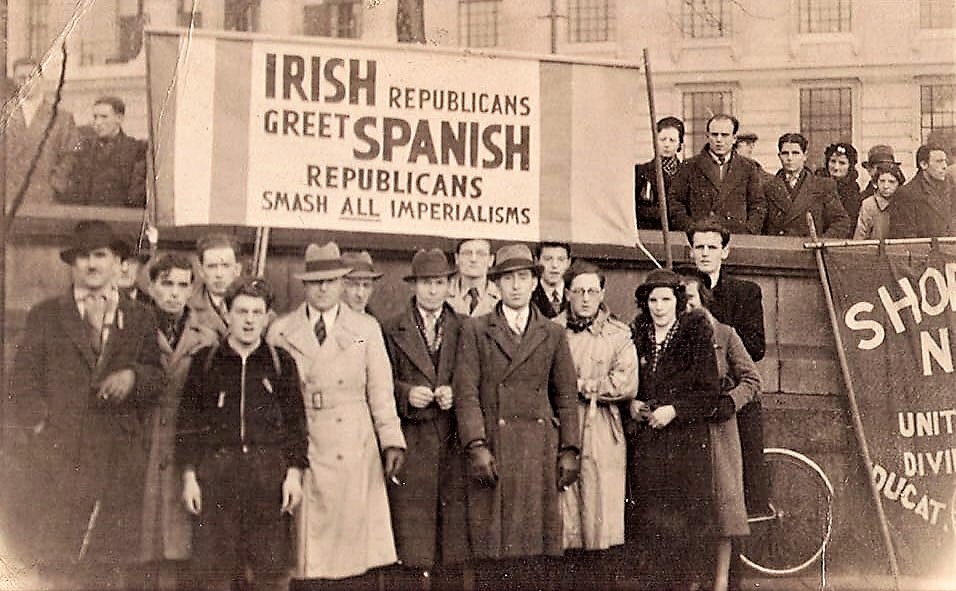
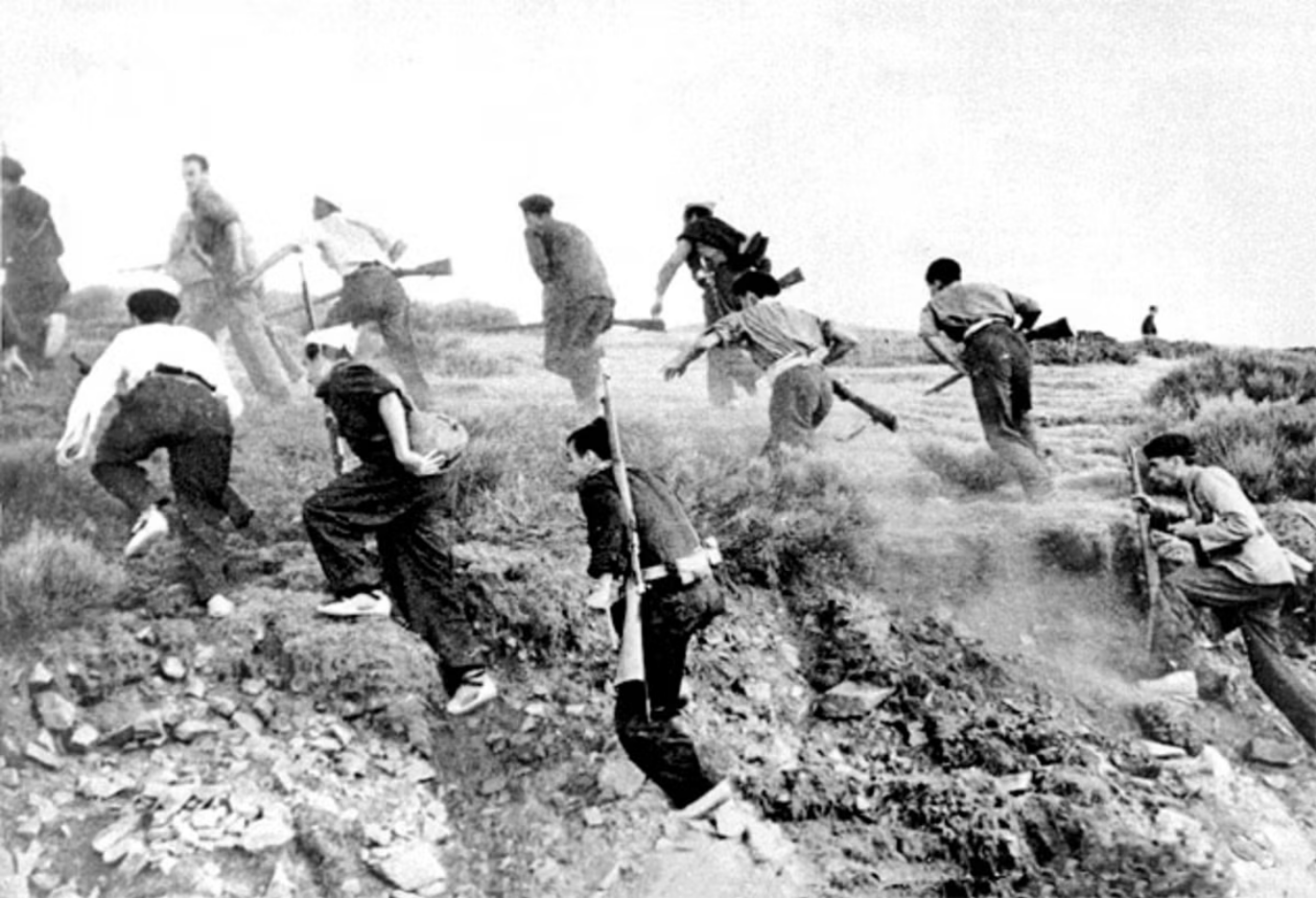
A touching, defiant, and proud letter of solidarity and enhanced resolve from Kathleen, ‘an Irish war widow’ of the Spanish Civil War. Though unnamed, her martyred husband was Bill Henry, a member of the Connolly Column. A Protestant from the Shankhill in Belfast, Bill was an active Communist and a republican. A veteran of the First World War, Henry was also member of Irish Distributive Workers Union, and the NI Labour Party. Nearing 40 when he volunteered, he arrived in Spain on December 12, 1936 as a member of the XV Brigade, Lincoln Battalion, Company 1, Section 2, James Connolly Column, Group 2. His previous combat experience got him promoted to command of the Irish Section. As such he led the Column at the Battle of Jamara where the Lincoln Battalion, which included the Connolly Column, attempted a second assault on the fascist stronghold of Pingarrón on February 27, 1937.
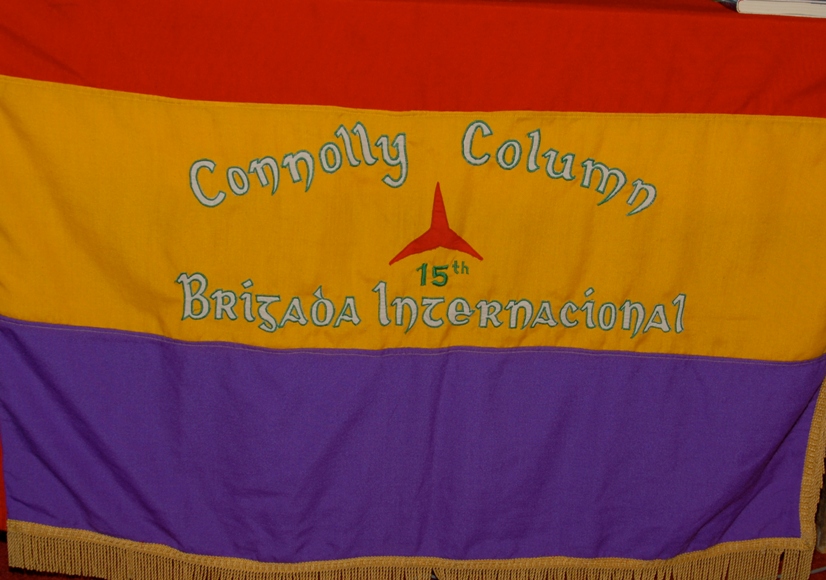
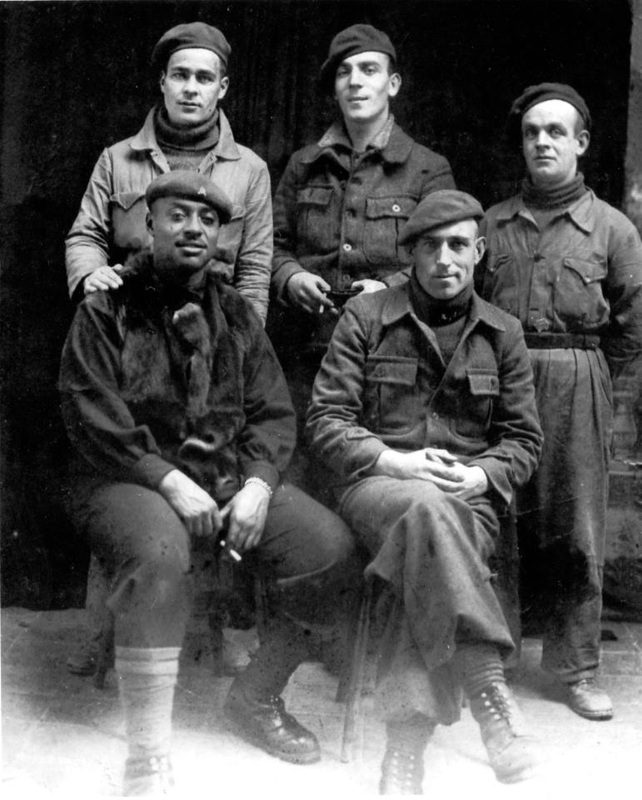
Of the 450 who went over that day in a most desperate attack, 147 quickly fell dead in a sheet of machine gun fire, including comrade Henry, killed instantly with a shot to the head. The poet and Republican Congress leader Charlie Donnelly then took command of the shattered Column only to be killed hours later, his body lying in no-mans-land for two weeks before it could be recovered. The Brigade and its Connolly Column suffered horribly, losing members Liam Tumilson (Belfast), Michael Blaser-Browne (New York), Danny Boyle (Belfast), Kit Conway (Tipperary), Pat Curley (Dumbarton), John Dolan (Donegal), Charlie Donnelly (Tyrone), Bill Henry (Belfast), Robert. M Hilliard (Killarney), Samuel Lee (London-Jewish), Paddy McDaid (Dublin), Bert McElroy (Louth), Eamonn McGrotty (Derry), Thomas Morris (Boston), Thomas T. O’Brien, Dick O’Neill (Belfast), Maurice Quinlan (Waterford), and Michael Russell (Ennis) in the desperate fight on fascism those brutal, heroic days. I have been unable to locate a picture of comrade Bill Henry.
‘From an Irish War Widow’ from the New Masses. Vol. 24 No. 4. July 20, 1937.
This is what she wrote in answer to news of her husband’s death while fighting for the loyalists.
A Letter to a Comrade in Spain
I NEVER really believed that my poor Billy would be killed. From the moment we parted I have lived for the time we would meet again, and the news of his death has fairly broken my heart. The most awful thing about it is that I shall never see him any more, and, when I think: of this, I feel that I shall never be able to hold up my head again. We were such pals that I cannot visualize the future without him. However, I will try to be brave. I have asked myself how Billy would have wished me to behave in the event of his death, and I know that he would have said, “Be brave and carry on with the struggle to the end,” and that’s what I shall do.
I am pleased to be able to say that it was through working in the movement that we first met. It was at an Easter week: commemoration in 1933, and the friendship, based as it was chiefly on a similarity of ideals, grew steadily until I went over to Belfast the following year, since when we’ve been inseparable comrades through good times and bad. I am also pleased to recall that it was from Billy I got my first appreciation of the working-class struggle. Prior to that my whole life had been devoted to the cause of Ireland’s freedom from British oppression and the reclaiming of her national culture, but Billy taught me that the economic struggle is by far the most urgent. When he expressed the wish to go to Spain last December, I was human enough to be a bit downcast at first at the thought of parting with him, but in the end my better self triumphed, and I gave him the encouragement I had previously withheld. At the same time, I begged him to take me with him, reminding him of our mutual resolve that we would always stick: together, but although he believed in the equality of the sexes, etc., he was inconsistent enough always to make exceptions where I was concerned. He refused to consider such an idea, and nothing I could say would shake his resolve. On his stating that he could give himself wholeheartedly to the Spanish struggle only if he knew I was safe at home, l gave in, not wishing to do anything to stand in his way. Happy in the knowledge that we were doing what was right, we left Belfast on the eleventh of December; and Billy brought me back to my people here in Liverpool from where he left on the fourteenth for his last journey.

I want you to know, Comrade, that I am unspeakably proud of the way my man died. As you are probably aware, he did not believe there was any life after this, and that makes his sacrifice greater. For myself, I only wish I could believe in a hereafter that I might look forward to being with Billy again, but I’m afraid the possibility does not appeal to my reason. The sentiments you expressed regarding the question of religion are more or less my own. Never definitely as atheistic as Billy, I merely hold the conviction that I do not know. Without God and a hereafter, life becomes a farce, and yet the God I have been taught to believe in does not exist for me, at least as a just God, for he is the God of the wealthy and the oppressors; rather than serve him I prefer to follow my own conscience, and take my chance when my time comes with whatever comes after.
Billy, an atheist, is an example to any Christian, and he died in the noblest way a man could, the system being the rotten one it is. Not only am I proud of the manner in which he met his end, but glad, too, for the simple reason that it was the way he told me he wanted to go: suddenly, while fighting in defense of his class, the class for which he had striven all his life. I do not regret his having gone to Spain because it was the right thing to do, but naturally I regret that he did not survive the struggle to see the victory of which he definitely assured me in his letters. I regret also that I could not have been with him when the end came, but I have the consolation of knowing I did as he wished by staying home.
As you say, Comrade, there has been a lot of shameful slander about you boys, but it is not so prevalent now, thanks to the exposures by the Daily Worker [England]. We women get our fair share of the slanders too. They jeer at us, and tell us our men wouldn’t have left us if they had cared for us, and why don’t they fight for their own country, etc. It is useless trying to explain that our men are fighting for our class, and as for them leaving us to be rid of us, for my part I can confidently say that there was only one thing Billy held dearer than me, and that was the cause for which he gave his life.
I mustn’t forget to thank you, Comrade, for undertaking to break the awful news to me. I appreciate how distasteful a task it was, as you are probably aware of the extent to which Billy and I were related. It came hard, following as it did on the death of my beloved father only a couple of months ago, but even my father’s death fades into insignificance compared to Billy’s, as the latter was dearer to me than any other being.

I would like very much to have the pictures you mention or anything that you think would be appropriate for me to have belonging to him. I have in my trunk: quite a number of little presents which he bought me on various occasions during the last four years, but I would dearly love to have some little keepsake from him that he had on him when the end came. He spoke in one letter of having. Collected some presents for me from Spain, but, if they were not amongst his things, he had probably sent them to me, and they have been lost in the post. I know that’s what happened to a pretty little bracelet he sent me.
I suppose it is useless to ask if Billy gave you any message for me in the event of his being killed; it’s a habit among soldiers, I’m told, but maybe he believed he would survive the war, poor boy. His letters were so full of plans, but then that was probably just to keep me up; he must have been aware of the possibilities. Would you give me the details of how he met his death-I can bear it-and if you know, just where in Spain. Could I trouble you also for a description of the spot where he is buried? It’s so unsatisfying merely to imagine. I would like to think he was thinking of me at the last, but for his sake I’m glad it was the way you described, for I couldn’t tolerate the thought of his being in pain. Maybe some day, after all this is over, we women who are left can go out there and see the place where our men fought and died.

I shall be delighted to send you chaps the Daily worker and to write to you also as long you wish it, and I’m pleased to associate myself with anyone who was a comrade of my Billy. Later on I will send you a photo of him. I have a splendid one of him which I made him take the day he left Liverpool, and I intend to get copies taken for his family and friends. I have written to his mother and family, and I am sorry to have had to give them the bad news, for though they and he did not understand each other very well, it’s only natural that they will feel it. As it is, they blame him for going and blame me for letting him go, but I am proud of him and have no regrets. There are a lot of people in Belfast who will deplore his passing for he was well liked and respected for his quiet, unassuming manner and deep sincerity…
Well, I have his photo here before me now, and all I can say is, “I salute you, old pal, and every time I think of you I shall be inspired to carry on to help build a system that will prove you did not die in vain.”
I will close now, Comrade, with every good wish for you and the boys.
Yours in unity, KATHLEEN.
P.S. There’s one thing you chaps must bear in mind: no matter who may slander you, we, the workers, believe in you.
PDF of full issue: https://www.marxists.org/history/usa/pubs/new-masses/1937/v24n04-jul-20-1937-NM.pdf
 Revolution's Newsstand