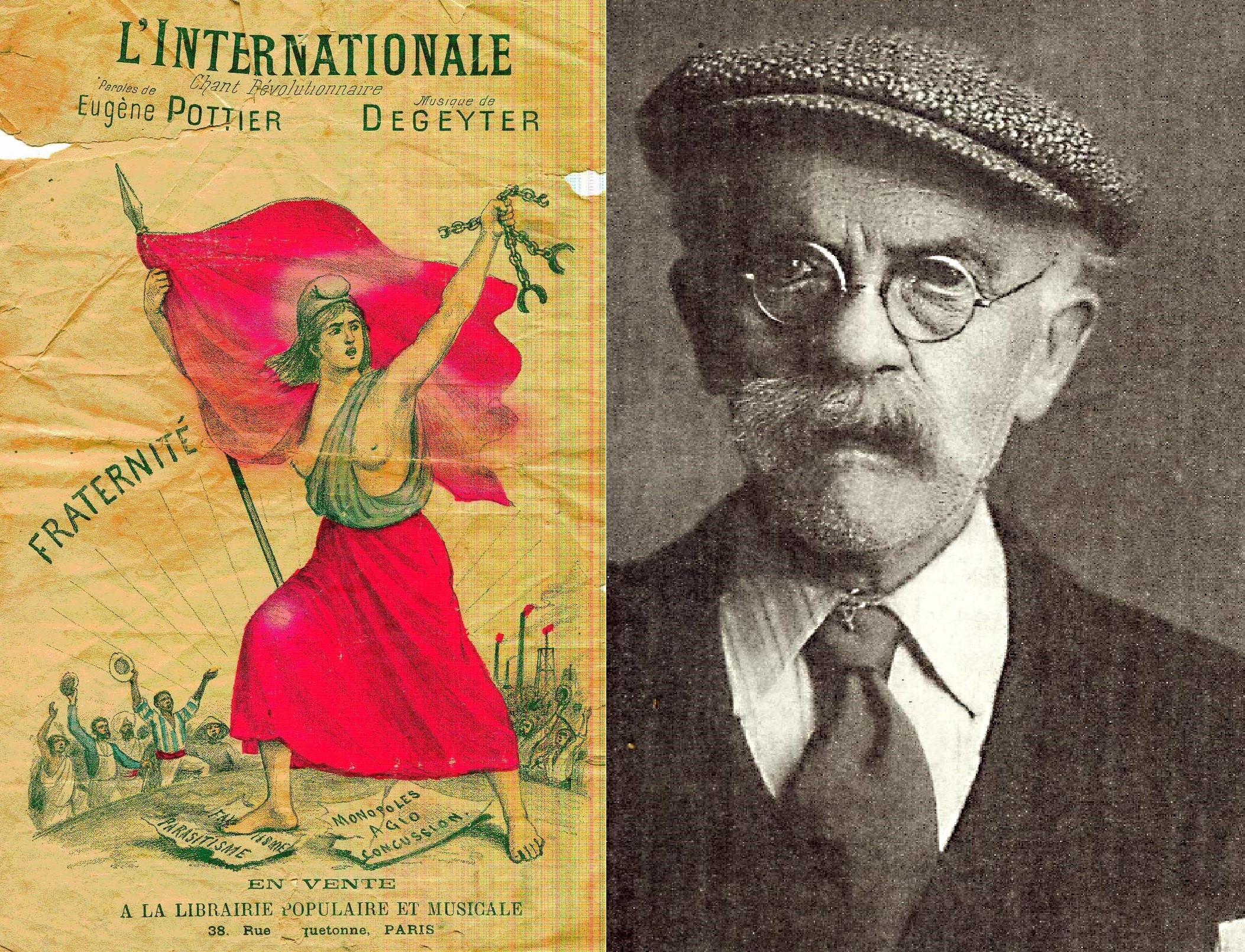
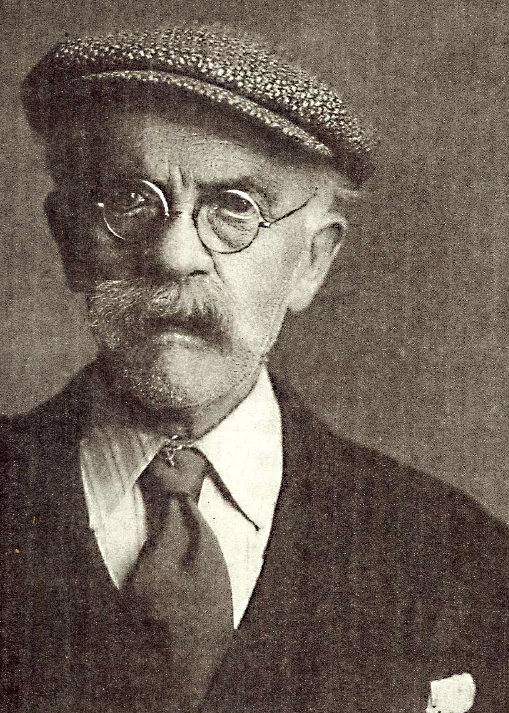
A wonderful look our anthem’s musical composer, Peter Degeyter, how it came to be, and the honor and celebration afforded the then 70-year-old at the 1924 congress of the French Communist Party. Given Eugen Pottier’s poem in 1889, Degeyter is responsible for the martial music. Written to quicken the heartbeats of all partisans of human freedom, the notes are still heard, sung, and hummed the world over by our class as both a statement of defiance today, and liberation on the morrow.
‘The Composer of ‘L’Internationale,’ Peter Degeyter’ by Amadeus Dunois from International Press Correspondence. Vol. 4 No. 36. June 26, 1924.
There recently appeared in the editorial office of our French Party organ, “Humanite” Peter Degeyter, the composer of the music to that world-famous battle song of the proletariat, “L’Internationale”. In reply to the question: how he came to compose this melody, we learned that thirty five years ago he was a textile worker in Lille, the industrial centre of the north of France. At that time the Socialist movement in Lille was making great progress. Peter, along with his, brother Adolf took part in it. Before all he was a great lover of music, and it was here that he entered a workers’ choir which elected him as its leader. Among the members of this workers’ choir there were two who have since become famous: Gustav Delorry, the Mayor of Lille, and later, member of parliament for Lille, and Henri Ghesquiere, who likewise. became member of parliament and died during the last days of the German occupation. All kinds of songs were sung by this choir, the workers would willingly have sung socialist songs too, but they did not know any.
One day in 1889 a comrade handed to Degeyter a poem by Eugen Pottier, the former member of the Paris Commune, who had just died in the direst poverty in Paris. The poem was called: L’lnternationale. The date next to the signature – 30 June 1871 – indicated that the verses of the revolutionary song had been composed immediately after the bloody week of the Commune.
This poem, charged with glowing force, began with a call to the defeated in the social battle:
“Arise ye srtarvelings, from your slumbers,
Arise ye criminals of Want!
For Reason in revolt now thunders
And at last ends the age of Cant!”
As the poem proceeds the whole program of the social revolution is indicated in the wonderfully compressed lines.
Peter Degeyter was quite enthusiastic. He again and again repeated these powerful lines, in which burned the fire of an unvanquishable hope. For in fact “L’Internationale” is not the lamentation of the vanquished, humbly deploring their defeat. It is the war-cry bursting forth from the inmost of a class, the working class, which is preparing its revenge and knows that its revenge will come…

The humble textile worker Degeyter at this moment had the inspiration that these lines of revenge were only lacking an appropriate melody in order to become the proletarian revolutionary hymn.
“I shall attempt” he said, “to put these verses to music.” He started work immediately and some days afterwards, the music was composed – this martial catchy tune, which we all know so very well. Peter Degeyter at once began to make copies for his comrades in the choir.
Thus in a suburb of Lille in 1889 “L’Internationale” was born. It is true it required some time to become popular. It was sung in Lille, but in no other place.
In 1899 a general congress of the workers’ organizations and the French Socialists was held in Paris: The first Congress of Socialist unity. When the Congress was just about to disperse, a delegate suddenly mounted a table. It was Henri Ghesquiere. And in the general silence he started a song, which to most of the delegates was unfamiliar…After the third couplet all the delegates joined in the refrain:
“Then Comrades come rally!…”
This was “L’Internationale”. A year later the whole of Socialist France sang it, and thus it happened that the hundreds of delegates who attended the International Congress of 1900 learned to know this song. After this the simple song of Degeyter began to become known throughout the whole world.
While his song achieved such a great success in the Socialist world, Peter Degeyter had to have recourse io the law courts in order to establish his claim as the composer of “L’International”, as owing to the intrigues of Delory and Ghesquieres, his brother Adolf was, held to be the composer of the ‘song. It was only after 20 years of law suits that the court recognised him as the real composer of the “International”.
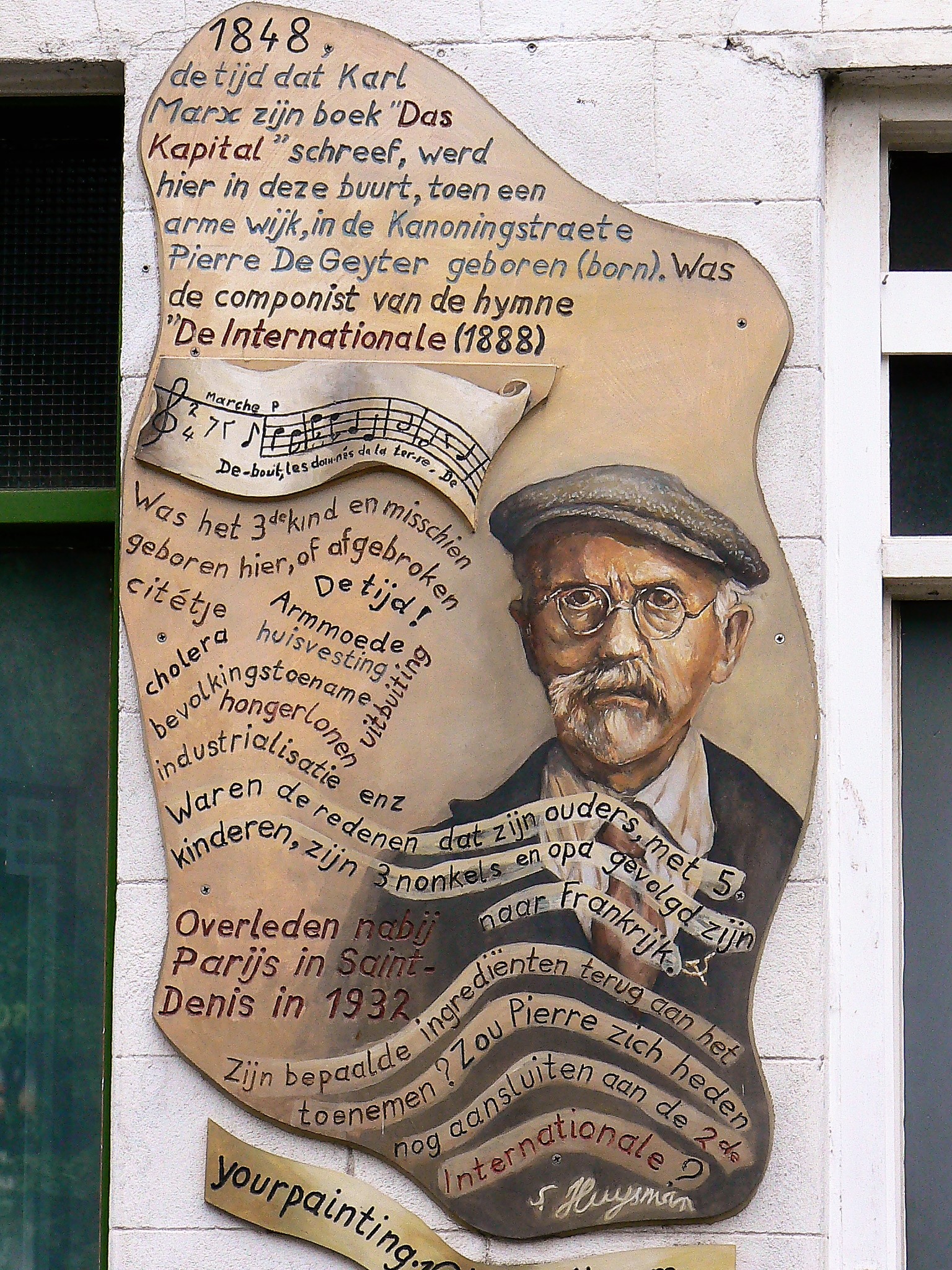
Peter Degeyter, who, is, by now 70 years oi age is leading a very poor existence along with his, wife, earning only a! few francs by the sale of confectionary. Now, when the Russian Comrades have learned of his situation, they have decided, on the suggestion of the French comrades, to grant him a monthly pension and to arrange a festival for his benefit.
Great homage was, paid to Peter Degyeter at the last national Congress of the French Communist Party, when he was asked to take a seat on the tribune and to address the Congress with a few words. But owing to great excitement the worthy old man stumbled with his words until the chairman, comrade Sellier, asked the orchestra to strike up the “International”. And the latter, a workers’ brass band from Lyons, started the immortal music. The whole Congress rose to their feet and joined in the refrain.
At this moment Peter Degeyter was wholly changed. He looked as if the whole thing to him were a dream in his poor exploited life, which up to then had not found any expression. With his right hand he beat time, with the movements of his head he marked the rhythm. One could not turn ones eyes from the touching picture of this grey haired man. He was pale, his eyes appeared to be gazing into the distance, his nostrils trembled. And he seemed at this moment to be the living symbol of the working class, which will experience as a whole, after long and hitter sufferings, persecutions and injustice the day of its final victory.

It is very likely that this scene will be repeated in these days in Moscow. On the proposal of the French comrades the Executive Committee decided to invite Peter Degeyter to take part in the V. World Congress. He certainly has the right to receive the homage of the International and we hope that he will find no difficulty in accepting this brilliant homage in the Capital of the Communist International and the world revolution.
At the same time it is our duty to pay grateful homage to the old poet who wrote the verses of the “International”, of “Jean Misere” and the “Monument des Federes” and many other revolutionary songs, inspired by the glorious Commune. We refer to Eugen Pottier, whose name we have to rescue from the oblivion with which it is threatened.
International Press Correspondence, widely known as”Inprecorr” was published by the Executive Committee of the Communist International (ECCI) regularly in German and English, occasionally in many other languages, beginning in 1921 and lasting in English until 1938. Inprecorr’s role was to supply translated articles to the English-speaking press of the International from the Comintern’s different sections, as well as news and statements from the ECCI. Many ‘Daily Worker’ and ‘Communist’ articles originated in Inprecorr, and it also published articles by American comrades for use in other countries. It was published at least weekly, and often thrice weekly. The ECCI also published the glossy magazine ‘Communist International’ edited by Zinoviev and Karl Radek from 1919 until 1926 monthly in German, French, Russian, and English. Unlike, Inprecorr, CI contained long-form articles by the leading figures of the International as well as proceedings, statements, and notices of the Comintern. No complete run of Communist International is available in English. Both were largely published outside of Soviet territory, with Communist International printed in London, to facilitate distribution and both were major contributors to the Communist press in the U.S. Communist International and Inprecorr are an invaluable English-language source on the history of the Communist International and its sections.
PDF of issue: https://www.marxists.org/history/international/comintern/inprecor/1924/v04n37-jun-26-1924-inprecor.pdf
 Revolution's Newsstand