
‘The Wobbly in American Literature’ by Alan Calmer from New Masses. Vol. 12 No. 12. September 18, 1934.
DURING its heyday, the Wobbly movement was violently distrustful of intellectuals. But this does not mean that it sneered at all intellectual endeavor. Contrary to most beliefs, the “official” attitude of the I.W.W. toward culture was by no means a negative one. It displayed a high regard for any kind of literary or artistic expression- when such work praised the manual worker, or sniped at anybody hostile to the working-class.
This respect for culture is shown by the four-sheet Wobbly newspapers, which frequently featured verse, embellished with drawings, on the first page. The New Solidarity, for example, ran a stanza on capitalist justice, by M. Robbins Lampson, in the center of its front page during one week in 1919. The March of the Hungry Men, a poem by Reginald W. Kaufmann, was featured in the Industrial Worker during the preceding year.

According to John Reed, the Wobbly movement created intellectual groups throughout the western section of the country. “Wherever there is an I.W.W. located,” he wrote, “you will find an intellectual center- a place where men read philosophy, economics, the latest plays, novels; where art and poetry are discussed and international politics.” They were also interested in the theatre: “And there are playwrights in the I.W.W. who write about life in the jungles and the Wobblies produce the plays for audiences of Wobblies.” In Rambling Kid, a novel of the I.W.W., Charles Ashleigh tells of heated discussions in Midwestern saloons “as to whether Sinclair and Dreiser were revolutionary writers.”
As a matter of fact, the I.W.W. glorified any writings that dealt with the workers-no matter how mediocre such efforts were. If we can speak of a Wobbly aesthetic, it might almost be summarized in these terms: on the one hand it eulogized writings of the type we have mentioned; on the other, it sneered at all other forms of literature. This primitive approach to culture resulted in exaggerated praise of mere doggerel and jingles and tendentious compositions of the most blatant character- entirely because they expounded the point of view of the militant labor movement.
However immature this method of evaluation was, its bias is quite understandable. It was simply a spontaneous expression of the pride which the workers felt for the incipient literature of their own class. Certainly the panegyrics of the rising bourgeoisie for their own didactic dramas were not less extravagant.
It is true that this vulgarized attitude-the confusion of aesthetic with ethical categories, as well as the lack of understanding of the problem of the heritage of past culture-hampered the development of working-class literature. But its low level was due even more to the absence of first-rate poets in the Wobbly movement. Its rhymesters were of a distinctly minor character. No major literary figure in this country had as yet identified himself with the working-class.
Nevertheless, the poems and songs of the I.W.W. marked an advance in American labor literature, when compared with the verse of the obscure worker-poets and poetasters of labor in the nineteenth century.
The development of social conditions in the United States was just beginning to turn a few minor poets into the organized working class. In addition, a talented songbird arose out of the American labor movement for the first time in our history. Despite its youth and ignorance, American labor literature, as expressed in the I.W.W., made a few blundering steps forward.

Poetry to the Wobblies was usually conceived as a tool for direct action, as a naked “weapon” in the most obvious sense of the word. During 1917 the Industrial Worker carried a news item dealing with a prison episode in Moscow, Idaho,- which illustrates the way the Wobblies used their verse. The story was captioned, Songs Get Sheriff’s Goat, and read: “Since Saturday we have received no papers. The fellow-workers made up a parody on T.P. Jones, the potlatch scabherder, to the tune of Casey Jones. One Wobbly sent out a copy in a letter which the sheriff read. We have been kicking about not receiving our papers, and finally the sheriff told us that if we will stop writing such songs he will let us have the papers again.” For them, the motto of V.D. Scudder, “Great literature is always the record of some great struggle” which they quoted in their newspapers- was interpreted in the most literal fashion, as a rigid formula. Here is another example of a minor, but no less direct manner in which they employed verse- this time to raise funds for the defense of Bill Haywood:
Remember our Joe Hill,
And brave Frank Little, too;
If you would save the boys and Bill-
PUT YOUR DONATIONS THROUGH!
The Wobblies used the breezy lyrics of Joe Hill and other I.W.W. songsters in every strike and free speech fight. In his play, Singing Jailbirds, Upton Sinclair has tried, with some small success, to capture the spirit in which they enlisted their songbooks in the class struggle.

Not only did they use their old songs to drum up the courage of the workers on the picket line. Every new conflict evoked some form of poetic response. The battles of the I.W.W. furnished the inspiration for new songs, which were immediately put into service. An early example is Joe Hill’s satire on a labor misleader in the Lawrence strike of 1912-sung to the tune of A Little Talk with Jesus. Some of the last instances of this sort are found in the prison songs and poems written in the post-war period, when Wobblies edited “shop” papers from their cells in Fort Leavenworth, under such titles as Wire-City Weekly and the Can-Opener.
The best of the rather stilted verse of the Wobbly poets dealt with their heroes who were killed in battle. The martyrs of the free speech fight at Everett, Washington, were memorialized by one of the Wobbly prison poets. Taking his theme from the report of a witness- “And then the fellow worker died, singing Hold the Fort …”- Charles Ashleigh wrote:
Yet, the mad chorus from that devil’s host,-
Yea, all the tumult of that butcher throng,-
Compoundof bullets, booze and coward boast,-
Could not out-shriek one dying workers’ song!
Some of these poems were defiant challenges hurled at the ruling class. Arturo Giovannitti’s long recitation, When the Cock Crow,, written in “memory of Frank Little, hanged at midnight” in Montana during 1917, warns:
“…someone will bear witness to this to the dawn. Someone will stand straight and fearless tomorrow between the armed hosts of your slaves, and shout to them the challenge of that silence you could not break.”
Ralph Chaplin’s sonnet to Wesley Everest, murdered at Centralia two years later, is softer, but in the same mood. So is his elegy to Joe Hill.

Hill was the successor to the miner-bards of the Molly Maguire period in American labor history who improvised songs to cheer the workers in the midst of their strikes. Like them, he was a genuine worker-poet, who wrote always as a worker rather than as a writer. From the day he landed in New York, a Swedish immigrant, he spent his time in the harvest fields, construction camps, machine shops, and mines-or in the jungles and Wobbly locals. “I have always worked hard for a living,” he said just before he was murdered, “and my spare time I spent by painting pictures, writing songs, and composing music.” One of his first compositions, written in the midst of a railroad strike, is a little masterpiece of narrative labor poetry. Its story of how Casey Jones went to heaven after scabbing on the “S.P. Line” only to be re-routed to hell for scabbing on the angels, illustrates Joe Hill’s lively imaginative gifts, which were revered by Wobblies of every type.
In addition to his narrative songs, which include the well-known “Tramp, tramp, tramp, keep on a-tramping, Nothing doing here for you,” Hill will be remembered for his marching, lilting songs like “Should I ever be a soldier, ‘Neath the red flag I would fight” and “There is power, there is power, in a band of workingmen,” which were sung throughout the world.
Like Old Quiz- an Irish poet who died of starvation in New Orleans during the eighteen-seventies- Hill was a literary martyr of the American proletariat. When he was framed and put up against a wall in the Salt Lake pen to face a firing squad, he died “game.” “The cause I stand for means more than any human life–much more than mine,” were his last words. “Let ‘er go!” And to Bill Haywood he wrote just before his execution: “Don’t waste any time in mourning. Organize.” His will, composed in verse form, was carried out to the letter. “I have met men carrying next their hearts, in the pockets of their working clothes,” wrote Jack Reed years later, “little bottles with some of Joe Hill’s ashes in them.”
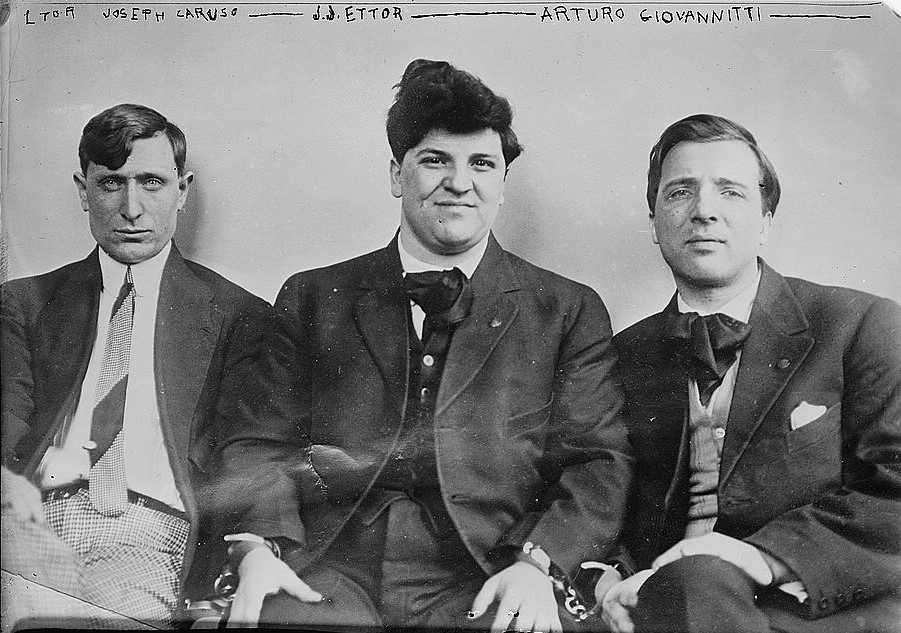
Joe Hill was in the thick of the Wobbly struggles to the very end. It is significant to point out that both Ralph Chaplin and Arturo Giovannitti, the ablest of the minor poets around the I.W.W., stopped writing when they withdrew from the forefront of the labor conflict. Their well of inspiration apparently ran dry once they lost contact with the revolutionary labor vanguard. Ralph Chaplin’s early verse, printed in the labor press under the signature of “A Paint Creek Miner,” is more fiery if less polished than his later efforts. His first work, collected in When the Leaves Come Out, is full of defiance thrown at the enemy class. In one early poem he addresses his comrades with proletarian cocksureness:
They laid their crafty traps for us to trip and
stumble in,
But when we stick together, hell I How can
we help but win?
Bars and Shadows, which contains the poems Chaplin write during his long imprisonment in Cook County jail and Leavenworth, includes the famous Mourn Not the Dead:
But rather mourn the apathetic throng-
The cowed and the meek-
Who see the world’s great anguish and its
wrong
And dare not speak!
However, most of the verse in this volume is cluttered with an outmoded imagery and a pliant mood that are rarely suited to revolutionary subject-matter. Giovannitti’s first contact with the Wobbly movement was made in the Lawrence strike of 1912, where ‘he learned to write his revolutionary anthems. One of his first poems was written while he sat on the prisoners bench with Joseph Ettor:
And now we, too, must sit here, Joe. Don’t dust
These boards on which our wretched brothers
fell,
They are clean, there is no reason for disgust,
For the fat millionaire’s revolting stench
Isn’t here, nor the preacher’s saintly smell,
And the judge never sat upon this bench.
His unrhymed recitations like The Senate of the Dead, on Karl Liebknecht, written in 1918, scarcely belong to social poetry, although they showed signs of poetic talent. But apparently even these efforts ceased when Giovannitti became identified with a reactionary section of the labor movement.
One of the rhyming contributors to the Wobbly papers who deserves mention is Covington Hall. His poems, collected in the volume, Songs of Rebellion (New Orleans, 1913), consist largely of moralistic comments on the mass martyrs of humanity. Some of them, like God Said, emulate the Casey-Jones type of Joe Hill song:
If you want the land, go take it!
I am wearied of your need:
I have filled the earth with plenty:
Have your brains all run to seed?

The Wobbly was represented not only in his own literature, but also in occasional writings by liberal men of letters of the time. The scene in O’Neill’s The Hairy Ape which describes an episode in a Wobbly headquarters was presented rather realistically. William E. Leonard’s poem, The Heretics, displayed genuine sympathy for certain victims of the red raids.
In sharp contrast are the popular novels which dealt with the Wobblies. Zane Grey’s Desert of Wheat and Robert W. Chambers’ The Crimson Tide, both written during the Palmer raids, are full of vile defamations and scurrilous attacks. In the latter, the plot is completely forgotten for entire pages while the author raves at the militant sections of the American proletariat. Beyond the Desert, a novelette by Alfred Noyes, written at the same time, is a more subtle attack:; it is the story of a former Wobbly leader who sees the light in time to stop a great strike planned by the I.W.W.
It may truthfully be said that the Wobbly found no permanent corner for himself in American literature until after the I.W.W. had disintegrated, in post-bellum days. With the dispersing of the Wobbly movement, its literary school followed the same course. When class issues grew sharper after the Russian Revolution, some Wobbly authors turned reactionary; many retired from the revolution; the most courageous continued ahead. The revolutionary heritage of the Wobblies in American literature, as in economic struggle, passed on to the Communists. Young writers who were first attracted to labor literature by the I.W.W.- Keene Wallis, in his Bughouse Square and earlier poems, and Louis Colman in his novel, Lumber – joined the Communist literary movement. Only in recent years, with the rise of revolutionary literature, has the heroic fight of Wesley Everest been commemorated in an enduring form, in one of Dos Passos’ prose etchings; or a Wobbly character added to American fiction, in Forty-second Parallel.
More recently, Josephine Herbst has takes a note which Bill Haywood voiced long ago -“Joe Hill is dead, but his songs live to greet the Red Dawn” -and woven it into one of the best revolutionary short stories, You Can Live Forever. The same theme is the subject of a poem by Alfred Hayes, one of the younger poets who has developed inside the Communist movement. Adept at handling many moods, this young Communist poet salutes his predecessor in his own idiom, I Dreamed I Saw Joe Hill Again:
And standing there as big as life,
And smiling with his eyes,
Joe says, “What they forgot to kill
Went on to organize.”
“Joe Hill ain’t dead,” he says to me,
“Joe Hill ain’t never died,
Where workingmen are out on strike,
Joe Hill is at their side.”
“From San Diego up to Maine,
In every mine and mill,
Where workers fight and organize,”
Says he, “You’ll find Joe Hill.”
The Wobbly literary movement was buried long ago. Its revolutionary heritage has passed on to the Communist men of letters.
The New Masses was the continuation of Workers Monthly which began publishing in 1924 as a merger of the ‘Liberator’, the Trade Union Educational League magazine ‘Labor Herald’, and Friends of Soviet Russia’s monthly ‘Soviet Russia Pictorial’ as an explicitly Communist Party publication, but drawing in a wide range of contributors and sympathizers. In 1927 Workers Monthly ceased and The New Masses began. A major left cultural magazine of the late 1920s and early 1940s, the early editors of The New Masses included Hugo Gellert, John F. Sloan, Max Eastman, Mike Gold, and Joseph Freeman. Writers included William Carlos Williams, Theodore Dreiser, John Dos Passos, Upton Sinclair, Richard Wright, Ralph Ellison, Dorothy Parker, Dorothy Day, John Breecher, Langston Hughes, Eugene O’Neill, Rex Stout and Ernest Hemingway. Artists included Hugo Gellert, Stuart Davis, Boardman Robinson, Wanda Gag, William Gropper and Otto Soglow. Over time, the New Masses became narrower politically and the articles more commentary than comment. However, particularly in it first years, New Masses was the epitome of the era’s finest revolutionary cultural and artistic traditions.
PDF of full issue: https://www.marxists.org/history/usa/pubs/new-masses/1934/v12n12-sep-18-1934-NM.pdf
 Revolution's Newsstand