
A valuable history of the development of the workers’ movement in Argentina in the 1890s.
‘The Socialist Movement in the Argentine Republic’ by M.H. Schultze from the International Socialist Review. Vol. 5 No. 1. July, 1904.
BUENOS AIRES became necessarily the starting point of the socialist movement in the Argentine Republic, not because it is the metropolis, but because industrialism and capitalist exploitation developed nowhere else in the land so strongly and rapidly as in that city.

On January 1, 1882, the German club Vorwärts constituted itself with thirteen members, at the initiative of G. Nocke and C. Mücke. Its declared object was to “assist in the realization of the principles and aims of Socialism, as expressed in the platform of the German Social Democratic Party.” The club Vorwarts grew slowly through the advent of new German elements that had, like the majority of its founders, fled from the persecutions which began after the adoption of the anti-socialist laws. It developed and extended its influence within the bounds of its means and environment. It had acquired 250 members sere it inaugurated its own headquarters at 1141 calle Rincon, in 1895.
In May, 1886, the club acquired its first meeting room. And in October of the same year it published the weekly Vorwärts, edited in German by A. Uhle. This paper was continued until the middle of 1901. A dramatic section and a singing society were also founded, which many of its members joined. And in 1890 a co-operative bakery was founded which existed until 1898.
The club Vorwärts has offered the free use of its club rooms to all workingmen who began to unite for the amelioration of their condition, since 1886. It also has to its credit the manifesto, written in Spanish, which was dedicated to the working class of the federal capital in commemoration of the hundredth anniversary of the French Revolution. It furthermore took the initiative in celebrating the First of May, in 1890, and in agitating, since 1891, for the naturalization of strangers with a view to encouraging their participation in the political struggle and wresting concessions from the Argentine bourgeoisie.
The initiative in the celebration of the First of May resulted in the constitution of a committee of organization in 1890, which had charge of the program corresponding to that adopted by the international congress of Paris, July, 1889. The first celebration of the First of May in Buenos Aires proved a success far beyond the expectations of the committee of organization. Three thousand citizens met in the Prado Espafiol, and the public meeting held in that place decided to organize the Federacton Obrera de la Republica Argentina (Federation of Labor of the Argentine Republic). An international labor committee was organized, which was entrusted with the formulation of a suitable program. This was quickly accomplished, and the federation was permanently constituted on June 29 of that year.
Although exclusively a labor organization in character, the federation nevertheless had a straight socialist program, modeled after that of the most advanced European countries. It soon had a strong section in Buenos Aires, composed of carpenters, shoemakers and a federal union; also sections in Mendoza, Rosario and Santa Fé, where the First of May had also been celebrated.
On December 12, 1900, the first number of the periodical El Obrero (The Worker) was published, edited and managed by Comrade G. Ave-Lallemant. It became the organ of the federation.
This organization presented two petitions to Congress and one to the president of the republic, asking for laws protecting the working class, and for the organization of a labor exchange. The Santa Fé section did the same before the legislature of the state of Santa Fé. It goes without saying, that all these petitions met the same fate—they were shelved without the respective committees taking the trouble of considering them.
On August 15, 1891, the first labor convention was held by the federation. The carpenters and auxiliaries, the German printers, the bakers, the socialist club Vorwärts, the metropolitan federal union, and the local unions of Santa Fe and Chascomus attended. The comrades who then devoted themselves to this organization and to the socialist movement were full of confidence and enthusiasm. But they met many difficulties. Along came the financial embarrassment of the country, the political disturbances, and a prolonged state of siege. The growing organization was prevented from continuing its propaganda and in 1892 it was completely weakened and dissolved, the periodical El Obrero was discontinued.
But under the ashes the sparks still glowed. Comrades A. Kühn and G. Hummel, who had belonged to the federal union of the Federation of Labor, formed the Agrupacion Socialista (Socialist Group) in December, 1892. Their organ was El Socialista, which began publication in March, 1893, but was abandoned soon after.
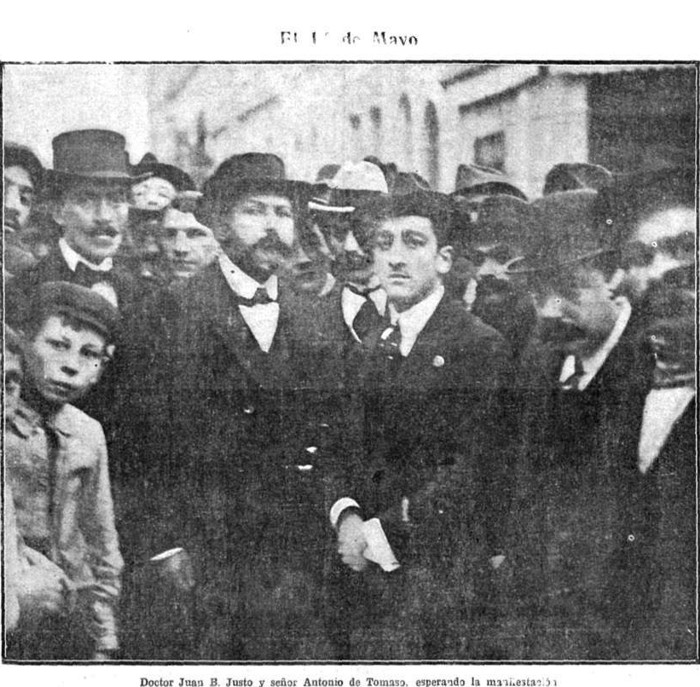
On April 7, 1894, the publication of La Vanguardta (The Vanguard) was begun, with Comrade Dr. Juan B. Justo as chief editor. And in August of the same year the Agrupacion Socialista changed its name to Centro Socialist Obrero, which it has retained to this day. Three other groups also came into the field: A French group, Les Egaux (The Equals), which soon after published the periodical L’Egalité (Equality); an Italian group, Fascio det Lavoratori (Bond of the Workers), which edited La Rivendicazione (The Demand for Betterment) ; and a group of students, Centro Socialista Universitario. There were, then, five socialist groups. This led, in December of the same year, to the formation of a central committee, which was the first link between the Argentine socialists.
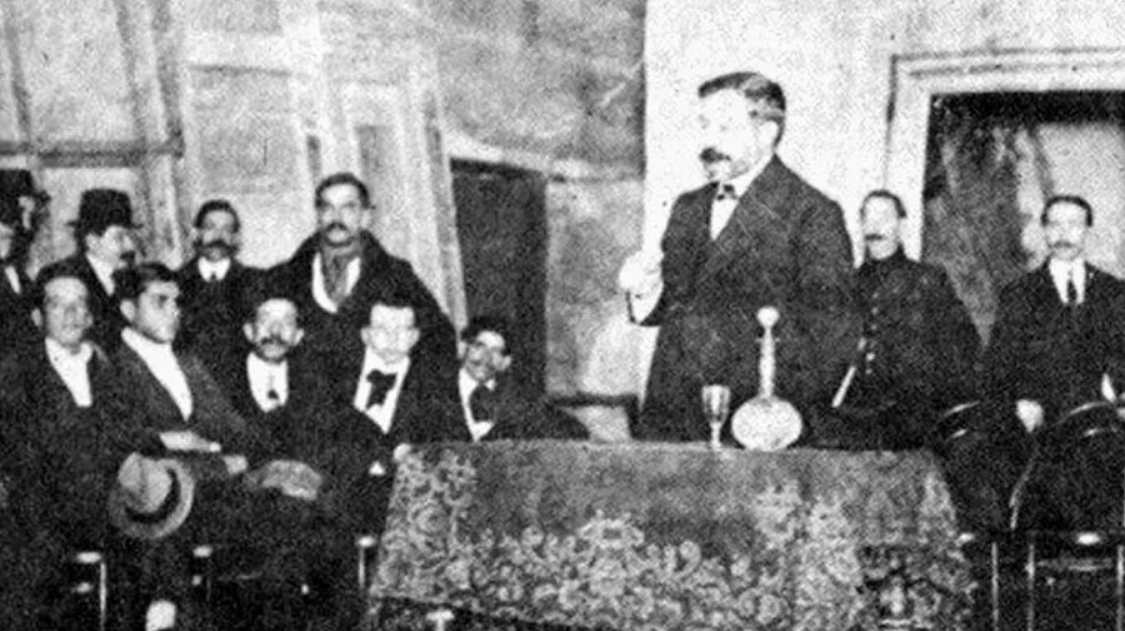
In 1895 there were already seven socialist groups in Buenos Aires. They adopted a declaration of principles and a minimum program, and decided to take part, for the first time, in the elections of 1896, with comrades Dr. Juan B. Justo, J. Schaeffer, A. Patroni, G. Avé-Lallemant, and G. Abad, for candidates. On June 28-29 of the same year the first socialist convention was held in Buenos Aires, which resulted in the permanent constitution of the Socialist Party. As the invitations for this convention were liberal, it was attended by the delegates of ten straight socialist sections, seven labor organizations, eight unaffiliated socialist sections and seven unafhliated labor unions. The Centro Socialista Obrero transferred La Vanguardia to the party, making it the central organ.
Since then the affiliated sections and individuals of the Partido Socialista Argentino have carried on their work continuously. The existing labor organizations and the propaganda of the socialist ideas and principles have taken all their time. The state of siege of 1902 was unable to shake them.
It must be admitted that the progress of the party is slow. But, nevertheless, it is manifest. The sections belonging to it have grown in quantity and quality. While only ten sections were represented at the convention of 1896, there were thirteen in 1898 and eighteen in 1900. The fourth convention, held in La Plata in 1901, the only one called outside of the federal capital, showed an increase to twenty-one sections, and the fifth, held in July, 1903, counted thirty.
Owing to special local conditions and vicious election practices, against which the mass of the people are indifferent, the party has not obtained many votes in the four national elections in which it participated. The unreliable official statistics gave us 52 votes in 1896, 99 in 1898, 136 in 1900 and 204 in 1902. But it must be considered that many socialist votes were never counted. The election officials have a wonderful ability in confiscating the votes of the opposition. Computations made by reliable and very reasonable comrades attribute to us 250 votes in 1896, 500 in 1898, 700 in 1900, and 1,100 in 1902—M. H. Schultze in Almanaque Socialista de la Vanguardia Para, 1904.
The International Socialist Review (ISR) was published monthly in Chicago from 1900 until 1918 by Charles H. Kerr and critically loyal to the Socialist Party of America. It is one of the essential publications in U.S. left history. During the editorship of A.M. Simons it was largely theoretical and moderate. In 1908, Charles H. Kerr took over as editor with strong influence from Mary E Marcy. The magazine became the foremost proponent of the SP’s left wing growing to tens of thousands of subscribers. It remained revolutionary in outlook and anti-militarist during World War One. It liberally used photographs and images, with news, theory, arts and organizing in its pages. It articles, reports and essays are an invaluable record of the U.S. class struggle and the development of Marxism in the decades before the Soviet experience. It was closed down
PDF of full issue: https://www.marxists.org/history/usa/pubs/isr/v05n01-jul-1904-ISR-gog.pdf
 Revolution's Newsstand