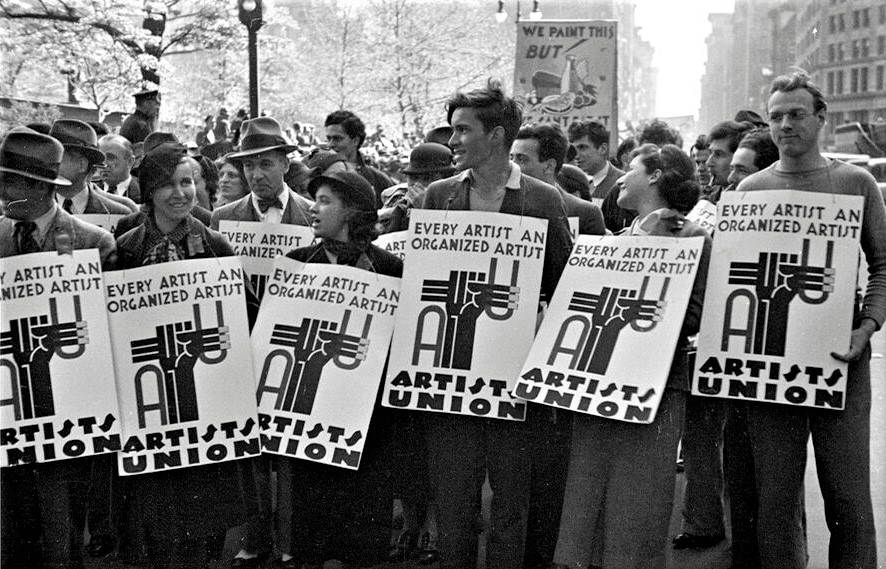
‘Artists Union Convention’ by Russell T. Limbach from New Masses. Vol. 19 No. 8. May 19, 1936.
THE black years of the crisis which began in 1929 brought nothing new for the artist except a more heightened and extended personal crisis that for him had been going on for many years. The artist in America had never been a respected member of society and no one had ever recognized him as a worker who had a right to make a living by means of his craft. This attitude was so widespread and had been in effect so long that even the artist himself thought that in order to paint he had to suffer and starve in an attic. Few indeed were the painters who could manage to eke out a living purely by their pictures or sculpture even in the days when higher and still higher rewards were the rule in almost every other professional group. More than a few artists after a struggle were forced into taking up some “sideline” in order to go on living and buy paints to work with in their spare hours.
The fortunate few who did manage to exist through the products of their art were affected almost immediately by the rapidly growing crisis, the people who bought their art had an all-too-insecure future staring them in the face to permit their indulging in luxuries least needed in their daily lives and the “sidelines” of the other artists were swept away along with the other millions of jobs that once existed. – When the dispossessed workers throughout the country began to organize into Unemployment Councils fighting for relief and a measure of security a handful of artists in New York City organized their own group of unemployed. It included such a variety of artists from abstractionists to revolutionary realists that it soon became apparent that the organization was a bona fide trade union free from quarrels of various esthetic schools and brought together for strictly economic purposes. The militancy of that early group which has grown to a membership of over 1,500 artists today as the Artists Union, has set the pace which has since inspired their membership. Last week in New York delegates from the Eastern cities representing more than 2,000 artists came together for the purpose of forming a national organization to coordinate and plan programs for the protection and betterment of the artists’ economic interests and the establishment of a permanent national art project.
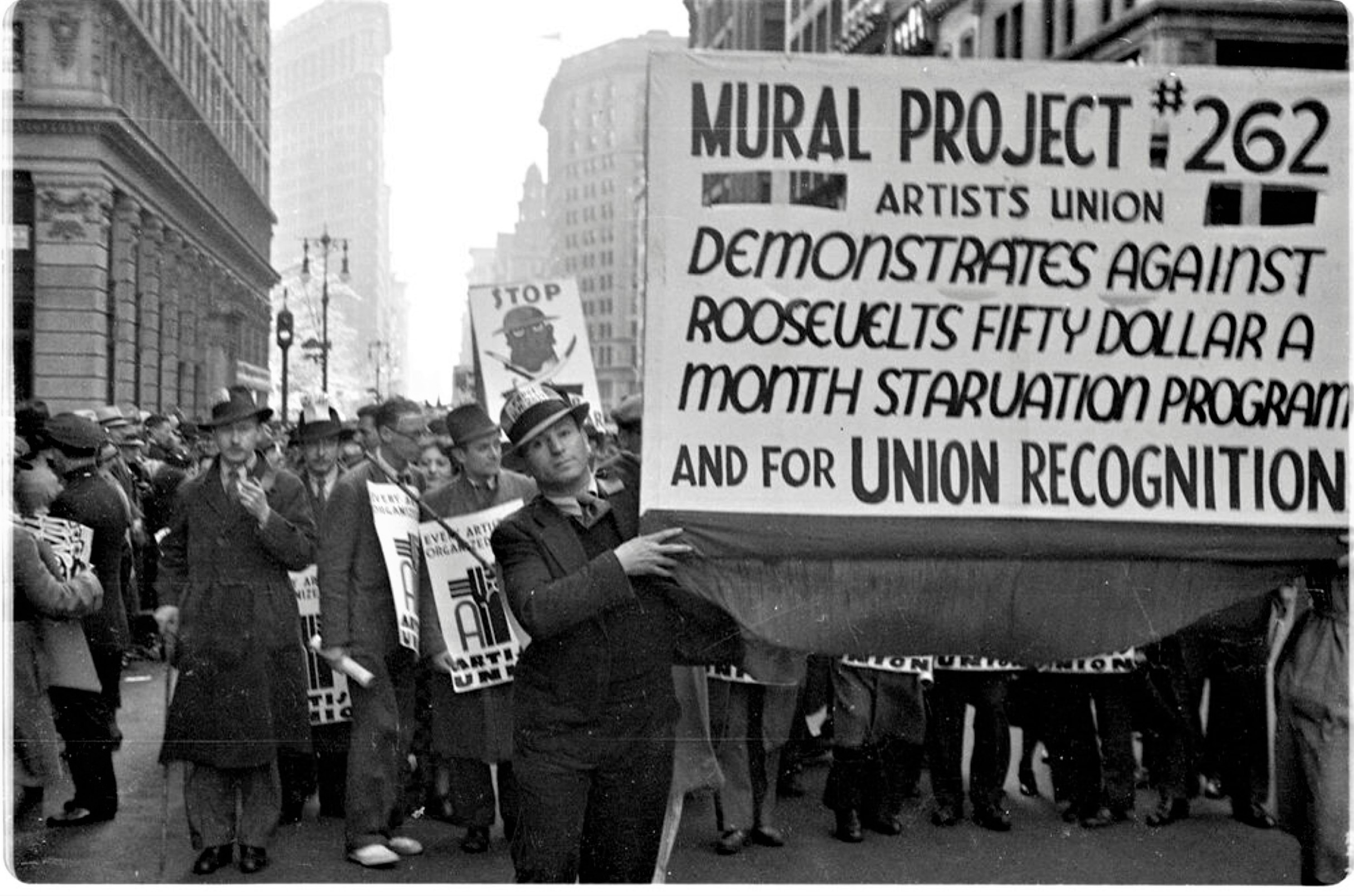
At the open session at the Hotel New Yorker such various speakers as David Freed, secretary of the Musicians Union; Elmer Rice, playwright; Stuart Davis, Samuel Putnam, Francis J. Gorman, labor leader and Meyer Schapiro were applauded for reaffirming that the Artists Union was an organization whose aims must be the aims of all labor, that they must fight to retain the advances they have already won, to prevent the liquidation of the many art projects supported by Federal funds, to organize and fight in the political field with a party of the workers.
The mass meeting recommended to the convention the serious consideration of building a Farmer-Labor Party wherever there is a local and at closed sessions of the delegates on the following days the discussions centered around concrete economic and political proposals and recognized the great danger of the gathering attacks from reactionary forces, the danger that the weakening of the economic standards of the artists will lead to further attacks on the cultural standards of America.
The convention voted to boycott Hearst publications, the Olympic art exhibition, the Venice show in fascist Italy. The danger of war as a threat to art was recognized in a resolution calling for the membership to refuse aid in. the production of war posters. Support of the Frazier-Lundeen Bill, the Marcantonio Bill and The Federal Art Bill was voted and a resolution adopted that the unions work for an immediate national wage scale of $ro3.40 monthly with an ultimate fight for a trade-union hourly wage of $2 for a minimum 1 5 hour week.
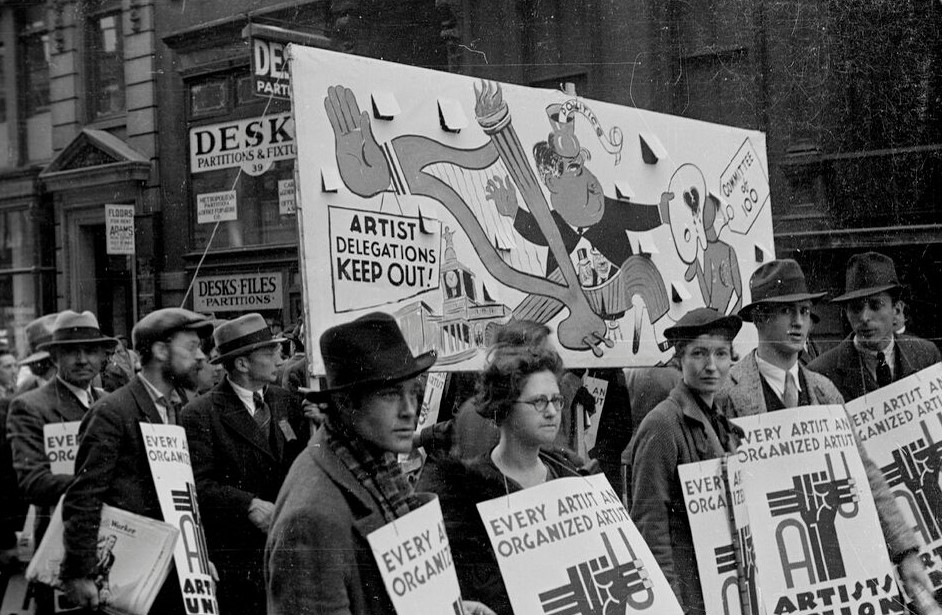
The artist in a few brief years has stepped out from his studio in a Greenwich Village attic into the trade-union hall and has found that the problems of wages, war, fascism and political action in a party with all other workers are the problems he must have the answer to in determining his own future. Artists can confidently feel that this first Eastern District convention, the Mid-West convention that will be held in Chicago May 22 to 24 and the National convention which will take place this fall are all steps leading to the ultimate emancipation of the arts and to making their enjoyment and use available to all.
The New Masses was the continuation of Workers Monthly which began publishing in 1924 as a merger of the ‘Liberator’, the Trade Union Educational League magazine ‘Labor Herald’, and Friends of Soviet Russia’s monthly ‘Soviet Russia Pictorial’ as an explicitly Communist Party publication, but drawing in a wide range of contributors and sympathizers. In 1927 Workers Monthly ceased and The New Masses began. A major left cultural magazine of the late 1920s and early 1940s, the early editors of The New Masses included Hugo Gellert, John F. Sloan, Max Eastman, Mike Gold, and Joseph Freeman. Writers included William Carlos Williams, Theodore Dreiser, John Dos Passos, Upton Sinclair, Richard Wright, Ralph Ellison, Dorothy Parker, Dorothy Day, John Breecher, Langston Hughes, Eugene O’Neill, Rex Stout and Ernest Hemingway. Artists included Hugo Gellert, Stuart Davis, Boardman Robinson, Wanda Gag, William Gropper and Otto Soglow. Over time, the New Masses became narrower politically and the articles more commentary than comment. However, particularly in it first years, New Masses was the epitome of the era’s finest revolutionary cultural and artistic traditions.
PDF of full issue: https://www.marxists.org/history/usa/pubs/new-masses/1936/v19n08-may-19-1936-NM.pdf
 Revolution's Newsstand