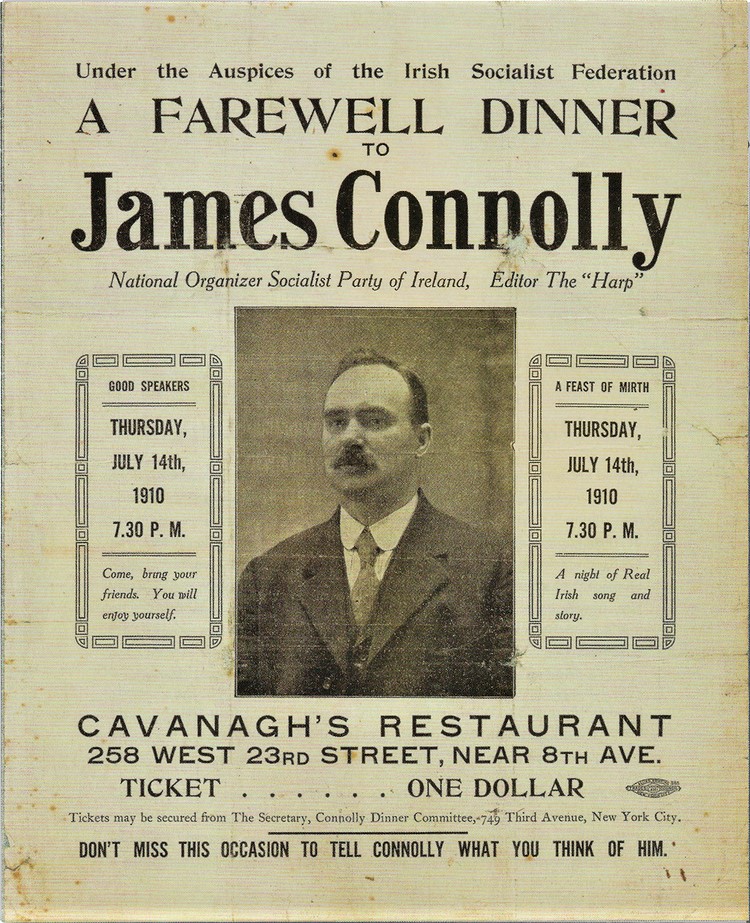
‘Memories of James Connolly’ by Bernard McMahon from the American Socialist. Vol. 2 No. 45. May 20, 1916.
His Life, His Work And His Martyrdom For Labor.
James Connolly, the well known Socialist, who was the “commander-in-chief” of the rebel army in the recent outbreak in Dublin, Ireland, was shot dead Friday, May 12. It is reported that he was convicted of high treason by court martial. Connolly was wounded during the fighting in Dublin and this delayed for a few days his being brought before a firing squad.
THE pathetic ending of the life of James Connolly in Dublin last week, one of the best of Ireland’s sons went to the great beyond. He was a remarkable man; one who loved his kind with all the intensity of his Celtic nature. It is hard to describe him to the matter-of-fact American; a taciturn dreamer, an un-Irish Irishman; for we have been called the greatest talkers since the Greeks and poor Connolly was chary of speech even to those with whom he was well acquainted.
In the year 1907, if my memory serves me right, some comrade in New York mailed me a copy of “The Harp”. I had not heard of its being contemplated. Looking it over casually I saw that it was a Socialist paper with a special appeal to the Irish race, and that its editor was James Connolly, of whom I had heard. I read every line of it and concluded at once that it was worthy of Bronterre O’Brien, Finton Lalor, or John Mitchel, three of Ireland’s greatest writers on economic subjects. Later, on a trip to New York, I failed to meet Connolly, but became interested in The Harp, naturally, as to its circulation and outlook for the future.
Speaks for Socialism.
Some time after, Connolly arrived in Chicago and, as the National Executive Committee of the Socialist Party was then in session, Comrades Mary O’Reilly, Patrick Reardon and I appeared before them, urging them to route Connolly over the country as soon as possible. This was done, and reports to the National Office from all over the Union were that Connolly was “making a hit”, everywhere.
In the meantime he had talked, under the auspices of the Cook County (Chicago) Office to different branches of the party and was the main attraction at the campaign picnic at Riverview the year following. One of the most generous tributes is ability was from the late Thomas Morgan who said that he could “sit at the feet of Connolly and look up to him cheerfully for instruction.”
A comrade in Joliet said that Connolly was the best posted Socialist he had ever heard and added quite significantly, that he had listened to them all. An active worker in New York City told me that, as a literary production, the “Harp” was easily first in America in Socialist literature.
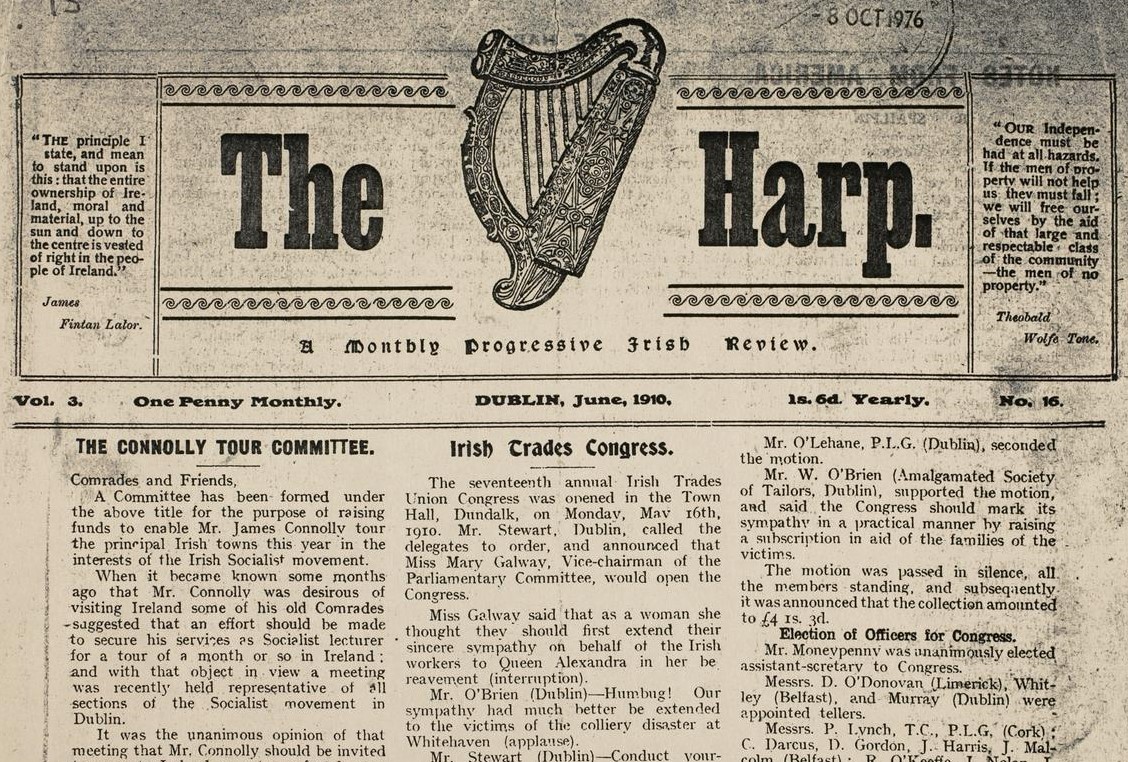
Unfortunately the little paper had no chance to live long, the most important reason being that there were not enough Irish people interested in Socialism to support it, and while it was a paper that was attractive to most people, it was primarily written in a way that should have been especially appealing to Irishmen and Irishwomen. Subsequently the paper was transferred to Dublin where it lingered for a while, finally going the way of most Socialist journals.
Useful Book For Irish.
James Connolly has written one book, “Labor in Irish History” that in my judgment is the most useful book ever written for Irishmen. It tells Ireland’s true history, its economic history, dug up from old records by this quiet, patient worker for his native land. It shows that the Emmet movement as well as its predecessor, the movement of Wolfe Tone (and practically all of Ireland’s “risings”) were largely based upon Erin’s economic wrongs.
It is tiresome to the Socialist Irishman or Irish woman to listen to the average Irish “patriot” expatiating upon the lives of those two heroes, not knowing or caring of their efforts on behalf of the Irish working class.
Connolly hit the nail on the head when he wrote, “What would it avail the Irishman, if, after achieving the liberty of his country and succeeding in establishing an Irish Republic, on the following morn he had to wait on an Irish capitalist, hat in hand, and ask for a job to help maintain himself and his family in the Green Isle, that he had risked his life to free the day before.”
Dared To Do All.
Many of us may feel that Connolly and his compatriots threw their lives away; and it really makes one sick at heart to think of the whole tragedy; but the history of Erin is one continuous list of failures of this kind; yet, can we call them failures?
Who fears to speak of ninety-eight?
Who blushes at the name?
When cowards mock the patriot’s fate
Who hangs his head for shame?
He’s all a knave and half a slave
Who slights his country thus
But true men, like you men,
Will fill your glass with us.
James Connolly was a most unpretentious man; usually reticent in speaking of himself, but his heart was filled to overflowing with a love, not only for the toilers of his own country, but for the toilers of all lands. But he knew Ireland’s story well, and he knew how the worker had been despoiled and betrayed and he determined, come weal or woe, that he was going to do his share in remedying the wrongs of his kind. That he knew this was a man’s work is self-evident, and that he “dared to do all that doth become a man” he fully proved.
Connolly was heart and soul in the Socialist movement; it was a sacred thing to him, and he measured the work and worth of others by that standard. He was as true to its promptings as the needle to the pole. Socialism was his life’s work, his duty while here, and he felt it incumbent upon him to interest everyone in its teachings and its philosophy.
I have said he knew Ireland’s story, her sad heritage of spoliation and injustice, and for that reason, his life was one continuous effort to help to restore her from her present provincial position to something akin to her former glorious one. He well knew that if any particular nationality suffered more acutely from the capitalist system, it was his own, for we are naturally a light hearted, improvident race, and this accursed system sits heavily on us. The average Irishman doesn’t know that it took England almost five centuries before she completely foisted her feudal system on his country—helped of course by some of our aristocratic countrymen.
“Let Erin remember the days of old Ere her faithless sons betrayed her—”
James Connolly’s work is not over—it has begun now in reality, for thousands will now be attracted to his writings that might never have been interested, and this fight must go on until the end, that Connolly and his fellow-martyrs sought, is reached.
Pays For His Devotion.
Is it not a frightful blot on our alleged civilization to think that not only the men and women of Ireland, but of the whole world must be worried and made uneasy thruout their lives about whether they will get a chance to toil from a small possessing class so that they can feed themselves and the children that they love?
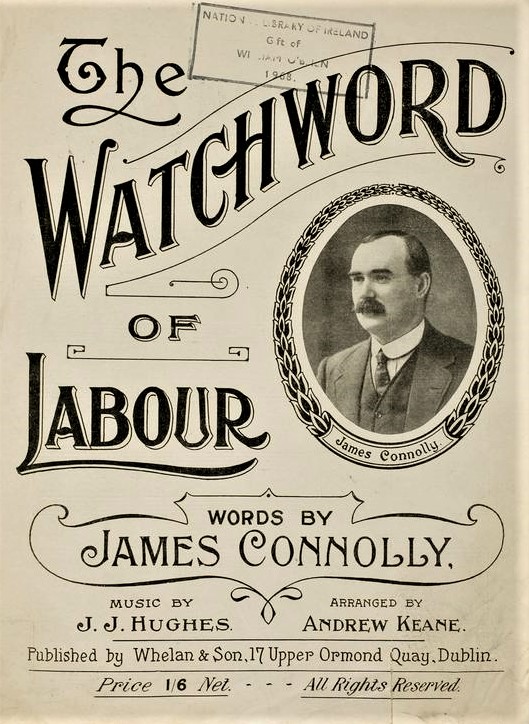
What a world of misery this dread and fear brings to the people of the earth and to what holier cause could Connolly have devoted his life than to wipe out this iniquitous system of Capitalism, and how dearly he Has paid for his devotion.
“Whether on the scaffold high, Or in the battles’ van, The noblest place for man to die, Is where he dies for man.”
Connolly left a wife and seven children behind and it naturally follows that they will have some hard days before them for men of his type are not the best providers and frequently are sneered at because of it. The wife of an agitator has usually trying experiences in the bringing up of the family—the lack of the necessities of life is not infrequent, but now it will be harder for Connolly’s poor widow, and even those who might gladly help are not often able to do it.
Another Period of Agony.
Ireland is going thru another period of agony, but because of men like Connolly, who signed their own death-warrant when they attached their name: to the Proclamation, thousands of his own coutnrymen will die peacefully in Ireland and not in the French trenches. May this love for his fellow countrymen be reciprocated by them in the near future so that the cause he fought and died for may be helped as ably and as nobly as this patriot martyr— James Connolly did help.
The American Socialist, edited by J. Louis Engdahl, was the official Party newspaper of the Socialist Party of America in the years before World War One. Published in Chicago starting in 1914, the Appeal continued the semi-internal Socialist Party Official Bulletin founded in 1904 which became Party Builder in1913. The American Socialist closely followed the SP’s electoral challenges, Engdahl was often an SP candidate in Chicago as he edited the paper, and took an early and prominent anti-war position. With a circulation of around 60,000 the paper was one of the leading anti-war voices in the run up to US entry into World War One. The paper was suppressed by Federal authorities, along with much of the anti-war left, in 1917.
PDF of full issue: https://www.marxists.org/history/usa/pubs/american-socialist/v2n45-may-20-1916-TAS.pdf
 Revolution's Newsstand