Oliver Carlson reports on the founding of the Young Workers League, youth group of the Communist Party at a meeting in 1922 attended by 46 delegates representing 2500 members.
‘Our First National Convention’ by Oliver Carlson from Young Worker. Vol. 1 No. 4. June-July, 1922.
Well, comrades, it’s history now. Our first national convention is a thing of the past. However, that doesn’t mean that we are to forget about it. Quite to the contrary. It means the inauguration of a new era in the development of our young peoples movement, — and era of intensive work in creating a mighty mass movement of the revolutionary working class youth. Our organization is still very young! as a Young Workers League, but within our ranks are to be found all of the ablest and best elements that were in the Young People’s Socialist League in the days of 1917—18—19. These comrades have behind them a fund of experience, and this they have and will utilize in building up the Y.W.L. We have learned from the mistakes of former days, and will not repeat them again. The whole tenor of the Young Workers League Convention showed that, with few exceptions, the delegates present had come to the convention for constructive work, determined to weld together into a solid, compact organization all of the revolutionary youth organizations that had answered the convention call.
To be sure, the convention was scheduled to begin at 1 o’clock Saturday afternoon, May 13th. The usual delays took place, so it was 4.30 P.M. before the convention was officially convened by comrade O. Carlson, the secretary for the National Organization Committee. He briefly outlined the development of the movement up to the time of the convention, and pointed out a few of the major problems confronting the assembled delegation.
Temporary convention rules and order of business which had been prepared by the N.O.C. were read to the convention. Following this came the reading of greetings to the convention from various organizations. It seems as tho the importance of a young peoples movement in this country is realized as well by the revolutionary youth in other parts of the world, for a communication had been received from the Executive Committee of the Young Communist International greeting our first national convention and wishing us every success in our work. The communication follows:
“Moscow, March 23, 1922. “To the Central Committee of the Young Workers’ League of America:
“We have received the material regarding your League and have studied it with closest attention.
“We understand from this the powerful development in the movement of young workers in the United States, and the great activities carried on by the young socialist revolutionists who are guiding this movement.
“We shall gladly comply with your wishes to institute a regular correspondence thru which we shall be mutually informed, and shall in the future give you the desired information regarding various questions.
“In the name of the revolutionary young workers’ movement of Europe and of other parts of the world who have banded together in the ranks of our organization, the Executive Committee of the Young Communist International enthusiastically greets the first convention of the socialist working youth of America which is laying the foundation of a new epoch in the history of the working youth.
“We assure you of the heartiest active interest and greatest attention of all our young comrades in other countries who are watching with the greatest intenseness the struggle of their brothers in the citadel of capitalism.
“We hope to hear more from you soon and especially to receive the reports of your national convention. We, in turn, shall furnish you the desired material in the near future.
“With International Youth Greetings, E. C. of the Y. C. L (Signed) Otto Ungar.”
The letter was received with great enthusiasm and prolonged applause by the delegates, who thus showed they really look to that organization as the leader and inspirer of the working class youth in its struggle to overthrow capitalism.
There were thirty uncontested regular delegates, and five fraternal delegates. Besides this there were 16 contested delegates, representing 7 city organizations of the YWL and one branch of the YPSL.
Chicago had come with a delegation of five, and mighty fine representation, which showed that the comrades there were fully aware of the importance of the convention, and were determined to fight for the principles and tactics which they considered essential for the building up the Y.W.L. Philadelphia, one of the strongest Leagues, tho but recently organized, had four regular delegates. New York city had a contested delegation, but was finally allowed eight delegates. Representatives were also present from the Y.W.L.s of Reading, Pa.; Pittsburg, Pa.; Patterson, N.J.; Washington, D.C; Minneapolis, Minn.; Boston, Mass.; Cleveland, Ohio; Gardner, Mass.; Coketon, W.Va.; Syracuse, N.Y.; Newark, N. J.; Providence, R.I.; Worcester, Mass.; the Marxian Educational League of Milwaukee, Wis.; the Labor Educational Society of Newark, N.J.; the I.Y.P.S.Ls of Rochester, N.Y.; Cicero, Ill.; Trenton, N.J.; Paterson, N.J.; Newark, N.J.; and Elizabeth, N.J.
The fraternal delegates were H. Davis from the State organization of the IYPSL of N. J.; D. Zeldon and A. Malino of the Workers Self Educational Center of New York City; B. Lipshitz of the United Toilers of America; and C.E. Ruthenberg of the Workers Party of America.
The greetings by the fraternal delegates was next on the order of business, following the election of comrade Martin Abern of Minneapolis as temporary chairman and George Oswald of Chicago as temporary secretary.
Comrade Lipshitz of the United Toilers urged the YWL to remain completely independent from any revolutionary political party, and then launched into an attack upon the Workers Party claiming that it was being dominated by centrists and opportunists, and could in no way be considered better than the Socialist Party.
The representative for the Workers Party, comrade C.E. Ruthenberg, who had just been released from prison after serving more than two years because of his Communist activities, received a mighty ovation from the convention as he took the platform. His speech was a masterly one. He told how the real work of creating a Communist Society really rested upon the younger generation, for, their task was to BUILD the new society, and that was a far more difficult task than to overthrow capitalism. He showed how necessary it was to have close cooperation and unity between the revolutionary youth and the adult workers organization, and urged the convention to place itself under the political directives of the Workers Party of America.

The matter of the contested delegates was then considered, and by an overwhelming vote, the majority report of the credentials committee was upheld and the contested delegates whom they recommended be seated were made regular delegates at the convention. The report of the minority was very obviously a biased one, as it questioned the existence of Leagues such as those in Camden, St. Louis, and other places altho plenty of correspondence was offered to substantiate their existence.
Delegates representing the YWLs of Camden, N.J.; St. Louis, Mo.; Superior, Wis.; Waukegan, Ill.; Los Angeles, Cal.; Detroit, Mich; and New York City; and the IYPSL of St. Louis, Mo. were seated.
When these matters had been disposed of — which took till the afternoon session on Sunday — the various committees were elected to prepare drafts for Manifesto and Program, Constitution, Resolutions, and Organization Promotion- Following this a report as to the activities of the National Organization Committee was given by comrade Carlson, which was accepted.
The last days session was devoted to considering the reports of the committees. The reporter for the committee on Manifesto and Program stated that the tentative draft that had been prepared by the N.O.C. and published in the March-April issue of the Young Worker had been accepted by the majority with but few changes. A minority report was given, which accepted the majority with the exception of three sections. The part most strenuously objected to by the minority was the section relating to our position to the Workers Party, which they desired to be stricken out, and to substitute in its place a clause proclaiming the absolute independence of the YWL from any Party, but stating that they would “support” all organizations claiming to adhere to the principles of the Third International. The Majority report was accepted.
A resolution on the relationship between the YWL and the WP was then introduced and carried. (This resolutions appears in another part of the magazine.)
The Constitution that was accepted recognizes the principle of democratic centralisation of authority. The National Executive Committee, elected at the convention is the supreme body between conventions. The method of organization into district and other units was provided for, be that there will be an adequate machinery to function as the League develops. The old term “circles” is replaced by that of “branches” to signify the lowest unit of the organization. Delegates to the City Central Committees are to be elected by means of a limited proportional representation plan. No branch is allowed to have a membership of more than 150. The disciplinary powers of the various units of the organization are specifically dealt with. A national convention shall be held at least once every year. Subordinate units are to hold conventions at least every six months. A provision was also made that 10% of the proceeds of all affairs conducted by Leagues or branches i3 to be remitted to the National Office of the Y.W.L. Dues will be 25c per month, of which 10c goes to the National Office. The emblem of the League will be a crossed hammer and sickle on a five pointed star within a circle. Within the circular margin shall be inscribed the words: “Young Workers League of America,” and underneath, “Clarity and Action.”
The Organizational Promotion Committee brought in a number of recommendations, all of which were referred to the incoming N.E.C.
A large number of resolutions were adopted by the convention. These were on: Political and Class War Prisoners’, The World War Veterans; Friends of Soviet Russia; Unemployment; Soviet Russia; Children’s Organizations; Revolutionary Political Unity; The YOUNG WORKER; The WORKER; The FREIHEIT; Striking Miners; Striking Textile Workers, and others.
It was then decided that the National Office of the Young Workers League should be located in Chicago hereafter.
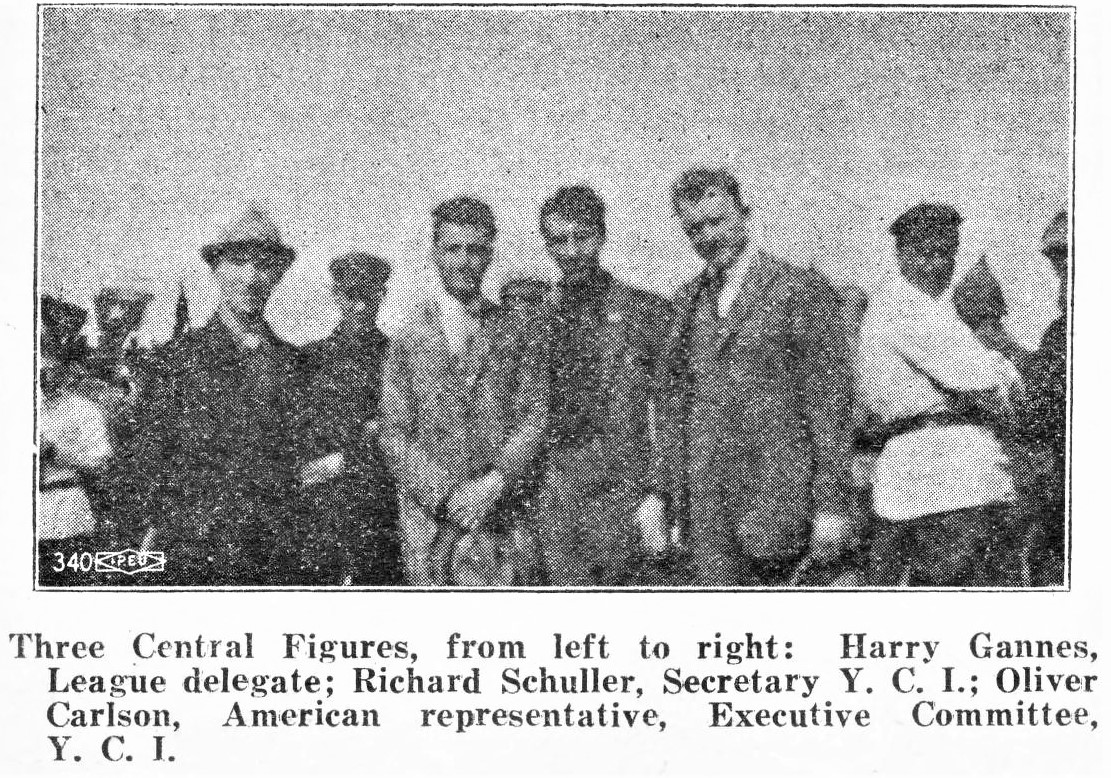
The National Executive Committee as elected by the convention consists of H. Jacobs of Philadelphia; L. Marks of Boston; H. Zam of New York; H. Gannes of Chicago; M. Abern of Minneapolis; G. A. Schulenberg and O. Carlson of New York.
Five alternates were elected. They are: J. Edwards of Chicago; A. Zanen of Philadelphia; G. Oswald of Chicago; W. Theinert of Providence; and N. Kaminsky of New York.
The Convention adjourned at 7 o’clock Monday afternoon, May 15th, with the singing of the International, The convention was over, and the 46 delegates left the hall with a determination to carry out in a truly revolutionary fashion the decisions that had been made. Everyone realized that altho there were 51 cities already organized under our banner with a membership of almost 2500, still there were ten times that number of cities where we must establish branches. They realized that the membership must be multiplied by many times the number that it was now before the Y.W.L. could become a real factor on the life of the American labor movement. They realized that we must have a powerful press which can reach still wider masses.
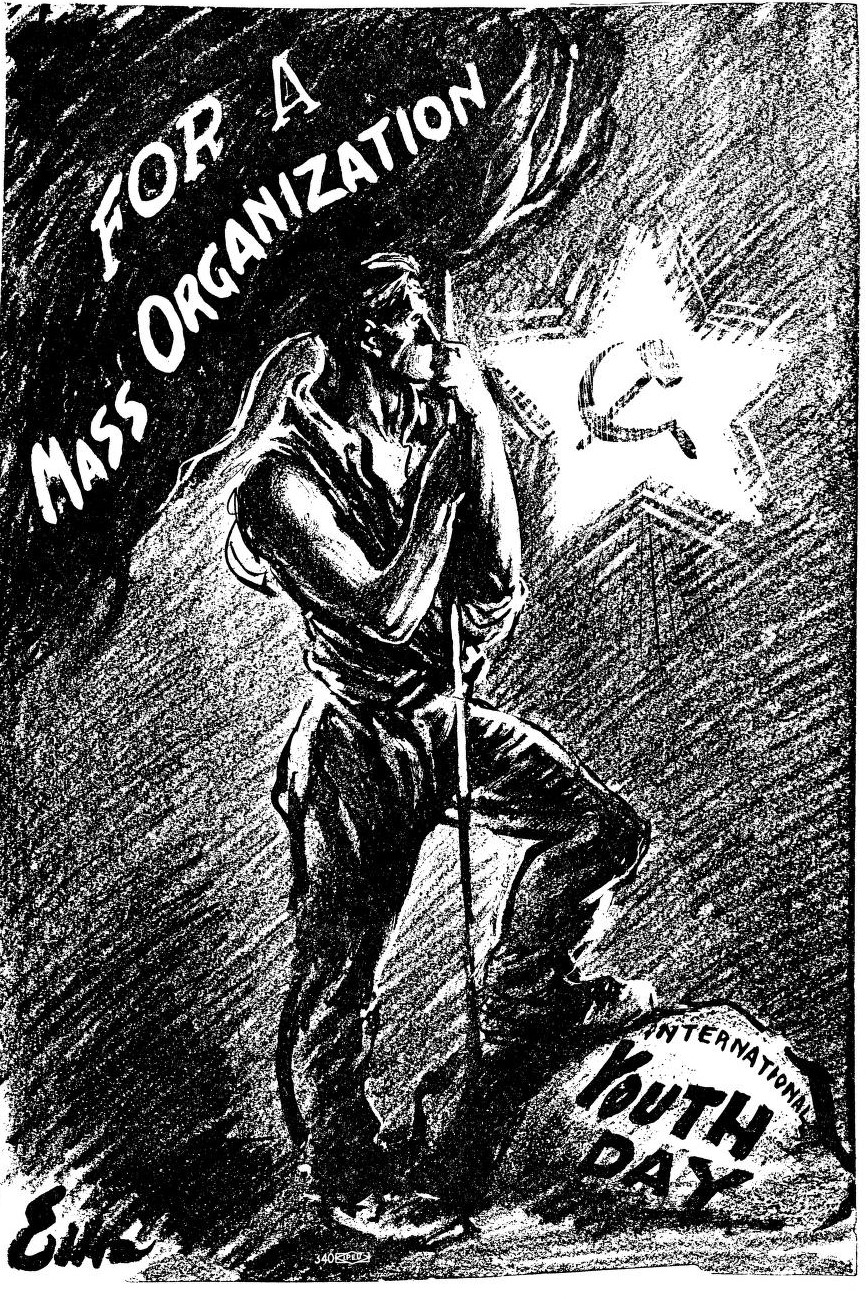
Our first convention is a thing of the past, but it has accomplished all that could be expected of it. Now it remains up to you, the comrades in all parts of the country, to put your shoulders to the wheel and help your Executive Committee to build a MASS MOVEMENT.
CLARITY AND ACTION is our motto, let us live up to it.
The Young Worker was produced by the Young Workers League of America beginning in 1922. The name of the Workers Party youth league followed the name of the adult party, changing to the Young Workers (Communist) League when the Workers Party became the Workers (Communist) Party in 1926. The journal was published monthly in Chicago and continued until 1927 when it moved to New York City and remained in print until 1937. Editors included Oliver Carlson, Martin Abern, Max Schachtman, Nat Kaplan, and Harry Gannes.
PDF of full issue: https://www.marxists.org/history/usa/pubs/youngworker/v1n4-jun-jul-1922-yw-LB.pdf
 Revolution's Newsstand