
What an amazing article, and one with much to share about organizing today’s service industries. I.W.W. delegate ‘R.B.,’ a telephone operator, details the working and social conditions of the telephone industry, in particular as they relate to their majority women workforce. Written in the aftermath of the great 1919 switchboard operators’ strike, this is both a time capsule of a past era, full of wonderful detail, and comment on a capitalist workplace almost everyone of us would recognize.
‘Need of a Telephone Workers’ Industrial Union’ by R. B., Delegate M 659, from One Big Union Monthly. Vol. 2 No. 4. April, 1920.
Telephones—time saving devices—that touch every other industry, in the process of creating a distinct and separate industry of telephone work. It is difficult to imagine a machine so universally used—even in an age of machine production—as are telephones. They have become necessities in all lines of work from the humble and most useful domestic service to the exalted and (no pardon craved, Mr. Broker) practically useless broker on Wall street. The telephone has supplanted much of the work formerly done by means of long, laborious journeys, superseded messengers, infringed upon the fallow territory of the earlier telegraph; has replaced the social visit largely, and the shopping trips for staple articles are halved (to be conservative) by means of the telephone.
And this industry, so interwoven into every phase of our social life, is operated by workers drawing about $14.00 a week or less.
The workers drawing the magnanimous “salary” are usually young girls, known as operators. Almost all states have a law fixing a minimum age for these employes. The origin of this law, like other “friend to labor” laws, can usually be traced to some reformist on some welfare board—or what not—who has sought to graft off the results of the social malady of economic misrule, rather than radically go to the root of the evil and eradicate its cause.
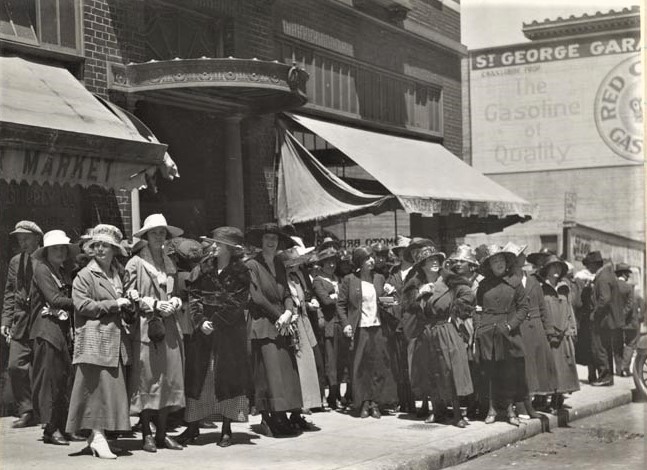
The result of this “friendly” legislation is that the “company” (ought to use a capital C—but I do not) winks at the knee dresses of the blooming young applicants whose misrepresentation of their ages is passed over easily, and the children whom the reformer sought to benefit and shield are glibly saying ‘‘Number, please?” in response to the winking lights of the impatient public, so fast and so often that— — well, try it and see what your nerves do! If you are willing to learn from another’s experience you can fancy dry throats, twitching fingers, glittering eyes surrounded by dark circles, all telling of the continual strain.
The why of this you may understand from the detailed description of the work which follows. You girls who do this work, yourselves, seldom realize, the slow—(maybe very fast) work of undermining your health that is going on. But one thing you will all agree on—you don’t’ get enough money to live on decently—You know that. A few of you complain faintly, but you have no remedy well in mind—Let’s study together on three things —(1) What we are doing—(2) The result of this work to (a) ourselves; (b) to industry in general— and (3) How to make the telephone industry safe and agreeable for the workers—as well as for the public and the “company.”
(1) What we are doing.
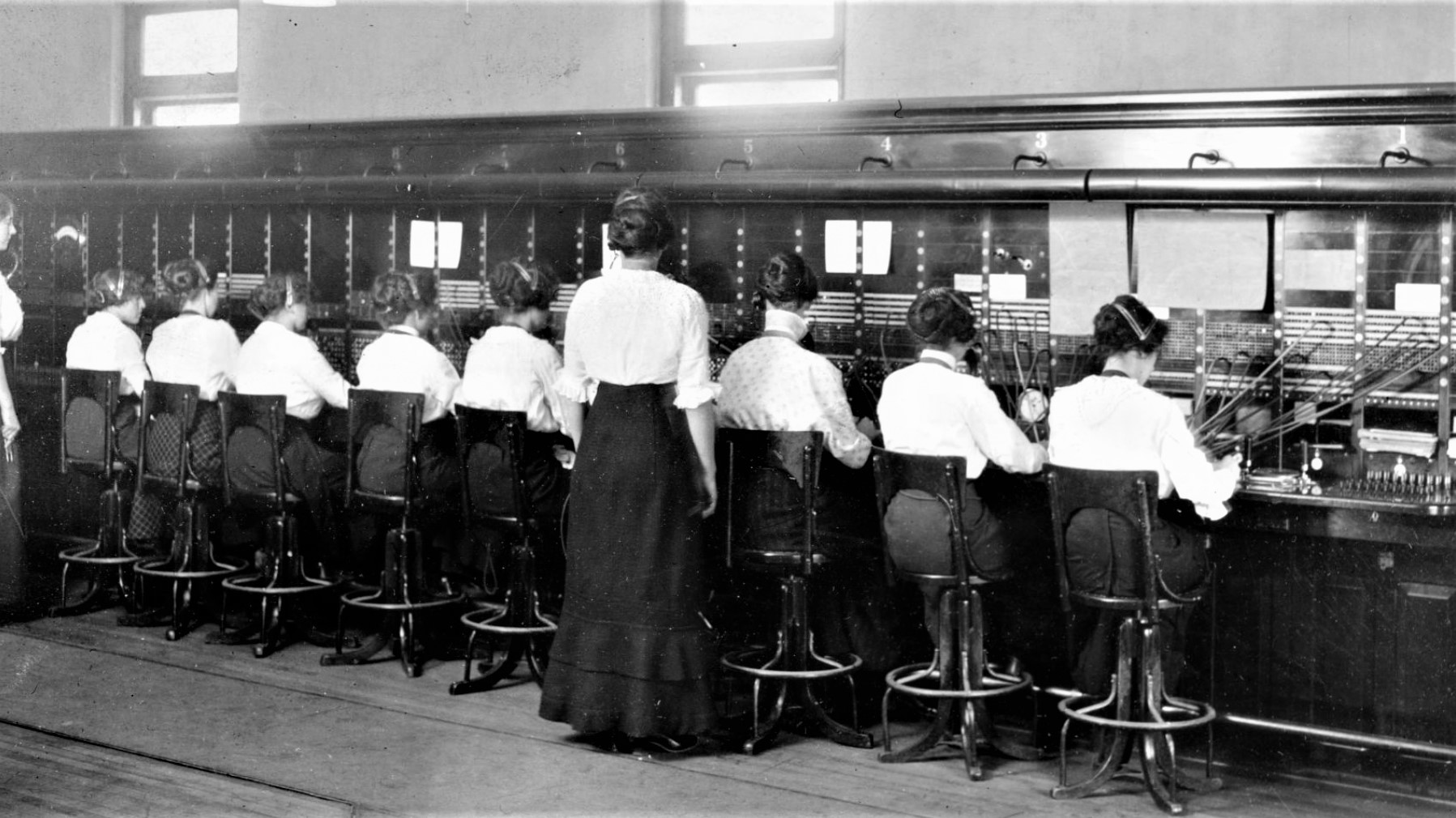
We operators, of course, are not the whole force, but we are the most important part and the most poorly paid part. (It usually happens that very essential workers in an industry are the most poorly paid; for example, salesgirls in big stores; power machine operators in factories; ironers in laundries; etc.) Here we sit at the A boards getting numbers and assigning them in our own control—passing those calls asking for another central to operators at B boards who are more rushed than we are (and who gets just a few cents a day more pay for the greater wreck being done to their nerves.) And all of us—A-operators and B-operators alike—are piling up profits for the “company” and serving the public vitally—and for ourselves—what are we — From $10.50 to very seldom over $18 a week.
Many of you menstruate too profusely and for too long a period and too frequently. And you don’t realize perhaps that this is due to the strain incident to the reaching for the distant numbers. And further you do not realize the deep seated trouble you are fostering in the organs of your sex by this abusive work.
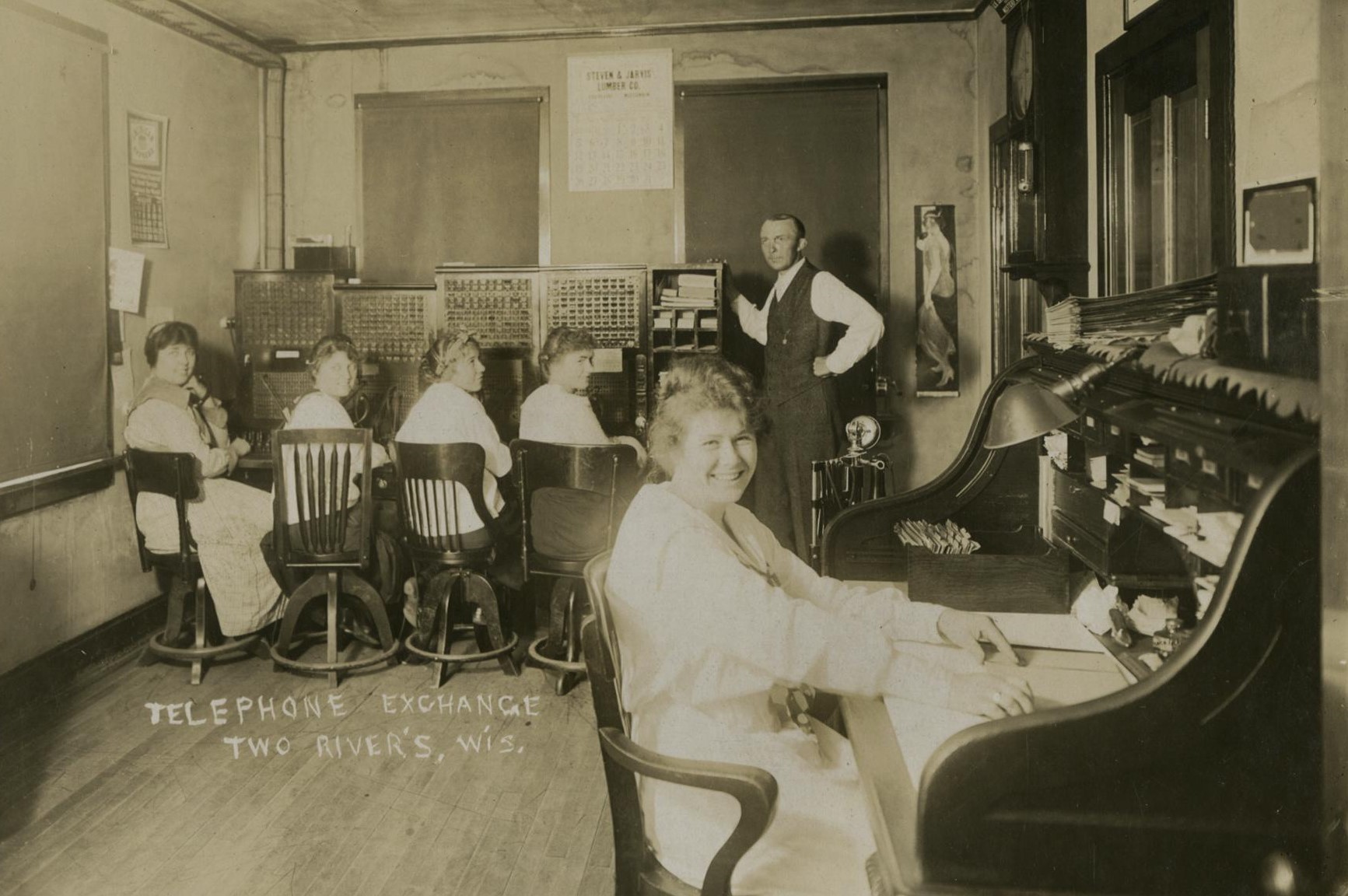
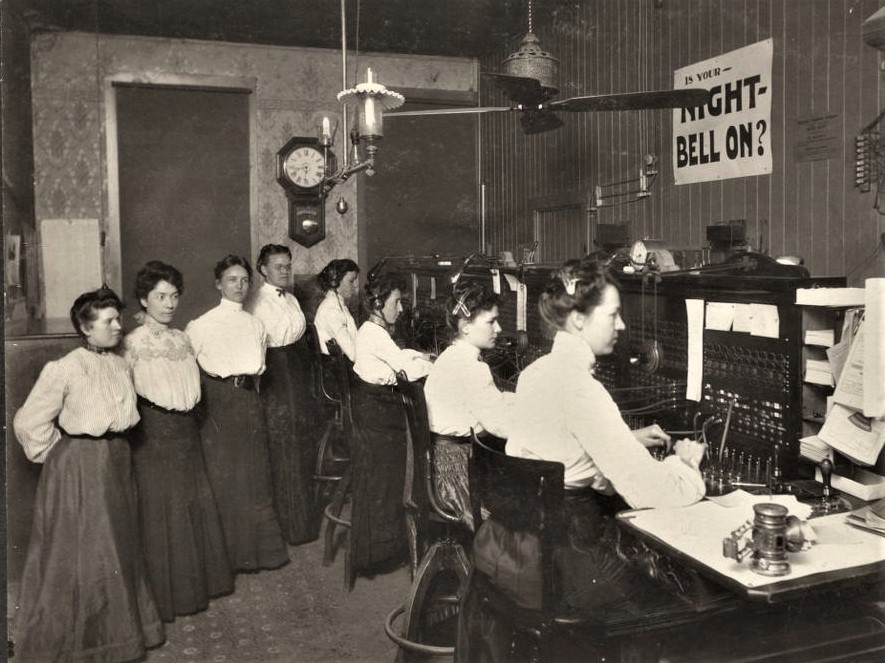
Let us pause a moment here to let the public see slightly more of their — than the posts set by “common laborers,” yet a part of our industry whose wages are low (but perhaps three times our own!)—or the wires put up by the line man, or his telephone installed by the “company’’—Let this public, whose pulsating arteries are controlled by us, see us in our chairs, elbow to elbow, in front of our various “positions” able to reach some 8 or 9 thousand numbers (by reaching our farthest!) staring at the board full of 1/4 inch round holes in panels of 100 each. If one of us becomes extra proficient let the “company’s” subscribers see the supervisor who paces up and down behind each 12 (or so) girls—and observe that supervisor place that proficient operator with an empty board on one side and a new or “green” operator just learning on the other side. Thus a price is paid by the proficient, who is placed in such a position that she is rushed as much as a new beginner.
And the supervisor “makes good” by such deeds —She earns her $3.50 (this varies.) $3.50 is a scant living but it is so much better than the operators’ pay she drew so long—that the supervisor begins to think of how much better off she is than the operator that her mind is “subsidized’”’ and her soul belongs to the company. What else can she earn $3.50 a day at? So the work of driving you biddable young slaves 8 or 9 hours a day, and every so often a Sunday thrown in, goes on. Anyway there is the Chief Operator to drive the supervisors—Oh! the regal fat Chief Operator. Never Queen ruled more completely! Her salary is a dark secret. It must be $5 or $6 a day! Fables and fairy tales! And above her and the other chief operators in the other exchanges are the traffic manager and assistant or assistants depending on the size of the city. These are the real producers of the company.
The managers’ business is to show the smallest expense sheet possible in his reports. Is he apt to want to raise your wages a dollar a week? Several hundred girls—say 900—That would be $900 a week more expense, each week. That would be $46,800 a year. If you will think a little even, you can see why the manager may be given a $5,000 a year raise if he can keep you out of a 50 cent a week raise. Even at that, he would save the company over $20,000 a year.
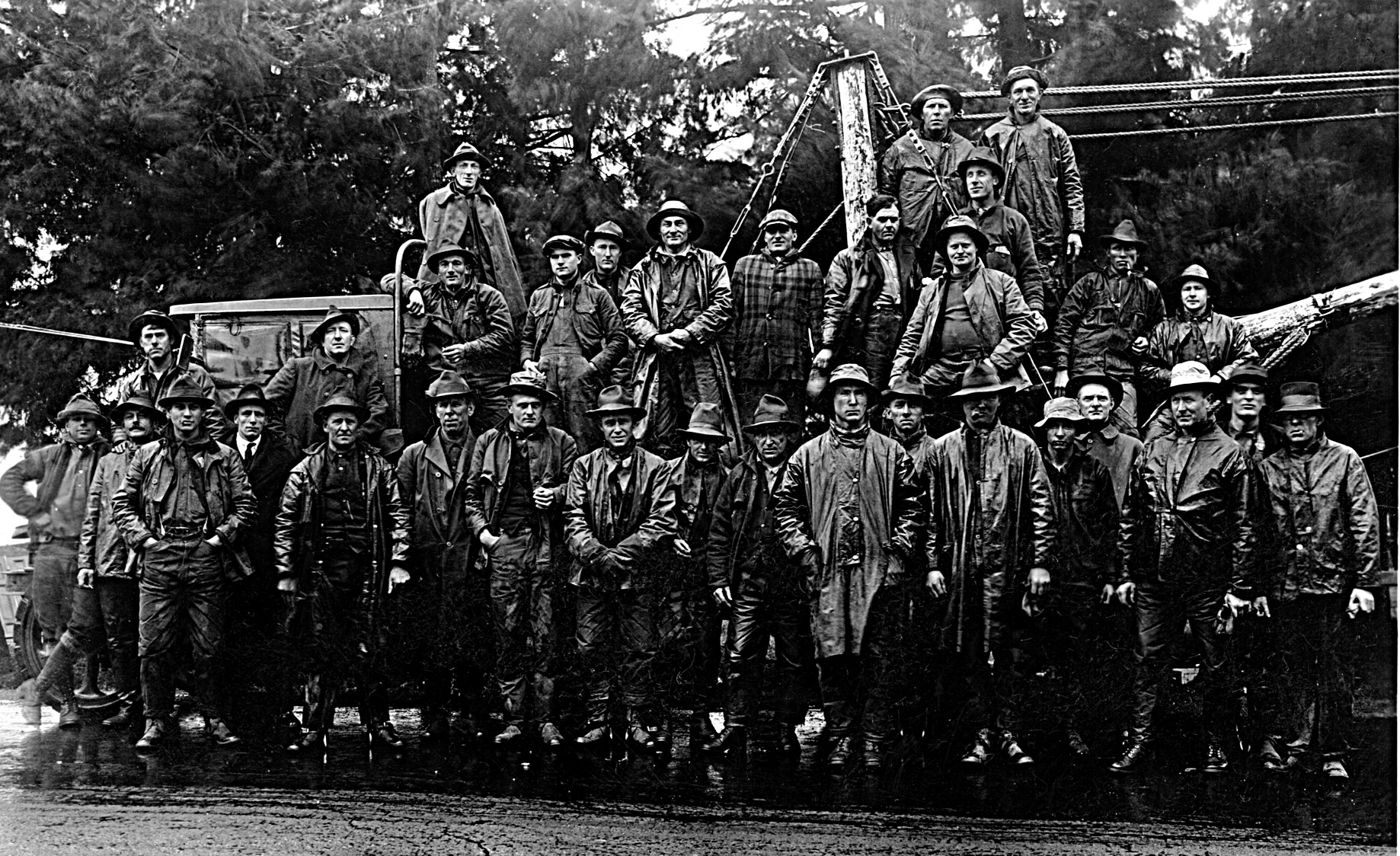
Other people engage in telephone work. are young men who learn repairing. They get more money than operators too. The system under which our business is run decrees that male workers should receive enough to take a female partner so as to raise more workers for the future. And women take less—because they do not get together and demand more! Shame on us women, then for our short-sightedness!
There are bookkeepers, typists, stenographers— yes a nurse, a matron, janitors, and elevator operators, long-distance operators, service observers and various other workers giving all their time to working with telephones.
About these service observers. Many of you operators—and users of telephones-—did not know there was such, did you? These girls with their “boss” can “listen in” on subscribers’ lines for any desired length of time—and if you’ve used an incorrect phrase, or waited too long to answer, a “report” is made against you. All operators know that Her Majesty, the Chief Operator, can “listen in” on anyone she chooses at any time for as long as she pleases. We know it, for notes and speeches tell us that “so and so” was discharged because this company “stool-pigeon” heard her say “so and so” over the phone.
In this part of our task, let us try to realize this; we are performing a very important work in commerce and society and that every worker from the elevator boy up to the supervisors; and managers are important—But there is immense inequality in the wages received for equally important services given. Let us also try to think of telephone work as an industry involving all of the workers giving time to the work instead of individuals—or operators, repairers, etc. We are a group of workers serving everybody—the public— and being paid wages by an immense corporation which is making thousands—yes, millions of dollars each year out of our work. This company is keeping back some money that we have earned from —the public. We have no reason to quarrel with each other as operators because one can answer more calls than another, or for any other reason; but we all should stand solidly together and recognize our real enemy—the company who is picking our pockets in the most systematic and orderly way imaginable.
(2) The Results of This Work. (a) To Ourselves.
The workers, except the operators and lunch room help, are possibly existing on the average slightly better than a gandy dancer on the railroad. The operators, who make a tremendous majority of the employees, are developing chronic nervous debility and female trouble almost without exception, and they are dressing poorly and eating poorly unless some ‘‘friend” is helping them out now and then as the wide-wide world knows women workers are helped out by “friends” all along the way. Free system! Every senator and representative knows these conditions, but big business is headstrong and our laws don’t require decent, safe wages; but our laws do call prostitution vagrancy. Our free system, forces vagrancy or semi-starvation of body and soul, and fixes a penalty of jail sentence and fine for the same! Girls, girls, think! And then stand together and demand, step by step, enough to live on better, till you get all you earn—you deserve all you earn. No “company” has any right to pile up millions off your work. For after all, a company is just a group of men and women, who have young daughters like you—and for the overindulgence of the people of the company your tiny 50 cent raise is quarreled at continually.
2 (b) What Our Work Does for Industry in General.
It serves all. None are left out. If we all “layed off”. just one day once—how many millions would howl? Imagine what our calls would be the next morning. The banks, the factories, every thing— farmers—all industries are served by us—We have power—for all who serve have power. They can make that power felt by stopping the service for a time.
3. How to Make the Telephone Work Safe for the workers.
Now we come to the last effort in thinking and the most vital—Some girl with an over abundance of conscience may say, it is safe. Yes, safe for the public and the company—but not for the workers. A supervisor or a constitutionally “loyal’’ slave— or my blooming cheeked lass with a conscience, or the born, crawling, snitching stool-pigeon hereupon enumerates the good points as follows and for every point mentioned I show you a reason which is to your enemy’s, the “company’s” advantage.
(Here a supervisor interrupts by saying, the company is no enemy but gives us all jobs and we remind the “super” that the company in a very few years has stolen millions of our earnings for their daughters to spend in “having a good time”— Any person who steals from you is your enemy. And the objection is not counted ef enough importance to be called a point)
Point I. But the “company” has a lunch room where we can get meals cheaper than down town.
Answer: Yes, but it costs them nothing. You pay; for food, overhead, and all—and your strength is saved thereby to put into your job. If you had to race around and wait for meals elsewhere you’d be less fit for work. Remember, the “company” loses no money on that cheap lunch.
Point II. We are given a rest room and hospital room? Answer: Surely—The furniture in this room costs at most a few hundred dollars and the dancing to victrola lulls you into forgetting your robberies—Thus for a few hundred dollars outlay the “company” saves itself thousands annually—Also your work is more efficient—(Same argument as lunch room).
Point III. We get relieved a few minutes twice a day. Answer: You usually need it, don’t you? For very definite reasons. Where is the first place you go when relieved? You can “speed up” more when you go back in, too.
Point IV. It is a better place to work than the stores or factories. Answer: Now, that is natural—I do agree with you in part—not altogether—But two people can have the same disease and one be much sicker than the other—Two children dirty—one dirtier. Both, however, are dirty. You and the other girls of the stores, etc., may have similar troubles, but remember—your nerves are being “used up” more than any other type of worker.
Why continue these arguments? But you say “well, they do pay us here while we are learning?”
Answer: Yes, but there again is efficiency—by which the “company” saves. Think how much better to take a group of “green” girls off into a separate room and teach them the exact phrases and the names of the various equipment rather than bungle along at the regular board with them. This saves the “company” money. They want what you need. Money! They get what they want by keeping back some of what you earn constantly. The “company” therefore is rich. You are poor. And you’ll stay that way and grow more so all along if you don’t act along some definite lines.
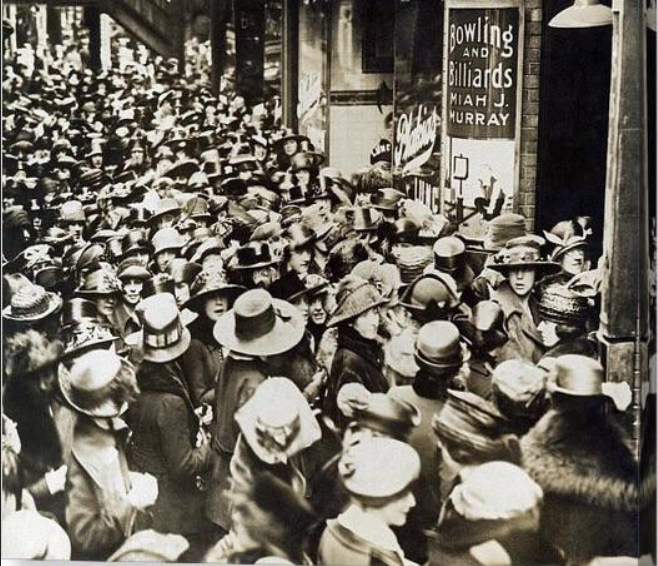
First Step: Act together. All workers in the telephone industry get together. ‘In union there is strength.”
Second Step: Shall you ask and try to argue the “company” or the manager into giving you more wages? Waste of time. Their purposes and yours are opposed. They need to keep you down to the least pay possible. So you do not need to ask for more. They never give. They say they do but workers take it. Prices go up 100 per cent—you are raised 5 per cent for fear you may get restless. Managers study you, if you don’t study them. They study you like a doctor does a fever thermometer and when it gets too hot, they apply a cold pack. Therefore you must take what you want.
Third Step: How shall we take it? Demand a certain increase in wages without warning. Give the “company” a few hours—not more than a half day. Directors and stockholders can be reached over “long distance” in that time. And if the demand is not granted “Strike”—all together. (You see this involves union. All workers together. Here the operators become the most important workers. Repairing telephones, keeping books, lining wires and testing multiple jacks will not answer calls—and refusal to answer calls will let the public know you have a grievance. The public wants to use telephones. They will help you to win your strike. Details on managing a strike will follow in a later article. A group of telephone workers are developing the first steps. The operators then must be kept in good morale. She should strike but remain at the board, report regularly to work, act in solidarity, occasionally tell the calling subscribers what the demands were—or give some such publicity. In this way the pay check will be unaffected—and if the workers in even a single city will stay just 24 hours solidly together—all demands for more wages and shorter hours will be granted— not because the “‘company” wanted to but because the workers have made their power felt.
Fourth Step: Sketchily we have arrived at the place where the problem is narrowed down to how to get together and how to keep together solidly. An immense subject. One which has never been perfectly practiced, but good beginnings have been made. Here are a few general points:
First. Learn your industry thoroughly. Not just the work you do but all parts. Not necessarily how to perform all the different duties but the nature of the work. This is Education.
Second. Get all workers in the industry interested in the fight. All together, working as a unit with committees you elect. (Don’t pay high salaries to your officers). Pay them just what you get at the job.) This is organization. You will need the help of workers in other industries. Be sure to have your union affiliate with all workers into One Big Union of All the Workers of the World.
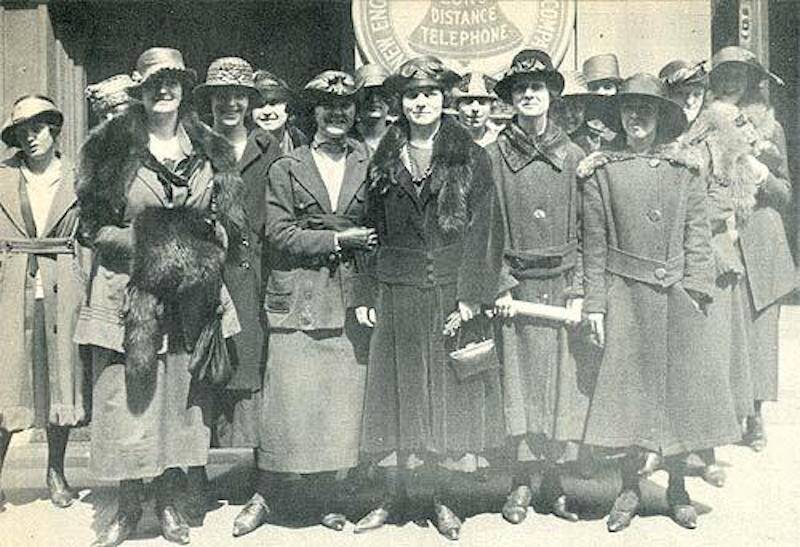
Third. Know what you want. “More wages” help out for today. Shorter hours for you makes places for unemployed people to work. But “more wages” will never be satisfactory for all time—for after your wages are raised, you will in a short time find you are paying more and more for the things you buy. Therefore you must understand that your final problem is to keep on demanding more and more by means of the “no-warning-strike,” till the “company” has to go out of business and the workers are running the telephone industry, for the public. Then the workers will elect their own supervisors, their chief operators, their own managers, etc., and all workers will receive the same pay—the full product of his toil. (If an operator worked the same length of time and got the same pay as a manager would it not be as pleasant to be an operator as to be a manager?) This is Emancipation.
Educate! Organize! Emancipate! Begin by thinking; then act; and end by living! Come on, telephone workers—the whole works are ours if we act together. Hurrah for the O. B. U. of the Workers of the World!
One Big Union Monthly was a magazine published in Chicago by the General Executive Board of the Industrial Workers of the World from 1919 until 1938, with a break from February, 1921 until September, 1926 when Industrial Pioneer was produced. OBU was a large format, magazine publication with heavy use of images, cartoons and photos. OBU carried news, analysis, poetry, and art as well as I.W.W. local and national reports.
PDF of full issue: https://archive.org/download/sim_one-big-union-monthly_1920-04_2_4/sim_one-big-union-monthly_1920-04_2_4.pdf
 Revolution's Newsstand