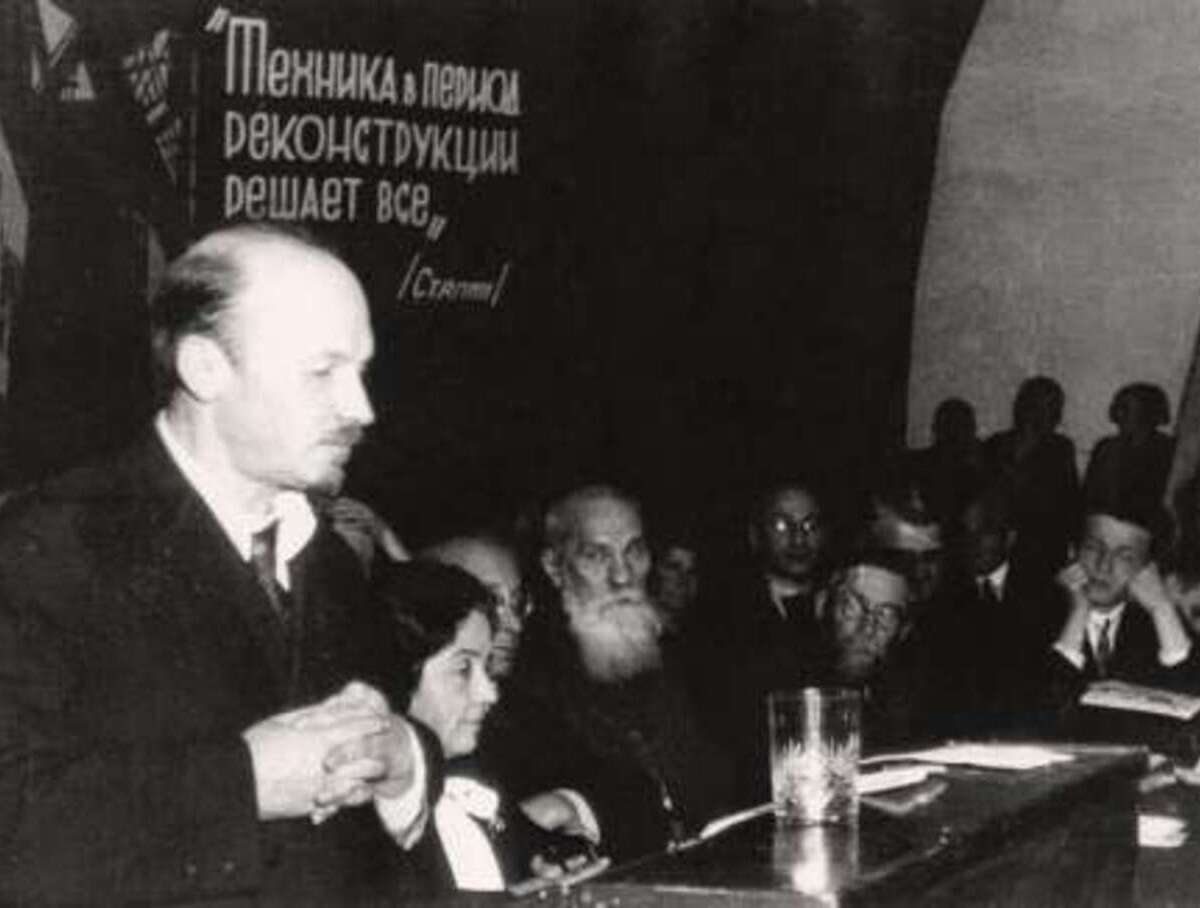
‘The Stabilization of Capitalism, the Second International and Ourselves’ by N. Bucharin from International Press Correspondence. Vol. 5 No. 53. July 2, 1925.
Below we publish from Comrade’s Bucharin’s report on “The present situation and the Policy of the Party” at the 6th Union Conference of the Russian Leninist Young Communist League, the introductory section, which deals with the international situation.
In analyzing the international situation, I must dwell on the question of the stabilization of capitalism.
First of all we must explain where we differ from all theoreticians, economists and politicians of the 2nd International.
When they speak of the stabilization of capitalism (Hilferding and many who blindly follow him in Germany, Austria etc. are typical in this respect) they describe the present period more or less as follows: the revolution which resulted from the war is, in its nature, no proletarian revolution and is altogether a peculiar kind of revolution. It is, as the Menshevik Dan says, a military species of revolution. Now the excitements has subsided; Russia which has lived through the military revolution, is being re-established, according to their opinion, on the basis of bourgeois conditions, and a new cycle of sounder capitalist development is beginning. In the most important capitalist countries, things are again running on smooth lines, capitalism is flourishing once more, the curve of capitalist development is ascending and capitalism is assuming new forms.
Hilferding maintains that the Marxist assumption that the development of capitalism is inevitably accompanied by shedding of blood, should be done away with and that peaceful forms of understanding between the great powers are possible. Thus we are entering on a great period of world history with a much greater advance and much wider development of capitalist conditions than before the war. This is the theoretical conception which the theoreticians of the 2nd International connect with the idea of the stabilization of capitalism.

When we speak of the stabilization of capitalism, we understand something quite different. We do not in any way repudiate our assertion that capitalism has entered on the epoch of its decay. We only state that in the course of this epoch there will be periods of ebb and flow, periods of decay and periods of expansion of capitalism. In one country capitalism will advance, in another recede. It will present a very variegated aspect. It will be different in the various parts oi the globe and will change with the times. It would be wrong to imagine that capitalism will necessarily decline at the same rate in every country. During the last few years capitalism has declined, but now the picture has changed. In all European countries capitalism was a short time ago on the decline, but it is now beginning to raise its head again. We say: in the first place, this phenomenon is a temporary one and in the second place it is not to be seen everywhere. It does not embrace the whole extent of capitalist conditions, but only some countries in which the crisis of capitalism has been particularly acute. This means that when we speak of the stabilization of capitalism, we understand a comparative stabilization.
Needless to say, this point of view is diametrically opposed to that shared by the theorists of the 2nd International. The theorists of the 2nd International maintain more or less the following: throughout the whole world, capitalism which has recovered from its wounds, is advancing uninterruptedly forwards. We, however. say that capitalism on the whole is even now in a period of decay. Only in a single section of the front, in which the affairs of capitalism were in a very bad way, have conditions improved. But that is all.
It is not difficult to demonstrate that the deliberations of the theorists of the 2nd International are simply contrary to the facts. In all countries of the world, an increase of armaments and preparations for new wars are taking place.
Not long ago a proposition was made at the Conference of the Limitation of Armaments called by the League of Nations. The proposal was to restrict the use of bacteriological war, i.e. to institute a campaign against the use of bombs filled with cholera and plague bacilli and all kinds of other good things (laughter). The Conference rejected this proposal, alleging as the reason for its rejection that in any case the proposal could not be carried out. This means that the cause of war has already advanced so far that it would be of disadvantage to the most powerful States to limit themselves even in such a dastardly affair as is the preparation of bacteriological bombs. Armaments are going ahead at full steam. At the present moment there are more men under arms than before the war. The theorists of the 2nd International, however, say: “we are now entering on a peaceful epoch. We must do away with the Marxist assumption that there will always be war.” And they say this when under our very eyes two wars are proceeding, in China and in Africa. We have at present a whole series of very deep seated conflicts and we have two wars.

In these conflicts and wars capitalism is showing its most loathsome sides. It is carrying on an imperialist policy of plunder which will lead to collisions and serious conflicts and will inevitably result in a second world war. Therefore the Menshevist theory as to a peaceful stage in the development of capitalism is a completely nonsensical, deceptive, mendacious and rotten theory, which is contradictory to facts.
Can it possibly be said that the present situation is similar to that which preceded the war? This is simply nonsense! Before the war we had Czarist Russia. Now we have Soviet Russia. In China, where there are 430 millions inhabitants, we have a colossal movement which is receiving spiritual nourishment from us. A very eminent German professor openly states that he wishes God would give every bourgeois government as much influence with its own people, as have Comrade Karachan and the Soviet Embassy in Peking. Through its correct national policy, the Soviet Union has roused the greatest sympathy for our country among the enormous number of the Chinese people. Was there anything similar. to this before the war? Not a bit of it, there was nothing similar.
Before the war we had a very powerful Germany. Germany and Russia were the incorporation of the international gendarmerie. At present there is no German navy and the German bourgeoisie has had its fangs drawn; therefore it hisses with a toothless mouth and preaches virtue: “Oh, how disgracefully the Entente is behaving in China!” ·
Now as regards England. The capitalist regime is still in force there. That is true. But the working class is there also now beginning to make its appearance as a fairly strong revolutionary force. Further, take into consideration a whole series of colonial ferments in Egypt and other countries.
Is all this a pre-war picture? How can anyone say that capitalism has a firmer foothold than before the war?
It is true, things have apparently improved in Germany, but in China there is a great commotion, an enforced peace has been concluded with Germany, but war is being carried on in Morocco. England has issued victorious from the German war, but on the other hand its working class has begun to get a move on. Draw the balance, and we shall see what kind of a stabilization you will have. So you see that stabilization is of an extremely relative and extremely conditional character. Among the questions of international relationships which are at present of interest, there must be mentioned the question of the united front of the imperialists against ourselves.
You know that a comparatively short time ago, a series of communications appeared in the newspapers to the effect that the capitalist powers are preparing for a general attack against us. They spoke of the demand that the Communist International should be expelled from the Soviet Union, of the economic blockade and so on. An English squadron is to visit the Baltic in order to show how formidable it is. You know many other things as to England’s activity in Afghanistan, Persia, Turkey, Roumania etc., not to mention the Conference of representatives of the general staffs of the Baltic countries which took place a short time ago. To put it briefly, they are feeling our pulse in order to ascertain how weak or how strong we are.
The campaign against us was especially intensified in connection with the explosion in the cathedral of Sofia and in connection with the terrible, absolutely unprecedented persecutions which were let loose on our brother Communist Party in Bulgaria. The possibility of united action against us could be felt in the air. It cannot be said that an end has yet been put to this activity. At the first suitable opportunity the capitalist powers may inflict a whole number of horrors on us. That this has not happened so far is due to the fact that many States have more trouble than they know how to deal with. Do you not think that China is a pretty hard nut for England to crack? Do you think that Morocco is a trifle for France? You know however Comrades, how things occur in history. Exactly the same cause, acting in the same way, leads at one stage to one kind of result, and at another stage to completely the reverse result.

The aggravation of conditions in China has up to now shattered the united Bloc against us. If however events in China continue to develop, it is extremely likely that the imperialists, seeing themselves seriously threatened, will proceed against us in a united front.
All must know that we are not concerned in any “manoueuvres” and that we desire peace at all costs.
International Press Correspondence, widely known as”Inprecorr” was published by the Executive Committee of the Communist International (ECCI) regularly in German and English, occasionally in many other languages, beginning in 1921 and lasting in English until 1938. Inprecorr’s role was to supply translated articles to the English-speaking press of the International from the Comintern’s different sections, as well as news and statements from the ECCI. Many ‘Daily Worker’ and ‘Communist’ articles originated in Inprecorr, and it also published articles by American comrades for use in other countries. It was published at least weekly, and often thrice weekly. The ECCI also published the magazine ‘Communist International’ edited by Zinoviev and Karl Radek from 1919 until 1926 monthly in German, French, Russian, and English. Unlike, Inprecorr, CI contained long-form articles by the leading figures of the International as well as proceedings, statements, and notices of the Comintern. No complete run of Communist International is available in English. Both were largely published outside of Soviet territory, with Communist International printed in London, to facilitate distribution and both were major contributors to the Communist press in the U.S. Communist International and Inprecorr are an invaluable English-language source on the history of the Communist International and its sections.
PDF of full issue: https://www.marxists.org/history/international/comintern/inprecor/1925/v05n53-jul-02-1925-inprecor.pdf
 Revolution's Newsstand