A report on France’s May 12, 1935 national municipal elections in which the Popular Front scored major breakthroughs, particularly in the suburbs of Paris; a portent of its national victory the following year.
‘The Red Belt Around Paris’ by Andre Ribard from the New Masses. Vol. 15 No. 12. June 18, 1935.
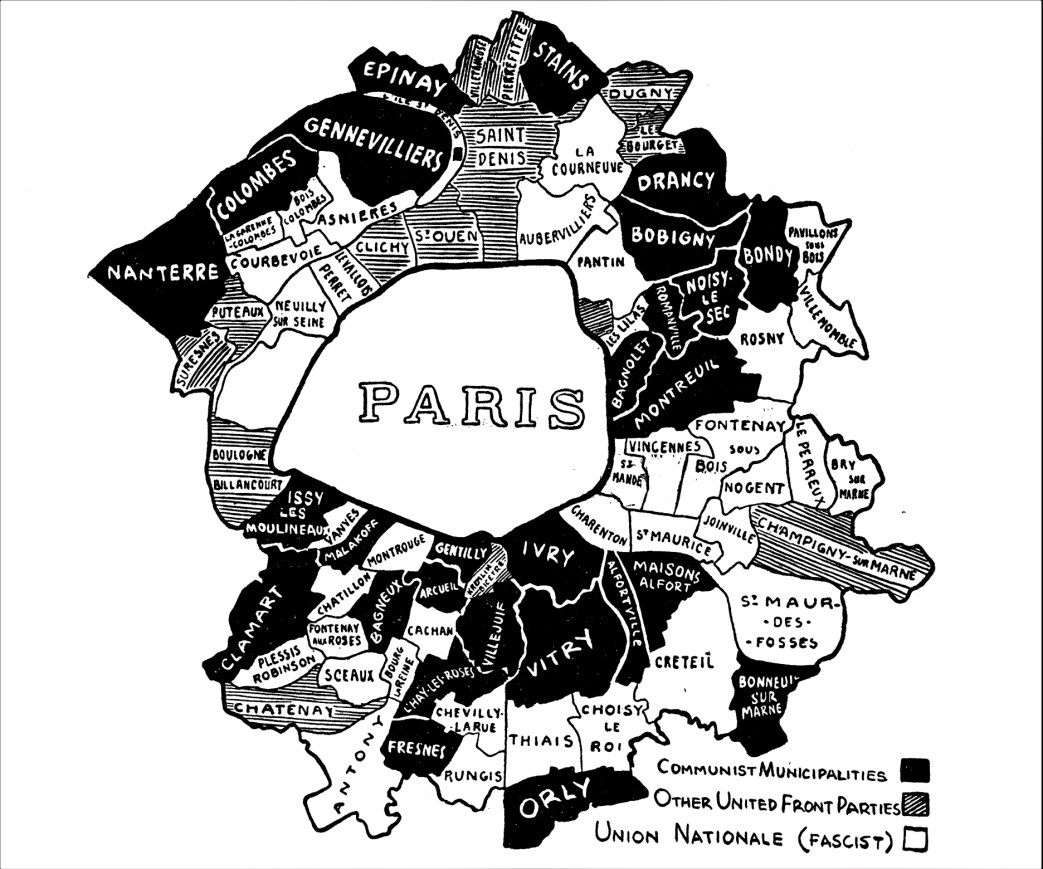
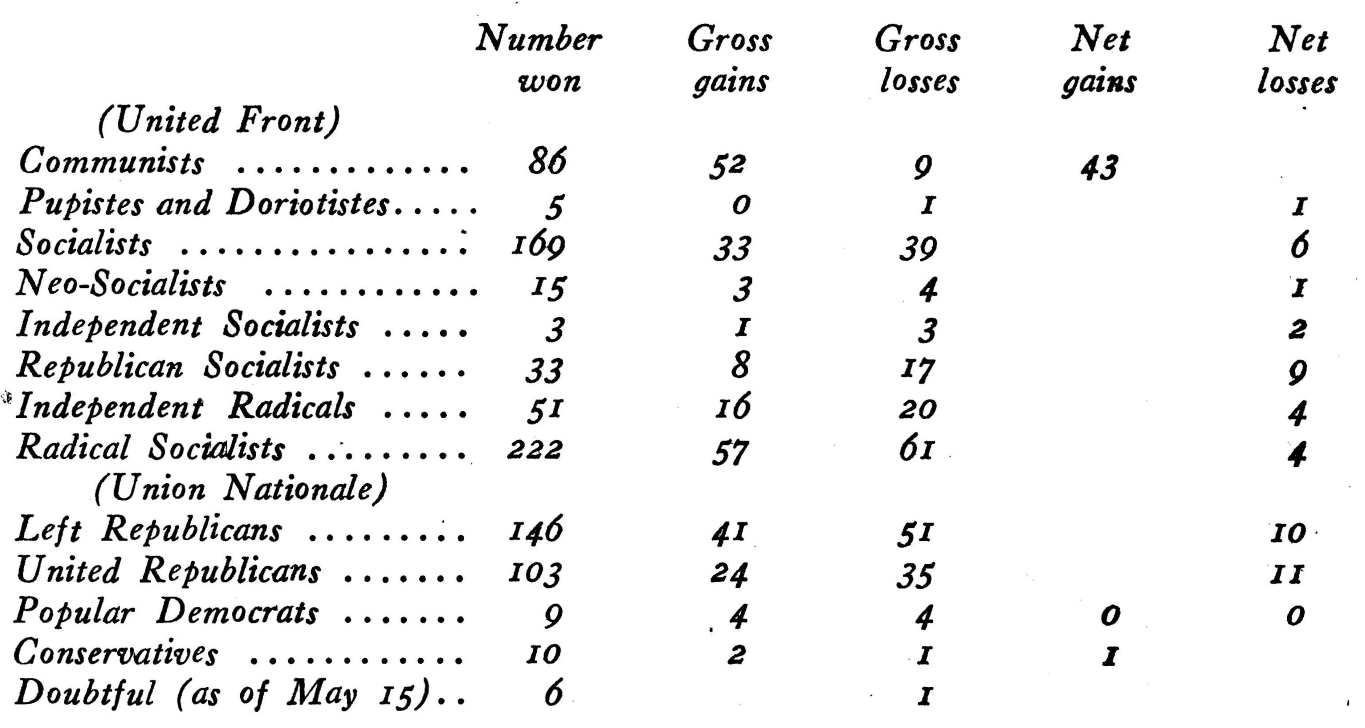
(NOTE FROM NEW MASSES EDITOR. For weeks the papers have carried news of financial crisis in France and the toppling of cabinets. Laval emerges with semi-dictatorial powers aimed at saving the country from financial collapse. The real factor behind the insecurity of French politicians is the united front called the “Front Populaire,” which won sweeping electoral victories for the workers on May 12. Formed last year on the initiative of the Communist Party of France, the “Front Populaire” has united under the anti-fascist banner the Socialist and Communist Parties, the Pupistes (Communist Opposition), some Independent Radicals and Republican Socialists and some Radical Socialists and other groups. In less than a year it has changed the current of political history in France. The results of the recent elections, sent to us by a correspondent in Paris may be summarized as follows: Three factors stand out: (1) The progress made by the Communist Party; (2) The success of the united front against fascism; and (3) the election of Prof. Rivet, one of France’s outstanding intellectual leaders and chairman of the Intellectuals’ Vigilance Committee Against Fascism. Consulting the official tables which we reproduce below, giving results for 858 communes of over 5,000 inhabitants each, the reader will observe that the Communist Party made net gains of exactly 100 percent. But these tables do not tell the whole story. No distinction is made between the larger and smaller communes of over 5,000. They do not indicate that the Party gained Colombes (57,000), Velleurbanne (65,000) and a number of other cities of importance; nor that the nine “losses” of the Party did not include suck outstanding places as Argenteuil (70,600). A gain, the statistics do not show the great progress made by the Communists in towns of less than 5,000 and Paris itself. Before the elections there was one Communist on the Paris municipal council. There are now eight. Although this is less than 10 percent of the total Council (90), the Party polled 20 percent of the Paris votes. The electoral system of Paris is notoriously undemocratic; less than 45 percent of the voters elected the reactionary councillors forming 60 percent of the body. Finally in the Paris region (including the city and its suburbs) with nearly 5,000,000 inhabitants, the Communist Party emerged as the strongest single party. It polled 235,000 votes there, or 30 percent of the total of 760,000. Before the elections it controlled nine suburban municipalities. Today it will administer twenty seven, comprising more than a third of the suburban population; and the united antifascist front won fifty-five suburban municipalities forming a “Red Belt” around Paris. Opposed to the “Front Populaire” was the bloc of Right parties forming the “Union Nationale,” all basically fascist. Had the “Front Populaire” kept the “Union Nationale”. from advancing it would have been a victory. But the united front accomplished far more; it imposed positive losses on its adversaries. It achieved positive gains for itself. We publish below an analysis of the fundamental issues behind the election results, by one of the leading French political writers of the Left.)
The Red Belt Around Paris.
FOR a century capitalism has made of the French municipalities mere branch offices of its industrial and commercial enterprises. On the pretext of competence and technical ability, the bourgeois capitalist has been the appointed administrator of the business of the city, to better strengthen his own business. The administrative myth supplemented the democratic myth. Now, however, on the morrow of such searching examinations as those of May 5 and May 12, the capitalist system finds it imperative to overturn its own constitutional forms. It must find new social myths; there capitalism interferes with the laws which tend subtly to support the direction of the social struggle and provide for democratic liberties.
Opposing this offensive brutally carried out by capitalism, the united front marks the first defensive stand of the workers. The origin of the united front is the reintegration of the classes which capitalism for a century has been busy splitting and scattering. But the reintegration was taking place without their knowing it. All that was needed to make manifest the realization of it was the fascist drive; all that this required was to see the hand of capitalism raised in attack upon these painfully acquired liberties. The united front is the restitution on a political plane of a natural unity which was bound to be sacred to all who toil. The united front is the will of the workers who have grasped the facts.
Without doubt in their ranks and among those elected May 12, there are men who still hold only to the defense of the threatened liberties. But to be anti-fascist means to think. By judging capitalism in its process of fascization, these men arrive at the inevitable conclusion of their thinking; and to escape fascism they will plunge into struggle against the regime that brings it forth. Anti-fascism, originally a position of defense, finally becomes anti-capitalism and the understanding of that position demands attack. The united front, a provisional line of defense, is thus transformed into a line of attack.
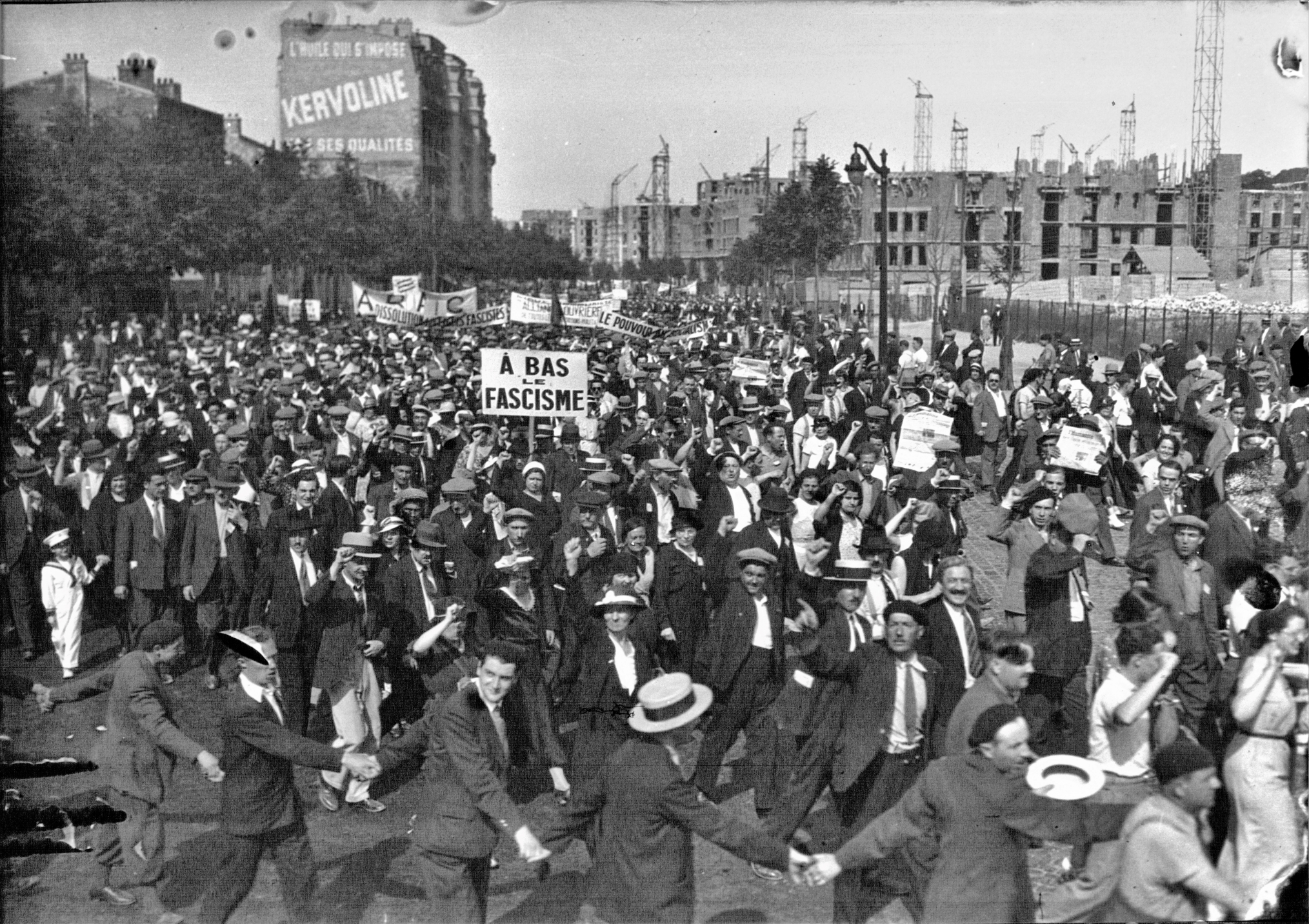
The struggles of tomorrow will eliminate the differences of doctrine, the conflicts of method among the masses of the united front. The most aggressive, effective and best adapted to events will triumph over the others. These methods will take the lead in the conflict and impose themselves because they will be right.
The bourgeoisie, terrified, at first saw only the gain of mayoralties and schools, the possession of which, of course, is precious to capitalist interests. The reality is much greater. Certainly anti-fascists, Communists and Socialists, when elected to office, very often violently alter the shameful drift of municipal life as capitalism conceives it. Their task is to expose the regime still more effectively and to defend, in spite of it and as long as it lasts, the interests of the workers. But the undertaking has further ends in view. Socialism is on its way to the conquest not only of political posts but of thought. And we may confidently assert that after such a victory as that of May over the innumerable ties that bourgeois interests have created around themselves, after such a shattering of servilities, of friendly relations, of all sorts of handouts, it is not a question of an electoral blow without a sequel, which capitalism is ordinarily pleased to imagine typical of democracy. Facts once lodged in the human mind persist. It is a blow, but a blow in the direction of a task, of a positive accomplishment.
Let nobody fool himself. This is what the votes of Paris have declared and those of the suburbs and the provinces.
The bourgeois press stated that Paris had voted “national” in the capitalist sense of the word. This is absurd. The figures are plain. There are today in Paris three clearly defined groups. On the one hand 160,000 voices bound up directly or indirectly, through interest or ignorance with the continuance of the regime. Opposed to these there are first some hundred thousand uncertain voters, who partly joined the united front at the second balloting. Is it not significant that at the second balloting the fascist candidate himself lost strength to Professor Rivet? But the great social potentiality of the future in Paris are the 160,000 revolutionary voices who asserted themselves from the first Sunday’s election. If Paris had not been electorally gerrymandered with that cleverness the bourgeoisie always displays in everything that touches its profits, Paris would have a majority of anti-fascists in the municipal government and one would not see a fascist elected in one district by 452 votes, while in a neighboring district a Communist was beaten in spite of his 4,367 votes.
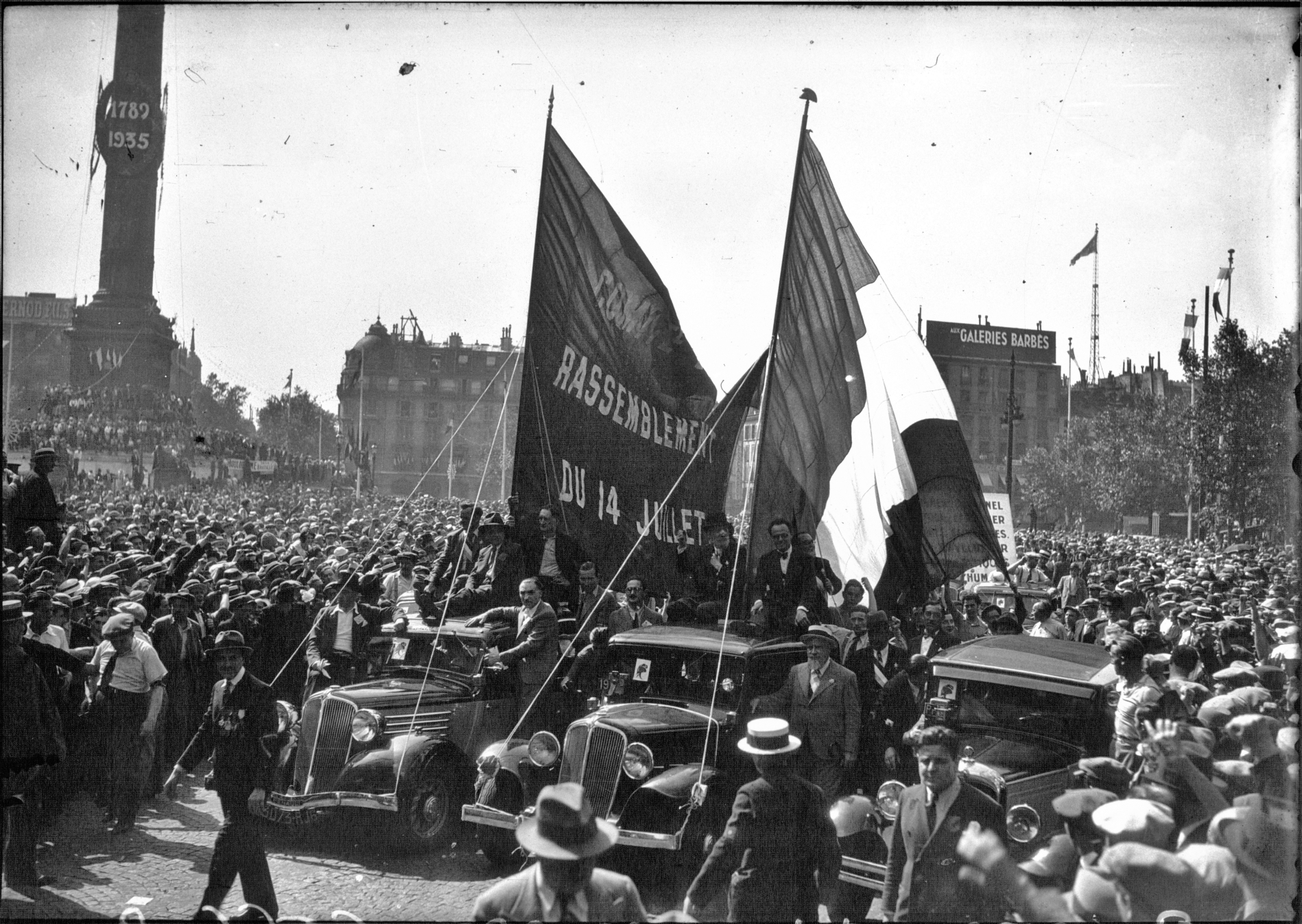
Such results in Paris should cause reflection to those who in February, 1934, flattered themselves that they were going to carry the capital with a high hand and that they expressed public opinion. But there still remain the suburbs of Paris and the provinces.
While twenty-one anti-fascists enter the municipal council of the Seine, the votes of the suburbs have enlarged the “Red ‘belt” around Paris. The entire press admits this. The fact that the capital has today a solid wall of revolutionary town halls around it carries a double meaning. It means first a tribute to administration by the masses; the “administrative myth” vanishes. The government of men ceases to appear the privilege of certain elements among them. But these votes above all demonstrate how the will to erect a new world has taken hold of the popular masses. The workers of the Parisian suburbs have already turned the united front into a front of attack. The dread of the bourgeoisie is justified. It will have to take into account these suburban effectives united with 160,000 Parisian Socialists and Communists.
However reassuring these results are, they would not be adequate to the defense of popular liberties and to the coming struggles if the provinces had not responded to the lead of the capital. In fact, never has France seen such unconditional elections. Even the figures of defeat are indicative, such as for example· the 6,505 votes of the Communist Party at Nice, where it polled only 540 in 1929. Everywhere, in the smallest rural communes as in the largest cities, the parties of labor gained votes, almost everywhere they elected candidates and they took possession of new municipalities by the hundreds. It is these hundreds of thousands of votes that determine in the final count the effectiveness of the united front. And already these figures are in default, the human march has left them behind. The united front is ceaselessly in motion, it lives on the thought that animates it. Continually growing stronger it will take control of economic developments as fast as the workers show willingness to master them.
The most notable result is the effect of the united front on the workers’ parties. The bourgeoisie, trying to neutralize the Second International, has often announced that the united front would turn against it. It is worth knowing, then, that the Socialist Party has not been the goat in the contest. The shift of votes within the parties of the extreme left is found in general to have been compensated for by new gains. It is among the middle class that the united front has made thousands of recruits. The parties of socialism have all been enriched by new adherents. The bourgeois trickery met with cruel exposure in Marseilles, Lyons, Toulouse, Narbonne, Montpellier, Nantes, Colmar, Laon, Calais, Agen, Dijon, Perpignan, everywhere. The sections most devoted to preserving the status quo, the High Alps, Finistere, La Manche, Ain, Correze, have taken a part in the contest. The Mayoralty Chambers, where for so many years the voting of the budget was nothing but an administrative formality delivering the community over to exploiters, these chambers where empty forms of the Republic never succeeded in doing more than substitute her effigy in place of the statues of the Emperor, these rooms, throughout the country, are going to echo to the voices of the masses, which capitalism wanted to strangle under fascism, but which in France will not be suppressed.
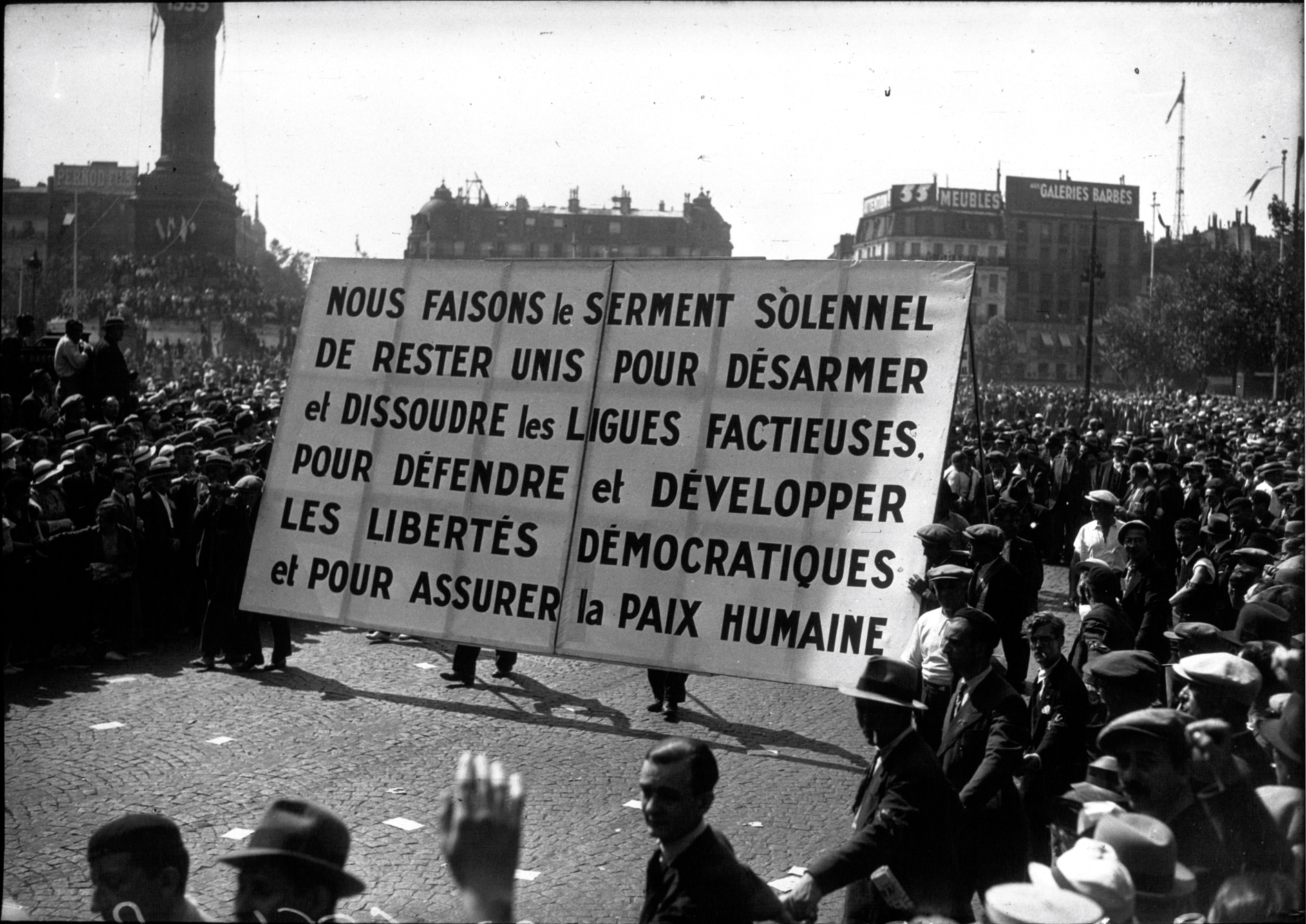
Thus has been achieved a stage in the political life of France. In the eyes of the Radicals, formerly themselves vilified, socialism integrated ceases to seem a regime of destruction and murder. For the middle classes, it finally presents a possible social solution and the course of events is going to show before long that it is the only equitable solution, humanity’s only chance. The united front will take up henceforth the fulfillment of that inspired rough draft which was the Commune of 1871. The new municipalities are bound to this future, from the most revolutionary to those that speak as yet only of anti-fascism. The mission of the Front Populaire has only begun. Tomorrow it will have need of all its followers. The next stage will be rocky. Serious events are in preparation. The strength of the united front alone will be capable of grappling with them successfully. The workers know now that the liberty of the masses depends upon their unity.
The New Masses was the continuation of Workers Monthly which began publishing in 1924 as a merger of the ‘Liberator’, the Trade Union Educational League magazine ‘Labor Herald’, and Friends of Soviet Russia’s monthly ‘Soviet Russia Pictorial’ as an explicitly Communist Party publication, but drawing in a wide range of contributors and sympathizers. In 1927 Workers Monthly ceased and The New Masses began. A major left cultural magazine of the late 1920s and early 1940s, the early editors of The New Masses included Hugo Gellert, John F. Sloan, Max Eastman, Mike Gold, and Joseph Freeman. Writers included William Carlos Williams, Theodore Dreiser, John Dos Passos, Upton Sinclair, Richard Wright, Ralph Ellison, Dorothy Parker, Dorothy Day, John Breecher, Langston Hughes, Eugene O’Neill, Rex Stout and Ernest Hemingway. Artists included Hugo Gellert, Stuart Davis, Boardman Robinson, Wanda Gag, William Gropper and Otto Soglow. Over time, the New Masses became narrower politically and the articles more commentary than comment. However, particularly in it first years, New Masses was the epitome of the era’s finest revolutionary cultural and artistic traditions.
PDF of full issue: https://www.marxists.org/history/usa/pubs/new-masses/1935/v15n12-jun-18-1935-NM.pdf
 Revolution's Newsstand