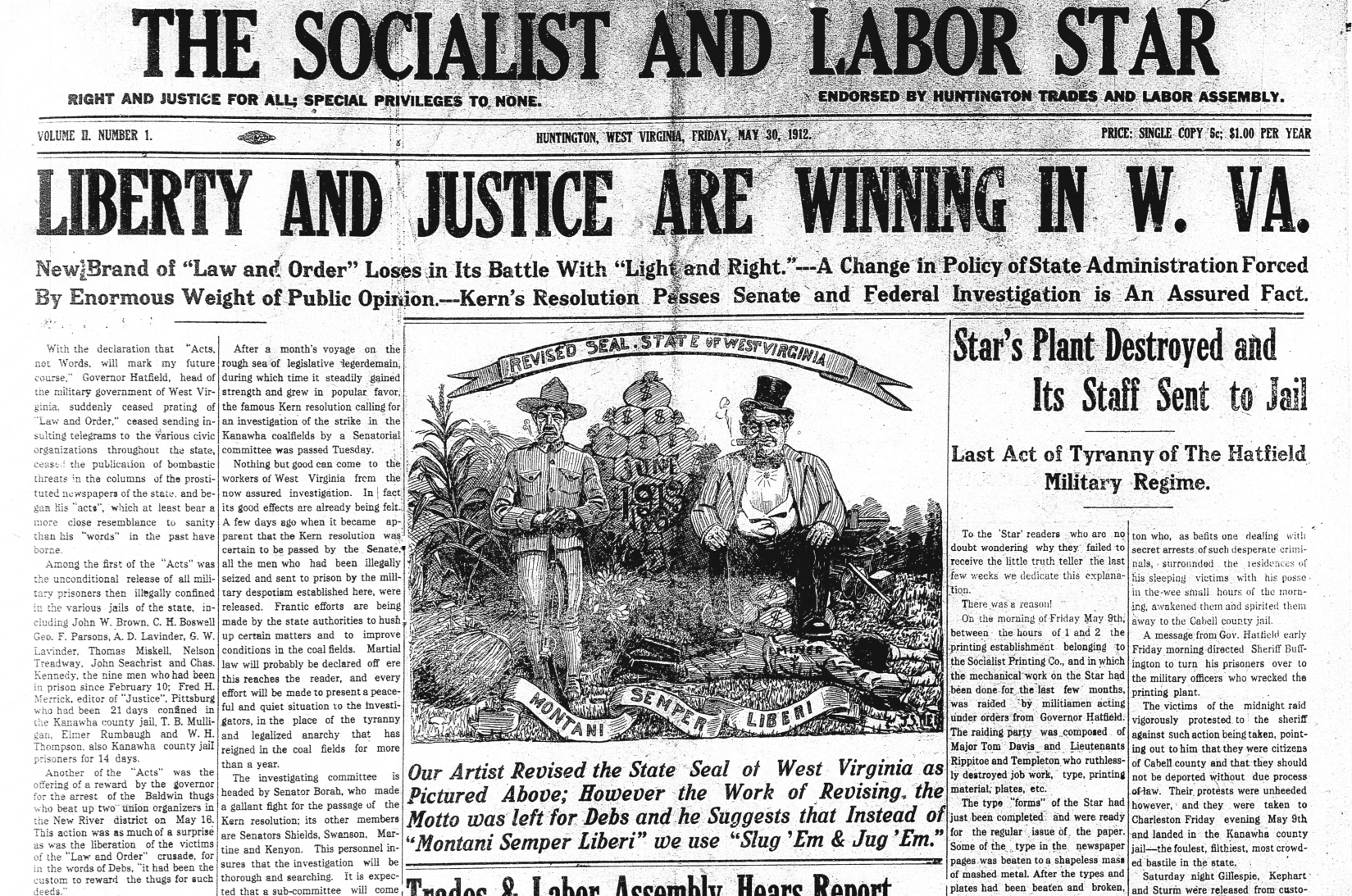
‘The Socialist Outlook in West Virginia’ by Harold W. Houston, State Secretary from The International Socialist Review. Vol. 12 No. 10. April, 1912.
It is impossible to write of the political situation in this state without enthusiasm. The apathy of recent years has given place to a marvelous awakening among all classes of voters. The seed sown by the early agitators has taken deep root in our soil and is bearing abundant fruit. The dues paying membership of the Socialist party is about one thousand. We have ninety-three locals in good standing. Our party press is a development of the last two years, and we now have the following papers: The Labor Argus, Charleston, edited by C. H. Boswell; the Clarksburg Socialist, Clarksburg, edited by E. H. Kintzer; the Wheeling Majority and the West Virginia Socialist, both of Wheeling and edited by Walter B. Hilton; the Plain-Dealer, Cameron, edited by William E. Lang. A movement is now on to start several other papers during the coming campaign.
Several towns in the state have elected Socialist mayors and other officials. Star City, Hendricks, Adamston, Miama and other towns have been swept into the Socialist ranks. All indications point to our carrying at least five counties in the coming election. Our state government is located at Charleston, Kanawha county, and the political piracy that always characterizes the doings of the politicians that infest the seat of government has polluted that community beyond description. The voters there are in revolt. The generals of the old parties find themselves without an army. The Socialists have set themselves the task of electing the entire ticket in that county, especially the legislative ticket. Our enemies freely admit that we have a splendid fighting chance. At Clarksburg, Harrison county, the situation is intensely interesting. It has attracted the attention of all of the lyceum lecturers. The industrial workers of that section are intelligent and progressive, and during the last two years they have been coming into the Socialist movement in battalions. This is another county that is almost certain to land a full Socialist ticket.
At Wheeling there is the same widespread response to the call of Socialism. The voters are organizing the entire county, and there is little doubt but that we will secure at least a portion of the ticket in that county. One of the most gratifying things about the West Virginia movement is the utter absence of factional strifes and disruptive tactics. Some slight differences do indeed exist as to minor matters, but there is no bitter or serious breaches in the organization. On the whole complete harmony reigns. The personnel of the movement is exceptionally high, and the movement is revolutionary to the core.
This is a war-born state, and it has a population that illy wears the collar of industrial servitude. When it seceded from Old Virginia it placed upon its coat of arms the motto: “Montani Semper Liberi” (Mountaineers are always free), and the sweep of the Socialist movement over the mountains and valleys indicates that we are going to translate those words into a reality. We send greetings to our comrades of other states, and we say to them that the coming election will show that we have been in the thick of the battle.
HAROLD W. HOUSTON, State Sec’y.
The Socialist and Labor Star was a Socialist Party paper in Huntington, West Virginia. This picture taken during the Paint/Cabin Creek Mine War in April, 1913. The paper they are holding is in reference to outrages committed by the National Guard in the city, who the night before threatened to assault the paper’s offices in response (another Socialist paper in the State, the Labor Argus had recently been raided with wounded and arrests). Armed socialists stayed all night to defend the paper. This is their victory picture. Two weeks later, in a protest against the Baldwin Felts agents in the city several SP members were shot, with one killed by gun thugs. That night the office was raided, and destroyed, by Baldwin Felts agents. The woman is holding an International Socialist Review, the magazine of the Left Wing of the Socialist Party.
The International Socialist Review (ISR) was published monthly in Chicago from 1900 until 1918 by Charles H. Kerr and critically loyal to the Socialist Party of America. It is one of the essential publications in U.S. left history. During the editorship of A.M. Simons it was largely theoretical and moderate. In 1908, Charles H. Kerr took over as editor with strong influence from Mary E Marcy. The magazine became the foremost proponent of the SP’s left wing growing to tens of thousands of subscribers. It remained revolutionary in outlook and anti-militarist during World War One. It liberally used photographs and images, with news, theory, arts and organizing in its pages. It articles, reports and essays are an invaluable record of the U.S. class struggle and the development of Marxism in the decades before the Soviet experience. It was closed down in government repression in 1918.
PDF of full issue: https://www.marxists.org/history/usa/pubs/isr/v12n10-apr-1912-ISR-gog-Corn.pdf
 Revolution's Newsstand