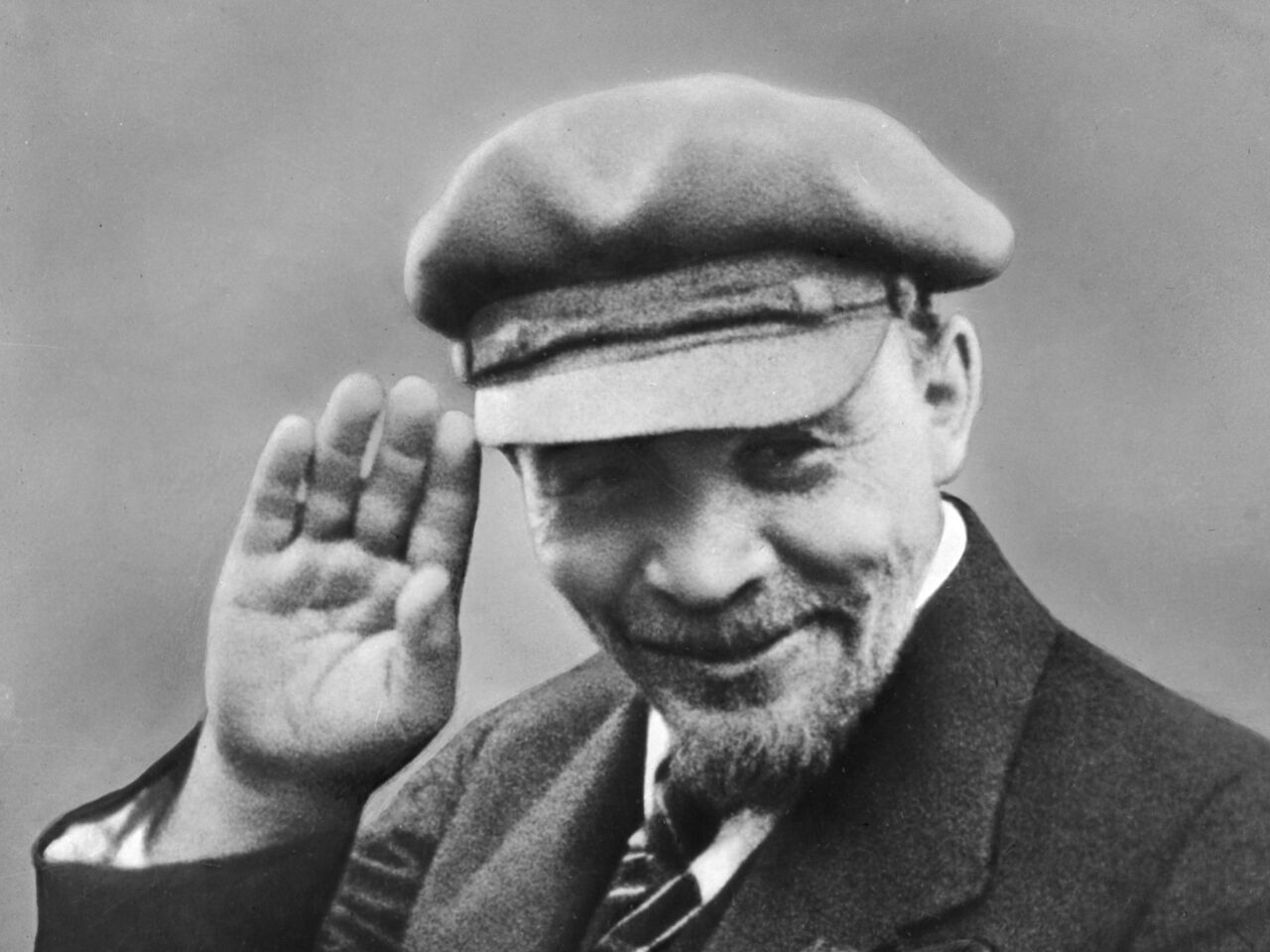
An early (original?) translation of among Lenin’s most read works, printed as a stand-alone pamphlet by the semi-legal Communist Party of America (using the initials as publisher). What is better known as a chapter of 1920’s ‘Left Wing Communism, An Infantile Disorder,’ saw Lenin intervene in a larger debate with ‘Lefts’ in the Communist International over work in bourgeois parliaments and bureaucratic unions. Interestingly, in the United States that ‘Left’ was present both in the syndicalist-leaning Communist Labor Party, and even more strongly in the A.F.L.-leaning (hence this chapter printed as a pamphlet, and not the next) but anti-parliamentarian Communist Party of America responsible for this production.
‘Should Communists Participate In Reactionary Trade Unions?’ by N. Lenin. Literature Department of the Workers Party of America, New York. 1923.
The German “Lefts” (Kommunistische Arbeiterpartei) after having considered this question, have definitely rejected the proposition of participation in reactionary trade union activities. They consider that mere denunciation and declamation against the reactionary, counter-revolutionary unions is sufficient. The barrenness and futility of such participation by “revolutionary” communists in yellow, social patriotic, reactionary, counter-revolutionary trade unions of Legien and Co., is emphasised by the “Left” Communist leader Horner more than by others.
Notwithstanding the certainty of the German “Lefts” that such tactics are revolutionary, they are, in reality, fundamentally erroneous and consist of but hollow phrases. In order to clarify this issue, I will take examples from our own experiences.
The general plan of this article aims to adapt that part of our Russian experience which, can be profitably applied to Western Europe and which is unavoidably in keeping with the history and contemporary tactics of Bolshevism.
Workers’ Dictatorship in Russia.
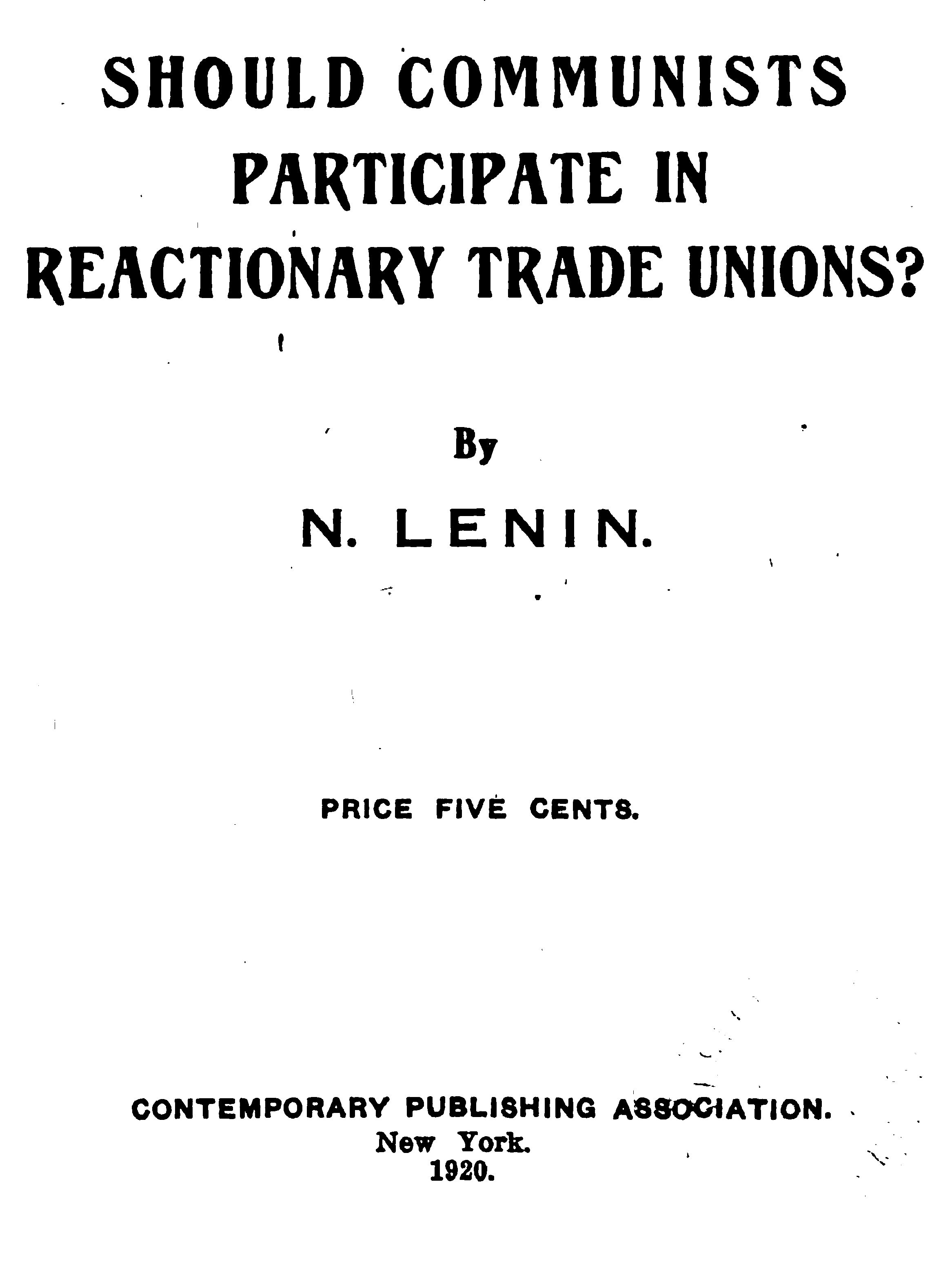
The inter-relations of leaders, parties, class and mass and the relations of the Dictatorship of the proletariat and the Communist Party to the trade unions is represented in Russia, at the present time, concretely in the following form. The Proletarian Dictatorship is realized through the Communist Party (Bolsheviki) which counts in its ranks, 611,000 members according to the latest reports of the ninth convention of the Party, held in April 1920. Before and after the November Revolution the membership fluctuated, and was much smaller even during 1918 and 1919. We fear the abnormal increase of the Party, for political and intellectual adventurers — who usually deserve to be shot — naturally attempt to insinuate themselves into the Party by cajolery and chicanery. The last time that we threw the doors of the Party wide open to the workingmen and peasants was in the winter of 1918 when Yudenitch was a few miles from Petrograd and Denikin reached Orel — 350 versts from Moscow— that is when the Soviet Republic was menaced on all sides and in deadly danger. In these dark days, the careerists and other unreliable elements, did not join the Party because, instead of receiving responsible and remunerative positions, they would expect to be sent to the gallows and tortured by the counter-revolutionists.
The Proletarian Political State.
The Communist Party meets annually in convention and is represented by one delegate for each 1000 members. It is headed by a Central Committee elected at the Convention and consisting of 19 members while the current work is conducted by a still smaller group at Moscow— the Collegium— called the Organization and Political Bureau, consisting of five members each, who are in turn elected by the plenary session of the C.E.C. No important political or organization question is decided by any State institution of the Soviet Republic without the sanction of the C.E.C. of the Communist Party.
The Party in its work is directly supported by the trade unions which now count in their ranks according to reports from their convention in April 1920 over tour million members, and which are nominally independent of the Party. (Ed. note: The Russian trad -unions, according to latest reports in Izvestia now number over five million members.) As a matter of fact, all the executive bodies of the vast majority of the trade-unions, and of the All-Russian Central Council of Trade Unions, are composed of Communist Party members who carry out all the instructions of the Party.
By this means, the Party maintains close contact with the working class and the masses and out of nominally non-communist and flexible machinery is developed a broad and mighty proletarian apparatus through which, under the leadership and direction of the Communist Party, is realized the Dictatorship of the working class.
Without maintaining this close contact with the trade-unions, without their active support, without their self-sacrifice and work, not only in the industries and economic reconstruction, but upon the Proletarian Dictatorship or to govern the country, not only for two and one half years, but for two and one half months.

It is obvious that in order to bring about this close contact with the trade-unions and the masses, very arduous and intricate work of propaganda and agitation is necessary. Frequent and timely conferences with leading officials, are necessary, not only in connection with directing the masses but also to keep in touch with every influential and active man in all the trade unions. It also means a decisive conflict with the Mensheviki, who even now, though small in number, exercise a certain influence. Their adherents are taught to use various methods of counterrevolutionary trickery, — beginning with the ideological defense of bourgeois democracy; the preaching of “independence” of the trade-unions, i.e. making the unions independent of proletarian state power; culminating in sabotage and the destruction of proletarian discipline, etc., etc.
We do not consider that juncture with the masses through trade-unions in itself sufficient. Conferences of workingmen and peasants who have no political affiliation were created during the progress of the Revolution which the Communists seek to support, broaden, and develop into institutions through which we can keep in touch and understand the masses, answer their inquiries and develop from out of their ranks men fitted for government posts, etc.
The Peoples’ Commissariat of State Control was recently reorganized by decree into the Workers’ and Peasants’ Bureau of Inspection to which the conferences of non-partisan workers and peasants were invited to send delegates to participate in these elections of members to the state control commission created for the purpose of controlling the different departments.
It must be understood that the work of the Party is earned on through the Soviets, which unite all working masses, regardless of distinctions in trades or industries. The county conventions of Soviets are democratic institutions such as, even the best bourgeois parliamentary democracies have never conceived —and through these Soviets, which are kept under the vigilance of the Party, and by assigning class conscious workers to all village posts, achieves for the proletariat the leading role in their relation to the peasantry and realizes the Dictatorship of the city Proletariat through the constant conflict for the suppression of the rich, exploiting bourgeois peasantry.
All this is the general mechanism of the Proletarian State Power as examined by the leaders from the point of view of the practical realization of the Dictatorship. We trust the reader will understand that the Russian Bolsheviki were familiar with this mechanism and watched it develop, during a period of twenty-five years from illegal underground, small circles to its present proportions. All the talk as to whether control should be exercised from above or from below or as to whether there should be a dictatorship of the leaders or of the masses, etc., is as ridiculous as to ask whether a man’s left foot is more essential to his body than his right arm.
Fallacy of Forming “Pure” Unions.
It seems to us that the German Lefts are also involved m ridiculous childish absurdities in their grave and very learned and terrifically revolutionary chatter, as to the advisability of Communists carrying on their work within the reactionary trade-unions, or of their refusal to so participate and to withdraw from them entirely and form obligatory, brand new, simon pure industrial unions. These workingmen’s unions are very youthful and’ are the inventions of the “left” Communists.
While Capitalism transmits a heritage to Socialism of century old craft and trade distinctions among the workers, it, at the same time brings out the trade-unions in which in time can and will develop broader industrial forms embracing whole industries and which will abolish all trade and craft distinctions and eventually bridging the gulf between intellectual and manual labor. The workers then become universally educated, trained and equipped to accomplish all their necessary tasks. Communism tends toward and must accomplish this, but through a long process of development. To go into raptures over this inevitable growth and to expect these industrial unions of themselves to grow into a full fledged and perfect Communist society is as criminally foolish as to expect a four year old girl to become a mother. At the best, this is ridiculous and puerile and at worst, a nasty crime.
We should and must begin to construct Communist society, not out of fantastic notions nor from artificially and man-created materials, but from such materials as are at hand and inherited from Capitalist society. It is self-evident that this is a difficult task to accomplish, but any other means to achieve this end is pure circumvention and unworthy of serious consideration.
The trade unions in the early period of Capitalism represented a great advance by the working class, during the transition from their helpless and unorganized condition to the beginning of class unity. When a higher form of class unity of the proletariat begins to develop the revolutionary political party of the Proletariat would, be unworthy of its name if it failed to understand how to connect their leaders with the working class and the masses in one integral whole.
It is inevitable that the trade-unions will show reactionary craft narrowness and conservative characteristics. But there could be no other process of development of the proletariat than through the trade-unions and the reciprocal influence of the working-class party.
Functions of Communists in Trade Unions.
The conquest of political power by the proletariat is a tremendous step forward. The mission of the Party is to educate the trade-unions to use new tactics instead of old ones to lead them, and at the same time to remember that the unions are and will be for a long time “schools of Communism” and preparatory schools for the realization of the Proletarian Dictatorship. These unions are necessary to achieve the solidarity of the workers in order to take over the administration of all the industries of the entire country by the working class as a whole and not by the individual trade or industrial unions.

Even under the proletarian Dictatorship some forms of reaction are unavoidable within the trade-unions. Not to understand this means not to have the slightest conception of the fundamental conditions obtaining in the transition period from Capitalism to Communism. To fear this backwardness of the trade-unions, to attempt to circumvent it, to try to escape is nonsensical and indicates a lack of faith in the role which the proletarian vanguard must assume as the instructor, the leader, and the beacon which attracts to the new life the lowest strata and the backward elements of the masses, the working class and peasantry. To postpone, however, the realization of the Dictatorship of the Proletariat, until the last reactionary trade-unionist or workingman relinquishes his craft or trade-union bias, would be a profound mistake.
The art of politics, the proper understanding by Communists of their problems, consists in correctly considering and discounting the conditions and the moment when the proletarian vanguard may successfully conquer political power; to be able to immediately obtain sufficient support from the non-proletarian elements of the laboring masses; and afterward to be able to safeguard and maintain their power and to extend it, educating, leading and attracting the whole laboring masses.
Expose Reactionary Leaders.
Furthermore, in countries more advanced than in Russia, the reactionary tendencies in the trade-unions are naturally more pronounced, more conspicuous, than in our country. In Russia, the Mensheviki had (and to some extent still have in a very few trade-unions) the support of the trade-unions due to trade narrowness and opportunism and craft exclusiveness. The Mensheviki of the western countries have a greater influence in the ranks of the trade-unions because these unions are dominated by a more powerful element of labor aristocracy, who uphold trade-union narrowness and the self-interest and sordidness of these petty bourgeois inspired imperialistic trade-unions whose leaders are corrupted and bribed by the capitalist imperialists. These statements cannot be successfully contradicted. The struggle with the Gomperses, Jouhaux’s, Hendersons, Merrheims, Legiens et al, in western Europe and America, is much severer than the conflict with our own Mensheviki who represent a more homogeneous social and political type.
This struggle must be carried on without compromise and these reactionary and incorrigible social patriotic, opportunist leaders must be exposed, discredited and expelled in disgrace from the trade-unions. It is impossible to conquer political power until this fight has been waged up to a certain degree. In different countries and in different circumstances, the degree to which the fight should be carried is not always identical. These conditions can be carefully appraised only by trained, thoughtful and experienced political leaders of the proletariat of each country.
In Russia, for example, the criterion of success in this conflict was determined by the elections to the Constituent Assembly in November 1917 — a few days after the proletarian uprising of October 25, 1917. In these elections, the Mensheviki were overwhelmingly defeated, receiving 700,000 votes (including trans-Caucasia— 1,400,000 votes) as against 9,000,000 votes received by the Bolsheviki. (See my article on the Elections to the Constituent Assembly and the Dictatorship of the Proletariat.)
The struggle with the “labor aristocracy” we carry on in the name of the working masses and for the purpose of winning the masses over to our side. This struggle with the social-chauvinist and opportunist leaders must be carried on in order to attract the working class to us. It would be sheer folly to ignore this most elementary and self-evident truth. And it is precisely this folly that is being committed by the “left” German Communists, who, because of the reactionary and counter-revolutionary character of the leaders of the trade-unions, jump at conclusions and withdraw from the unions, refusing to work within them; evolving new and fantastic forms of labor organizations. In persisting in this unpardonable folly, the communists are rendering the greatest service to the bourgeoisie. For the Mensheviki, the social-chauvinist and Kautskian leaders of the trade-unions are nothing less than agents of the capitalists within the working-class movement, (just as we have always said of our own Mensheviks) or, in the beautiful and profoundly truthful expression used by De Leon, in America, “the labor lieutenants of the capitalist class.”
To refuse to take part in the reactionary trade-unions means to abandon the undeveloped or backward masses to the tender mercies of the reactionary leaders, the agents of the bourgeoisie, and to the “aristocrats of labor,” the capitalist-minded workers. (See a letter written by Engels to Marx in 1852, referring to the English workers.)
The silly “theory” of non-participation in the reactionary trade-unions discloses in a most striking manner the superficial attitude of the “left” communists toward the question of reaching and influencing the masses. Their ravings about the “masses” become abusive and worthless.
Work with the Masses.
In order to be in a position to assist the masses, and win their sympathy, good-will, and active support, we must fear neither insults, hardships, or persecution at the hands of the reactionary leaders, who being social-patriots, are in most cases directly or indirectly connected with the capitalist government and the police powers of the state. IT IS INCUMBENT UPON US TO WORK WHERE THE MASSES ARE!
We must school ourselves to make any sacrifices, to be able to overcome the greatest obstacles, in order to carry on, systematically, and with indomitable determination., our propaganda and agitation in all these unions, societies, etc., even though they are the most frankly reactionary, provided always that they are composed of proletarian or semi-proletarian working masses. The trade-unions and workers’ co-operatives (the latter only to a certain extent) are just the kind of organizations which take in the working masses According to data cited in a Swedish newspaper of March 10, 1919, the membership of the British trade-unions increased from 5.5 million in 1917, to 6.5 million in 1918, a 19 per cent, increase. At the end of 1919 this figure jumped to 7.5 million. I do not happen to have at hand corresponding figures for France or Germany, but it is incontestable that the membership of the trade-unions in these countries has also increased enormously.
These figures and facts bear out with the utmost clarity that which is being indicated by a thousand other manifestations, viz. the growth of consciousness and the intense desire for unity and organization among the proletarian masses and the most backward elements, of the workers. For the first time millions of workers in England, France, and Germany, are passing from a condition under which there was an utter lack of organization of any kind, to the elementary (and for those who are still imbued with bourgeois-democratic prejudices), the most accessible, lowest, and simplest form of organization, namely, the trade-unions. The revolutionary, but inconsistent, left communists stand alongside of this phenomenon shouting to the masses, at the same time refusing to work within the trade-union, refusing under the pretence that these unions are reactionary; while at the same time organizing or inventing brand-new, simonpure, organizations, which, while free from bourgeois-democratic prejudices, are still burdened with the sins of trade and craft exclusiveness. The Workers’ Union will be broad (?) they say, and will admit everybody only upon ONE condition, i.e. the recognition of the Soviet System and the Dictatorship. Greater foolhardiness, greater detriment to the proletarian revolution, than this sort of activity on the part of the left communists of Germany is impossible to conceive. If we, in Russia, after two and one-half years of unparalleled victories over the Russian bourgeoisie and those of the Entente, should now stipulate as a condition for admission to the trade-unions, the recognition of the Dictatorship, we would be committing a blunder, and impair our influence with the masses and thereby play into the hands of the Mensheviki. For the real task of the Communists is to be able to convince the most backward masses, to work among them, and not to isolate ourselves from them, by fanciful and childish “left” slogans.
Gompers, Henderson, Jouhaux, Legien, are without doubt, grateful to these left revolutionaries, who, like the German “opposition on principle” (save us from such principles ) or like some revolutionists in France, or the American Industrial Workers of the World, preach with-drawing from the reactionary trade-unions, refusing to work within them.
Communists Must be Tactful.
There is no doubt but that the opportunist leaders of the unions will resort to all the dirty tricks of bourgeois diplomacy, invoking the help of the capitalist governments, priests, police, judges, etc. in order to prevent the communists from penetrating into the trade-unions, to force them out of the unions, to make their work within the unions as dangerous as possible, aiding the police to persecute and run them down. But we must be able to withstand all that, to be ready for any and every sacrifice, and even if necessary to practice trickery, to employ cunning, and to resort to illegal methods, to sometimes even overlook or conceal the truth, — all for the sake of penetrating into the trade-unions, to stay there and by every and all means carry on the work of COMMUNISM.
Under the Czarist regime, prior to 1915, we had no legal status, but when Zubatov, of the Russian secret police, undertook to organize the “Black Hundred Labor Assemblies” and Labor Societies for the purpose of trapping the revolutionists and combatting them, we dispatched to these meetings and organizations, some of our best men, who got in touch with the masses and contrived to carry on a campaign of agitation within these organizations, with the result that we succeeded in turning the masses away from the influence of the Zubatovists.
Gompers, Henderson, Jouhaux, Legien, and Co. are nothing but “Zubatovs” who- are distinguished from the Russian Zubatov by their modish dress, their cultural polish, and by their more refined and democratically developed technique, in carrying out their infamous policy.
It is certainly much more difficult to accomplish the kind of work carried on in Russia, by the Communists, in the countries of western Europe and America, because the workers are so thoroughly permeated with legalistic, constitutional, bourgeois-democratic prejudices. Nevertheless this kind of work not only can be done, but must be done, and done systematically.
The Executive Committee of the Third International, should, in my opinion, straight-way condemn, and recommend that the Third International should issue a thesis exposing in detail the stupidity of such tactics, as being inimical to the best interests of the proletarian revolution, and particularly denounce the line of conduct followed by the Dutch “Tribunists” who directly or indirectly, openly or covertly, completely or partially, support this misguided policy.
The Third (Communist) International must repudiate the tactics of the Second International and settle burning questions, not in an ambiguous way but directly and clearly, hitting straight from the shoulder.
We told the German Independents (Independent Socialist Party) the whole truth, everything that we thought about them. We must tell the whole truth to the “left” Communists as well, and right to their faces.
PDF of original pamphlet: https://books.google.com/books/download/Should_Communists_Participate_in_Reactio.pdf?id=4whCAQAAMAAJ&output=pdf
 Revolution's Newsstand