
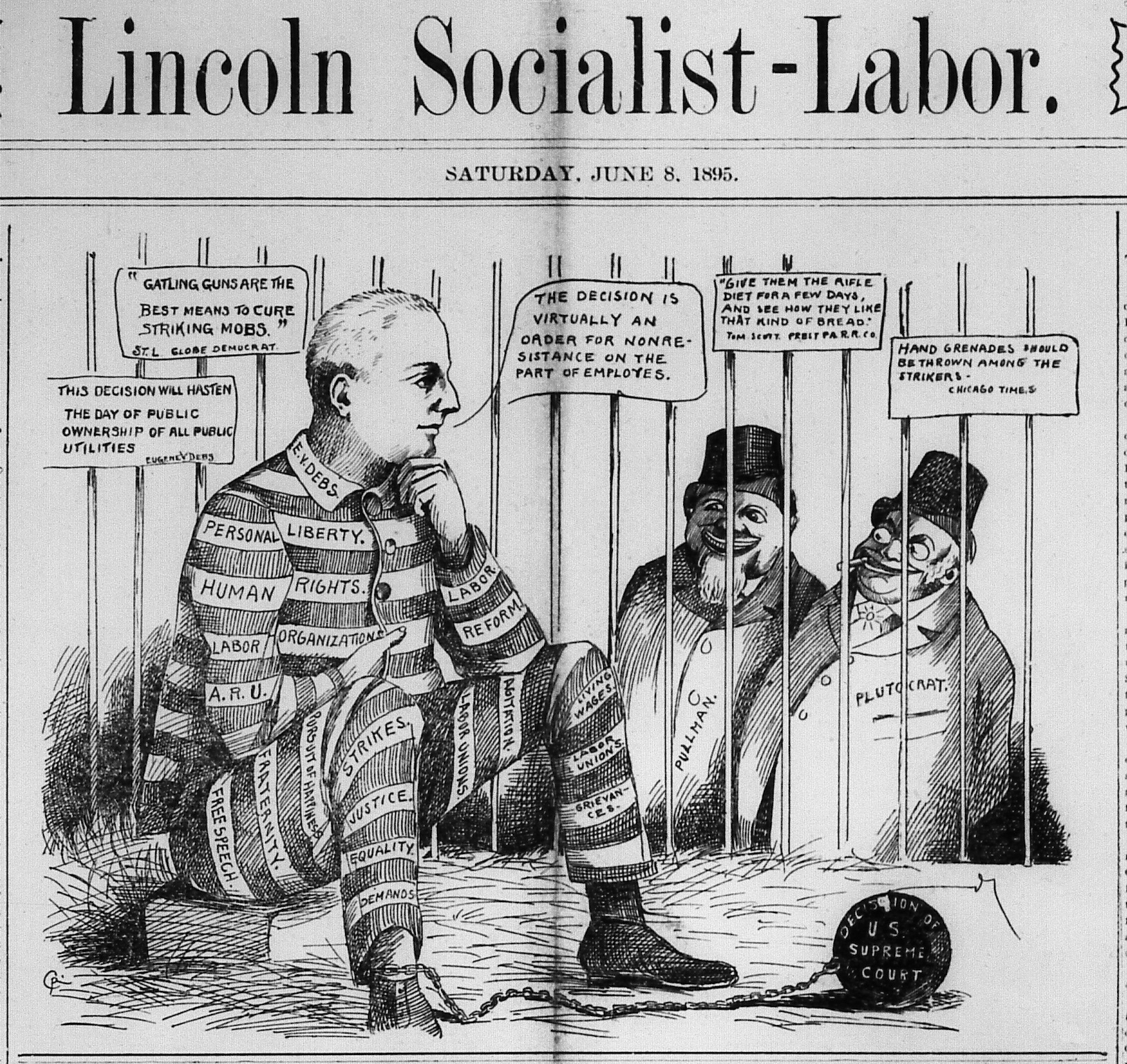
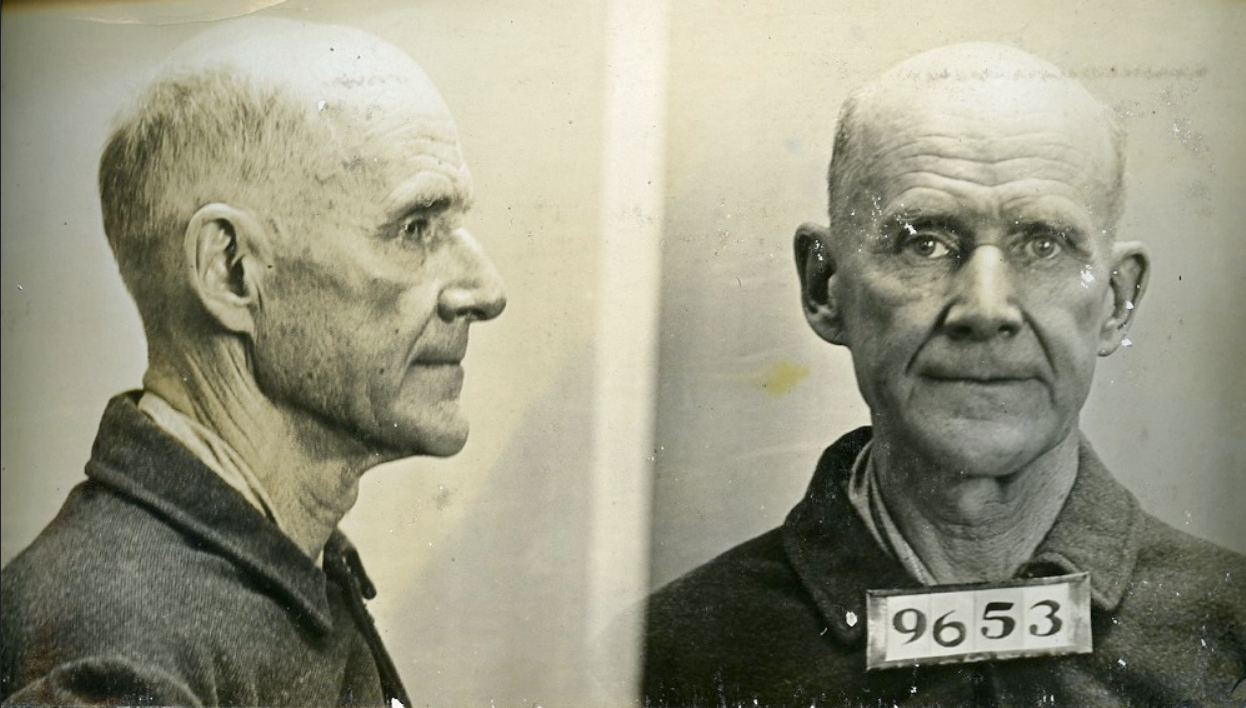
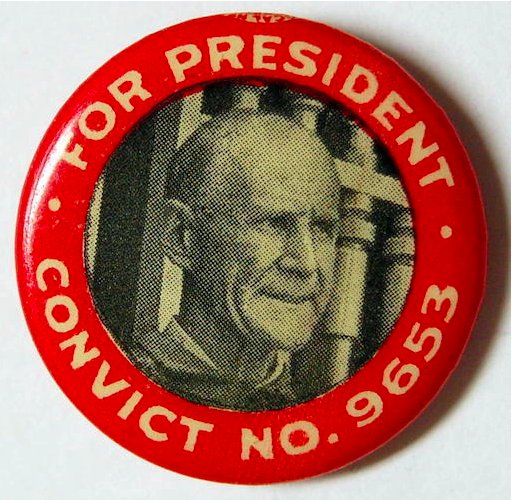
Eugene V. Debs, formerly incarcerated felon and prison abolitionist.
‘Socialism and the Prison’ by Eugene V. Debs from Walls and Bars. Published by the Socialist Party, Chicago. 1927.
Socialism and prison are antagonistic terms.
Socialism means freedom and when the people are free they will not be under the necessity of committing crime and going to prison. Such exceptional cases as there may be requiring restraint for the protection of society will be cared for in institutions and under conditions betokening a civilization worthy of the name.
Socialism will abolish the prison by removing its cause and putting an end to the vicious conditions which make such a hideous thing as the prison a necessity in the community life.
I am aware in advance that what is said here in regard to abolishing the prison will be met with incredulity, if not derision, and that the theory and proposal I advance will be pronounced visionary, impractical and impossible. Nevertheless, my confidence remains unshaken that the time will come when society will be so far advanced that it will be too civilized and too humane to maintain a prison for the punishment of an erring member, and that man will think too well of himself to cage his brother as a brute, place an armed brute over him, feed him as a brute, treat him as a brute, and reduce him to the level of a brute.
Socialism proposes that the people — all the people — shall socially own the sources of wealth and social means with which wealth is produced; that the people, in other words, shall be the joint proprietors upon equal terms of the industries of the nation, that these shall be co-operatively operated and democratically managed; it proposes that the people shall appropriate to themselves the whole of the wealth they create to freely satisfy their normal wants instead of turning the bulk of that wealth over, as they now do, to idlers, parasites and non-producers while they suffer in poverty and want.
When the community life is organized upon a co-operative basis according to the socialistic program every man and woman will have the inalienable right to work with the most improved modem machinery and under the most favorable possible conditions with the assurance that they will receive in return the equivalent of their product, and that they may enjoy in freedom and peace the fruit of their labor.
In such a society there will be a mutuality of interest and a fraternity of spirit that will preclude the class antagonism and the hatred resulting therefrom which now prevail, and men and women will work together with joy, not as wage slaves for a pittance, but in economic freedom and in an atmosphere of mutual goodwill and peace. The machine will be the only slave, the workday will be reduced in proportion as the productive capacity is increased by improved machinery and methods, so that each life may be assured sufficient leisure for its higher and nobler development.
What incentive would there be for a man to steal when he could acquire a happy living so much more easily and reputably by doing his share of the community work? He would have to be a perverted product of capitalism indeed who would rather steal than serve in such a community. Men do not shrink from work, but from slavery. The man who works primarily for the benefit of another does so only under compulsion, and work so done is the very essence of slavery.
Under Socialism no man will depend upon another for a job, or upon the self-interest or good will of another for a chance to earn bread for his wife and child. No man will work to make a profit for another, to enrich an idler, for the idler will no longer own the means of life. No man will be an economic dependent and no man need feel the pinch of poverty that robs life of all joy and ends finally in the county house, the prison and pottersfield.
The healthy members of the community will all be workers, and they will be rulers as well as workers, for they will be their own masters and freely determine the conditions under which they shall work and live. There will be no arrogant capitalists on the one hand demanding their profits, nor upon the other cowering wage slaves dependent upon paltry and insufficient wages.
Industrial self-government, social democracy, will completely revolutionize the community life. For the first time in history the people will be truly free and rule themselves, and when this comes to pass poverty will vanish like mist before the sunrise. When poverty goes out of the world the prison will remain only as a monument to the ages before light dawned upon darkness and civilization came to mankind.
It is to inaugurate this world-wide organic social change that the workers in all lands and all climes are marshaling their forces, recognizing their kinship, and proclaiming their international solidarity.
The world’s workers are to become the world’s rulers. The great transformation is impending and all the underlying laws of the social fabric and all the irresistible forces of industrial and social evolution are committed to its triumphant consummation.
Capitalism has had its day and must go. The capitalist cannot function as such in free society. He will own no job except his own as a worker and to hold that he must work for what he gets the same as any other worker. No man has, or ever did have, the right to live on the labor of another; to make a profit out of another, to rob another of the fruit of his toil, his liberty and his life.
Capitalism is inherently a criminal system for it is based upon the robbery of the working class and corner-stoned in its slavery. The title-deed held by the capitalist class to the tools used by the working class is also the title-deed to their liberty and their lives.
Economic slavery is at the foundation of every other slavery of body, mind and soul. But the capitalists rob not only the workers, but also themselves in appropriating what is produced in the sweat and misery of their toil. They lapse into a state of parasitism that robs them of their higher development, the intellectual and spiritual estate to which all human beings are heirs who live in accordance with the higher laws of their being.
Often at night in my narrow prison quarters when all about me was quiet I beheld as in a vision the majestic march of events in the transformation of the world.
I saw the working class in which I was born and reared, and to whom I owe my all, engaged in the last great conflict to break the fetters that have bound them for ages, and to stand forth at last, emancipated from every form of servitude, the sovereign rulers of the world.
It was this vision that sustained me in every hour of my imprisonment, for I felt deep within me, in a way that made it prophecy fulfilled, that the long night was far spent and that the dawn of the glad new day was near at hand.

In my prison life I saw in a way I never had before the blighting, disfiguring, destroying effects of capitalism. I saw here accentuated and made more hideous and revolting than is manifest in the outer world the effects of the oppression and cruelty inflicted upon the victims of this iniquitous system.
On the outside of the prison walls the wage slave begs his master for a job; on the inside he cowers before the club of his keeper. The entire process is a degenerating one and robs the human being, either as a wage slave walking the street or as a convict crouching in a cell, of every attribute of sovereignty and every quality that dignifies his nature.
Socialism is the antithesis of capitalism. It means nothing that capitalism means, and everything that capitalism does not.
Capitalism means private ownership, competition, slavery and starvation.
Socialism means social ownership, co-operation, freedom and abundance for all.
Socialism is the spontaneous expression of human nature in concrete social forms to meet the demands and regulate the terms of the common life.
The human being is a social being, and Socialism would organize his life in the social spirit, under social conditions and along social lines of advancement.
What more natural than that things of a social nature in a community should be socially owned and socially administered for the individual and social well-being of all!
What more unnatural, what more antagonistic to every social instinct, than the private ownership of the social means of life!
Socialism is evolving every hour of the day and night and all attempts to arrest its progress but increase its power, accelerate its momentum and insure its triumph for the liberation of humanity throughout the world.
Walls and Bars by Eugene V. Debs. Published by the Socialist Party, Chicago. 1927.
PDF of book: https://archive.org/download/wallsbars00debs/wallsbars00debs.pdf
 Revolution's Newsstand