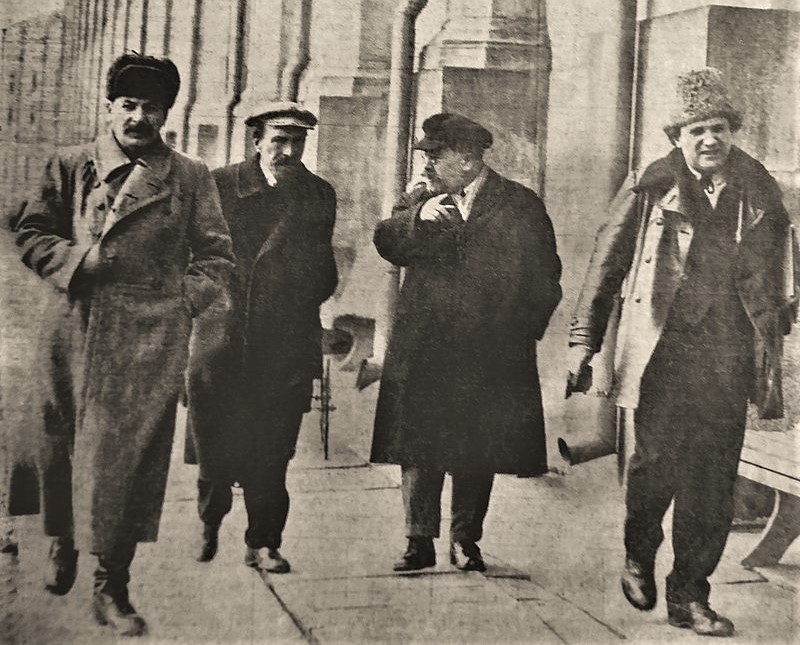
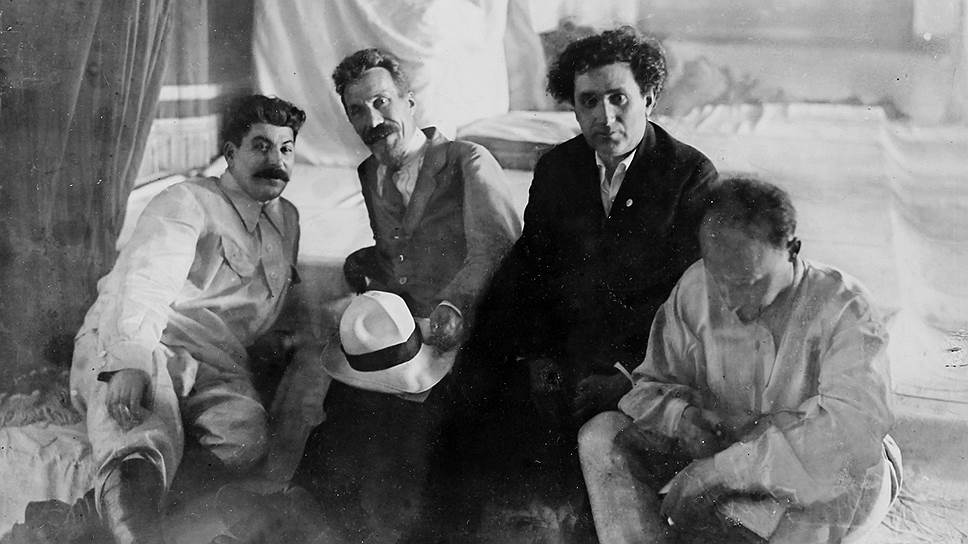
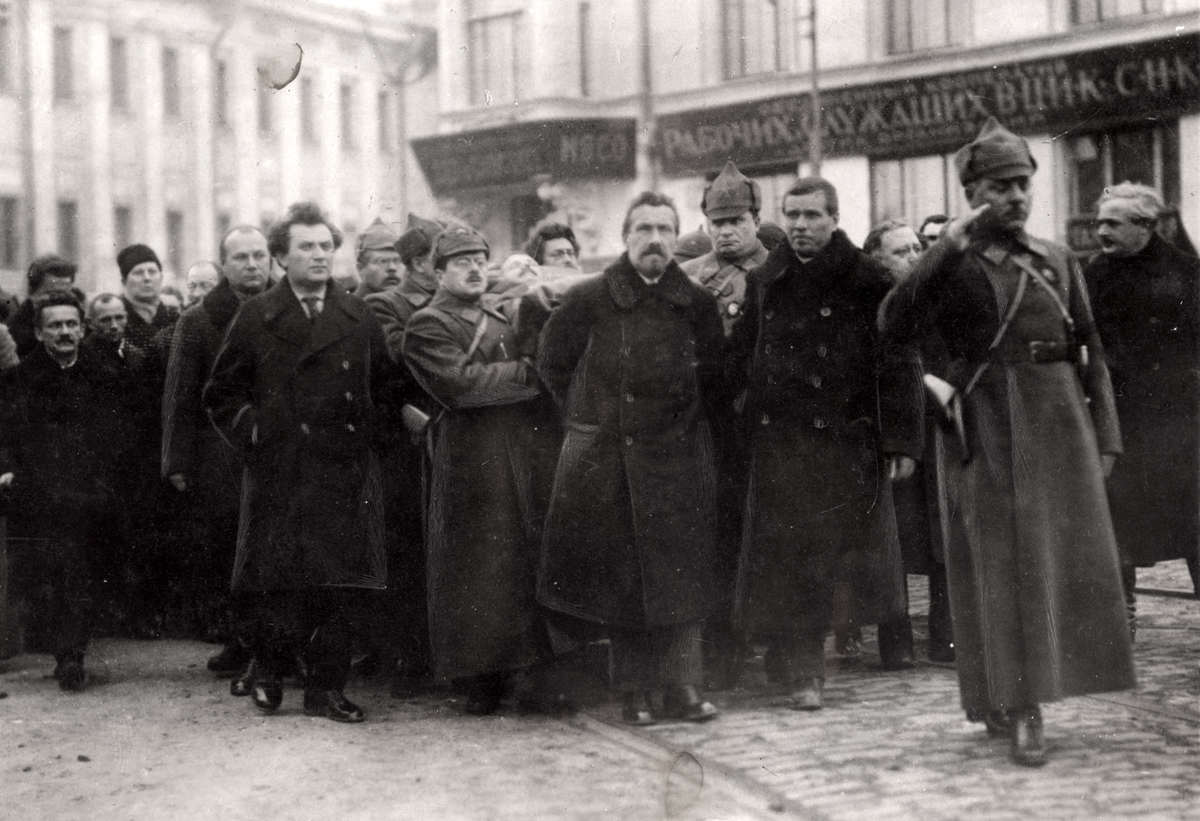
In early 1925 factional allegiances began shifting, with the ‘triumvirate’ of Zinoviev, Stalin, and Kamenev that defeated Trotsky and the Left Opposition at 1924’s 13th Party Congress breaking down over Bukharin’s elaboration of ‘Socialism in one country’ and continued divergences of the NEP and associated questions related to the peasant classes. The disputes came to a head at the 14th Party Congress in December 1925 which saw Zinoviev, Kamenev, Krupsakaya, and Sokolnikov form the so-called New Opposition. Stalin allied himself with the Right bloc centered on Bukharin, Rykov, and Tomsky. With only Zinoviev’s Leningrad base (unanimously) supporting the New Opposition, the Opposition was soundly defeated with the Stalin-Bukharin faction gaining more seats on the Central Committee and Politburo and the Party’s policy bodies. While Zinoviev retained his position in the Politburo, he lost his base in Leningrad and was relegated to the Comintern, for the moment, while Kamenev, who had called for Stalin’s removal from office during the discussion, lost his positions in the top leadership of the Bolsheviks entirely. As 1926 developed the United Opposition with Trotsky would be formed. Trotsky, recovering from illness was present but did not participate, however he was reelected to the Politburo. He and Stalin would be the only two consistent members of that body for the Revolution’s first decade. Below are the official reports of Zinoviev’s opening and closing speeches from the Congress, giving an indication of how the debate developed and hardened over the course of the meetings.
‘Speeches to the 14th Party Congress’ by Grigory Zinoviev from International Press Correspondence. Vol. 6. Nos. 5 & 7. January 15 & 22, 1926.
Opening Speech
The time has come for the differences of opinion existing in the Party to be laid before the whole Party for discussion. Doubtless a solution will be found enabling the Party to continue its great work undisturbed.
The situation in which the Party Conference meets may be summed up as follows: —
Firstly: After almost five years of the New Economic Policy, Soviet Russia is beginning constructive economic and cultural work on a extensive scale.
Secondly: These five years have proved that the means to socialism chosen in the New Economic Policy have been perfectly right.
Thirdly: It is an incontestable fact that in Soviet Russia socialism is being built up. The only point upon which there is disagreement is the question: is it possible for a socialist state of society to be completely realized and maintained in an agrarian country such as the Soviet Union. We throw no doubts whatever upon the possibility of the socialist development of the Soviet Union, since the economic and political prerequisites exist, but the final realization of socialism is only possible on an international scale.
Fourthly: It is certain that socialism is being built up, and must be build up in closest alliance with the middle and small peasants.
Fifthly: Characteristic for our progress is the extraordinary increase of political activity among the whole population of the Soviet Union, especially of the working population.
The following difficulties exist:
1. The delay of the world revolution and the partial stabilization of capitalism, extending over a whole period.
2. The development of a socialist state of society in a backward country with a preponderating peasant population.
3. The difficulties of forming a collective Party leadership after the death of Lenin.
Under these conditions it is only natural that errors and deviations should occur among some of us, and the Party Conference should not pass over this fact. The present peaceful period involves the danger of stabilization and liquidation tendencies.

Comrade Zinoviev then proceeded to deal with the real character of the differences of opinion, and declared: In the discussion on state capitalism there is a tendency io deny the existence of any capitalism in the Soviet Union, to idealize the New Economic Policy, and to proclaim the NEP, as socialism. The point at issue is not merely one of formulation, but touches our system of politics and the estimation of the economic structure of our country. There is no doubt whatever that our state industry represents, as Lenin himself said, an industry of a consistently socialist nature. But this does not imply that our state undertakings are completely socialist.
State socialism is not confined to undertaking on leases and concessions, as is now being declared, but extends to free trading, and to the growth of capitalism in the individual agricultural enterprises. It need not be said that state capitalism develops into socialism, and represents, as Lenin declared, a three quarter socialism.
Comrade Zinoviev recalled how comrade Bucharin wrote an article in February 1922 in which he refused to recognize the State undertaking as socialist in the strict sense of the term. Comrade Zinoviev asked how it was possible that this reservation was attacked as liquidatory and heretical. The question of state capitalism is not a mere terminological quarrel, but a serious political question, which cannot be passed over.
In the peasant question comrade Zinoviev declared: It is only those who will not realize the whole truth as to the growth of the rich peasantry, who accuse the other comrades of under-estimating the middle peasantry. Comrade Zinoviev quoted from a report issued by him on the peasant question in November 1918, in which he took his stand precisely against the under-estimation of the middle peasantry. During the present year he again dealt with the matter, at the Leningrad Party Conference in January 1925, where he declared that the economic interests of the middle peasantry should be respected. He: thus repudiated the TE of having under-estimated the importance of the middle peasant, the leading figure among the Russian peasantry.
Comrade Zinoviev declared to be entirely false the assertion that he is not in agreement with the decisions of the XIV. National Party Conference, and is anxious to reverse these decisions. We are, and continue to be, solid with the decisions of the XIV. National Party Conference, which decisions are perfectly right. The slogan of the development of the productive forces of agriculture is right, as are also the Party decisions referring to -certain concessions made to the richer strata of peasantry, especially in ‘the questions of land leasing and employment of wage workers. Comrade Zinoviev declared that when he designated these measures of peasant policy as a retreat (at the session of the Communist Fraction of the Soviet Congress), the majority of the political bureau raised no objection. In the course of the same speech he had declared that this partial retreat was a part of the main retreat of 1921, of the NEP, which had proved necessary and useful.

The real differences of opinion began at the time of the XIV. National Party Conference, when comrade Bucharin sent forth to the peasantry the winged words of: “Enrich yourselves!” We shall fight consistently against such an interpretation of the decisions of the XIV. National Party Conference. It is true that comrade Bucharin now withdraws these words, but they have been seized upon by others, and some comrades have even gone so far as to propose an extension of the NEP. to agriculture, which would almost realize the NEO-NEP. desired by our enemies. Had the Party struggle been concentrated against these people, instead of against the Leningrad comrades, many differences of opinion would have been spared. If you are fully convinced that a deviation regarding over-estimating the rich peasantry danger is more dangerous for the Party than a deviation of under-estimating this danger, then say this straightforwardly, and add at the same time that the decisions come to by the XIV. National Party Conference should be revised.
Is it not sufficiently symptomatic that there have been people in Georgia who have even begun to speak in the Party press of a partial denationalisation of the land, and have had to be rebuked by the Georgian Party Committee? It must be remembered that such ideas may gain ground during the present protracted period of stabilization. `
The numerical strength of the kulak peasantry is insignificant, totaling 3 to 4% of the whole peasantry. The absolute number is about 1.5 million, approximately the same as. the number of agricultural labourers. The economic power represented by the rich peasant is, however, enormously greater. The rich peasant has his complement in the city, in the new city bourgeoisie, and among some of the specialist and employee elements, who are anxious to establish political contact with a rich peasantry growing in strength. Besides this, the rich peasant has the support of the whole bourgeois environment of the Soviet Union.
We might be accused of being in a state of panic with regard to the rich peasant danger, were we merely to name the danger, and not the means of checking the growth of the rich pw class: The economic support of the poor peasantry, a firm alliance with the poor and middle peasantry, and the isolation of the rich peasantry.
The accusation of panic is however not justified, for we join the Party in prescribing this remedy. We must not idealize the middle peasant, we must not deny that he is a petty bourgeois. We must not assert too hastily that petty bourgeois capitalism no longer predominates in our country, we must not ignore millions of peasant undertakings and ten milliard roubles worth of agricultural products.
The new peasant policy adopted by the Party has occasioned some confusion among the communists in the country, for it is interpreted as a withdrawal of the peasant policy based on aid given to the poor peasantry. It has even been asserted in a communist peasant newspaper that today one middle peasant is of more value in the Party than ten poor peasants!
Such mutilations of Bolshevist peasant policy have nothing in common with true Leninism. It is not necessary to state that we are entirely opposed to any arousing of civil war among the peasantry.
The Soviet power is strong enough today not to be forced to resort again to the methods of war Communism for combating the rich peasant danger. We must however show the poor peasantry plainly that we shall not allow the rich peasantry to pillage the poor. We need not seek refuge in war communism again; we must hold to the decisions of the XIV. National Party Conference, but at the same time we must never permit the carrying of economic measures for developing the productive forces of agriculture to cause us to overlook the political character and importance of the rich peasant.
We shall of course build up socialism with the aid of the New Economic Policy, but we must not endeavour to sweeten the latter. We must not accede to comrade Bubnov’s proposal to strike out the words “not for ever” in the formula “The New Economic Policy to be pursued seriously, and for a long time, but not for ever.”
The proletariat has become stronger; its influence among the peasantry has increased. But if our further increase of strength is to proceed more rapidly and with less friction, we must repulse all tendencies inconsistent with Leninism.
With respect to the third category of difference of opinion; these relate to the composition and the collective leadership of the Party. In this regard we should simply confirm the decision of the XIII. Party Conference, which commissioned the C.C. so to adapt its working methods that in the near future the majority of the Party membership consists of workers actually employed in the work of production. It is incomprehensible that the concrete proposal made by the Leningrad comrades on this subject should have been attacked so sharply.
Industry has almost reached its pre-war standard. The proletariat is no longer declassed. The cultural level and activity of the working class have increased enormously. Why is it feared that the joining of large numbers of workers would dilute the Party, and why is it believed that the Party is to be extended by workers belonging to the peasant class? It must be remembered that the old cadre of the proletariat influences the new comers, not the reverse.
The statistical data show that since the XIII. Party Conference the percentage of factory workers in the Party has fallen by 3%, despite the fact that their actual number in the Party has increased.
With respect to the leadership of the Party, deviations have occurred in fundamental questions. A firmly established policy has not always existed, otherwise such a slogan as Bucharin’s “enrich yourselves” would never have been tolerated for a moment. It need not be said that our C.C. is composed of the best of the Party, but we must not therefore degenerate into self-glorification, and confuse gestures with firm policy.
Even if no inner differences of opinion existed, and Lenin were still at the head of the Party, this would not abolish the actual objective difficulties now existing, and differing entirely from the difficulties of a few years ago. Our present difficulties are those of growth, of the stabilization, of the peasant question as affected by the present international situation.
The differences of opinion have been laid before the whole Party rather too late than too soon. Deviations exist, but not those named here. We do not under-estimate the importance of the middle peasantry. No single difference of opinion has existed as to the practical measures to be adopted with reference to the middle peasantry since the XIV. National Party Conference. But with respect to the under-estimation of the kulak danger, we can name dozens of deviations. It is not we who suffer from liquidatory lack of faith, but those comrades who try to represent the NEP to be Socialism.
These are our views, and we shall not depart from them. (Applause from the Leningrad delegation.)
Concluding Speech
We can divide the questions into three groups:
1. Questions of principle.
2. History of the differences of opinion.
3. Solution of the situation and practical programme.
Attempts were made at a preventive understanding, in order to avoid discussion at the Party Conference. We declined to entertain this attempt, since without any guarantee of what was to follow, our capitulation and the revision of the organisatory decisions of the Leningrad Party conference were demanded. This circumstance, as also some of the declarations made in Stalin’s report, induced us to bring forward a co-report.
Comrade Bucharin accuses us of regarding the NEP merely as a retreat, which means a deviation from Leninism. I have frequently spoken of Bolshevism as an advance against the bourgeois system, against counter-revolutionary social democracy, and against imperialism, and I have especially emphasized that the retreat was made in order to render a greater advance possible.
Comrade Zinoviev, quoting from his own work: “Leninism”, declared that he protests categorically against the attempt to represent him as an apologist of retreat. With reference to the accusation on the question of the under-estimation of the middle peasantry, Zinoviev referred to the fact that the slogan: “The Face to the peasantry!” was issued by him. This slogan referred to the whole peasantry, and thus included the middle peasantry. As to the question of the leadership of the revolution the speaker declares that at the present time the forms of the proletarian dictatorship should be rendered more mild along the lines of Soviet democracy.
With regard to the possibility of realizing socialism in one single country, Stalin has asserted that the organization of socialist production is only possible with the assistance of the proletariat of some other civilized countries, and he denies that in the Political Bureau he pointed out our technical backwardness.
Comrade Zinoviev denied having tried to cover up the error committed by him in October 1917. Comrade Bucharin has accused him of not having mentioned the peasantry when describing the events in 1905, in his history of the Party. Incontestably this was a mistake but not one from which it need be concluded that the writer of the book ignores the peasantry. The peasantry is widely dealt with in the book. Zinoviev further protested against Bucharin’s assertion that he had maintained that the Soviet Union was still without any socialist foundation. Much has been recovered, the Soviet Union approaches the pre-war standard. It would however be wrong to take this fact as basis for the assertion that we have built up the foundation of a socialist economy. The speaker proceeded to deal with the question of the differences of opinion existing on the peasant policy: Comrade Stalin’s report laid special emphasis on a thesis which is not contained in the resolution of the October plenary session of the C.C. and of the Moscow Party conference. This is the thesis on the concentration of the fire of the Party against the deviation of under-estimating the importance of the NEP.
The Party conference is of course supreme, and can make decisions independent of the plenary session. But Stalin’s addition is polemical in character. The more events develop, the clearer does it become that it was a grave political error to direct our fire against those who pointed out the Kulak danger. The fact that the kulak is gaining ground arises out of our whole present political and economic situation. The political appetite of the kulak grows with his growth, and he will find his political. complement in the city. This danger can be fought, it we foresee the danger early enough.
There is no doubt that much successful work has already been accomplished toward a rapprochement with the middle peasantry, but on the other hand nothing has been accomplished towards a rapprochement. to the poor peasantry. This constitutes a tremendous political danger. The policy pursued, by the Party among the peasantry is correct in principle, but in the course of the actual execution of this policy a number of difficulties have been encountered. The task set us at the present juncture is to expend every effort upon reaching the poor peasantry. Thus our fire must be directed against those who fail to fully realize the kulak danger.
The speaker protested against the assertion that he regards the agricultural labourer objectively as a dominant factor. The agricultural labourer is exploited by the kulak. It must be admitted that the C.C. is not to blame for the discontent among the poor peasantry. But the danger must be fully realized; not that we need fall into a panic, but that we may recognize the political problem,
The speaker referred to Lenin’s formulation, at the VIII. Party conference, of the two counter agents: the working class and the poor peasantry on the one hand, and the middle peasantry on the other. So it must remain. Not the working class on the one side, and the poor and middle peasantry on the other.
The speaker then proceeded to reply to the attacks made on his article entitled: “The Philosophy of the Epoch.” In the first place the article was not written for the purpose of forming a platform for the Party Conference. The most far reaching accusation is that which places a vulgarly democratic interpretation upon the slogan of “equality”. This slogan has been described as social-revolutionary and liberal demagogy. The attempt to prove that the slogan of “equality” was intended to be thrown in to the masses in a bourgeois-democratic sense is a gross misrepresentation. It may be admitted that the term “socialist equality” is more accurate, and the slogan may be well thus altered. But when Rykov and Kalinin deem this slogan demagogic, that is again an over-estimation of the NEP.
The speaker protested against the action of a group young Red professors, who are revising Leninism.
As to the question of the composition of the Party membership, Zinoviev declared the Leningrad conference to be of the opinion that at the present time 50% of the Leningrad metal workers should be admitted into the Party. This would not mean padding by any means. In the present situation, and given the present relation of class forces, our slogan must be: “Workers, nearer to the state, to the Party, to economic construction!”
The speaker then passed on to the question of the Leningrad organization, and declared that the latter is not isolated, and will not be isolated. The speaker, in the course of a description of the differences of opinion, declared that he had altered his attitude after being accused of being a liquidator and defeatist. Leningrad is entitled to one of the leading positions, for its organization has earned prominent importance in our historical development. The Leningrad delegation has the right to make proposals for the alteration of the political line.
The speaker then described the differences of opinion in the C.C. After the second discussion with Trotzky; Bucharin and Kalinin represented the standpoint that no organisatory consequences were necessary, as the Party masses would not understand them. The speaker and the comrades sharing his views represented on the other hand the standpoint that if Trotzky were accused of being a semi-Menshevik, there could be no place for him in the general staff of Leninism. (Interjection from Trotzky: Quite so!) The same may be maintained with regard to the present discussion. If the Party conference is seriously of the opinion that he and the comrades accused of being defeatist really are such, then they should not be permitted to hold the highest leading positions in the Party. The accusation of defeatism was never raised against Trotzky.
The differences of opinion accumulated, it became increasingly difficult to work together. The differences of opinion have matured, and it would be wrong to maintain that no political differences of opinion exist. Great problems are maturing in connection with the peasant question, and from these arise the differences of opinion in the Party. It is beyond doubt that new groups are growing in the Party, and these will take leading parts. There is no doubt whatever that the leadership must be in the collective hands of the C.C.
The assumption that the opposition demands Bucharin’s head is entirely wrong. We must remember Lenin’s remark that it was impossible to be angry with Bucharin, even during the sharpest fight. It must further be remembered that the foreign communists, and the communist and social democratic press, will be deeply interested in the discussion. It is decidedly undesirable to bring the discussion to a close, for the accused comrades have had no opportunity of publicly replying to the accusations.
The speaker then proceeded to deal with the solution of the situation. After stating that he opposed no special policy to that of the C.C., he passed on to the enumeration of the concrete proposals:
1. Combating of the revisionist “school” created by the young Red professors. The slogan must be: “Back to Lenin”.
2. Inadmissibility of a revision of Leninism in the question of state capitalism.
3. The thesis on the concentration of our fire against one of the deviations in the peasant question must be rejected.
4. In the question of the composition of the Party membership there must be no deviation from the decisions of the XIII. Party conference.
5. The question of the extension of inner Party democracy must be raised.
6. The agitation against Leningrad must cease. The Leningrad organization must be given the opportunity of choosing its own leaders.
7. The Central Committee must induce all the forces of the former groups to participate in the work, and give them the possibility of working under the leadership of the C.C. (Noise, shouts: repeat!)
8. Security must be given that the functionaries are chosen by election.
9. At the first session of the C.C. the question of the imitations of the functions of the Political Bureau, of the Organization Bureau, and of the Secretariat, in the direction of setting up a fully competent Political Bureau and the Secretariat subordinate to it, is to be dealt with.
Comrade Zinoviev closed with the hope that the discussion closes a chapter, and enables one to be begin in which co-operation will be possible. The responsibility lies with the majority of the Party conference. (Prolonged applause from the Leningrad delegation.)
International Press Correspondence, widely known as”Inprecorr” was published by the Executive Committee of the Communist International (ECCI) regularly in German and English, occasionally in many other languages, beginning in 1921 and lasting in English until 1938. Inprecorr’s role was to supply translated articles to the English-speaking press of the International from the Comintern’s different sections, as well as news and statements from the ECCI. Many ‘Daily Worker’ and ‘Communist’ articles originated in Inprecorr, and it also published articles by American comrades for use in other countries. It was published at least weekly, and often thrice weekly. The ECCI also published the magazine ‘Communist International’ edited by Zinoviev and Karl Radek from 1919 until 1926 monthly in German, French, Russian, and English. Unlike, Inprecorr, CI contained long-form articles by the leading figures of the International as well as proceedings, statements, and notices of the Comintern. No complete run of Communist International is available in English. Both were largely published outside of Soviet territory, with Communist International printed in London, to facilitate distribution and both were major contributors to the Communist press in the U.S. Communist International and Inprecorr are an invaluable English-language source on the history of the Communist International and its sections.
PDF of full issue: https://www.marxists.org/history/international/comintern/inprecor/1926/v06n05-jan-15-1926-Inprecor.pdf
PDF of full issue 2: https://www.marxists.org/history/international/comintern/inprecor/1926/v06n07-jan-22-1926-inprecor.pdf
 Revolution's Newsstand