The story of comrade John Lenthier, 22-year-old Communist, actor, and member of the International Brigades from Boston, killed by fascists on February 27, 1937 in a charge at the Battle of Jarama.
‘John Lenthier: Killed in Action’ by Herbert Kline from the New Masses. Vol. 23 No. 4. April 20, 1937.
John Lenthier, American actor who didn’t do things by halves, met death charging into a hail of fire from Franco’s gunners.
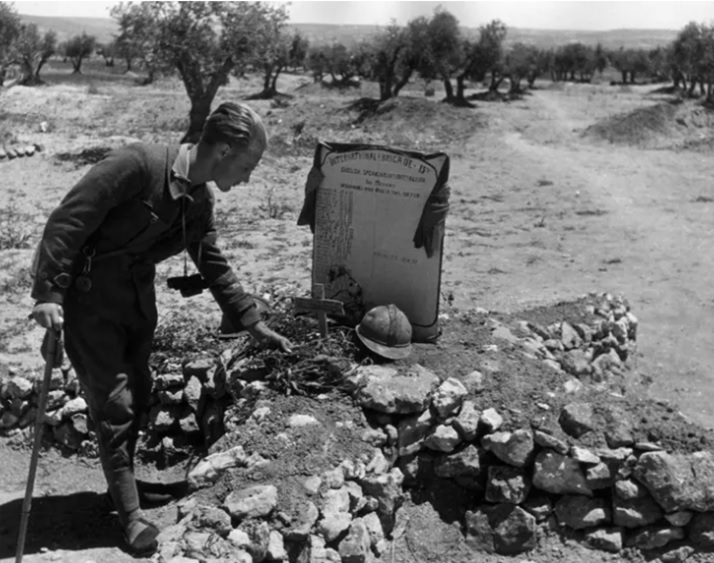
ON March 7, late at night, comrades Chapelet, Perdix, Delpune, Leglise, and Viguier of the Franco-Belgian International Volunteers, bellied across no-man’s land between our lines at Morota and the fascist lines 150 meters distant. They made two trips. They brought back the bodies of ten loyalist dead, all Americans. Their commandant gave them holy hell for taking such chances without permission, but cited them for bravery.
Remember their names: Chapelet, Perdrix, Delpune, Leglise, Viguier. One of the dead men they brought back was John Lenthier, whom all of us knew well as a comrade of the early League of Workers’ Theatres days. His body had been lying out there on the bloodstained Morota soil since February 28, the day on which the fascists’ Jarama River drive was stopped with a fierce counter-attack by Spanish regiments, supported by Franco-Belgian-British-American and German Internationals. John Lenthier fell in that charge, his body riddled with bullets from a fascist machine gun. I remember talking with him, about death, as people do in Spain, half-serious, half joking. “Listen, Herb,” he said, “if I get bumped off by those fascist bastards, try and get a notice into New Theatre and tell them all good-by for me.”
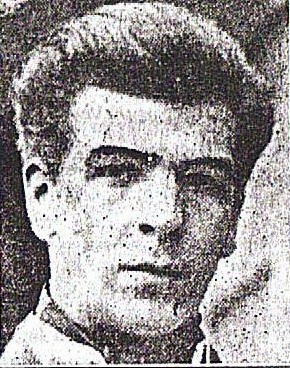
John Lenthier was only twenty-two. He was in love. With life. With the theater. With a girl he had married only a year before. Now he is dead, this youth so much in love with life, this young workers’ theater actor who played his last part in a charge against the fascist lines at Morota, a charge that left the field strewn with loyalist dead, but that had stopped the fascists’ drive to cut the Valencia road, Madrid’s main line of communications.
HE WAS from Boston, of old American stock, just enough French in his blood to keep alive the name of the pre-Revolutionary pioneer Lenthier. John knew what it meant to act in the 1930s as our forefathers acted in 1776. He was jailed more than thirty times in the cradle of liberty for such crimes as taking part in strikes, demonstrations, eviction protests; for distributing leaflets and playing in Boston-banned dramas like Waiting for Lefty.
I’ll never forget the time the Boston New Theatre Group decided to defy the police ban on Odets’s taxi-strike play. I was sent up from New York City in an overnight drive to make an anti-censorship speech before the trial performance began. “Give ’em hell!” John whispered when I went on before the play; and then he went on, to give a stirring performance as the labor faker Fatt. John was one of our workers’ theater people from the early days when police and American Legion hoodlums used to break up our showings. He knew what it was to work all day, yet find somehow the vitality to help create a militant, fighting theater for workers at night. He had played, long before the Waiting for Lefty days, in such agit-props and mass chants as Scottsboro, Tempo-Tempo; Free Thaelmann, Newsboy, etc. He took part in our theater conferences at Chicago, in New York City, in Philadelphia. I remember him speaking as delegate of the Bostch group-a tall youth, with long, straight hair, “kinda poetic looking,” as one of his buddies in the Internationals here described him. He used to write long letters to the League office and to New Theatre about the work in Boston.
Now he’s dead. And the dead don’t rise in this war.
John knew what he was risking his life for. He was a member of the Communist Party for a year, for four years before, a member of the Young Communist League of Boston. He didn’t do things by halves, this boy. He said he joined the Communists because he saw, in the early days of the crisis, that they were putting up the best fight against the madness and heartlessness of capitalist society. He said he decided to go to Spain because he believed (as all of us believe who have come to Spain) that victory against fascism here will be the turning point in the world struggle against the advance of the fascist powers. He was always stressing this point to less politically minded comrades-in-arms.
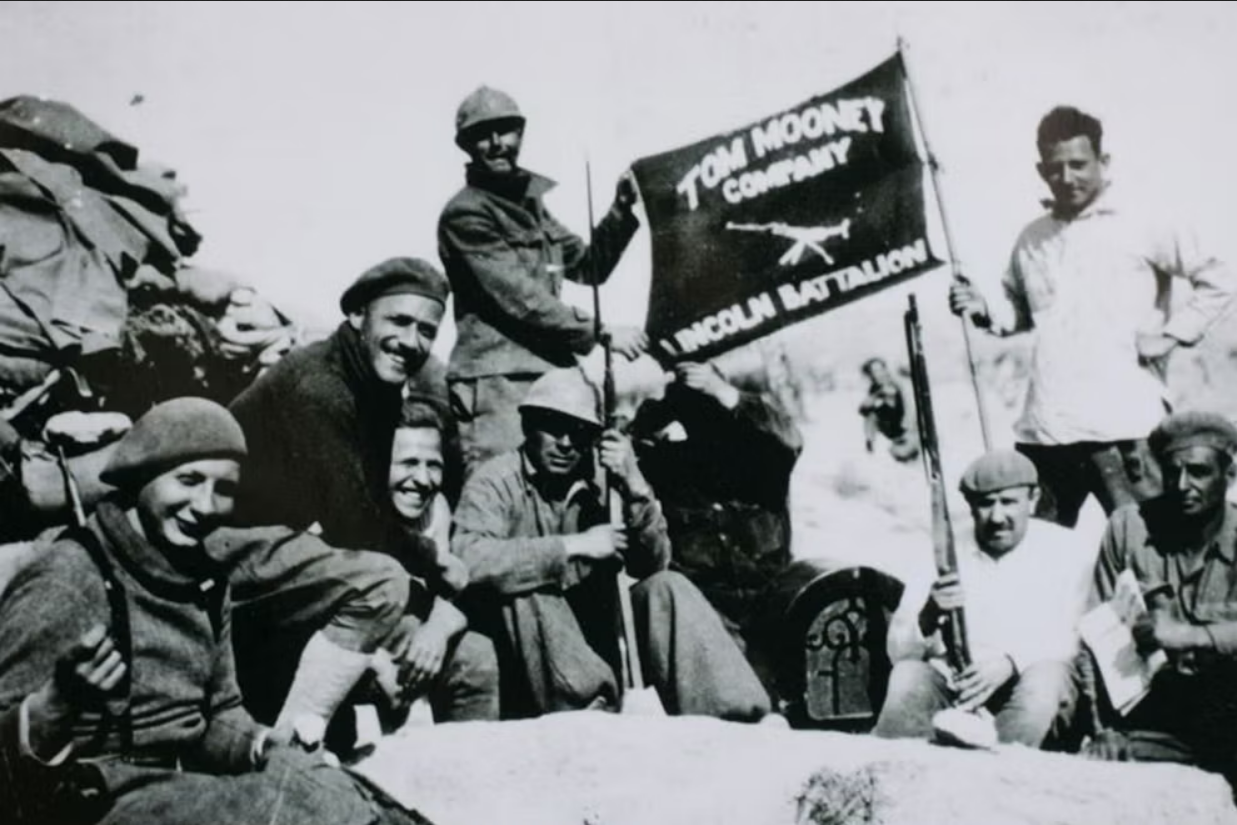
I last saw John alive one evening, a few weeks before the American boys went into the front lines. The day’s training at war was over. John and a lively Irish lad got up an entertainment for the evening. I remember the Irish lad singing song after song that his people love, and a Jewish truck-driver from Brooklyn getting up right afterwards to get a big laugh by repeating several of the songs in a surprisingly fine Irish brogue. Then an automobile worker from Detroit, a chap who had fought with the Chinese Nineteenth Route Army at Chapei, got up and sang Joe Hill’s “Scissorbill.” A Cuban youth, a friend of Torriente-Brau, the NEW MASSES correspondent who was killed in the defense of Madrid in December, got encore after encore for some amazingly difficult toe-and-tap dancing. A Spaniard sang song after song in the tongue he knew as a child before coming to America to work in a Connecticut shoe factory. A Negro youth from Harlem recited part of Langston Hughes’s old chant about Scottsboro. A young Canadian volunteer led the crowd in singing “Allouette.”
Then John Lenthier got up and sang the song of the American Abraham Lincoln Battalion. The words are simple. Maybe they don’t seem like much when you read them in cold black print. But hearing them sung that night-of, by, and for the volunteers-they were strangely impressive.
We stayed up late that night, John, the young Canadian writers, Ted Allan and Jim Watts, and I. We talked about a great many things, told stories of our past experiences, dreams of the future, planned a walking trip over the Pyrenees after the Spanish work was over. John spoke of work he would like to do in the theater, of the hope he shared with me for workers’ films. He asked me to tell him of things I had seen during my recent trip to the U.S.S.R., of the life of the people under socialism, of the theater. We spoke of Stanislavski’s new book on acting, of Theatre Workshop, of Shepherd Traube’s book So You Want to Go into the Theatre? John told of experience after experience in making the rounds for jobs, of how sick he was of being told they’d call on him when they needed a Gary Cooper type. We all laughed over this Gary Cooper business. But he really was a bit like Gary: tall, lean…
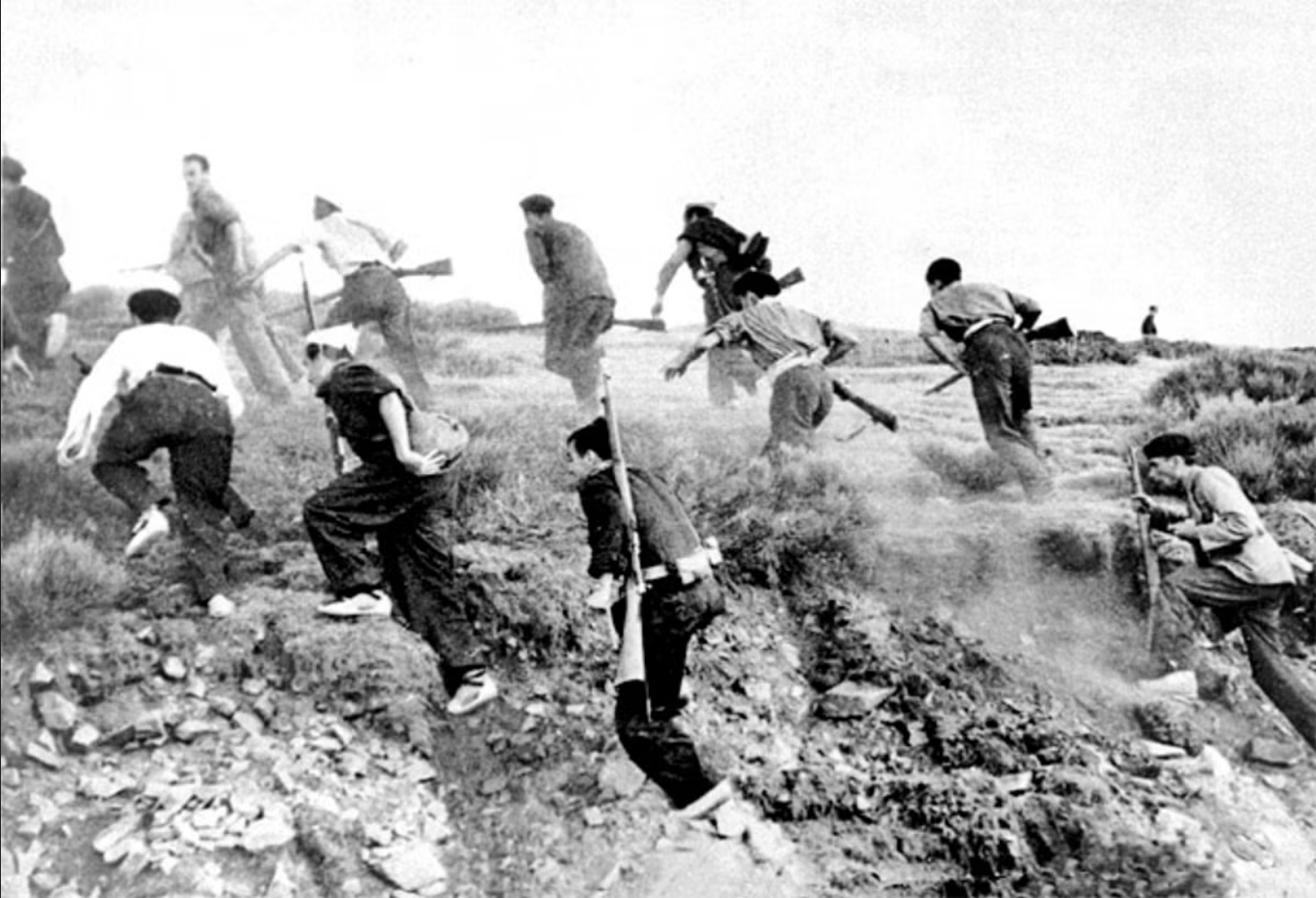
HE charged bravely, John did. One man among hundreds charging the fascist lines, Spaniards, Frenchmen, Belgians, Germans, Canadians, British, Dutch, Swedes, Czechs- anti-fascists all.
He charged that afternoon of February 28, and his tall young body was riddled with bullets- the new explosive kind with which the Italian fascists have been machine-gunning our men these last few weeks. We who knew him well can have one consolation. His buddies say he died without prolonged agony. “If I go, I want to go fast,” he said.
John Lenthier, American, native of Boston, member of the Communist Party, charter member of the New Theatre League, married, dead at twenty-two.
Remember till the day you die. It’s only on the stage that dead men rise. And realize that there’ll be no peace on earth till the fascism that John Lenthier died fighting is something the youth of tomorrow will look up in history books as we, ten years ago, looked up the Black Plague, not realizing that a new dark age was just around the corner.
The New Masses was the continuation of Workers Monthly which began publishing in 1924 as a merger of the ‘Liberator’, the Trade Union Educational League magazine ‘Labor Herald’, and Friends of Soviet Russia’s monthly ‘Soviet Russia Pictorial’ as an explicitly Communist Party publication, but drawing in a wide range of contributors and sympathizers. In 1927 Workers Monthly ceased and The New Masses began. A major left cultural magazine of the late 1920s and early 1940s, the early editors of The New Masses included Hugo Gellert, John F. Sloan, Max Eastman, Mike Gold, and Joseph Freeman. Writers included William Carlos Williams, Theodore Dreiser, John Dos Passos, Upton Sinclair, Richard Wright, Ralph Ellison, Dorothy Parker, Dorothy Day, John Breecher, Langston Hughes, Eugene O’Neill, Rex Stout and Ernest Hemingway. Artists included Hugo Gellert, Stuart Davis, Boardman Robinson, Wanda Gag, William Gropper and Otto Soglow. Over time, the New Masses became narrower politically and the articles more commentary than comment. However, particularly in it first years, New Masses was the epitome of the era’s finest revolutionary cultural and artistic traditions.
PDF of full issue: https://www.marxists.org/history/usa/pubs/new-masses/1937/v23n04-%5b05%5d-apr-20-1937-NM.pdf
 Revolution's Newsstand