
The following suggestions on organizing defense guards were attached to the SWP Political Committee minutes of July 25, 1939, and were distributed to all party branches.
‘Proposals on Initiating Workers’ Defense Guards’ by the Socialist Workers Party Political Committee. July, 1939.
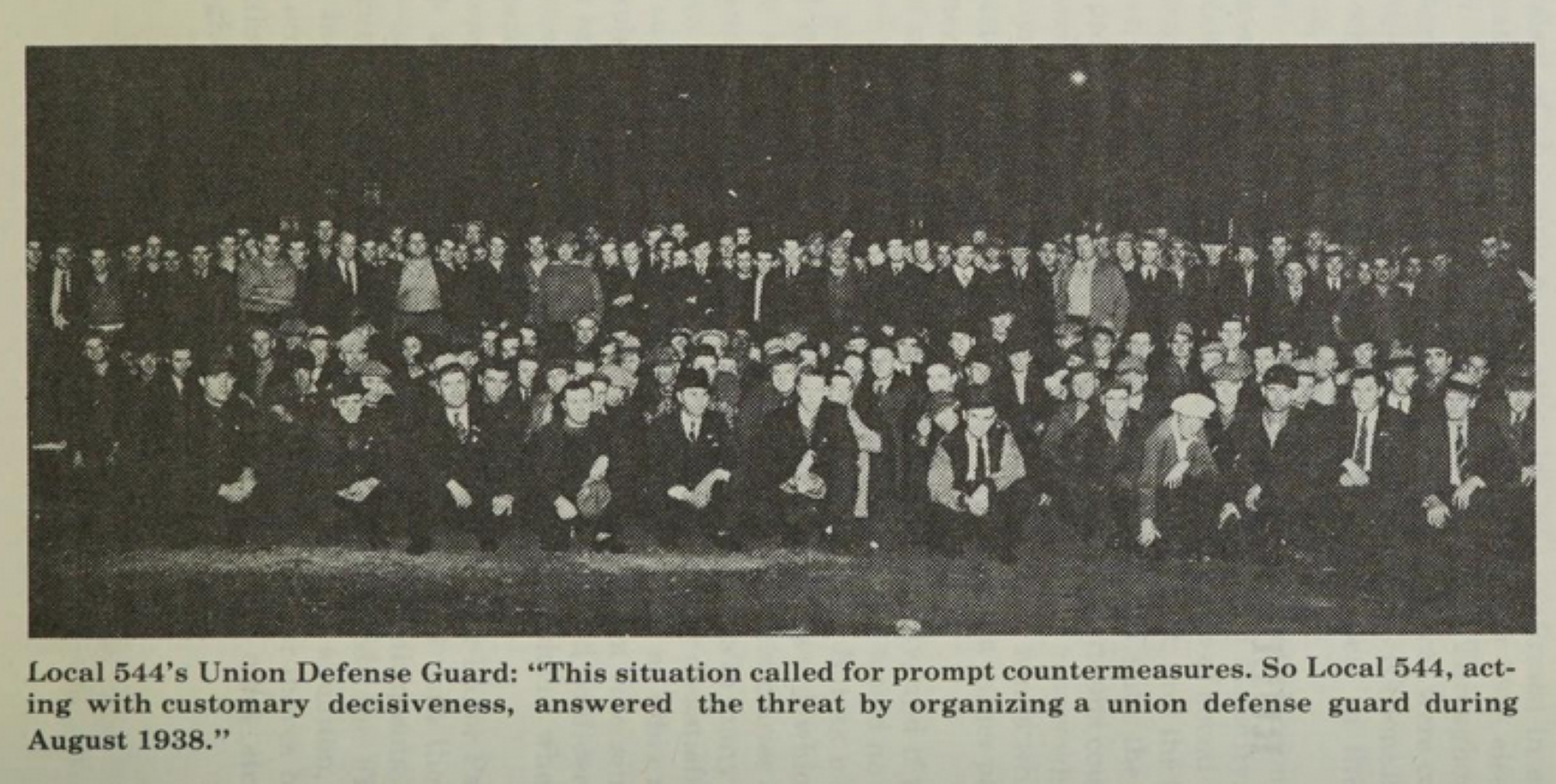
(1) The general line of the Workers Defense Guard is laid down by our convention resolution which makes clear that we attempt to help in building a mass guard based upon the support of trade unions and other mass organizations.
(2) The convention resolution also makes clear that we do not merely agitate and carry on literary propaganda for this idea, while waiting for the unions to take the lead in establishing the guard, but that at every available opportunity we utilize our available forces to set up nuclei of the future mass guard.
(3) It is obvious that at the present time in New York no unions or other mass organizations are ready to initiate and support the organization of a labor defense guard. These objective conditions dictate to us that we establish, as the immediate policy, a specialized type of activity in order to reach our objective by a flank movement as it were.
(4) The New York guard will select two favorable neighborhoods; one in the Bronx district, the other near the Flatbush district, and will “dig” themselves into these neighborhoods in the following manner: (a) they will hold regular open air meetings under the auspices of the guard. (b) They will seek to establish relations with every single available trade unionist and contact in the neighborhood with the view of eventually establishing relations with every single local union of the neighborhood.
(5) A speakers bureau will be organized in an attempt to send special representatives of the guard to address the organizations above mentioned.
(6) The guard will sponsor model resolutions which they will attempt to have their contacts and friends introduce in these organizations.
(7) The guard will organize as one of its central activities a well-planned and coordinated espionage system for the following purposes: (a) to gain full knowledge of the scope, character, and implications of all the groups adhering to the Coughlin movement, the Christian Front, and the other fascist groups. (b) To have full and accurate knowledge o all of the plans, moves and preparations of the enemy camp.
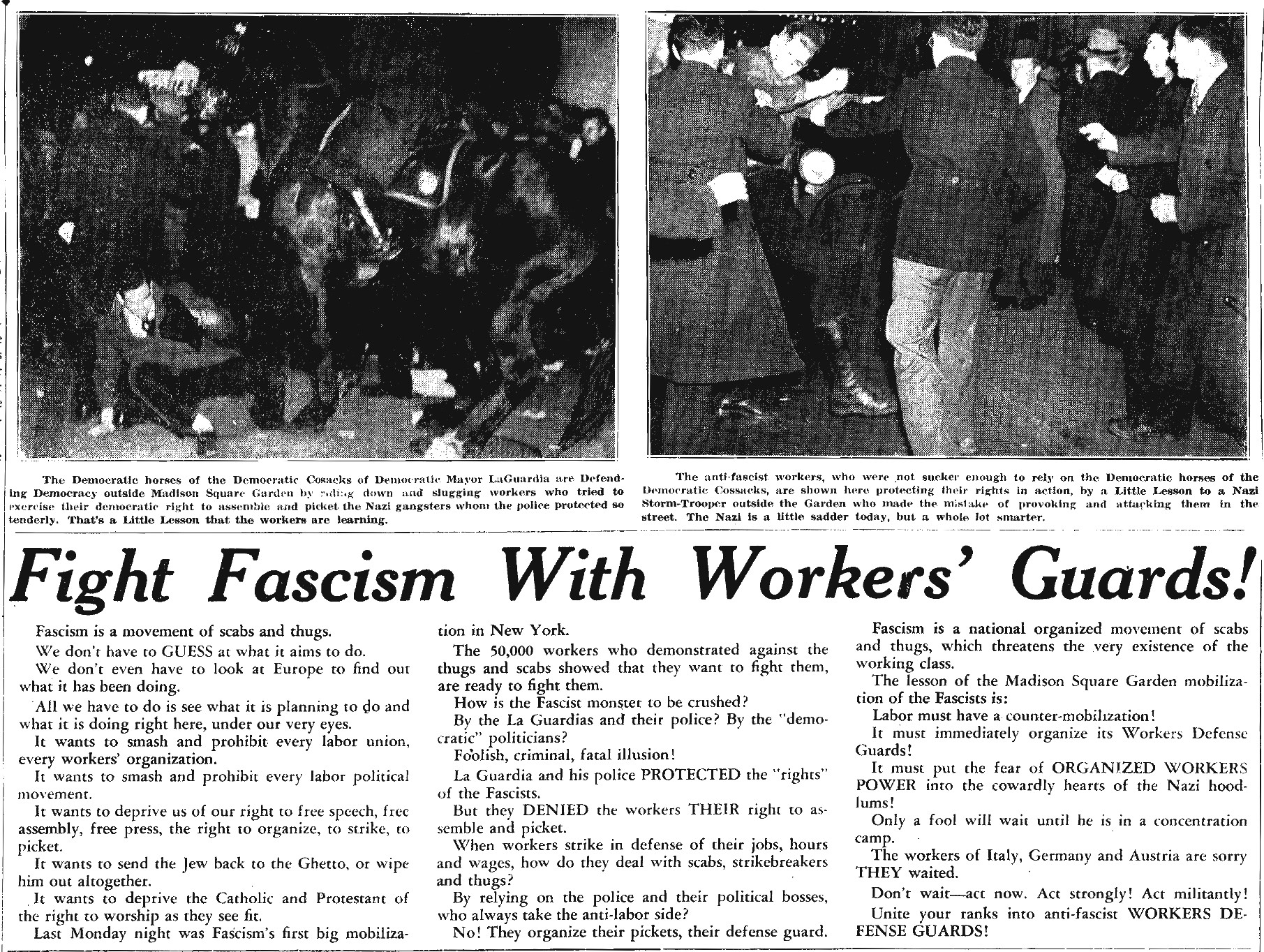
(8) With the ground well prepared by this deliberate day-to-day work of establishing connections with union members, local union organizations, fraternal bodies, etc., and with the full knowledge of the ramifications of the enemy organizations, gained by the most painstaking efforts, the guard will be in a position to make a great drive to secure finances from numerous Jewish storekeepers and other sympathetic individuals, etc., to carry on its activities and counteract the propaganda of the Christian Mobilizers and the other fascists to “Buy Christian and boycott Jewish business!” etc., etc.
(9) Using its knowledge of the plans of the enemy, the guard will attempt to contact the organizations in its neighborhood, with whom it presumably has established close fraternal connections, in order to gain the support of these organizations for mass actions in defense of the democratic rights of labor, etc., to be conducted against the Coughlinites. The guard becomes thus not only an organization of propaganda and agitation, but also an organization of action. It must be understood, however, that we always carry on our actions on the basis of our ability to mobilize larger masses behind our aims and moves than simply the members of the guard nucleus or even of the party membership.
(10) The guard will make preparations to publish a magazine to be written in a vivid and attractive style emphasizing the nature of the guard organization as one of action and aggressive opposition to the fascist movement.
(11) Given the present numerical strength, the guard will dress in uniform only in inside meetings. A small band of uniformed men marching in the streets tends at the present time to antagonize and alienate people, rather than aiding the guard in its basic purpose of winning support for itself of larger strata of the population.
(12) The guard is to emphasize its non-political character in all of its agitation and propaganda, and to stress that it is not a “subversive” organization, but is an organization protecting the democratic rights of the labor movement against the challenge of fascist dictatorship.

(13) The guard is to carry on all of its present propaganda under defensive slogans, always protecting the rights of the workers, defending meetings from unjust provocation or attack, etc.
(14) The guard is to be governed in its organization and practical work by a council with one coordinating officer, the organizer.
There have been a number of periodicals named Socialist Appeal in our history, this Socialist Appeal was edited in New York City by the “Left Wing Branches of the Socialist Party”. After the Workers Party (International Left Opposition) entered the Socialist Party in 1936, the Trotskyists did not have an independent publication. However, Albert Goldman began publishing a monthly Socialist Appeal in Chicago in February 1935 before the bulk of Trotskyist entered the SP. When there, they began publishing Socialist Appeal in August 1937 as the weekly paper of the “Left Wing Branches of the Socialist Party” but in reality edited by Cannon and other leaders. Goldman’s Chicago Socialist Appeal would fold into the New York paper and this Socialist Appeal would replace New Militant as the main voice of Fourth Internationalist in the US. After the expulsion of the Trotskyists from the the Socialist Party, Socialist Appeal became the weekly organ of the newly constituted Socialist Workers Party in early 1938. Edited by James Cannon and Max Shachtman, Felix Morrow, and Albert Goldman. In 1941 Socialist Appeal became The Militant again.
 Revolution's Newsstand