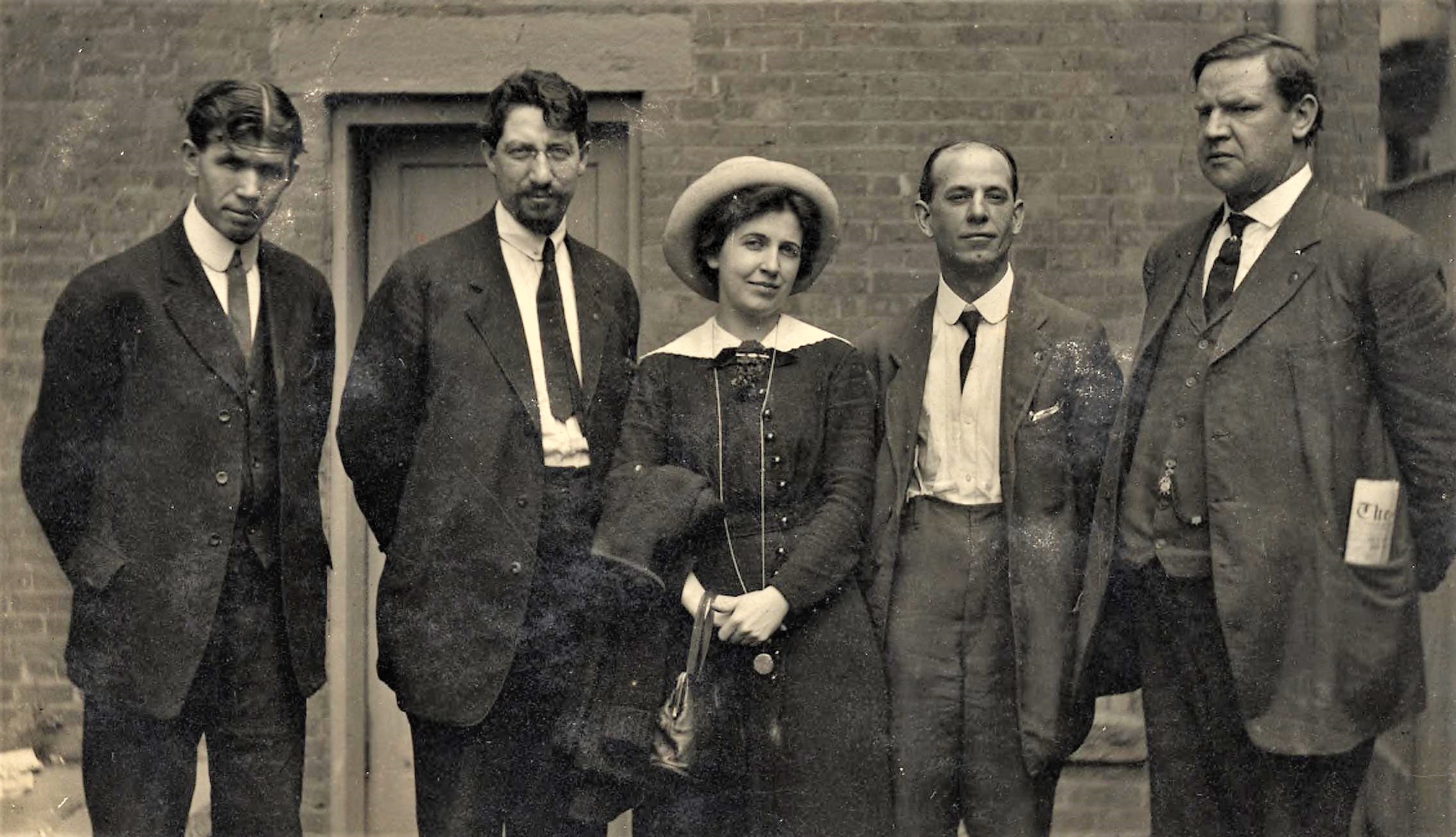
‘The Paterson Strike’ by Patrick L. Quinlan from Solidarity (New Castle). Vol. 4 No. 12. March 15, 1913.
I had intended at the beginning of the Paterson silk strike to write a daily bulletin of the situation, but unfortunately for my good intentions and plans the chief of police, Bimson by name, put the writer, Carlo Tresca, and Miss Flynn in jail on the charge of “inciting to riot.” As I was in the county prison for four days, and all the while the strike was growing, and has since I was released continued to grow like wildfire, I am unable to catch up with the fight.
To put it briefly, the strike was not general until Tuesday, Feb. 25, and up to that time the fight was limited to one factory, the Doherty mill. The cause of the dispute being Doherty’s attempt to introduce the three- and four-loom system instead of the two-loom, as was customary. The Doherty workers had been on strike for more than a month. Three weeks ago the workers themselves saw that if Doherty succeeded in installing the three- and four-loom system it would be generally introduced throughout the silk industry.
Mass meetings wee held, the situation from every angle and viewpoint was discussed and, after due consideration as to the responsibilities and risks involved, a general strike was called. Of course other grievances, such as hours, time, and pay, were taken into account, and the whole carefully, carefully crystalized by Lessig and Koettgen and the strike committee into a preamble and a list of demands for the workers, the public, and, above all, the boss manufacturers. The strike was then speedily licked into shape.
At first the response was dubious, but the arrest of Tresca, Quinlan, and Flynn seemed to be a challenge that the workers instinctively saw and knew should be accepted. And while Flynn and Tresca were in jail but one and two days respectively, the strike fever began to grow, the enthusiasm for a battle with the bosses once more began to gather like a whirlwind and swept all before it like grace through a camp meeting until every silk worker in Paterson feels that in order to be save he must go to the industrial union and, fortunately, this time there is no doubt as to who, which, and what only the one union — the IWW of Chicago.
The most widely read of I.W.W. newspapers, Solidarity was published by the Industrial Workers of the World from 1909 until 1917. First produced in New Castle, Pennsylvania, and born during the McKees Rocks strike, Solidarity later moved to Cleveland, Ohio until 1917 then spent its last months in Chicago. With a circulation of around 12,000 and a readership many times that, Solidarity was instrumental in defining the Wobbly world-view at the height of their influence in the working class. It was edited over its life by A.M. Stirton, H.A. Goff, Ben H. Williams, Ralph Chaplin who also provided much of the paper’s color, and others. Like nearly all the left press it fell victim to federal repression in 1917.
PDF of full issue: https://www.marxists.org/history/usa/pubs/solidarity-iww/1913/v04n12-w168-mar-15-1913-solidarity.pdf
 Revolution's Newsstand