
‘Military Organization and the Structure of Society’ by Nikolai Bukharin from Soviet Russia (New York). Vol. 2 No. 14. April 3, 1920.
THE organization of an armed force is always determined by the social-economic and political regime on the basis of which it is constructed. This organization is not something fixed and immovable. On the contrary, one can always follow its evolution with precision: and sometimes its revolution. It is easy to understand the fundamental causes of this phenomenon. Society, with its changing historical types, is constituted at each given moment in accordance with a single principle which assumes in its diverse parts a single and the uniform “style”.
The basis of a society where slavery exists is class relations between the owners, the slaves and the “speaking tools”, deprived of all rights. The absence of all legal rights coincides with economic exploitation. The political machine is constructed like the “economic structure” of society. And in those epochs where the revolts of slaves menaced the existence of the owners, the army was composed of “free citizens.” Slaves were excluded from it. They were “unworthy of carrying arms.”

Let us take an example very near to us,—capitalist society. Its economic bases are the relations between the owner, the means of production, the capitalist and the wage worker who has no property. The political government reflects this situation in this wise: that either the workers have not equal rights to those of the capitalist, in principle or in fact; or they have these rights in principle, but they have not in fact. In either case, it is the bourgeoisie who governs, the workers who execute, in submission. The same relations exist in the army. The elements which, from an economic point of view are the exploiters are the directors, in the army they are the commanders and they are organized into what is called the officer corps. From this point of view, the capitalist factory, every institution of the state or of the regiment of the capitalist army is constructed on the same basis: the elements of the classes which are superior to the worker find themselves in a superior position in the factory as well in the regiment; in fact, in every position. On the contrary the elements of classes which find themselves at the bottom of the hierarchy of the factory are at the bottom of the hierarchy of the regiment and every organ of the state.
It is easy to understand why one discovers in society this singular kind of architecture. It is the indispensable condition of the relative stability of the social type in question. Without this unity, society, in its quality as a definite system of social relations, would pass away. It is clear from the above that a given social system is the more stable as its interior structure has greater unity.

This is the necessary criterion to apply to the question of the organization of an army. A little before the October revolution it was an obvious fact that discipline had disappeared in the army. But it had disappeared exactly as the capitalist discipline had disappeared in any factory. The workman, who occupied the inferior position in the factory, ceased to obey the capitalist. The working class demanded for itself its rights, first for the control then for the direction of the factories. They no longer could, nor would, work in obedience to the beck and call of the exploiter. But even as the worker could no longer work for the capitalist and obey him at the factory, he could no longer work for him and obey him in the army. Thus the army went to pieces. The experience of the German and Hungarian Revolutions, as well as that of the Russian Revolution shows very clearly that the capitalist type of relations between men is breaking down simultaneously in all fields. That is why the hope of maintaining the old army is a vain utopia, an absolute absurdity.
Let us now look at the other side of the question.
What ought to be the organization of the armed forces when Communism is completely established: that is to say when a fraternal and free world economy will function? The answer is obvious: there will not be any, for there will be neither the enemy “external” nor the enemy “internal”, there will be neither states, classes, nor ranks there will be only humanity. But between international communism and the dictatorship of the proletariat as a road toward communism there is a series of intermediate steps.

One could imagine, for example, a situation like this: in all Europe communism is practically established, social production is organized, the bourgeoisie has been long in submission, even changed, and assimilated; classes have disappeared; the Europeans have become simply citizens of the socialist society. But in Asia and in Africa capitalism has developed, the bourgeoisie has armed itself, in an analogous imperialistic policy to that of the scattered European bourgeoisie. It is evident that in such a case an organization of armed force is necessary in Europe. In what form? Here the answer is clear. The military organization of communist society where classes have disappeared, but which must fight against the foreign bourgeoisie, must be the socialist militia formed by the entire people. It is the type of organization of armed forces which is the most free, most perfect; it is based on the profound consciousness of the members of the socialist society, equal, psychologically welded together, who are not divided by class division. That which is called “discipline by force” plays no part whatsoever here.
The army of the proletarian dictatorship must be distinguished from this type of organization of armed forces. It belongs to that historical phase which was the approach to communism, but which is not communism.
Here the economic basis is not a social economy directed by a society without classes, but a social political economy directed by the proletariat.
The state is not suppressed, but it is the dictatorship of the proletariat which rules, the complete break-up of the classes has not been established, but a state of civil war, more or less apparent, more or less latent, as well as the social struggle which develops under cover. Under these conditions, the organization of a popular militia is not easy. It does not correspond either to the present economic structure or to the soviet type of state. Our program rightly says: “The Red Army as an instrument of the proletarian dictatorship must necessarily have a clear-cut class character; that is to say, it must be composed exclusively of the proletariat and of the proletarian elements of the rural population that are near to it.”

If an army of this kind is not uniform as to its class composition; if it is caused by the existing differences between the proletariat—which is the conscious leader of the whole revolution—and the ideology of the small proprietors of the rural population, the hegemony of the proletariat will be and must be assured first by the corps of proletarian officers, the formation of which will give evidence of what in the terms of our program is “one of the most essential tasks”; and second by an iron revolutionary discipline which this phase of development renders indispensable. He who knows the history of the French Revolution knows how a revolutionary army was organized.
The formation of the army must obviously be accompanied by universal military instruction of all proletarians and semi-proletarians, and the placing in the curriculum of schools of things relating to this instruction. The general military instruction must, in the first degrees of the development of the dictatorship, have also class character and not become “popular” except as the process of class deformation progress. The concrete determination of the subjects which ought to be taught is a question of political fact; it is dictated entirely by the character of the moment, by the degree of change of the classes and of their assimilation by the proletariat.
It is only in these conditions that the system of the dictatorship of the proletariat will be stable, and that the Red Army will be victorious.
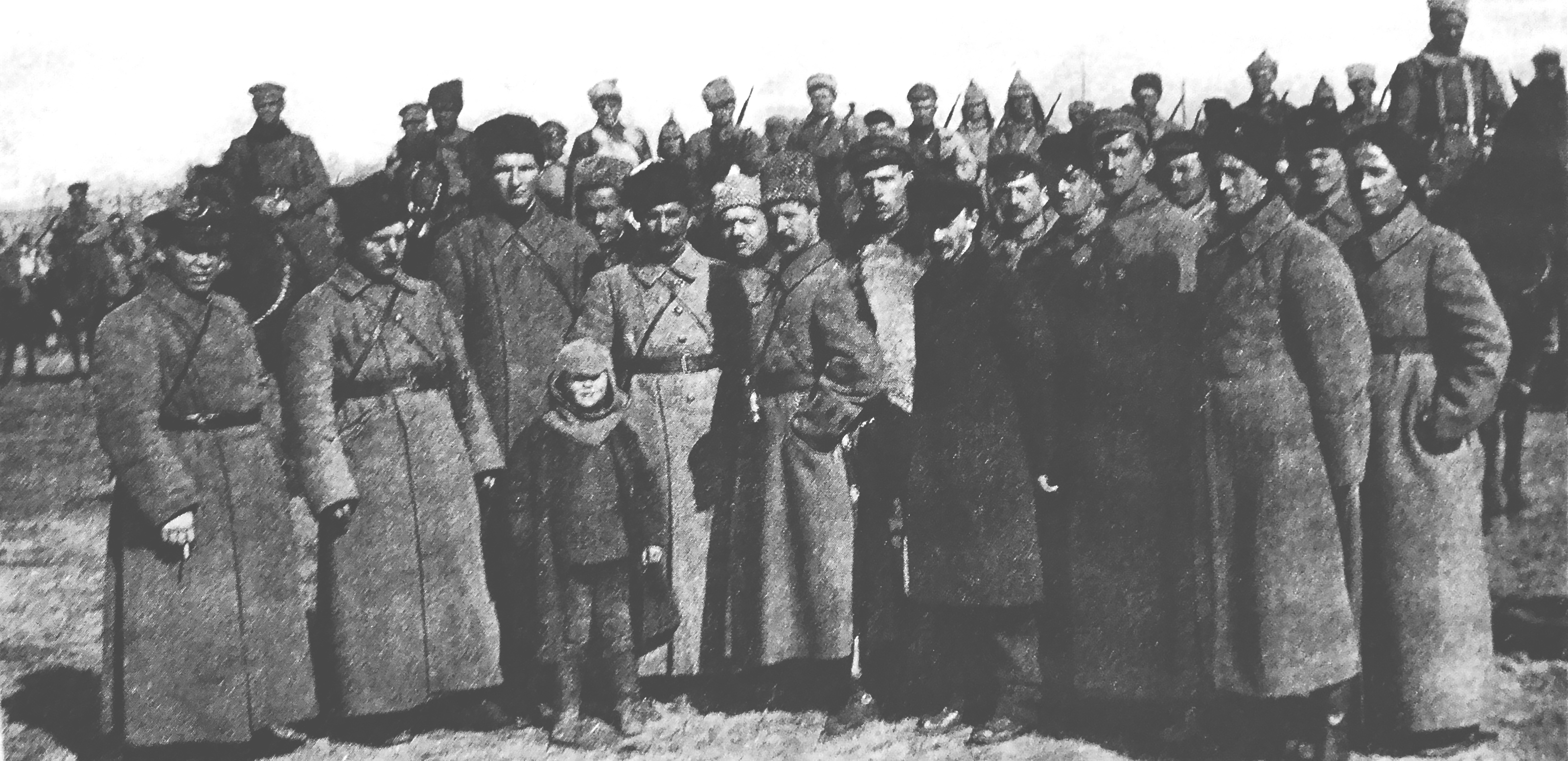
It is self-evident that now the army is not “outside of politics”, but that it ought to be entirely imbued with the Communist policies, and that the work of instruction and of military education of the Red Army should be based on the solidity of class sentiment and socialistic education.
The phrase of Klausewitz, the German imperialist theorizer, “war is the continuation of politics, but only by other means” has me a truism. But it remains none the less true, with this difference, that today, the victorious politics of communism is succeeding the politics of imperialism and the Red Armies of the Dictatorship of the Proletariat are the instruments thereof.
Soviet Russia began in the summer of 1919, published by the Bureau of Information of Soviet Russia and replaced The Weekly Bulletin of the Bureau of Information of Soviet Russia. In lieu of an Embassy the Russian Soviet Government Bureau was the official voice of the Soviets in the US. Soviet Russia was published as the official organ of the RSGB until February 1922 when Soviet Russia became to the official organ of The Friends of Soviet Russia, becoming Soviet Russia Pictorial in 1923. There is no better US-published source for information on the Soviet state at this time, and includes official statements, articles by prominent Bolsheviks, data on the Soviet economy, weekly reports on the wars for survival the Soviets were engaged in, as well as efforts to in the US to lift the blockade and begin trade with the emerging Soviet Union.
PDF of full issue: (large file): https://www.marxists.org/history/usa/pubs/srp/v4-5-soviet-russia%20Jan-Dec%201921.pdf
 Revolution's Newsstand