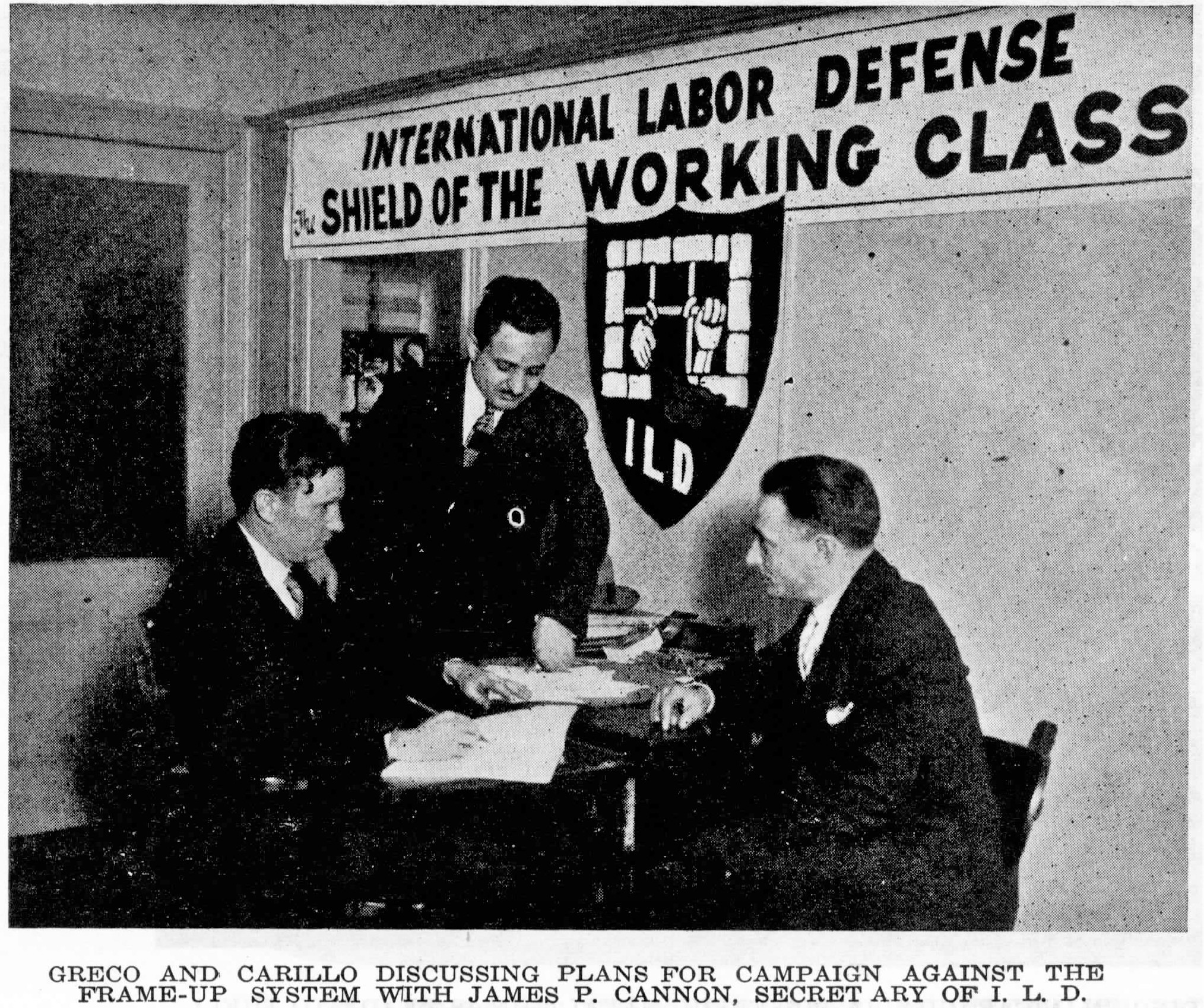
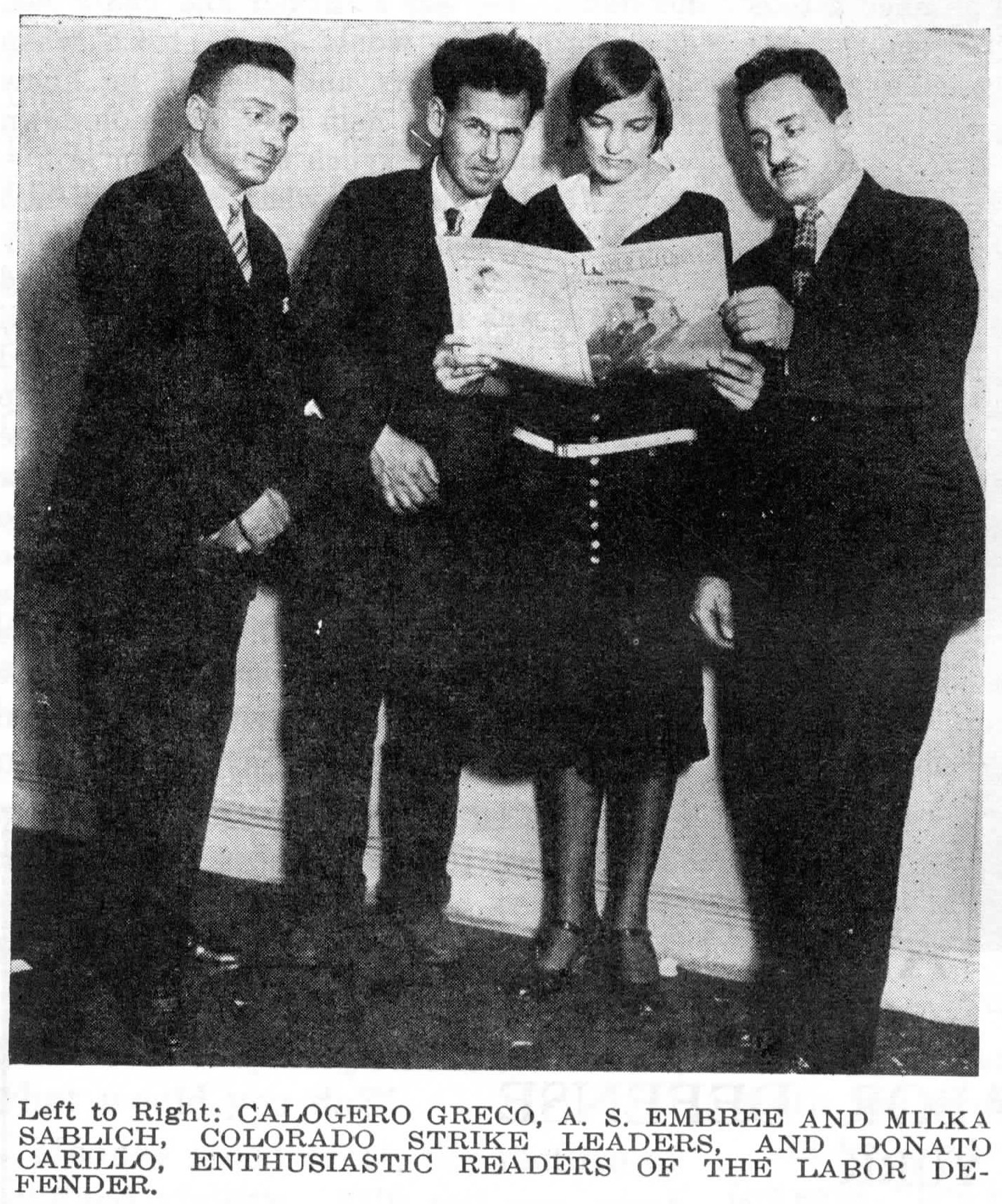
Violence between fascists and antifascists wracked Italian communities during the 1920s, and beyond, in the United States. Charles Yale Harrison tells of the arrest of leftists Calogero Greco and Donato Carrillo, comrades of Carlo Tresca, accused of murdering two uniformed fascisti in the Bronx on Memorial Day, 1927. In a rare win, coming just weeks after the execution of Sacco and Vanzetti, Greco and Carrillo (defended by Clarence Darrow) were acquitted of the charges in January, 1928.
‘The Long Arm of Mussolini’ by Charles Yale Harrison from Labor Defender. Vol. 2 No. 11. November, 1927.
ON May 30 (Memorial Day) of this year a band of fascisti, members of the Fascisti League of North America, were on their way to march in a Memorial Day parade in New York City. They wore the standard fascist regalia, black shirts, tassled caps, high boots and loud, militaristic riding breeches. On their shirts they had the fascist insignia which reads, “Intolerance to the enemy; death to the foe.”
As two members of the party approached the 183rd Street station on the Third Avenue elevated line, an unknown assassin sprang out from behind a hiding place and stabbed and shot Joseph Carisi and Nicholas Amoroso, both active in Bronx fascist circles and members of the “squadrista,” the guerrilla branch of the fascist movement. The men collapsed in a pool of their blood and the murderer made off unidentified.
They were rushed to Fordham Hospital and they died on the way before the ambulance arrived there.

The East Side of New York with its venal criminal gangs is a fertile field for the well-heeled recruiting agents of the fascisti. Some time before the Memorial Day murders, occurred the ranks of the Fascist League was torn by a factional struggle for supremacy; as a result Giacomo Caldora broke away and formed II Duce Fascist Alliance. The break rankled in the breasts of the fascist leaders and on many occasions Caldora’s life was threatened. On the day of the murders Caldora was standing within ten feet of the scene of the assassination and since then he has expressed the belief that the assassin meant to kill him and an associate and that they mistook Carisi and Amoroso for two members of the II Duce Alliance.
On hearing the news of the murders fascist circles in New York went insane with fury. Irresponsible charges were made against nearly every prominent antifascist and Italian labor leader in the city.
When the news of the murder reached Rome, Premier Mussolini and all his ministers and deputies stood in salute to the dead members of the “squadrista.” Deputy Alfieri rose in the Italian Chamber of Deputies and called upon the Italian Fascisti to avenge the deaths of Carisi and Amoroso. Two days later II Popolo d’Italia, a venomous fascist sheet said editorially, “The double assassination of the fascisti perpetrated by the refuse of Italy who have come together especially in New York city cannot leave us indifferent. The measure is full. It is necessary for us to take up the fight without mercy against these anti-fascisti who are living in foreign cities, against renegades who are exercising criminal propaganda against Italy and the lives of Italians themselves.
“We must crush the traitors as ice would a viper that bites at our heel.”
The New York Italian capitalistic papers (which are notoriously profascist) took up the cry for blood and clamored for a victim.
Six weeks went by and there were no arrests. Suddenly, on July 11th, the New York police working in conjunction with agents of the Italian Secret Service threw out what the newspapers are pleased to call a dragnet and arrested fourteen prominent anti-fascisti. The offices of II Nuovo Mondo, an Italian socialist publication was raided and Mario D’Amico and Frank Cancellieri were taken into custody. The raiding party then went next door and burst into the offices of II Martello, of which Carlo Tresca is editor, and arrested Mario Tresca, Carlo’s brother; Luigi Quintilliano and Mario Buzzi.
Earlier in the day the American and Italian fascists raided two working class homes in Brooklyn and arrested Calogero Greco and Donato Carrillo. Greco and Carrillo are active members of local 63 of the Amalgamated Clothing Workers of America. They were also members of the Anti-Fascist Alliance of North America, with which Carlo Tresca is prominently identified. Being workers and at the same time anti-fascists they were “suspicious characters” to the raiding party.
Instead of being taken to police headquarters for examination the “suspects” were taken to the Highbridge police station in a deserted locality of the Bronx and there submitted to official “questioning.”

After hours of grilling all but Greco and Carrillo were released and they were then charged with murder in the first degree.
During the questioning members of the New York fascisti were brought face to face with the accused and asked to identify them. The usual procedure, even in New York, is to put a suspect in the line-up with other suspects and then the witness is asked to pick out the culprit.
In the case of Greco and Carrillo, District Attorney McGeehan led the “witnesses” into a room where the suspects were sitting and asked, “Is this the man?” Of course they were identified.
The fascists who identified Greco and Carrillo were all members of the “squadrista,” the punitive arm of fascism whose duty it is according to its oath “to defend at all costs the fascist regime at home or abroad.”
As soon as Greco and Carrillo were properly “identified” in keeping with the best traditions of the Palmer-Burleson methods, Dr. Di Marzio, general secretary of the fascist branches in foreign countries began to give the case that deft touch which may eventually make it a case of international significance.

Di Marzio wrote to the American Ambassador Fletcher and asked that the envoy do everything in his power to see that Greco and Carrillo be electrocuted for the murder of the Bronx Fascists. Fletcher relied to Di Marzio as follows:
“I received your most courteous letter dated July 12, in regard to late arrests made in New York in relation to the killing of Carisi and D’Ambrosoli. I am sure that every attempt will be made to secure the guilty justice. With cordial salutations,”
(Signed) Fletcher It will be noted that in Fletcher’s letter to Di Marzio Amoroso is referred to as D’Ambrosoli. Why did Amoroso use an alias for his operations in America? Why did Mussolini himself rise to honor two apparently obscure members of the “squadrista?” Why were they sent to America from Italy? These are questions which will have a bearing when the case is heard.
Caldora, the head of the II Duce Fascist Alliance, when interviewed by reporters had this to say. “I saw Amoroso killed. The man who killed Amoroso didn’t look like Greco or Carrillo. If I ever see him again I will know him; I could pick him out of a million men. Greco and Carrillo are innocent.”
In the meantime five fascists have sworn that Greco and Carrillo are the murderers and the entire legal machinery of the State of New York is being oiled for speedy action when the men come up for trial.
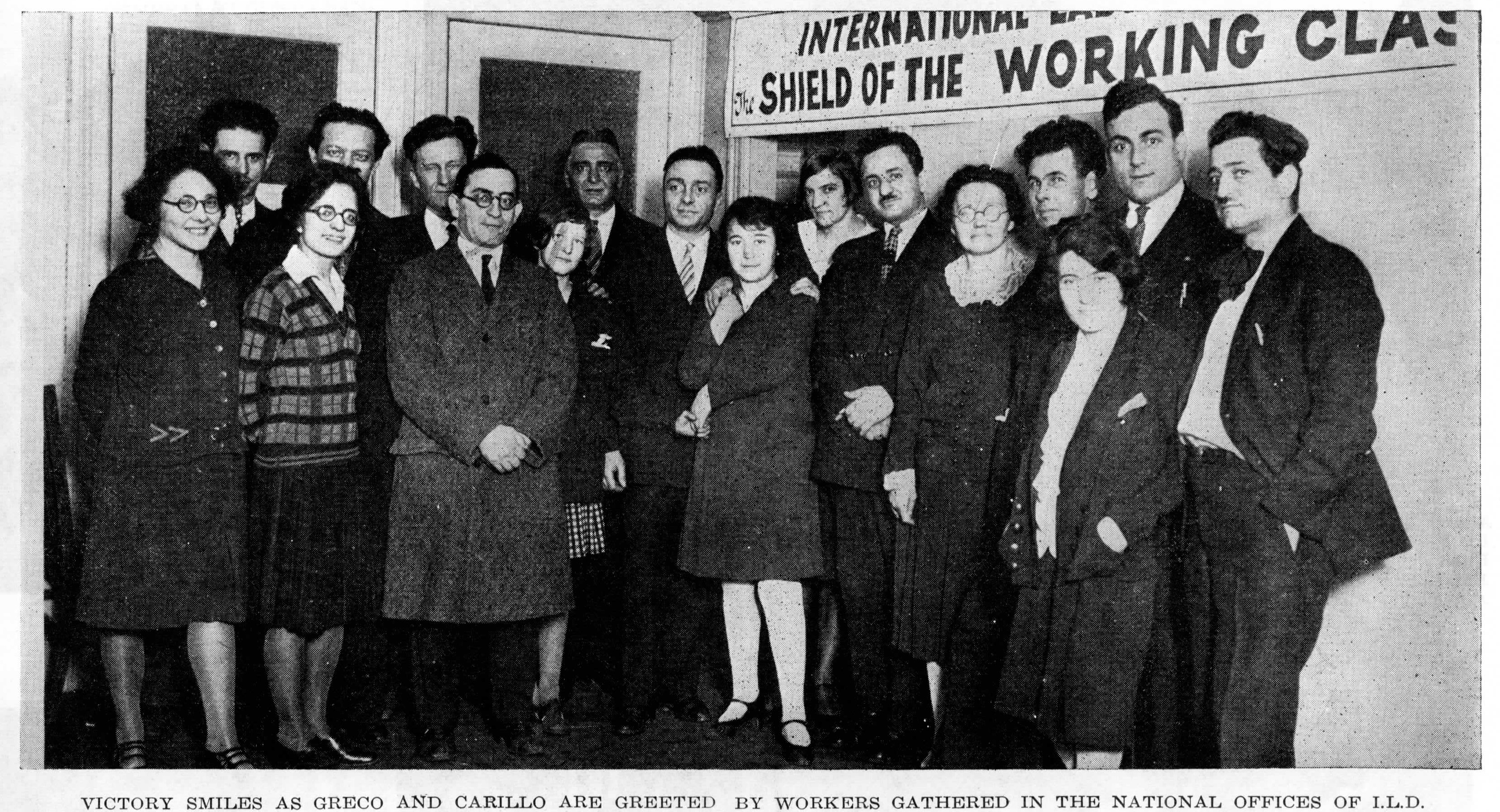
The case has all the earmarks of a frame-up. All the characters of the familiar railroading act are here. Two militant workers, the forces of professional patriots (in this case fascist patriots), the perjured testimony or affidavits and the usual “murder” charge. In all its aspects the Greco-Carrillo case bids fair to become another Sacco-Vanzetti case.
Two more workers are being groomed for the electric chair.
 Revolution's Newsstand