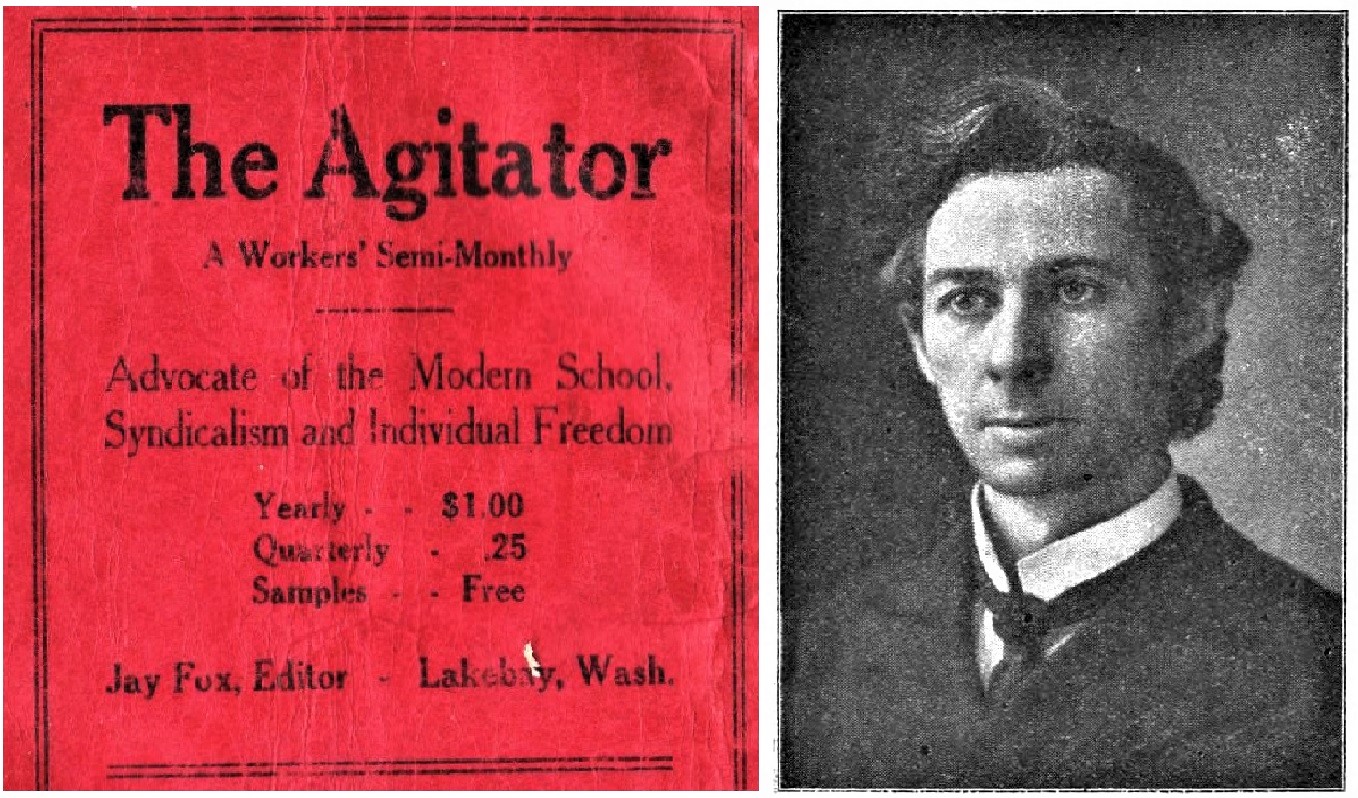
Jay Fox, editor of the Agitator, paper of the Syndicalist League of North America, which included William Z. Foster, responds to an article in the I.W.W.’s ‘Industrial Worker’ on the differences of perspective between their two organizations.
‘Syndicalism vs. I.W.W.ism’ by Jay Fox from The Agitator. Vol. 3 No. 3. February 1, 1913.
In a recent issue of the Industrial Worker (January 9) there appeared an editorial entitled “Industrialism Is Not Syndicalism,” that contained a fund of unproved assertions and misstatements of fact, combined with misleading allusions.
Hitherto the I.W.W. had taken to itself all the benefits of the advertising accorded to Syndicalism, by covertly aiding and encouraging the popular belief that it was the American representative of Syndicalism. But the growth of the Syndicalist League and the reported statements of the fundamental difference between the I.W.W. and Syndicalism that has appeared in this paper, have forced an open confession from the Worker.
But the Worker has not been satisfied to state the difference and let it go at that. It attempts to discredit Syndicalism and show that it is a back number, without the fairness to give a definition of what it stands for. On the contrary, by covert journalistic tricks it leads the reader to infer that Syndicalism is reactionary. For instance, it says:
“The craft union has fulfilled its mission, if it ever had one, and must disappear. Those who try to perpetuate it are today the deepest reactionaries, even though they may call themselves Socialists, Anarchists or Syndicalists.”
Not given a definition of Syndicalism, the inference is inescapable that it upholds craft unionism. The Worker must know Industrialism is one of the good things the I.W.W. borrowed from Syndicalism. If it does not know, then it should not presume to write about that of which it is ignorant. I quote again:
“Those who hold that craft unions will develop into industrial unions are ignorant of history.”
SOME ANALOGIES.
Then it wanders ail over the ages picking up “analogies” to bolster up its. assertion. It tells us that Luther started a new church, that the Socialists started a new party; the A.F. of L. a new union, and the steel trust “a new organization.” Then to clinch its argument proper, and to prove that the Syndicalists are a bunch of John Henry Dubbses, fit subjects for the comic section of the Worker; it says:
“The Syndicalists themselves give the lie to their own teachings by withdrawing from the I.W.W. rather than to attempt to change it to conform to their pet theories.”
If you are totally ignorant of the history quoted, and of the movements of the Syndicalists, and don’t stop to think as you read these “analogies” and the passage quoted, the “argument” will get you, perhaps. For myself, I would be afraid to trust you with such “evidence” in support of my assertions. But the Worker is evidently more reckless than I am.
Let me dwell on these “analogies” for a moment, not especially to prove anything, but to show you just how reckless the Worker is. Take the Socialists for starter. They started a new party because there was nothing else they could do. THERE WAS NO WORKERS’ PARTY FOR THEM TO “BORE” IN. Is that enough for you? Very well, we will pass on to the A.F. of L. The Worker says it “did not try to force its ideas upon the existing unions.”
The statement is misleading and unfair, because it gives an impression a statement of the facts would not warrant.
The A.F. of L. was started as a federation of international and national unions joined together for mutual protection. Where is the analogy between that and Tom Jones, the machinist, going into the Machinists’ Union to propagate for the general strike? You fail to see it? So do I. But wait a minute. While we are here let us go a little further into the history of the A.F. of L., ignorance of which the Worker so boldly charges us, and see what else we can dig up.
THE KNIGHTS OF LABOR.
The Knights of Labor was the ”one big union” of those days. It was built on the same general plan as the I.W.W. The executive authority was centralized in the heads of a few men. There was no craft or local autonomy. The idea was that unity of action demanded a central authority. While the organization was small and enthusiasm big there was no difficulty. But when the organization got big the red tape grew longer and unwound slowly. As a consequence discontent began to do its deadly work. It began to “bore,” and it called itself “Federation.” The Federationists bored hard and puriously in the K. of L. and carried one craft after another into the A.F. of L., where the red tape was absent, until the powerful industrial union, that had a million members in 1886, was reduced to nothing.

Thus it will be seen that where history touches our case, it not only sanctions our boring idea, but it goes even further and justified our “Federation of Industries” plan, as against the “one big union.” But suppose history was dead against us, what would the Worker’s analogies amount to? Its argument is simply this:
“You fellows are ignorant of history. See Luther standing back there! He’s got no auger in his hand, he has a hammer and saw. What! establish a new precedent! Blasphemy! As Luther did, so shall it be done forever after.”
Such is the logic of the Worker.
ABUSE DON’T PAY.
To those who might say the Federationist’s boring was different from that of the Syndicalists, I would answer: Only in detail; the principle is the same. If you have an idea. Above the common level, stick till you raise the common level up to it. Don’t run off by yourself, like a kid, and bawl. The man who works beside you, who sits beside you in the union, he’s the man you must convince, and you can’t do that by running away from him. There is one of the two main points of difference between the I.W.W. and the Syndicalist League of North America.
The two and a half million organized workers in this country are not going to be convinced of the splendors of Industrialism by vituperation and lying abuse. We may as well make up our minds to that first as last. They must be approached as man to man, with the kind word and the. glad hand of fellowship. “Fellow-workers,” not “scab!” must be our greeting to them. If we have a message of freedom for them we must carry it to them. That is our work as propagandists.
We have no quarrel with the I.W.W., except that we won’t stand for misrepresentation. We demand a square deal. We stand for the truth even though it consumes us, and we will struggle with our friends for it as readily as with our enemies.
Some Syndicalists leave the I.W.W. to go where their propaganda is more badly needed. If that is “giving the lie to their own teachings,” then the lie will continue.
Returning to the Worker’s history…I would like to ask it if that bit of recent French history, wherein it is recorded that a handful of revolutionists bored their way into the small and sicky labor movement of that country and developed it into a fighting body of 600,000 members, ready to go the limit at the drop of the hat, has not more bearing on the question at issue than the exploits of Martin Luther?
Syndicalism is Industrialism, Federated Industrialism. It stands for the ultra-revolutionary and scientific doctrine of decentralization. It holds that the real solidarity of a free proletariat depends more on the man at the bottom than the man at the top; more on the individual than on the local union; more on the local union than on the central council; more on the central council than on the industrial union; more on the industrial union than on the federation of industrial unions.
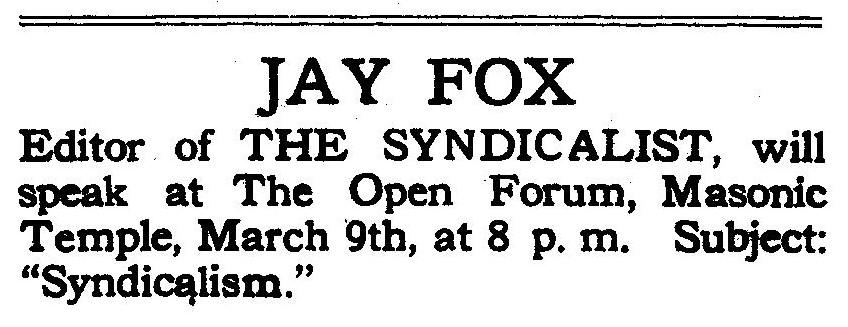
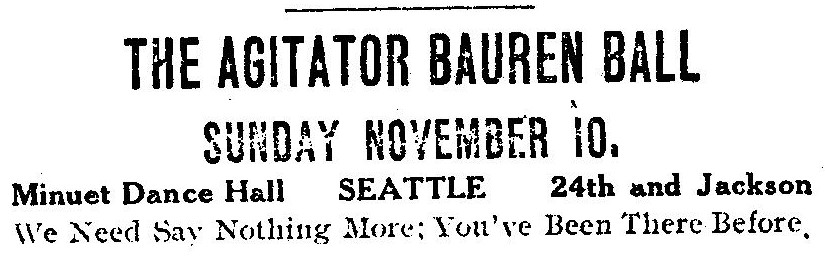
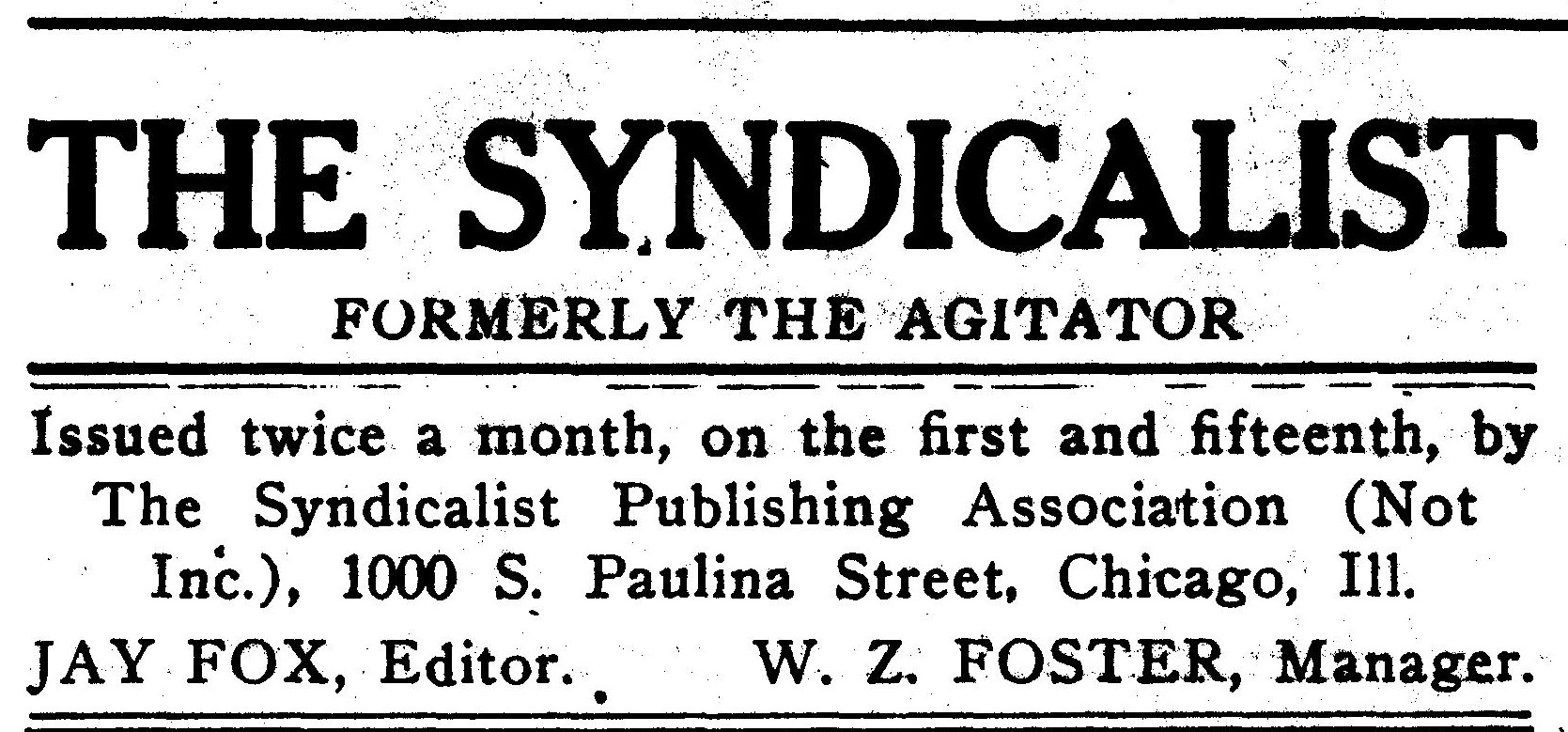
The Syndicalist began as The Agitator by Earl Ford, JW Johnstone, and William Z Foster in 1911. Inspired by the revolutionary syndicalism of the French CGT, they felt they were political competitors to the IWW and in early 1912, Foster and others created the Syndicalist Militant Minority Leagues in Chicago with chapters soon forming in Kansas City, Omaha, Minneapolis, St. Louis, Denver, Seattle, Tacoma, Vancouver, San Francisco, and Los Angeles. They renamed The Agitator The Syndicalist as the paper of the Syndicalist League of North America with Jay Fox as editor. The group then focused on the AFL. The Syndicalist ceased publication in September 1913 with some going on to form the International Trade Union Educational League in January 1915. While only briefly an organization, the SLNA had a host of future important leaders of the Communist movement. Like Foster, Tom Mooney and Earl Browder who were also members.
PDF of full issue: https://www.marxists.org/history/usa/pubs/agitator/v3n03-w51-feb-01-1913-syndicalist.pdf
 Revolution's Newsstand