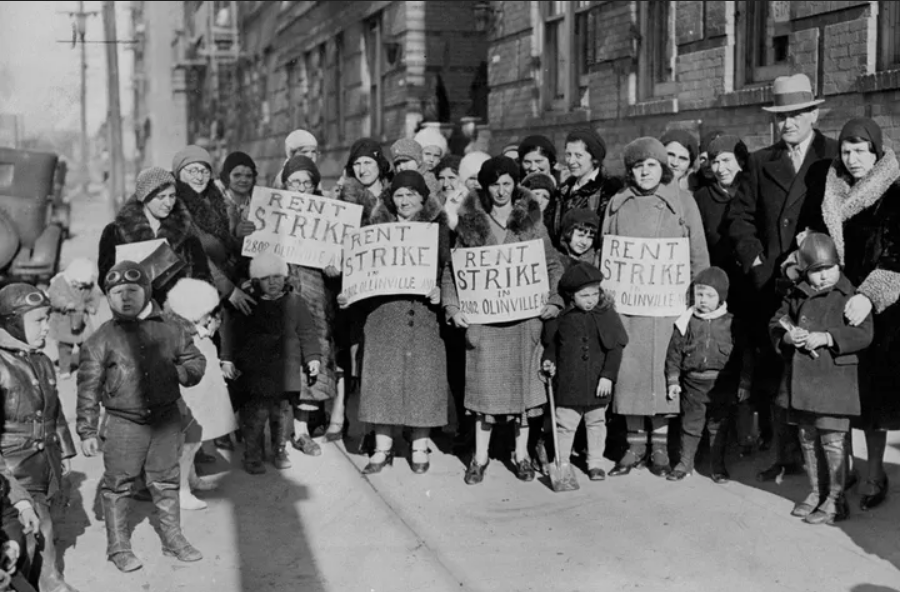
A Communist Party militant reflects on the experiences of the Bronx rent strike during the winter of 1932.
‘The Political Significance of ‘Rent Strikes’’ from Party Organizer (Communist Party Internal Bulletin). Vol. 5 No. 2. February, 1932.
THE rent strikes that have been and are organized and led by the Upper Bronx Unemployed Council gives us a treasure of experience. It is worthwhile to analyze these experiences and evaluate the political importance of these rent strikes.
The Rent Problem of the Workers
In organizing House and Block Committees, we found that the rent problem is one of the most burning one the workers are facing at the present time and which most important for the demand to reduce the high rents they are ready to organize and carry on a struggle, I think we can state that the Party as a whole up till the present time underestimated the immense possibilities that lays in organizing tens of thousands of workers through the organization of rent strikes. We also find that these rent strikes are developing not only amongst the poor workers, living in fire traps, paying 20-25 dollars a week, but also amongst the “better paid” workers. Certain comrades—at the beginning—wanted to ridicule the movement, not realizing the fact that these “better paid” workers are ‘members of the American Federation of Labor, many of them working in basic industries, such as railroads, others in the building and other important industries. In other words we can reach good proletarian elements, we can draw them into struggle under our leadership and then recruit them in the unions and shop organizations.
Great Masses are Involved
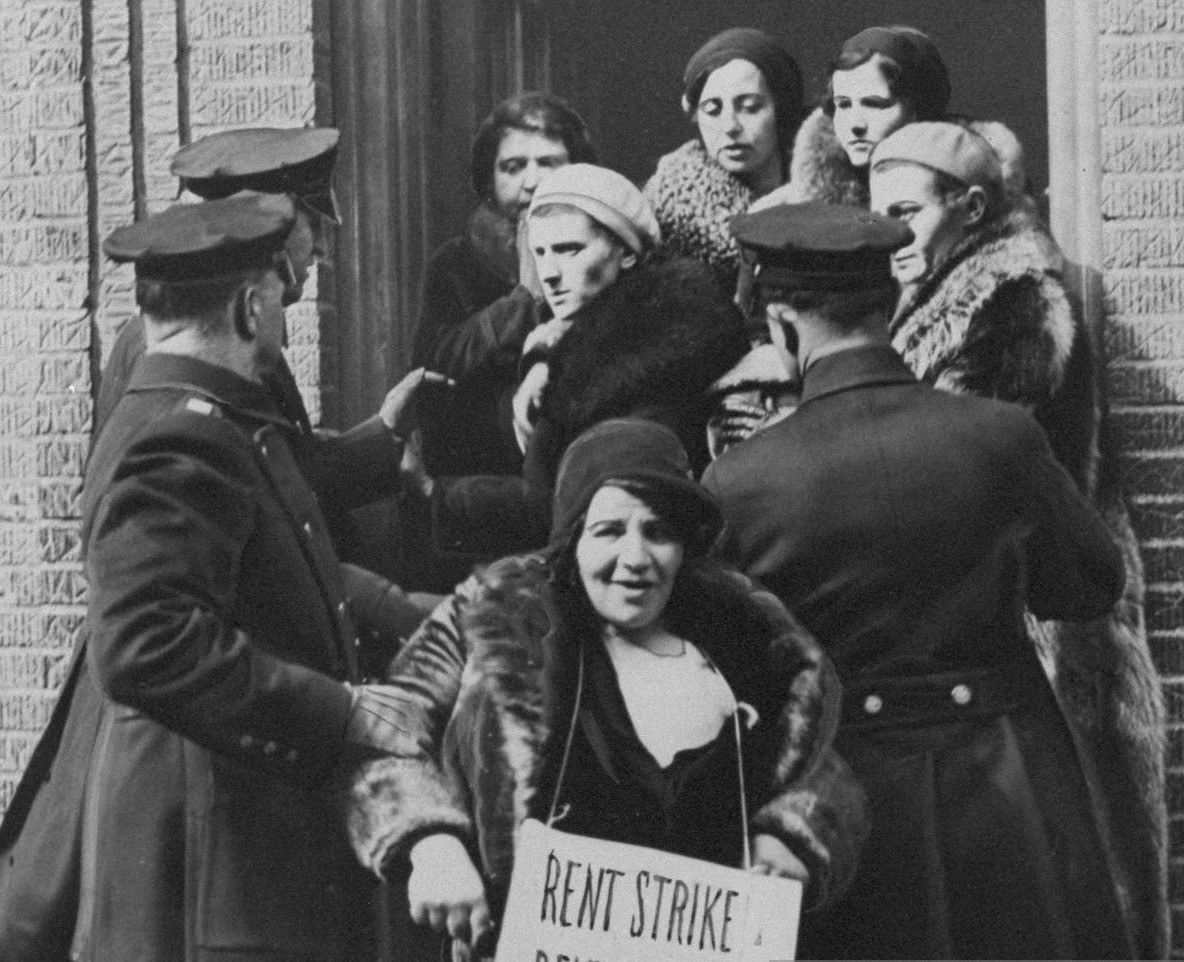
The rent strikes conducted during the past few weeks in Upper Bronx prove that we were able to draw into the struggle elements which never before participated in any way or form in the class struggle. We also found that under proper leadership and guidance we can involve them to participate for the immediate demands of lower rent, but also for immediate unemployment relief and unemployment insurance as well. So we found that the working men and working women who won their struggle under our leadership for lower rent participated in our January 30th Hunger March to Boro Hall, demanding immediate relief and unemployment insurance. They have marched with us miles, in spite of the rain for the first time in their life.
Uniting the Employed and Unemployed
Our unemployed movement lacked from the very beginning the unity of the employed and unemployed. This was and is the weakest point in our fight for unemployment insurance. In organizing House and Block Committees for reduction of rents, we succeeded in uniting both employed and unemployed workers for their immediate demands.
Rent Strikes and the Press
Great publicity is given to these rent strikes not only by our press, but also by the capitalist sheets. The workers, who are engaged in the struggle eagerly read these news and convince themselves that only the communist press writes the truth and helps them in the struggle. As a result of this we gained many new readers for the Daily Worker and the Freiheit.
A Lesson in American “Democracy”
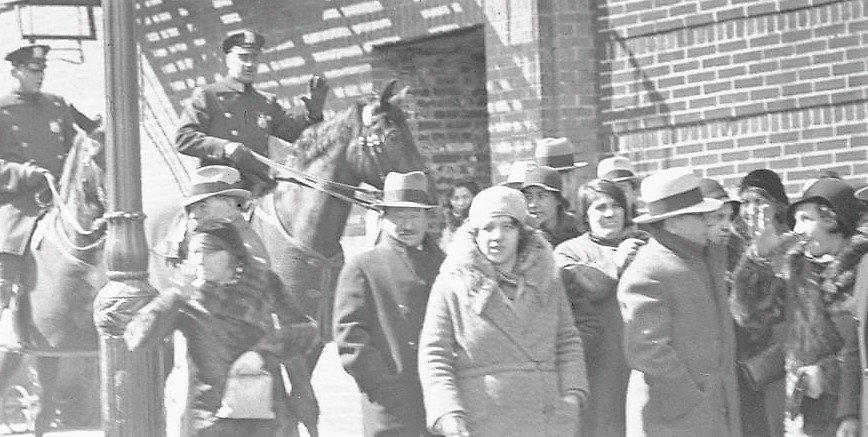
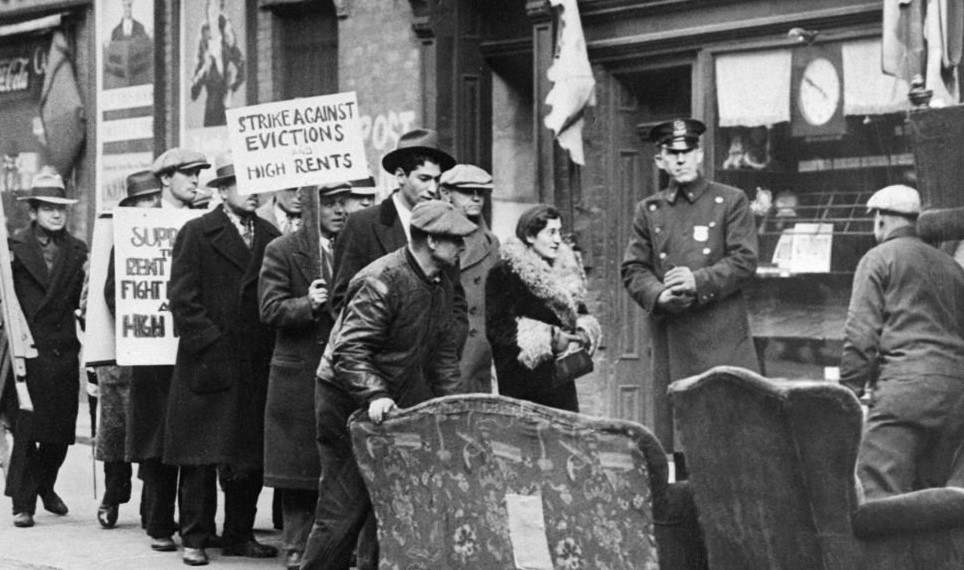
The strikes that are carried on for lower rents by thousands of workers always develops into a political struggle with the interference of the capitalist state apparatus. The courts and police were mobilized to defend the interest of the landlords. Due to this the workers learned from experience the role of the capitalist state. At one of the open air meetings held after the eviction of some of the rent strikers took place, which was attended by 3,000 people, one of the strikers standing on top of his furniture on the streets, his 13 year old daughter in his hands said the following: “I have told my daughter for years, that there is no democracy in this country for the workers, but she did not believe me. Now she is standing beside me and she agrees with me.” After his speech hundreds of school children demonstrated right there against police brutality and a great number have been recruited for the Pioneers.
Building Our Organizations through Rent Strikes
We are reaching out to new and up till now untouched elements through the organization of rent strikes. These elements during the struggle gain class consciousness and a wider outlook. These elements shall and must be approached by us and be convinced to join one of our mass organizations. Our experience shows this can be done. In one of our rent strikes we succeeded in organizing a new English speaking Woman’s Council out of the women who joined from one house. We can draw in others to the I.L.D., W.I.R., etc. and transform these organizations into real mass organizations.
But the most important thing is to approach the workers, working in the shops, to join our unions, to form shop committees.
Rent Strikes and the Political Parties
In organizing House Committees and conducting rent strikes we came across houses, where a number of socialists were living. These socialists did everything in their power to break the strike with such arguments as: “The landlords have to pay high taxes, we must pay high rents,” etc. The reaction of the workers was always: “If the socialists are against lower rents, we are against the socialists and if the communists are for lower rents, we are with the communists.”
Other times, non-Party workers at mass meetings stood up and said:
“Why is it that the Republican and Democratic parties are helping the landlords by mobilizing the police, the courts, the gangsters against us? Why is it that the Socialist Party is not coming to us and organizing us against the landlords? It is because all these parties are parties of the bosses, of the landlords and only the Communist Party is fighting in the interest of the working class.”
This proves that in the process of organizing and carrying on militant struggles for the immediate interests of the workers, they learn from experience that the Communist Party is the only Party of their class.
Therefore, it is our duty to pick out the best fighters from amongst the rent strikers and recruit them for the Party.
The Party Organizer was the internal bulletin of the Communist Party published by its Central Committee beginning in 1927. First published irregularly, than bi-monthly, and then monthly, the Organizer was primarily meant for the Party’s unit, district, and shop organizers. The Organizer offers a much different view of the CP than the Daily Worker, including a much higher proportion of women writers than almost any other CP publication. Its pages are often full of the mundane problems of Party organizing, complaints about resources, debates over policy and personalities, as well as official numbers and information on Party campaigns, locals, organizations, and periodicals making the Party Organizer an important resource for the study and understanding of the Party in its most important years.
PDF of issue (large file): https://files.libcom.org/files/Party%20Organizer%205.pdf
 Revolution's Newsstand