
Carlo Tresca reviews his old comrade Bill Haywood’s autobiography. PDF of the book here.
‘Bill Haywood’s Book: The Story of a Fighter’ by Carlo Tresca from New Masses. Vol. 4 No. 12. May, 1929.
I fought by the side of Bill Haywood a hundred battles. I was his comrade in arms.
His book has stirred me as deeply as the sight of him the first time I met him.
It was in Boston, at the Common, on the occasion of a huge meeting held in defense of Ettor and Giovannitti, who were then facing the same electric chair that later on was to take away from us Sacco and Vanzetti. I had led to that memorable meeting rour thousand working men from Lawrence, men and women of twenty-one different nationalities.
They were, those working men, a tremendous crowd: fifty thousand, said the capitalist papers the next day. A waving of flags, a thunderous applause greeted the appearance of Bill on the stage. The men from Lawrence, our Lawrence army, at the sight of the strong, towering, gigantic man standing pensive at first and then smiling before them started to sing the Marseillaise in twenty-one different languages. A thousand other working men joined in the chorus : it was a veritable uproar.
The crowd and its ideal were bewildered.
Then silence.
And Bill Haywood spoke, as he alone knew how, the word of the victims of oppression. Simple, warm, impressive.
I kept my eyes fixed upon him. I picked his words on his lips. They were not new. I had repeated them hundreds of times at our meetings, and yet when I heard them uttered by him, they made a tremendous impression on me.
The more he spoke the more his figure grew gigantic in my imagination. He appeared to me as a tower of strength.
To my eyes he was the personification of labor.
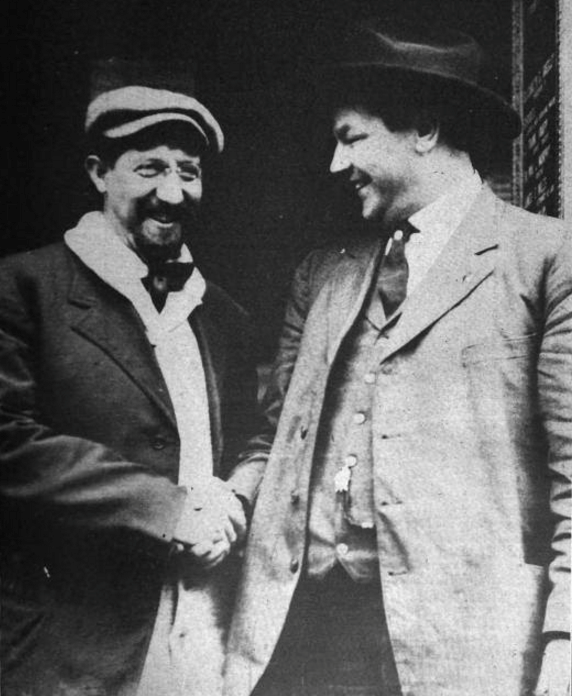
The speech over, the crowd surged onward like a stormy sea. Then a loud cry went up amid the general confusion. The police had arrived to snatch from the arms of these people their father, brother, comrade It had to happen. Wherever Bill Haywood was, there were struggle and life. Read his book over again if you have read it already. Read it. It will impress you as it impressed me.
In the first pages you see him as a child, small but bold: a tiny soldier. Unlike many other lads, he does not go in search of a chain to meekly shackle his own feet, but he rather hunts for arms to break it. In his tender age you may discover the germ of the revolt that is destined, later on, to be embodied in him.
The following pages are like the gust of a strong wind that carries the reader aloof and almost overwhelms him. Not one single battle has been fought by the working class of America without Bill Haywood taking part in it. Soldier or captain, he is always found in the advanced trenches: in Colorado as well as in Chicago, Lawrence, Paterson and New York: everywhere.
Hundreds of times manacles are locked around his wrists and he is thrown into jails. But the sun that he sees from behind the iron bars of the American bastilles brightens his brow and warms his heart. No prison can tame him; no threat of death, such as was made at the Boise trial, has the power to subdue him.
Which was the greater? He who stood accused of a crime, or Borah, who pointed at him an accusing finger? Haywood is dead, but he left behind a deep imprint. When Borah will be no more, no trace will ever be found of him.
Who remembers Moyer, the man who was chained to Haywood during the historic Boise trial, which was set up with a view to crushing the heroic Western Federation of Miners? It was Moyer who caused the Federation of Miners and the United Mine Workers to be brought together in an attempt to sink the former into the slow oblivion of class collaboration.
Against this collaboration Haywood fought his most vigorous battles, always remaining as rigid as metal, as invincible as an oak, faithful to that class struggle whose knowledge he had not acquired from books but on the arena of actual combats. And by his fights he wrote history. Not the history of a man, but of a class.
Here and there an overabundance of details is to be found, but as a whole the book is wonderful. It is a veritable panorama lightened by glowing flames: flames of hatred and love, of hope and despair.
Passing by this gigantic man we behold, small as their vision, black as their treason, other labor leaders who crossed the bridge and became the allies of the dominating class.
The more pages one reads, the more the stature of the man grows in one’s mind, until, on arriving with him in Russia, where he, the tireless nomad in quest of liberty, has gone to throw himself in the arms of his Goddess, one visualizes him as gigantic as he appeared to me at the mass meeting in Boston.
Read it and think: this is what Bill Haywood’s book demands.
By reading it we live over again with its author a life of intense struggles, of uncompromising principles and undying faith.
To reflect is to acquire new courage.
The book says to us: Stand up, your face turned to the sun. There is always hope where there is life. And a large breath of life comes from this book written by a man who is no more, a man who left behind strong, conflicting passions, arms ready for the fray.
The New Masses was the continuation of Workers Monthly which began publishing in 1924 as a merger of the ‘Liberator’, the Trade Union Educational League magazine ‘Labor Herald’, and Friends of Soviet Russia’s monthly ‘Soviet Russia Pictorial’ as an explicitly Communist Party publication, but drawing in a wide range of contributors and sympathizers. In 1927 Workers Monthly ceased and The New Masses began. A major left cultural magazine of the late 1920s and early 1940s, the early editors of The New Masses included Hugo Gellert, John F. Sloan, Max Eastman, Mike Gold, and Joseph Freeman. Writers included William Carlos Williams, Theodore Dreiser, John Dos Passos, Upton Sinclair, Richard Wright, Ralph Ellison, Dorothy Parker, Dorothy Day, John Breecher, Langston Hughes, Eugene O’Neill, Rex Stout and Ernest Hemingway. Artists included Hugo Gellert, Stuart Davis, Boardman Robinson, Wanda Gag, William Gropper and Otto Soglow. Over time, the New Masses became narrower politically and the articles more commentary than comment. However, particularly in it first years, New Masses was the epitome of the era’s finest revolutionary cultural and artistic traditions.
PDF of full issue: https://www.marxists.org/history/usa/pubs/new-masses/1929/v04n12-may-1929-New-Masses.pdf
 Revolution's Newsstand