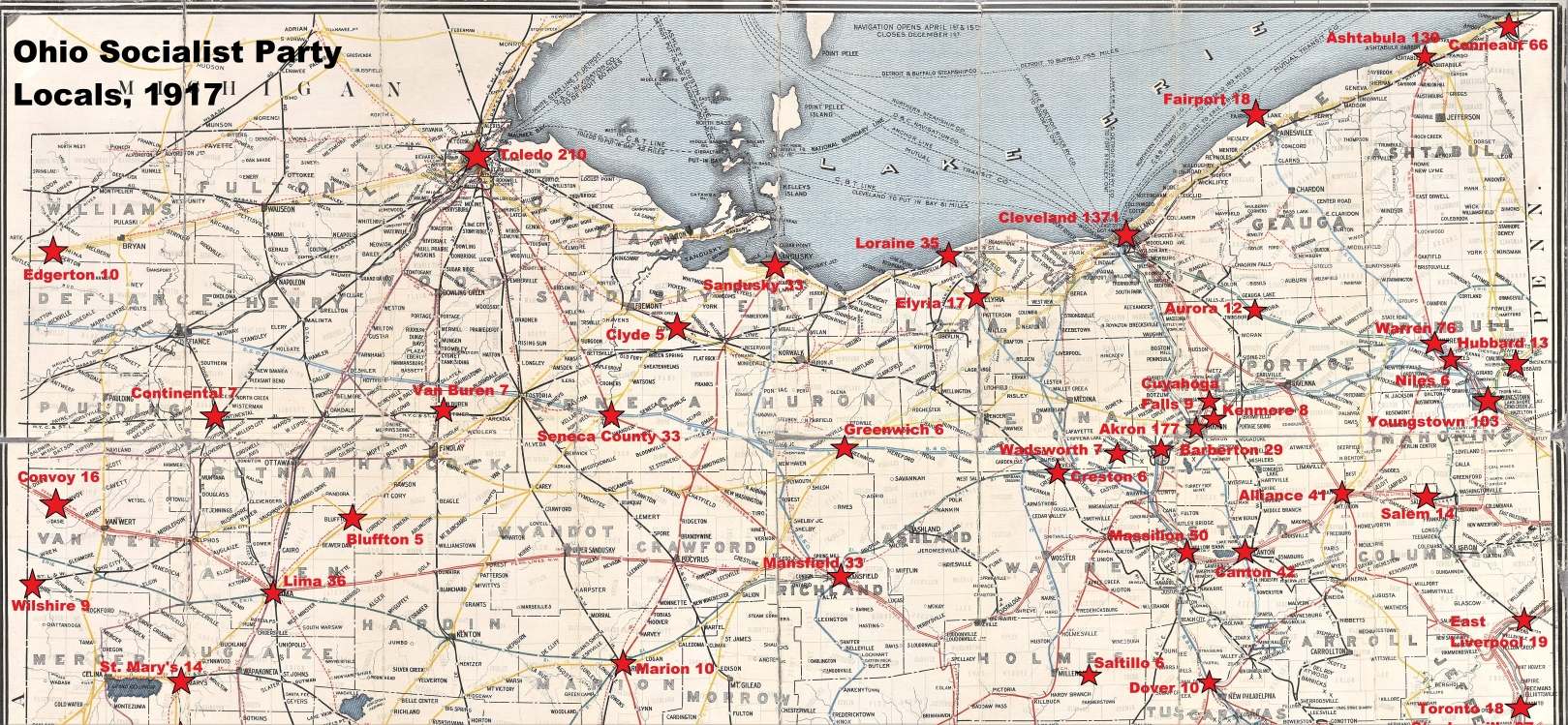
Ohio Socialist Party Locals Mapped, 1917.
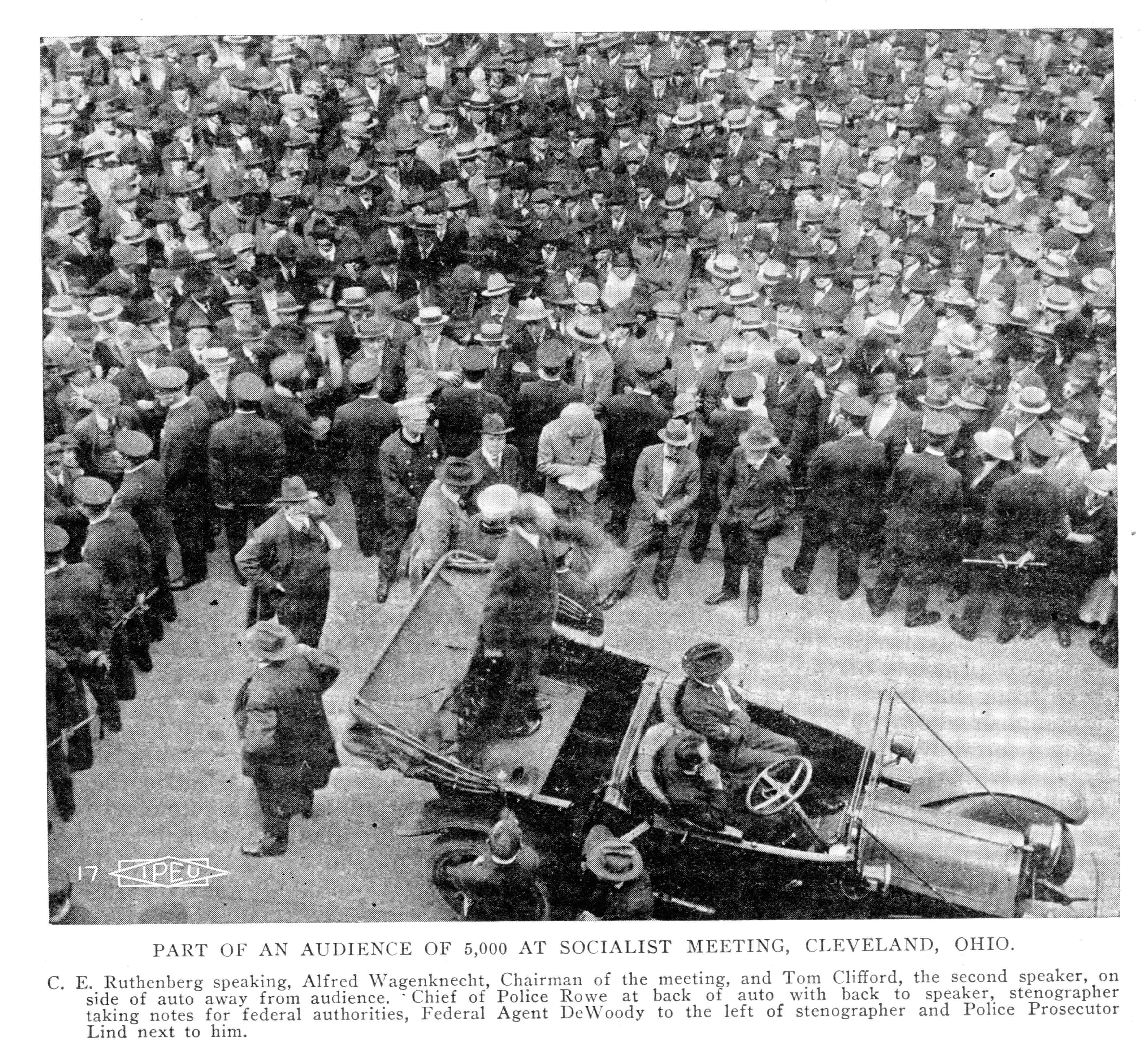
The Ohio Socialist Party elected delegates to its 1917 State Convention in the aftermath of the national Party’s Emergency Convention to address U.S. involvement in World War One in which Ohio played a leading role. Ohio was one of the ‘reddest’ states in the Socialist Party, with the delegates it elected to the Emergency Convention proof. They were Charles Baker, Willam Barnard, Tom Clifford, Joseph Jodlbauer, Frank Midney, William Patterson, Marguerite Prevey, C.E. Ruthenberg, Alfred Wagenknecht, and Scott Wilkins. All of which would face repression in the War, most of which would become founding members of the Communist Parties two years later. The national referendum on the anti-war resolution won in Ohio 1307 to 184 for the pro-war minority.
Locals with five or more regular members were asked to give their average dues-paying membership to allocate delegates to the state convention. Between May 1, 1916 and May 1, 1917 the state Party had an average of 4151 members organized in locals with another 784 at-large. The numbers also do not include the powerful Language Federations which were calculated nationally. Cleveland alone counted for a third of the total. Membership was down from its pre-war high of nearly 8000 in 1912, like the rest of the party the state had suffered from the war, and the 1916 campaign without its standard bearer Debs. Still, it was one of the largest state parties in the country. Here are the 77 reporting locals, with their average stamp-based memberships mapped (the detailed map can be downloaded). Northern and eastern Ohio would remain relative strongholds of the the Communist movement for another generation.
Official Call for Election of Convention Delegates State Convention Information and Regulations from the The Ohio Socialist. Vol. 1 No. 6. June, 1917.
To the Locals:
This is the official call to all locals to elect their quotas of delegates to the coming State Convention. The number of delegates to which each local is entitled will be found on other side of this letter. Here are reprinted, in as concise form as possible, the constitutional provisions which govern state conventions and such other information as may be of interest to delegates and locals:
1. The State Executive Committee has decided that this year’s state convention shall be held in Cleveland, Friday, Saturday and Sunday, July 20, 21 and 22nd.
2. The convention will be held in the headquarters hall of Local Cleveland, fourth floor, 737 Prospect avenue.
3. Basis of representation is by locals, each local being entitled to one delegate for the first one hundred members or less and an additional delegate for each additional one hundred members or major fraction thereof.

4. Locals consisting of branches may divide their branches into subdivisions, allowing each subdivision to elect a delegate. But the number of delegates so elected must not exceed the total number of delegates allowed the local as per tabulated statement and subdivisions must be so divided as to have In each an equal number of electors.
5. The railroad fare of all delegates, to and from the state convention, will be paid by the state organization.
6. Only those who have been members of the party for one year or more shall act as delegates, unless the local represented shall have been in existence less than one year, in which case the delegates must be charter members of the local.
7. Delegates to the state convention who fail to present their credentials to the credential committee by 3 P.M. of the first day of the convention will not be entitled to mileage.
8. LOCALS Akron, Alliance, Ashtabula, Barberton, Belmont County, Byesville, Canton, Cincinnati, Cleveland, Columbus, Conneaut, Dayton, Hamilton, Lorain, Mansfield, Newark, Salem, Steubenville, Toledo, Warren and Youngstown have foreign speaking branches within their jurisdictions. These foreign speaking branches must be given an equal voice in the election of delegates to the State Convention.
9. Original and duplicate credentials are being sent all locals. Local secretaries will carefully and plainly fill out the original credential and give same to delegate elected, who in turn will give it to alternate elected providing regular delegate can not attend. Local secretaries will also fill out duplicate credentials with care, and mail same to the state office BEFORE July 14th.
10. Local Cleveland has committees at work now, attending to the many details necessary to make the convention a success. Information as to hotel rates, restaurants, convention program and other details will be communicated to the delegates by Local Cleveland as soon a arranged.
Respectfully submitted, A. Wagenknecht. State Secretary, SOCIALIST PARTY OF OHIO.

The Ohio Socialist, published by the Left Wing-dominated Socialist Party of Ohio in Cleveland from January, 1917 to November, 1919. It was edited by Alfred Wagenknecht Wagenknecht spent most of 1918 in jail for “violation of the Conscription Act.” The paper grew from a monthly to a semi-monthly and then to a weekly in July, 1918 and eventually a press run of over 20,000. The Ohio Socialist Party’s endorsement of the Left Wing Manifesto led to it suspension at the undemocratic, packed Socialist Party Convention in 1919. As a recognized voice of the Left Wing, the paper carried the odd geographical subheading, “Official Organ of the Socialist Parties of Ohio and Kentucky, Virginia, West Virginia and New Mexico” by 1919’s start. In November of that year the paper changed to the “labor organ” of the Communist Labor Party and its offices moved to New York City and its name changed to The Toiler, a precursor to the Daily Worker. There the paper was edited by James P. Cannon for a time.
PDF of issue: https://www.marxists.org/history/usa/pubs/ohio-socialist/n06-jun-1917-BW-Oh-Soc.pdf
 Revolution's Newsstand