
A valuable report given to the Fourth International Conference of Work Among Women held in Moscow during May and June, 1926 by Aleksandra Artyukhina, textile worker, editor of ‘Rabotnitsa,’ and head of the Department for Work among Women (Zhenotdel) of the Central Committee of the Russian Communist Party. Full of facts and figures for the first decade of the Revolution on the activity of women in industry, trade unions, agriculture, education, clubs, soviets, and the Party, will be of interest to all students of the Revolution.
‘Report on Work of the C.P.S.U. Amongst the Toiling Masses of Women’ by Aleksandra Artyukhina from International Press Correspondence. Vol. 6 No. 69. October 26, 1926.
Introductory.
1. The Departments for work amongst working and peasant women attached to the Party committees, conduct mass work amongst the non-Party women workers. They carry out the instructions of the Party amongst the wide masses of women workers and peasants. Their task is to give the working and pas women an understanding of the most complicated problems brought up by our Party.
2. The working and peasant women’s departments also have the task of bringing before the Party the tasks and problems dictated by the special labour and living conditions. of masses of women.
3. During the period under report, the Working and Peasant Women’s Department of the C.C. of the C.P.S.U.(b) has brought before the Party a whole number of problems of a general, political and economic nature; the question of the position of female labour in production; the extension of Party influence over the scattered strata of toiling women (worker’s wives, teachers, etc.) the opening up of creches and clinics in the villages; the freeing of working women from worry about their children both during the working hours in the factory, and also during the time of their social work.
4. The question of female labour in production was put forward in connection with the fact that a tendency for decreasing the percentage of women in industry had been noticed. A number of measures taken by the Party and the Soviet authorities caused a definite move forward and as a result of two year’s work considerable attainments are to be recorded in this field.

5. The increase of activity of all strata of the toilers has caused a growth in the activity of the workers’ wives, housewives, etc. The Working Women’s Department urged upon the Party the necessity of ideologically organising this activity and directing it in the interests of the Party and the Soviet country. The corresponding instructions given by the Party help to extend the Party influence over a considerable strata of scattered toiling women and attract them into useful social work.
6. The increased participation of working women in social political life brought about the necessity of freeing them from worry about the children, not only during their hours of work in the factory, but also during the time of their social work. The Working Women’s Department has brought this question before the Party and the social organisations, and of late a considerable construction of special institutions adapted for this purpose has taken place (evening shifts in creches and preschool institutions, the organisation of children’s rooms and corners attached to clubs. etc.).
7. The immediate tasks of Party work among the toiling masses of women were defined by the decision of the XIV Party Congress and the April Plenum of the C.C. The tasks consist in the organisation of the increased activity of the masses of women and directing it into the channel of practical participation in the construction of Socialism by wider attraction of the toiling women into the work of economic, co-operative, trade union and other organisations, and more active work in the Soviets.
In connection with the decisions of the XIV Party Congress and the tasks of industrialisation of the country the problem of female labour in industry acquires special significance, not only in respect to its preservation and quantitative growth, but also in respect to its qualifications and qualitative improvement.
I. Conditions of Work in the Towns.

1. The determining factor in Parity work among the women masses of the town is the position of women in production and in social life. In the sphere of the position of female labour in production the main factor during the postwar period has been a considerable and quite normal decrease in the percentage of which engaged in industry during war time. At the end of this normal process there became manifest a definite tendency of the increase of female labour falling off in respect of the increase of the total number of workers. The economic successes and development of industry have been accompanied by a natural improvement in the qualitative and quantitative composition of the working class of the U.S.S.R. The number of workers during the last two years has increased from 5,500,000 (on April 1, 1924) to 7 millions (on October 1, 1926). Besides the growth of the working class in general, there has taken place an absolute increase in the number of women engaged in industry, especially connected with the development of the textile industry. But this growth of the absolute number of women is relatively less than the general increase of the number of workers. And this has caused a certain vacillation in the percentage of women in industry.
On October 1, 1922 in all trade unions there were 28,8% women
On October 1, 1923 in all trade unions there were 26,4% women
On April 1, 1924 in all trade unions there were 26,1% women
On July 1, 1924 in all trade unions there were 25,90% women
On October 1, 1924 in all trade unions there were 25,6% women.
2. This position has become the object of a thorough and serious study on the part of the Party and the competent Soviet and trade union organs. Special commissions were formed for studying and improving female labour in production, both in the People’s Commissariat for Labour and in the localities. Various measures were taken for strengthening female labour in industry, for a further increase in the percentage of women workers in production.
3. The study of the causes connected with the slacking down in the tempo of growth of female labour power in production divulged the following main factors:
a) The existence of certain prejudices on the part of factory authorities who are apt to regard female labour as less advantageous in view of the legal system of labour protection and protection of motherhood and infancy (the codex of laws on labour and legislation in the field of the protection of motherhood and infancy).
b) The second decisive factor is the inadequate degree of skilled female labour.
4. According to the data of the People’s Commissariat for Labour the percentage of women on skilled work has increased by 2,1/2%, on semi-skilled work by 1,7%. Of 396,545 women workers, 42,6% proved to be unskilled, 36,9% semi-skilled and only 16% skilled.

5. Such low qualification of female labour raises the urgent task of devoting increased attention to this question, for the construction of Socialism, the task of transforming the country from an agricultural into an industrial country, still more increase the demand for skilled labour power in general and for skilled female labour power in particular.
6. An analysis of this situation called great attention to questions of the skill of female labour. In this field a number of considerable attainments have been made of late.
On January 1st, 1925, in the factory apprenticeship schools, there were 51,625 girls or 17,7% of the total number of apprentices. In the trade technical colleges, there were 110,572 women, or 25,3% of the total number. In October 1925, in 50% of all factory apprenticeship schools. 35,9% girls were accepted, i.e. almost twice the number of the preceding year.
7. The surplus of free labour power in the country creates a constant and uninterrupted stream of new unskilled cadres of workers into the towns. Despite the growth and extension of industry, it is not in a position to absorb fully this surplus influx of labour power from the countryside and therefore, there is a considerable number of unemployed in the towns. Unemployment amongst women occupies a special place amongst the unemployed. In January 1925, unemployed women comprised 38,7% of all unemployed. In July 1925, they already comprised 40,6%. The big growth and certain permanency of female unemployment is again a result of the poorer skill and training of the women masses. In connection with the extension of industry and the retraining of the unemployed, which is being carried out by the organs of the Peoples Commissariat for Labour and the Supreme Economic Council, particular attention is being paid to bringing women workers into this training system. Much is done to bring unemployed women into those forms of public works which correspond with the physical possibilities of women.

8. The social conditions of the toiling women have tremendous significance in the entire work of the Party amongst women. In this field, considerable attainments have n made during the last two years. At the present time there are 737 factory creches in the U.S.S.R., 521 children’s clinics, 276 clinics for expectant mothers and 103 homes for mothers and children. Notwithstanding the considerable absolute quantity of these institutions, the service of such institutions for working women is still quite inadequate to meet the demand, especially in connection with the influx of new strata of women into the industry and the growth of the demands of the working class. Taking this fact into consideration, the Sixth Congress of Trade Unions decided to include creches. in the collective agreements. The XIV Party Congress passed the following decision on this question: “It is necessary not only to preserve, but wherever possible, to extend the system of creches, children’s homes and institutions, liberating the working woman from household work”. The construction of pre-school institutions-kindergartens and playgrounds has enormous significance in improving the social life of working women. Altogether there are about 800 pre-school institutions for the use of the children of workers and working women (not counting those in the autonomous regions).
9. There are also considerable achievements in the sphere of organising public feeding. During the last two years the number of restaurants for workers and their families has grown considerably. These restaurants are becoming more and more accessible for working women with families, In Ivanovo-Vosnessensk there is a “kitchen factory” which can serve 12,000 dinners per day.
10. In the sphere of housing construction, certain achievements are also to be noted. In a number of places: Moscow, Baku, Tula, the Donbass, Ivanovo-Voznessensk, Leningrad, and in the workers districts and regions, a number of new workers’ settlements have been constructed. In the construction of these workers’ houses attention is paid to the necessity of protecting the interests of the women, i.e. space is allotted in these houses for children’s institutions, for public restaurants, and other needs. The possibility of further emancipation of women is thereby secured.
11. Work in the field of house construction, public feeding, and in general a considerable part of the work in improving the social life of working women is undertaken with the aid of the co-operatives. This year the number of working women in co-operatives reached 1,085,342 and peasant women, 1,558,690 which makes 25% working women and 16% peasant women. There are considerable attainments in the sphere of attracting working and peasant women into the leading organs of the co-operatives (from 3 to 5%).

12. A big and complicated problem in the spheres of constructing the new life is the problem of properly organising children’s education. As a heritage from the difficult years of war and civil war, there still remain waifs and strays who require care and attention. Not only the Soviet public organisations are mobilised for the struggle against this destitution, but also considerable public self-activity. Beside the child destitution which remained as a heritage of the years of ruin, there are also certain elements of new destitution which are a result of not sufficiently well organised work for organising children’s leisure and reaching the wide masses of children. through social education. The attention of the wide masses of working women has been drawn to this work and it has now made considerable advances.
II. Work of the Trade Unions amongst Women.
1. The widely developed trade union work amongst the women masses has. tremendous significance. This work has made attainments both in the field of forming cadres of active trade union workers from amongst the women themselves and also in the field of reaching the entire mass of women and bringing them into trade union and social-political life. Working women are members of factory committees to the extent of 13,4%, members of the T.U. committees in institutions — 18,7%, in labour protection commissions there are 20% women, in wage tariff commissions 8,8%, in the productive conference 16,9%, in awaiting commissions 8,5%, women working as shop delegates 21% and in cultural commissions 19%. According to the figures of the A.U.C.T.U., 13,7% of the leading posts in trade union work are held by women, in the C.C. of the Unions — 15,1%, in the provincial departments 5,5%, and in the uyezd T.U. departments — 6,6%. The trade unions are confronted with the task of extending this work still more, and especially extending their influence over new strata of working women. and bringing them into cultural-public life, in particular those women brought into production with the development of industry.
III. Mass Work of the Party amongst Women.
1. Considerable achievements have been made in the work of the Party among the toiling masses of women. There is no longer any need to talk of the entire mass of women being backward and of the necessity of bringing them to the level of the vanguard of the working class. One can quite definitely observe the following three main categories amongst working women: 1. the active women workers comprising those elected to Soviets, trade anion and public organisations, and to economic work, 2. working women taking part in the work of delegate meetings, elementary political education circles, i.e. those who are at the present time under the specific and direct influence of the Party, and, 3. the. remaining masses of women not yet drawn into public life through the social forms of mass work.
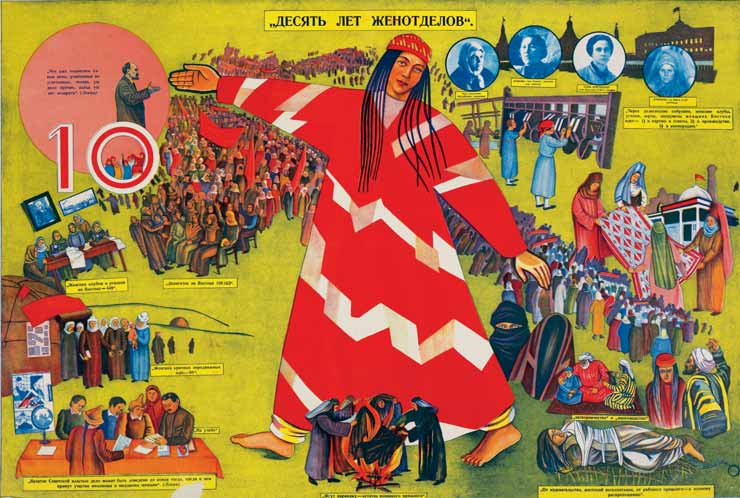
2. The active women workers are fairly significant. There are 25,3% women members of town soviets in the R.S.F.S.R., 33,291 women elected to co-operative organs, 13,4% of. the membership of factory committees, while 17,8% of the jury in the provincial courts and 18,6% in the people’s courts are women. This active group of working women also includes considerable masses of those who have passed through the school of delegate meetings. In respect to this group, the Party is confronted with the task of promoting them to various elected organisations, and the task of training them into business-like workers for responsible work in trade unions, co-operatives, soviets, etc. The method of work in respect to this stratum is in the first place to raise the qualification in the sphere of work in which they are now engaged. This cadre of promoted women public workers should be the basis for supplying further reinforcements for the Party.
Delegate Meetings of Working Women.
3. The second category of working women includes the women delegates of the present delegate meetings. and the students of elementary political educational circles. In 1925, there were 67,298 such women delegates and in 1926, 95,995. Thus, the number of women delegates increased by 28,697 in one year. The elections of delegate meetings during this year were on the lines of a wide mass campaign. Public organisations, the trade unions and other organisations participated extensively in the elections and helped the departments of working women and peasants attached to the Party committees, to conduct this work. Fifty per cent of the working women were reached through the reelections of the delegate meetings, The organisation of delegate meetings not only on a district and sub-district scale, but directly in the enterprises themselves, should be considered a great achievement. The delegate meeting remains the centre of attention of the entire Party work amongst the women masses. The experience of the whole period of the revolution has proved that delegate meetings are a school of Communism which has been fully verified and quite justified themselves in experience. All the present active women have passed through the delegate meetings, i.e. all working women promoted to public work, in soviets, co-operation, the trade unions, etc. Delegate meetings are the connecting link between the Party and the wide masses of women. With the aid of the delegate meetings, the Party takes the lead of the widest masses of toiling women. This is why the attention of Party organisations from top to bottom is concentrated on the guidance of the work of delegate meetings.
4. Delegate meetings are summoned to give the working women elementary information on political education and to imbue them with a number of practical habits in the sphere of public and political work. For this purpose the delegate meetings have brought up the practical questions of drawing women delegates into practical work in the Soviet sections in the commissions of factory committees, and also the organisation of special sections attached to delegate meetings.
5. This year, besides the usual sections — co-operative, trade union and protection of motherhood and infancy, the experience of organising industrial and juridical sections in a number of places has also justified itself. The industrial sections set themselves the task of training administrators and managers from among the working women. The experience of Moscow has given very valuable results. The juridical sections mainly unite the working women members of the juries. These sections help them in their direct practical work and also in training a considerable cadre of working women for work in the courts.
6. Besides delegate meetings. the method of organising elementary political education circles for working women in the factories has also justified itself. There are over a thousand of such circles in the U.S.S.R. with 35,726 students. These elementary circles render considerable aid in training working women for further Party education and at the same time are a step forward on the way to promoting the working women into public life.
IV. Work amongst the Backward Masses of Working Women.
1. There are working women in the factories who are not yet drawn into any public or political work. This category includes, in the first place, new strata of working women who have come from the villages with the extension of industry. In order to arouse the activity of these new strata and draw them into public work, it is necessary to practice a whole number of forms and methods of work which have excellently justified themselves during the experience of the first years of work of the C.P.S.U.(b) among toiling women, in particular the organisation of special women’s meetings. These special meetings of working women are a method of drawing the more backward strata into public life in general and above all into the life of their own factory. The chief feature of these meetings should be that they are able to bring up all the main problems interesting and occupying the masses of working men and women from the view-point of the position of working women in labour and life, her demands, and her social-political level. In very big enterprises where it was not possible to call such general meetings, the method of organising conferences of working women has justified itself during the last few years. It should definitely be stated that in the field of work with these new strata, positive results are not yet sufficiently big, the trade unions and nuclei are only beginning to grasp the forms and methods of approach to this work.
2. In respect to these categories just as in respect to the working women who are passive and little drawn into public life in general, it is necessary to increase attention in the field of drawing them, in the first place into the life of the entire enterprise, attracting them to the general meetings and productive conferences, getting the to take part in the examination of collective agreements, and in reelections to factory committees, etc., in fact, on the basis of solving the vital direct needs of the working women, they should be drawn in and interested in the more general problems of Socialist construction.
3. The clubs should play a great role in the work working women. According to data of the A.U.C.T.U. (All Union Council of Trade Unions) 20,8% of all members of clubs were women on January 1st, 1925. In a number of unions where women play a considerable role, such as for instance in the Textile Workers Union, women comprise 37,5% of the club membership and in the Chemical Workers Union, 27,4%.
It must be definitely stated that this percentage of women drawn into the clubs is still inadequate. The reason is that our clubs have not yet been able sufficiently to adapt the content of their work to the interests and demands of the women masses, in particularly the interest and demands of the adult and family women workers. Experience goes to show that in order to draw family working women into clubs, not only rest and recreation should be considered but also utility. The organisation of knitting and sewing courses in the clubs has justified itself in respect to drawing family women workers and workers’ wives into the clubs. Correct and well-organised work in liquidating illiteracy and semi-illiteracy also serves as a factor of attraction.
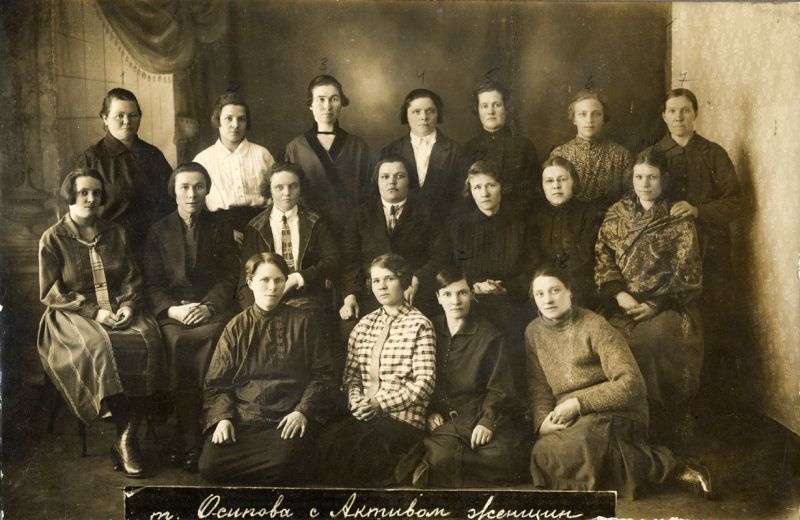
4. A great obstacle bath for the attraction of family women workers into clubs and in fact into any other social-political work, is their impossibility of leaving their children uncared for. While our children’s institutions work only during the daytime i.e. during the hours when the working women are engaged in the factory, things stood very unfavorably in respect to drawing adult working women into the clubs. The experience of organising children’s rooms and circles attached to the clubs has given very considerable results as it enables the working women and workers’ wives to take part in club work without any worry at all as they are sure that their children are in reliable hands.
5. One of the forms of mass work is the press. We have colossal achievements during the last year in the field of the special press devoted to the toiling women masses. All the special journals have considerably increased their circulation, commencing with the leading organ “Kommunistka” (Woman Communist) which is for the use of the active workers working amongst women and ending with the mass journals for working and peasant women. For instance, the circulation of the journal “Kommunistka” has increased from 3,000 to 24,000. The journal “Rabotnitza” (working Woman) has increased from 8000 to 78,000, “Delegatka” to 45,000, “Batrachka” (Woman Farm Labourer) to 26.000, “Rabotnitza i Krestyanka”’ (Working Woman and Peasant Woman) 275,000 and the “Krestyanka” to 45,000. The mass journals have now won firm sympathy amongst the women masses. They have a definite circle of their own readers and a further growth of their circulation is taking place quite voluntarily and independently. Grouped around these mass journals there is a considerable number of worker correspondents and village correspondents. Around the central journals published by the Women workers’ department of the C.C. there are grouped 1,860 women worker correspondents and village correspondents, while around the local journals there are grouped 1,493 women worker correspondents and village correspondents.
Besides journals, a considerable amount of popular literature for working and peasant women has been published this year. Two special series have been issued, one for working women delegates and the other for peasant women delegates. A number of booklets of a scientific popular mature has been published and a certain quantity of artistic literature. During the last year the work of publishing leading literature for the active workers working amongst women has also advanced. In the domain of the press there is the task of further improvement of its quality and a still greater advancement and study of the demands of the masses of women readers and support for the extension and attraction of working and peasant women in the worker and peasant correspondents’ movement.
V. Work among Workers’ Wives.
1. The increased activity of all strata of the toilers has also been seen in the relative activity of the scattered strata of toiling women, workers’ wives, women handicraft workers, etc. During the past year the department of working women has considerably extended and formulated work amongst these strata. A definite percentage of workers’ wives have been drawn into the delegate meetings of working women, into the Soviets, and into the practical work of reorganising women’s social life. During last year there were 30,559 workers’ wives in the delegate meetings and now there are 38,785. In the Soviets in Moscow there are 176 workers’ wives. in Tula 78, whilst in the Ukraine workers’ wives comprise 10% of the women elected to the Soviets. The main task in all this work is in the first place not to separate this work from work amongst working women and to ensure women the leading place in the entire work, to direct the activity of these strata alone the channel of participation in those forms of Soviet and public work in which this activity can be utilised to the greatest advantage in the interests of Socialist construction.
VI. Work among Peasant Women.
1. In the sphere of work with peasant women, we have considerable attainments to show in introducing system and greater Party leadership in all those forms of work which are practised in the countryside. The main form of work with the peasant women is the delegate meeting. It must be definitely stated that during this year delegate meetings of women peasants have in a number of places worked quite according to plan, systematically maintaining the programme issued by the Central Department, while increased attention and guidance in this work has been observed on the part of the Party organisations. One of the main tasks confronting the delegate meetings in the countryside is to link up the programme work with practical work still more and more in order that the work of the delegate meetings can really help the women delegates to be skirmishers in the reorganisation of economics and life on the new principles.
2. This year the network of delegate meetings has noticeably increased as also a number of peasant women is drawn into these meetings. Last year there were 246,702 peasant women delegates and now there are 311,741 women delegates.

3. A serious achievement in the work in the countryside is the organisation of work with the women peasants elected as members of the Soviet, of the Mutual Aid Committees, of the Co-operatives, etc. On an average there are now nearly 10% women peasants elected to the Soviets. If one takes into account the considerable inertia of the countryside in regard to the participation of women in the-leadership. of social-political life, this percentage should be reckoned as very considerable. Last year the percentage of peasant women was 8,6%. The main task in this sphere of work is to help these elected peasant women by systematic leadership, and give them the possibility of growing up into valuable active workers which is the best method of really securing the emancipation of women peasants in the countryside.
4. During these years there are serious achievements in the field of work of improving the social life of the women peasants. This year the network of children’s institutions has developed considerably, especially in the summer time — creches, clinics, etc. These children’s institutions are receiving greater and greater recognition and sympathy on the part of the peasant women. Around these institutions there is also developing in a number of places extensive work with mothers both on question of the better organisation of children’s education and in general on questions of a social-political nature.
Mass work with peasant women is not only conducted by means of organising meetings, knitting and sewing courses, talks, etc., of which there is already a considerable number, but also develops to a large extent around the village reading rooms. In a whole number of places the experience of organising “woman peasant days”, the reading of journals such as “Krestianka” in the village libraries, etc., have been well justified. Wherever the village reading rooms have sufficiently understood the importance of drawing peasant women into social-political work and have adapted the work of the village reading rooms also to the interests and demands of the female section of the villages, there has always been considerable achievement in this field.
5. This year undoubted advances are to be observed in drawing peasant women into study. The percentage of peasant women drawn into political education schools, and into all kinds of courses, workers’ faculties, etc., has increased. Things are considerably better in respect to drawing girls into schools.
VII. Work in the East.
1. The method of work amongst women masses in the East which has most justified itself is women’s clubs and Red Corners. In 1925 there were 51 such clubs with a membership of 15,000; there were 61 Red Corners with about 4,000 students. Besides club work which has become particularly well established in view of the specific labour and living conditions of the Eastern toiling women, the number of delegate meetings of women delegates is also growing and becoming firmly rooted: In 1923—24 there were 25,028 women delegates, in 1924—25 there were already 57,281. There are considerable achievements in the field of drawing the toiling women of the East into the Soviet apparatus. In 1923—24 there were 4,352 Eastern women, members of Soviets, while in 1924—25 there were already 17,643. The main tasks which confront the women workers’ departments in our Eastern republics and Regions consist in producing cadres of trained workers, from amongst the women of the local population which will ensure the possibility of reaching the women of the national minorities better and more extensively with all the existing forms of work. Problems of social life have special significance in Eastern work. It is still necessary to do a great deal to create the necessary change in attitude towards the problems of the emancipation of women in their living conditions. In this field great significance should be attached to the workshops, clinics, schools in diffusing elementary education, and sanitary hygienic habits among the women ere which are organised independently and around the clubs.
VIII. Working and Peasant Women in the Party.
1. The number of women amongst the members and candidates of the C.P.S.U.(b) is undoubtedly growing which can be seen from the following figures: In 1925 there were 76,494 women in the Party (10,3%), in 1926 there are 128,807 (12,8%). In the field of further attraction of working and peasant women into the Party, the women workers’ departments are confronted with the task of an extremely thorough and thoughtful approach to this problem. The women to be drawn into the Party should be those working and peasant women who have already passed through a school of social and practical work.

Besides drawing working and peasant women into the Party there is the task of a more attentive approach to the questions of political training of women Communists already members of the Party; in particular those from the last two Lenin enrolments. While not forming special women schools, consideration must be given to the level of development and the living condition of the women Communists in order to adapt the forms of Party education more closely to them.
IX. The Apparatus and Guidance of the Work.
1. The apparatus for work amongst working and peasant women has undoubtedly become strengthened during this period. The number of adult organisers has grown not only in quantity but also in quality. The cadres of workers in the factories are improving. A system has been instituted of special training and re-training of workers amongst women both by means of organising special courses and sections of general courses, and also by getting questions of work amongst women inserted in the general programmes of training for party workers.
International Press Correspondence, widely known as”Inprecorr” was published by the Executive Committee of the Communist International (ECCI) regularly in German and English, occasionally in many other languages, beginning in 1921 and lasting in English until 1938. Inprecorr’s role was to supply translated articles to the English-speaking press of the International from the Comintern’s different sections, as well as news and statements from the ECCI. Many ‘Daily Worker’ and ‘Communist’ articles originated in Inprecorr, and it also published articles by American comrades for use in other countries. It was published at least weekly, and often thrice weekly. The ECCI also published the magazine ‘Communist International’ edited by Zinoviev and Karl Radek from 1919 until 1926 monthly in German, French, Russian, and English. Unlike, Inprecorr, CI contained long-form articles by the leading figures of the International as well as proceedings, statements, and notices of the Comintern. No complete run of Communist International is available in English. Both were largely published outside of Soviet territory, with Communist International printed in London, to facilitate distribution and both were major contributors to the Communist press in the U.S. Communist International and Inprecorr are an invaluable English-language source on the history of the Communist International and its sections.
PDF of full issue: https://www.marxists.org/history/international/comintern/inprecor/1926/v06n69-oct-26-1926-inprecor.pdf
 Revolution's Newsstand