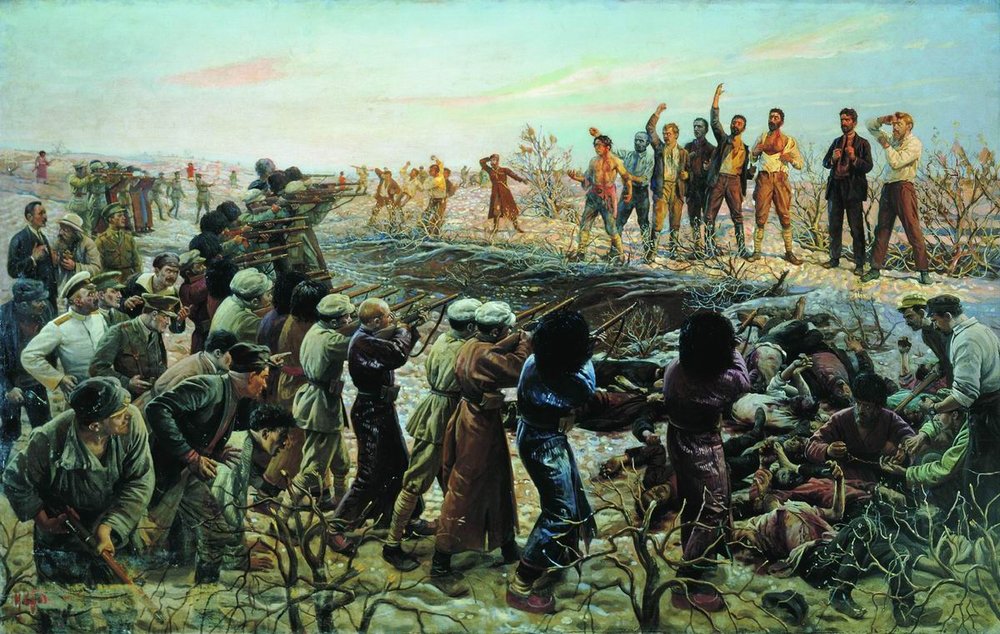
‘The Murder of Baku Commissars’ from Soviet Russia (New York). Vol. 3 No. 20. November 13, 1920.
[A report of the execution which was published in the Socialist press of the Trans-Caucasus and reprinted in the Vladivostok “Krqsnoye Znamya”.]
As has become generally known in Baku and far beyond it, in September, 1918, a group of commissars who had come to Krasnovodsk from Baku completely disappeared, under puzzling circumstances, on the territory of western Turkestan (in the Trans-Caspian region). A number of contradictory, gruesome stories originated in connection with the disappearance of these men, who had been officially arrested by the TransCaspian authorities when they landed near Krasnovodsk and were afterwards locked up in the local jail. There were rumors that all twenty-six commissars had been taken to India; or that they had been killed during an attempt to escape; or finally, that these men, as adherents of the Bolshevist rule with all its peculiarities and extremes, had been sentenced to death by an unknown tribunal and that the sentence was carried out.
Despite all the horrors of the implacable internal war which has dulled the senses of the people, there was no end of surmises and suppositions.
In reality the hideous action of cold-blooded decision concerning the life or death of over a score of people, and their removal and murder occurred in the following manner:
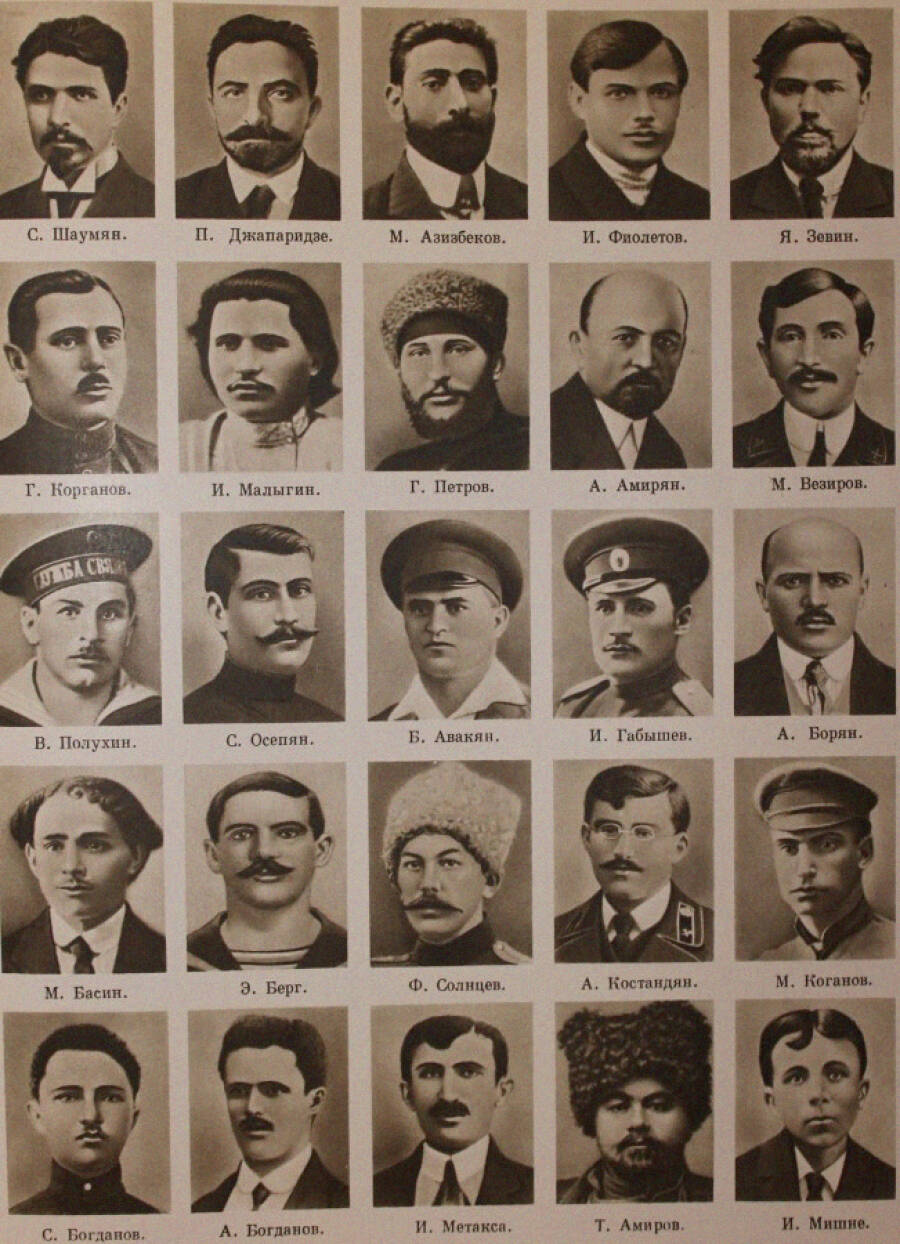
1. About the middle of September, 1918, the representative of the British Military Mission at Askhabad, Captain Reginald F. Tig-Jones, having been informed of the capture of twenty-six Bolshevist commissars on the Krasnovodsk banks, communicated with the head of the Trans-Caspian Criminal Bureau, Semyon Lvovich Druzhkin and with some members of the Regional Executive Committee, stating that, in accordance with the plans of the British Mission, he would like to have these commissars in India.
2. Fully agreeing with the reasons which Reginald F. Tig-Jones advanced in favor of the removal of the Baku commissars from Krasnovodsk to Meshed, and thence to India, S.L. Druzhkin, on his part, urged upon some the members of the Executive Committee of the Trans-Caspian region the necessity of assisting the execution of the plans and designs of the chief of the British Military Mission.
3. At the same time, however, Tig-Jones and Druzhkin informed the said members of the Executive Committee that they considered the removal of the commissars to Metshed and to India insufficient in many respects, and that all the commissars should be shot on the journey from Krasnovodsk, which was also fully in accordance with the designs of the British Military Mission in Askhabad, but that it should be arranged with certain “formal guaranties”.
4. Specifically, Tig-Jones’ and Druzhkin’s plan provided for a fictitious receipt stating that the Baku commissars had been turned over to the British military authorities at Meshed, though in reality they were to be shot during the journey on the railway, between the stations Krasnovodsk and Askhabad.

5. The receipt of the British military authorities at Meshed to the effect that the twenty-six Baku commissars had been turned over to them, was intended, according to Tig-Jones and Druzhkin, to explain to the public the disappearance of the commissars, and so to put an end to all rumors of their death, murder, or escape.
6. However, assuming naturally that some public organizations, or the relatives and friends of the victims would sooner or later demand that the ultimate fate of the removed commissars should be ascertained, Captain Tig-Jones told Druzhkin — who in his turn told the members of the Executive Committee who had been informed of the plan on foot — that in due time official certificates would be issued at certain intervals of the death of the twenty-six commissars, to which effect “any required medical certificate can be obtained.”
7. All these reasons and the “formal guaranties” of Tig-Jones and Druzhkin convinced the members of the Executive Committee who had been taken into their confidence, and who at first were undecided, that the murder of the twenty-six Baku commissars was practicable, expedient, and necessary, and as a result they gave their consent to the plan and to its immediate execution.
8. To effect this plan, the aforementioned members of the Executive Committee and some other persons arranged to go to Krasnovodsk, and in the evening of September 19 a special train arrived at the Krasnovodsk station for the purpose of removing towards Askhabad the commissars who were to be shot.
9. Late in the night of September 19 they applied at the Krasnovodsk jail to take the twenty-six commissars to India through Meshed, and the jail administration gave its consent without any particular formalities.

10. The same night, the special train left Krasnovodsk with the commissars, the persons in charge of the removal, a guard, and continued on the way toward Askhabad for about seven hours, with but few stops.
11. At about 6 A.M. the train, having run 200 versts, stopped on the road between the stations Pereval and Akcha-Kuima.
12. Here those in charge of the removal and the execution informed the twenty-six commissars of their fate and began to lead them out of the car in groups of eight or nine.
13. All the commissars were overcome by the announcement of their fate and were absolutely silent, with the exception of one sailor, who exclaimed loudly: “I am calm. I know that I am dying for freedom.” To this one of the men in charge replied: “We know that we too will sooner or later die for freedom. But we understand it differently.”
14. After this a group of the commissars were led out of the car into the morning twilight and were at once shot. The second group when led out — apparently noticing the character of the locality which is covered with gray sand mounds, and which may have aroused in them some hope of finding cover from the shots — made an attempt to escape, but were riddled by the bullets from repeated volleys. The last group made no attempt to escape.

15. After shooting all the commissars, and making sure of their death, the executioners hastily buried the corpses in the sand (about 200 feet from the railroad bed) and burned a part of the belongings of the victims there. Most of their belongings were burned in the train itself.
16. After this the train went back to the place from which it had started.
Such, in brief, is the story of the execution of the twenty-six Baku commissars.
Soviet Russia began in the summer of 1919, published by the Bureau of Information of Soviet Russia and replaced The Weekly Bulletin of the Bureau of Information of Soviet Russia. In lieu of an Embassy the Russian Soviet Government Bureau was the official voice of the Soviets in the US. Soviet Russia was published as the official organ of the RSGB until February 1922 when Soviet Russia became to the official organ of The Friends of Soviet Russia, becoming Soviet Russia Pictorial in 1923. There is no better US-published source for information on the Soviet state at this time, and includes official statements, articles by prominent Bolsheviks, data on the Soviet economy, weekly reports on the wars for survival the Soviets were engaged in, as well as efforts to in the US to lift the blockade and begin trade with the emerging Soviet Union.
PDF of full issue: https://www.marxists.org/history/usa/pubs/srp/v3n20-nov-13-1920-soviet-russia.pdf
 Revolution's Newsstand