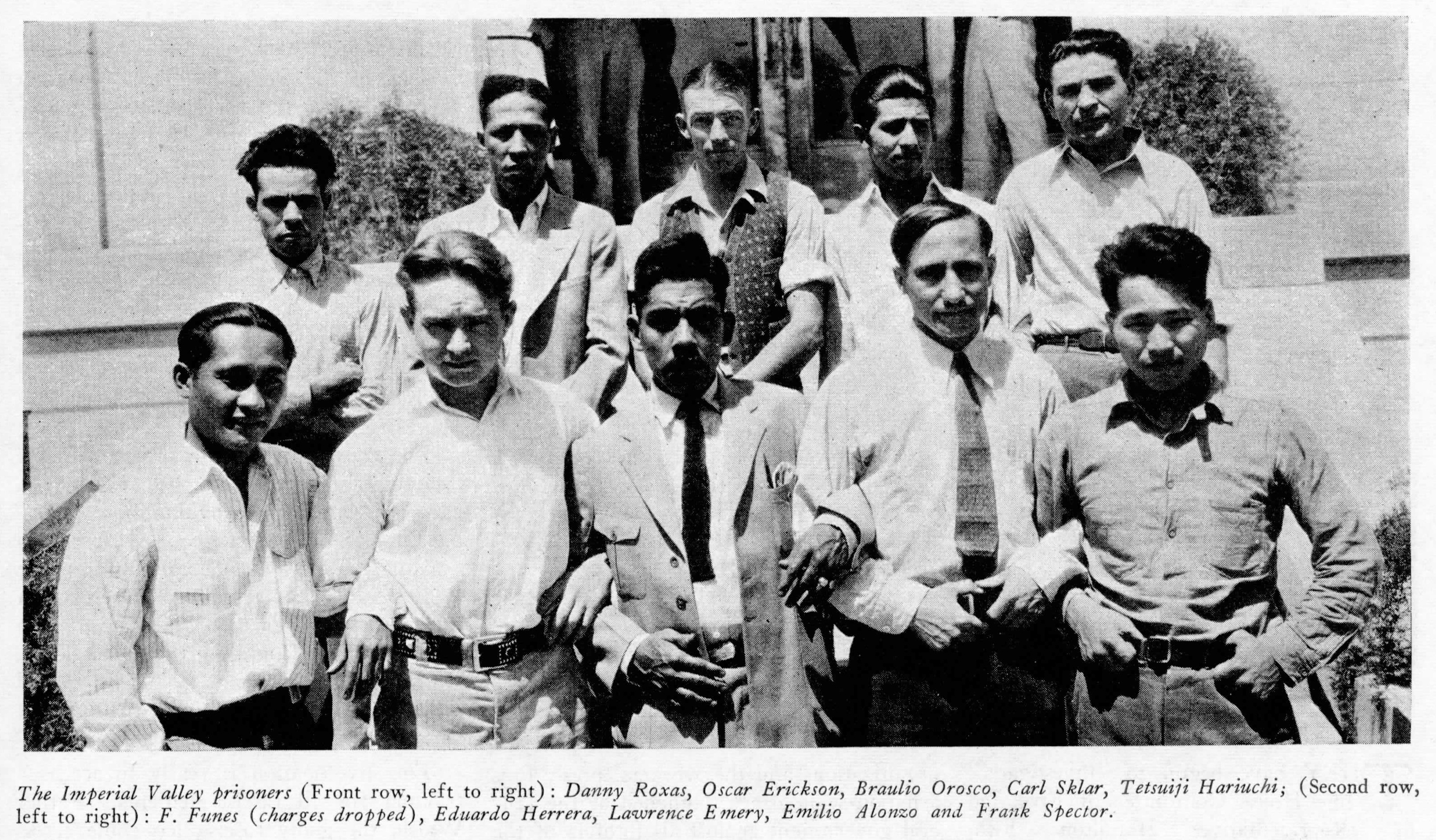
The Communist Party first came into large scale contact with Mexican workers in the U.S. through the T.U.U.L. ‘s Agricultural Workers Industrial Union organizing drive in California’s Imperial Valley leading to 1930’s lettuce pickers strike. Inspired by the ongoing struggle there, this pre-convention discussion piece was written for the upcoming seventh National C.P. congress urging a more consistent and serious orientation to Mexican workers in the United States.
‘The Mexican Workers and the Communist Party’ Pre-convention Discussion by Irving Kreitzberg and Jose Arispe from the Daily Worker. Vol. 7 No. 128. May 28, 1930.
THERE are about 3,000,000 Mexican workers in the United States. The overwhelming majority of these are engaged in basic industries, such as steel, agriculture, railroads, etc. In many sections of California, Arizona, New Mexico, they are a majority of the population. In other localities such as beet fields of Colorado, steel mills, of Gary, Ind., there are a large percentage of Mexican workers.
Work among the Mexican wage slaves is entirely underestimated. Despite the militancy of these workers, and their willingness to accept our leadership, real organizational work among them has been neglected.
Los Angeles which has over 200,000 Mexicans, a Mexican population only second to that of Mexico City, has only a handful of Mexicans in the Party. This is not necessarily due to an unwillingness of these workers to join our ranks, for every demonstration brings them out in large numbers. About one-half of the participants of the May First Demonstration in Los Angeles were Mexicans. Ever since the Feb. 26th Unemployment Demonstration in Los Angeles, Mexicans and various Spanish speaking lodges, clubs, etc., are continuously lauding the praises of a fighting Communist Party, speaking of the Communist Party as if it were a mysterious organization that performs miracles. In San Bernardino despite a vicious police terror and practically without leadership, workers mostly Mexicans, demonstrated there May First at the call of the Communist Party. This all proves that the Mexican workers are ready to join our Party and fight. Still there has been no real efforts of organization among them.
Large numbers of needle workers and capmakers in Los Angeles, are Mexicans. However, there is not one Mexican enrolled in the N.T.W.I.U. True, a weak, attempt was made at recruiting them by distributing leaflets. Still many Party members, working side by side with Mexican needle workers, make no effort to fraternize with them, remaining practically isolated. This procedure must be corrected.

If our Party minimizes these workers, petty bourgeoisie and anarchists, however, are active amongst them. We have in El Cultural, Los Angeles, a number of Party members; besides this many of the members are sympathetic to us. Still the leadership of this organization is allowed to be in the hands of the anarchists. What is more, no effort has been made to expose them and replace them with Communist leadership. In the Imperial Valley petty-bourgeoisie have organized a reformist union, the Mexican Mutual Aid. During the lettuce strike they undertook to divide the Mexican worker from other agricultural workers. Here, however, the labor fakers were exposed. The workers accepted TUUL leadership. This single occurrence shows conclusively what can be done among the Mexican workers if an effort is made in that direction.
In Los Angeles, from time to time, Mexican workers join our Party after hearing speakers address them in Spanish. However, when notice of their acceptance or notification of meetings are mailed, they are sent out in English. As most Mexicans can hardly speak let alone read English they asked their children or those of their neighbors to read their letters for them. These children being under the influence of capitalist schools and clergy, often purposely read uncorrectly or discourage the prospective members, with the result that they do not show up. No attempt has ever been made to write notices or letters to them in Spanish. Work among the Mexican youth is practically not in existence.
As explained, the Mexican worker in America knows little English. Spanish remaining the language even after four generations in the U. S. (New Mexico, Arizona, etc.), most of them read Spanish newspapers. In Los Angeles, Ortiz Rubio, president of Mexico, finds it profitable to subsidize El Heraldo de Mexico, a paper printed in Spanish. In every article of this newspaper one finds articles warning Mexican workers to keep away from the Communists. A number of opposition politicians also control newspapers there. Workers not knowing which paper to accept, read La Opinion which poses as “liberal independent,” but is really controlled by a Catholic faction.
The necessity for a Spanish newspaper in Los Angeles is indeed a great one. Vivda Obera, the Spanish newspaper published over 3,500 miles away can hardly serve the purpose. A sectional newspaper in Spanish similar to that of the proposed Southern Worker is badly needed. Printed at Los Angeles, it could serve the Mexican population as far east as El Paso or San Antonio. Being near the border copies would fall into the hands of Mexicans on the other side, aiding in many ways the Communist Party of Mexico, whose paper, El Machete, is illegal.
The Daily Worker began in 1924 and was published in New York City by the Communist Party US and its predecessor organizations. Among the most long-lasting and important left publications in US history, it had a circulation of 35,000 at its peak. The Daily Worker came from The Ohio Socialist, published by the Left Wing-dominated Socialist Party of Ohio in Cleveland from 1917 to November 1919, when it became became The Toiler, paper of the Communist Labor Party. In December 1921 the above-ground Workers Party of America merged the Toiler with the paper Workers Council to found The Worker, which became The Daily Worker beginning January 13, 1924. National and City (New York and environs) editions exist
PDF of full issue: https://www.marxists.org/history/usa/pubs/dailyworker/1930/v07-n128-NY-may-28-1930-DW-LOC.pdf
 Revolution's Newsstand