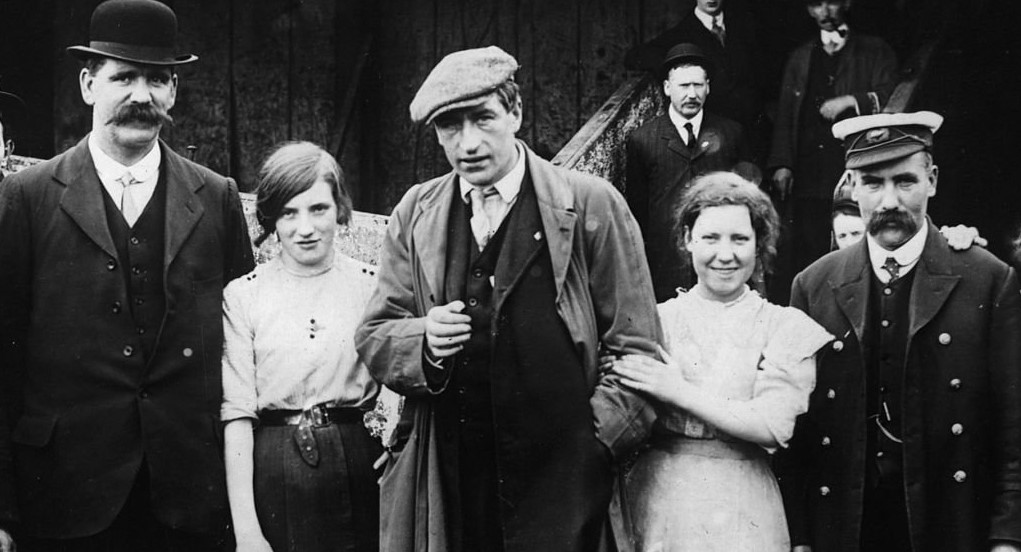
Danish-American wobbly Caroline Nelson, then traveling and reporting through Europe, wrote this wonderful sketch for ISR on Irish labor leader Jim Larkin the year of the great Dublin Lockout. Larkin and ‘Larkinism,’ while not entirely analogous to the industrial unionism of the I.W.W., was immediately, and sympathetically, recognizable to the radical U.S. audience. A The following year, Larkin would come to the U.S. where he would be a leading revolutionary voice and a founder of the Communist Labor Party.
‘Jim Larkin’ by Caroline Nelson from the International Socialist Review. Vol. 14 No. 6. December, 1913.
A SPECTRE is haunting all Europe! Parliaments are debating on how to fight it. Kings and emperors are concerned with its menacing significance. The capitalist class is arming to protect itself against it. The spectre is what the daily newspapers call fearfully “Larkinism.”
For a good many years the labor leader in Europe has been a worse parasite than his prototype in America. Here he is an autocratic little king drawing an enormous salary. It is harder for the workers to dislodge him because he has come from the working class himself and is thoroughly entrenched in his soft job through years of faithful service to those in authority in the unions. Greed for power on the part of union officials and pressure from the capitalist class has finally put most of the power of the trade unions into the hands of a very few conservative officials who protect the bosses better than they could protect themselves.
This sort of Labor Leader will probably be lost in the rush and hum of things. He will be unable to readjust himself to the new spirit of democracy and rebellion that is taking possession of the workers everywhere. This spirit produces men of a fire and self-abandonment that astonishes the world. They spring up unannounced and unheralded. Having been “nobody’s good dog,” they spurn all the old rules and tactics and phrases carefully preserved by the sleek, smooth-tongued, conservative labor leader. They serve no apprenticeship in the politics of unionism and spring into the forefront during a time of strife to fling defiance into the teeth of the master class and accomplish marvels of educational and organization work everywhere. Their stirring militancy finds an echo in the hearts of the rebellious workers and gives voice to those who have been mute.
Such a figure is Jim Larkin. Five years ago he landed in Dublin, a penniless tramp, looking for a job. He has been working here ever since. Today his name spreads terror throughout all Europe. The papers are wailing over the dangers of “Larkinism.”
Larkin employed the industrial union tactics calling for a general strike. Gravely this morning a Berlin paper regrets that Jim Larkin has taught the Irish workers the “sympathy strike,” claiming that the Dublin strike is so utterly different from what one might be led to expect from the British workers, that the workers have changed so rapidly from their old attitude of thoughtful consideration for the bosses, that nobody knows how to handle the situation. This is not to be wondered at when the German capitalists see their own labor leaders denying strike benefits to the workers who wanted to go out in sympathy with the Dublin strikers, in this way forcing them back to work.
The Dublin strike has lasted two months now. It started with the street car workers and the dockers and has spread to nearly all other trades like wild fire. The bosses denied the workers the right to organize.

Naturally the bosses in Dublin blame all the trouble on Jim Larkin. But the trouble lies in the system that exploits the working class. Jim Larkin is merely the militant voice of the workers. Larkin says:
“It will not take the working class long to tip over this damnable system when it becomes conscious of its power.”
Thanks to his splendid influence, the strikers have decided to drink no alcoholic beverages. Larkin has shown them how the man with a “booze” soaked brain makes a poor fighter and the strikers want to continue the battle, clear-headed and cleareyed.
And Jim Larkin is here, there and everywhere. One day he was arrested and the officials sent out word that he would be held so that he could not address the strikers. The meeting was called for 3:00 p. m. Jim sent word to the strikers that he would be on hand AND WOULD speak though ‘the heavens fell. Great crowds gathered together to hear Jim that afternoon. Slowly a great mass of over 20,000 wage workers surged toward the place of meeting. By 2 o’clock the crowd was packed tight making a solid wall about the speaker’s platform. Gleefully the police and the soldiers declared they would never let Larkin enter the crowd. They thought no man could make his way through it.
The crowd waited patiently and anxiously. The same difficulties that had occurred to the police, they saw. But at the stroke of 3 o’clock an old man, in the front of the solid mass pressed about the lecture platform, leaped lightly upon the stage, pulled a false gray wig and beard from his head and—behold! It was the beloved Jim, for whom the great heaving mass set the earth trembling in its mighty cheers. And Jim talked as he had never talked before. The police were unable to make any way through the crowd. Nothing could stop him.
Larkin took a lesson from the Lawrence strikers and the strike committee planned to send the children of Dublin strikers to their comrades in England to be cared for till the battle was won. Again the Catholic Church stepped in prohibiting the mothers from separating from their children. And thousands of the workers began to see just WHOM the Catholic Church serves in any crisis. Such events are a blessing in disguise. They show the workers their true friends—and ENEMIES. Our old friend, Mrs. Montefiore, was arrested with other socialists on a faked-up charge of kidnapping the children.
The Copenhagen newspapers rejoice that Jim Larkin is not an anti-parliamentarian. When the long fight comes to an end and home rule for Ireland becomes an established fact, they believe Larkin will enter Irish Parliament. They hint plainly that a little capitalist flattery may draw the teeth of the firebrand. Everywhere it seems to be the consensus of opinion that Jim Larkin must be fixed—either by imprisonment or by a high position that will tend to conservatism. They don’t know Jim. In the meantime Jim Larkins are springing up all over Europe. The crop is growing bigger and better every year because the European worker is being pushed nearer and nearer the abyss of despair.
In Berlin, Germany, 10,000 workers live in damp cellars and thousands upon thousands live in one room that never sees a streak of sunlight. The comrades took me through forests of those tall yard-buildings that are reached only through narrow alleys. Here is carried on much of the sweat-shop manufacturing. We have been told in America that Berlin has abolished the slum. No, she has only hidden them— sometimes behind plate glass windows.
But the workers are growing more intelligent all the time. The women are refusing to bring large families into the world and one does not see either in Berlin or Paris those crowds of miserable, hungry children that we see in London. This is partly because the English working class still holds to capitalist ideas on religion and morality.
Just now there is a noticeable period of reaction in Europe, caused by the Balkan war. The capitalist class in every country used this war to stir up the dead corpse of patriotism. It was during this campaign of military propaganda that the French ruling class was able to put through the bill for increasing military service to three years. But the protest and rebellion at once assumed threatening proportions. The public officials then granted the soldiers a four months’ leave of absence every summer which made their “victory” a barren one after all. The workers in France are not very respectful of the law nor are they very law-abiding.
When the old-age pension system was put through, which was to compel the workers to carry a card to be stamped with due stamps paid for by himself and his employer, the workers tore up the cards and ignored the law. They demanded a no-tributary system of no less than two francs a day at the age of fifty-five years.

The French working class deliberately violated the laws. What did the government do about it? What COULD the government do about it? Obviously it could not imprison the whole working class. So the matter rests. And the government has lowered the age for pensions five years.
This period of reaction cannot last long. Doubtless it will give the capitalist class a new breathing spell some places and enable them to draw the cords a little tighter around the workers. But the workers will rebel in a hundred places at once next year, or the year after and a thousand Jim Larkins will arise.
The New Unionism is making inroads in every land. It is spreading like a tidal wave, gathering power and momentum all the time. Its watchword is CLASS SOLIDARITY and it keeps the power of all decisions in the hands of the rank and file.
As I write word comes through the comrades that Jim Larkin has been arrested. Magistrate Swift, who caused his arrest, had issued a proclamation declaring the strike mass meetings illegal. Comrade Larkin burned the magistrate’s papers in the public square and joined the strikers in their own proclamation, which consisted of the following pledge:
“I will pay no rent until the tramway men have got the conditions they demand.”
Larkin was “sentenced to serve seven months on a charge of “sedition and inciting to riot.”
The International Socialist Review (ISR) was published monthly in Chicago from 1900 until 1918 by Charles H. Kerr and critically loyal to the Socialist Party of America. It is one of the essential publications in U.S. left history. During the editorship of A.M. Simons it was largely theoretical and moderate. In 1908, Charles H. Kerr took over as editor with strong influence from Mary E Marcy. The magazine became the foremost proponent of the SP’s left wing growing to tens of thousands of subscribers. It remained revolutionary in outlook and anti-militarist during World War One. It liberally used photographs and images, with news, theory, arts and organizing in its pages. It articles, reports and essays are an invaluable record of the U.S. class struggle and the development of Marxism in the decades before the Soviet experience. It was closed down in government repression in 1918.
PDF of full issue: https://www.marxists.org/history/usa/pubs/isr/v14n06-dec-1913-ISR-riaz-ocr.pdf
 Revolution's Newsstand