
‘Second Workers’ Music Olympiad’ by Ashley Petis from New Masses. Vol. 11 No. 8. May 22, 1934.
THE Second American Workers’ Music Olympiad, April 29 demonstrated the accomplishment of various groups of performing worker-musicians, including the following choral groups and instrumental ensembles: Pierre Degeyter Symphonietta, Charles Williams, conductor; Workers’ International Relief Band, J. Zilbert, conductor; F.S.U. Balalaika Orchestra (conductorless); Freiheit Mandolin Orchestra, Jacob Schaefer, conductor; Italian Workers’ Chorus, Giovanni Camajani, conductor; Finnish Workers’ Mixed Chorus-New York; Werner A. Birch, conductor; Freiheit Gezang Farein, Jacob Schaefer, conductor; Ukrainian Workers’ Chorus, Lahn Adohmyan, conductor; Brooklyn Finnish Workers’ Male Chorus, Werner A. Birch, conductor; Lithuanian Aido Chorus, Bernice Shelley, conductor, and the Daily Worker Chorus, Lahn Adohmyan, conductor.
The contest between the choral groups resulted in the award of the banner for the best chorus to the Freiheit Gezang Farein, Jacob Schaefer, conductor, the second time this extraordinary organization has been so honored. The much smaller but excellent Daily Worker Chorus, under the leadership of Lahn Adohmyan, received honorable mention.
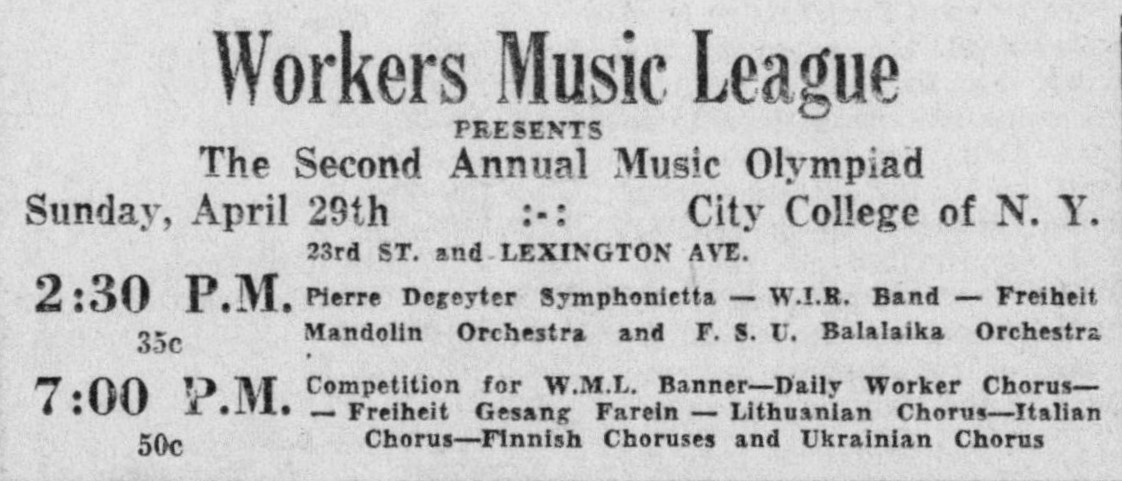
This Olympiad clearly showed the strength and weakness of the revolutionary musical activities organized by the Workers’ Music League. Everyone who heard the first Olympiad of a year ago seems to agree that the technical advance made by such instrumental groups as the W.I.R. Band and the Pierre Degeyter Symphonietta were notable achievements, due unquestionably to the excellent and indefatigable workmanship of their drillmasters. The extraordinary improvement made by the latter organization deserves particular mention. Williams has taken this group of players, and, in a very short time, through unrelenting effort and attention to detail, moulded the orchestra into a really excellent ensemble. As yet, the first violin group overbalances the other choirs in tone quality and precision. But the improvement already noted presages a significant future for this organization.
Choral groups under the skilled leadership of such conductors as Jacob Schaefer and Lahn Adohmyan showed their accustomed thoroughness of preparation, resulting in remarkable technical finish and perfection of ensemble. But this discussion is not for the purpose of tossing compliments to our really splendid workers’ choral groups and instrumental ensembles, which are filling such an important place and are destined to play an ever expanding role in American music life. The very importance of the part these organizations are destined to play places a tremendous responsibility upon those who guide their activities. This responsibility, as far as drilling is concerned, has been coped with successfully.
But that stage, in the development of such groups as the W.I.R. Band and the Pierre Degeyter Symphonietta, when we can excuse their lack of diversified and representative repertoire, is passing. It is all very well to affirm that instrumental groups must be grounded in traditional musical literature in order to develop technical assurance and precision which are the essential concomitants of a good ensemble, before they attempt more revolutionary “modern” compositions. As far as the playing of such classics as Handel, Mozart, Wagner, etc., are concerned, this necessity is self-evident.
However, when such banalities as Conductor Zilbert’s Overture in F, played by the W.I.R. Band, are interpolated, it is time to register a protest. There is no excuse for the playing of such twaddle as this and a “Suite” performed by the Pierre Degeyter Symphonietta and announced as the “first American performance.” I could not hear the name of the composer of this “Suite,” but it really doesn’t matter. The music was of that type of authentic dinner music which probably thrives in the restaurants of Hitler’s Germany, and which is, along with beer, conducive to that sense of well-being and absence of thought so valued by ruling classes under the term “gemuetlichkeit.”
If the rehearsing of classics and music of familiar form and pattern is necessary to the formation of skilled ensembles, by all means let us have the best classics, such as the Handel Concerto Grosso in which the strings of the Pierre Degeyter Symphonietta showed to such excellent effect; but not music such as Edvard Grieg’s Holberg Suite, in which Grieg’s strongest characteristic, the “folkspirit,” is reduced to a minimum, while he vainly attempts to attain symphonic proportions but only succeeds in writing well-made music of astonishing emptiness, without the stamp of individuality. The playing of such works as German’s Dances of Henry the Eighth, beloved of hotel and restaurant orchestras the world over, smatters of that familiar custom of the bourgeois world of “playing down to the masses.” Protest must even be made against the playing of the really terrible Fifteenth Jubilee March-Red Army by lppolitov- Ivanov. If this composition, which has all the faults of a bad military march with none of its virtues, really reflects lppolitov-Ivanov’s conception of the significance of the 15th anniversary of the Russian revolution, it shows that, although he has remained in Soviet Russia and been honored by the government, the revolution came too late in lppolitov-lvanov’s life for him to grasp its significance. Surely such stuff must be termed counterrevolutionary.
It was not until the W.I.R. Band reached its final number, Selections from American Revolutionary Songs, that a breath of new musical spirit was made manifest. Here one heard the refreshing, invigorating strains of some of the new revolutionary songs being written and sung in America, by Swift, Sands, Adohmyan, Schaefer, etc. But even here, Zilbert, in his “arrangements” of the songs, saw fit to make unnecessary and stupid concessions to outmoded convention, by the alteration and simplification of harmonies; by the deletion of dissonances; so that in such works as Schaefer’s Hunger March and Swift’s Scottsboro Song, the new, revolutionary character was almost completely lost. The W.I.R. Band is capable of and prepared for better things.
It had been announced that the combined choruses would join in the singing of Aaron Copland’s Into the Streets May First, which recently won THE NEW MASSES’ contest for a mass song. It was found impossible for the choruses to unite to rehearse this song, so the excellent Daily Worker Chorus, under the leadership of Lahn Adohmyan, essayed the composition. This chorus, a rather small ensemble, is not large enough to produce the volume of tone necessary to an adequate projection of Copland’s song. Furthermore, the intended effect of the composition and the inherent spirit of both words and music were largely nullified by a too trivial and detached (staccatissimo) rendition. The sense of climax, of growing color, as when the composition moves into the key of A, was lost. That the work was as effective as it was, without its structural values being projected, seems, in retrospect, quite extraordinary; and assuredly a tribute to Copland’s craftsmanship. To give this song its full meaning, the ending phrase, in public performance, when not used as a march, should be somewhat broadened. Otherwise the close lacks cumulative effect and the sense of finality.
The New Masses was the continuation of Workers Monthly which began publishing in 1924 as a merger of the ‘Liberator’, the Trade Union Educational League magazine ‘Labor Herald’, and Friends of Soviet Russia’s monthly ‘Soviet Russia Pictorial’ as an explicitly Communist Party publication, but drawing in a wide range of contributors and sympathizers. In 1927 Workers Monthly ceased and The New Masses began. A major left cultural magazine of the late 1920s and early 1940s, the early editors of The New Masses included Hugo Gellert, John F. Sloan, Max Eastman, Mike Gold, and Joseph Freeman. Writers included William Carlos Williams, Theodore Dreiser, John Dos Passos, Upton Sinclair, Richard Wright, Ralph Ellison, Dorothy Parker, Dorothy Day, John Breecher, Langston Hughes, Eugene O’Neill, Rex Stout and Ernest Hemingway. Artists included Hugo Gellert, Stuart Davis, Boardman Robinson, Wanda Gag, William Gropper and Otto Soglow. Over time, the New Masses became narrower politically and the articles more commentary than comment. However, particularly in it first years, New Masses was the epitome of the era’s finest revolutionary cultural and artistic traditions.
PDF of full issue: https://www.marxists.org/history/usa/pubs/new-masses/1934/v11n08-may-22-1934-NM.pdf
 Revolution's Newsstand