
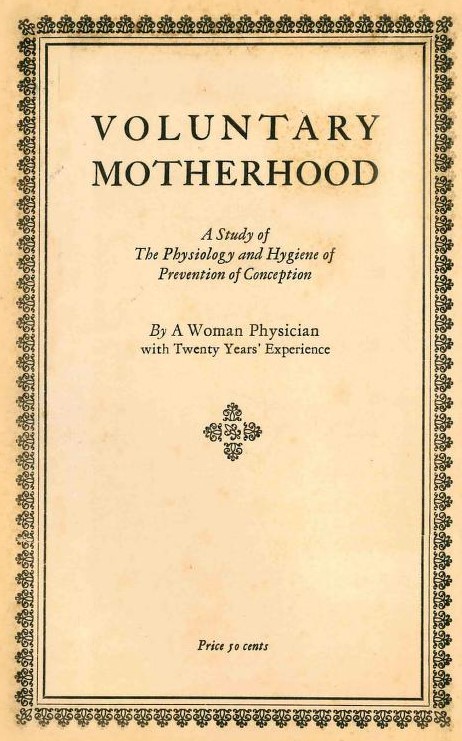
Russian-born Jewish revolutionary and women’s physician Antoinette F. Konikow joined Plekhanov’s Emancipation of Labor group in 1891 while in Switzerland, coming to the U.S. she became a member of the Boston Socialist Labor Party in 1893; left because of De Leon, became a founding member of Debs’ Social Democracy of American in 1897; was there at the formation of Socialist Party in 1901; helped to form the Socialist Party’s Women Commission in 1908 and inaugurate Women’s Day in 1909; a consistent voice on Boston’s strong proto-Communist wing, she worked with S.J. Rutgers and Louis Fraina in the Socialist Propaganda League of America; supported the Zimmerwald Left; was a charter member of the Communist Party of America in 1919; and original Left Oppositionist in the U.S., openly supporting the United Opposition’s struggle in 1926-7. Much of her work was around women’s liberation, health, and reproductive rights. He she is at over seventy demanding birth control for women and access to information about it. How far we have come.
‘Birth Control Is No Panacea, But It Deserves Labor’s Aid Against Reaction’ by Antoinette F. Konikow M.D. from The Militant, Vol. 5 No. 5. February 1, 1941.
The achievements of the birth control movement in this country are scarcely secure. The movement in the past has been successful in almost all slates. The first clinic was opened in 1923 in New York, Today there are reported to be 529 clinics in the United States. But birth control has been declared illegal in two states – Massachusetts and Connecticut – and can be undermined elsewhere as well.
A brief history of the legal status of birth control in this country may be helpful. The Comstock law of 1873 which prohibited the trade and circulation of obscene literature and articles of immoral use specifically includes birth control with abortion and obscene literature and articles. This is a federal law still in operation, 24 states passed similar laws. Eight states – New York, Ohio, Colorado, Indiana, Iowa, Minnesota, Nevada and Wyoming added provisions which exempt from prosecution by this law physicians using, applying or prescribing an instrument or article for the cure or prevention of disease. However, in other states the need for birth control information was so apparent everywhere and public opinion so much in its favor that the laws against it have not been enforced. In several instances where arrests were made of lecturers on birth control (myself, for example) or authors of books dealing; with sex problems the cases were quashed and some even won by the defendant.
Dangers Confronting Birth Control Advocates
But this was at the discretion of the courts which at that period chose thus to interpret the state or federal laws. At any time, however, the law may be enforced as it is today in Massachusetts and Connecticut, without any provision allowing physicians to prescribe birth control methods even for the protection of health (except in the above mentioned eight states). In 24 states where there is no law applicable to birth control, among which are Illinois, Michigan, Rhode Island and New Hampshire, the Federal Comstock bill can be utilized.

Many attempts to exclude birth control from the anti-obscenity law were made. In 1924 two senators were found progressive enough to introduce such a bill but it met with defeat. In 1934 a bill exempting physicians, hospitals and licensed clinics from the provisions of the Comstock law was heard by both Senate and House and actually passed by the Senate in the closing days of the session, only to be hurriedly reconsidered and killed.
Massachusetts and Connecticut may well signify the beginning of a reactionary wave which may attempt to destroy progress made in this field all over the country.
Catholic Opposition and Its Internal Difficulties
One of the strongest opponents of birth control is the Catholic Church, which wields considerable influence in Massachuaets where 41% of the population is catholic. In Holyoke, Mass., a lecture by Margaret Sanger was arranged to be held in the First Congregational Church. Catholic influence prevailed upon the church committee to withdraw permission to hold the meeting. Upon transference to the Holyoke Turnverein similar pressure was exerted and the hall broke its contract. The meeting was held, nevertheless, because the CIO Textile Workers offered their headquarters to the Birth Control Committee. It is very gratifying to note that a workers’ organization displayed independence of action and an interest in birth control.
The strong trend in favor of birth control is evidenced by the fact that even the Catholic Church had to accept a compromise. While it vigorously opposes the scientific method accepted by physicians, it approves a form of birth control described in Dr. Latz’s book Rhythm. The physiological theory upon which this system is based has been proven false by qualified research work. It is obvious, however, that the Catholic church has been forced to abandon its austere opposition to all forms of birth control. Catholic women are demanding the right to birth control information.
The Ladies’ Home Journal, in a poll in 1938 on birth control, reported 51% of Catholic women voting for it. 83% of them, explained that they favor it because of limited family income. If 51% dared to vote in opposition to the dictates of their church, there must be many more in agreement who dare not express themselves.

Working class parties have never officially taken a stand on the question of birth control. The main reason is, no doubt, that the leadership of the birth control movement has been entirely in the hands of middle class elements, many of whom are still followers of the almost extinct theory of Malthus.
Malthus, a prominent economist of the 18th century in England, claimed that poverty was due to the fact that the increase in population was more rapid than the production of foodstuffs. He preached abstinence to the poverty-stricken workers ot England (capitalism had just begun to develop) as a means of improving their conditions. His followers, the Neo-Malthusians (New Malthusians) substituted birth control for abstinence. Like Mathus, however, they consider overpopulation the source of all evil in the world – poverty, war, etc. Seemingly their theories received much support because the practice of birth control spread rapidly and the birth rate has declined in all industrially advanced countries. This, however. does not denote an acceptance of Neo-Malthusian theories but is the result of pressure of economic forces in woman’s life.
Industrialism or capitalism put women in the factories, offices ans professions. Women had to combine work with child-bearing. Birth control was woman’s protest against suffering under capitalism. Working men and women seek birth control information not for fear of future world overpopulation, but to prevent it in their own apartments, to keep hunger from their own doors.
It is important to isolate birth control from its stepfather Malthusianism. Many revolutionists identify this escape theory of the middle class with the support of birth control by the masses. Lenin expressed himself strongly against birth control but in actuality argued against the Neo-Malthusian theory.
In Soviet Russia (1926) my interest in their birth control work usually inspired the remark, “Oh! you are a Malthusian.” I had long discussions with leading people, among them Clara Zetkin, on that subject. To them birth control meant Mallhusianism.
What is the main significance of birth control for the workers and their families? It provides for planned parenthood and spacing of their family, which permits the working woman to combine work and the joy of motherhood without exhausting her health or the well-being of her child. It makes possible a slightly better standard of living for the average family. The working woman has more leisure to develop politically and participate In labor organizations. The worker, not overburdened with family responsibilities and worries, can participate more fully in his union or party.
Birth control is by no means a panacea for the evils of capitalism, but does offer some respite to workers during the period of bondage under capitalism. Workers, and particularly politically developed workers, should therefore protect against the onslaught of reactionaries, whatever progress has been made toward permitting the spread of birth control information. Unions with health centers should provide for birth control clinics administered by efficient physicians. Birth control often serves as a means of introducing into working women’s organizations the basic ideas of class struggle, I have recruited numbers of women to the cause of socialism by approaching them first with lectures on this problem.
No doubt under socialism there will be an increase of population, for the fear of insecurity will have disappeared. However, women will not agree to be merely child-bearing machines. The family will be limited for reasons of health or to provide more time for the attainment of education and culture. Under socialism, great strides will be made in the scientific research on this subject and the education and instruction of all on planned parenthood. There need be no fear that population will decrease for if, even under conditions today, parents still want children even though it means extra privation and suffering, how much more will that desire be manifested when society will have everything to offer children – health, education and the opportunity to develop into happy, useful people. What parent would ask for more?
The Militant was a weekly newspaper begun by supporters of the International Left Opposition recently expelled from the Communist Party in 1928 and published in New York City. Led by James P Cannon, Max Schacthman, Martin Abern, and others, the new organization called itself the Communist League of America (Opposition) and saw itself as an outside faction of both the Communist Party and the Comintern. After 1933, the group dropped ‘Opposition’ and advocated a new party and International. When the CLA fused with AJ Muste’s American Workers Party in late 1934, the paper became the New Militant as the organ of the newly formed Workers Party of the United States.
PDF of full issue: https://www.marxists.org/history/etol/newspape/themilitant/1941/v5n05-feb-01-1941.pdf
 Revolution's Newsstand