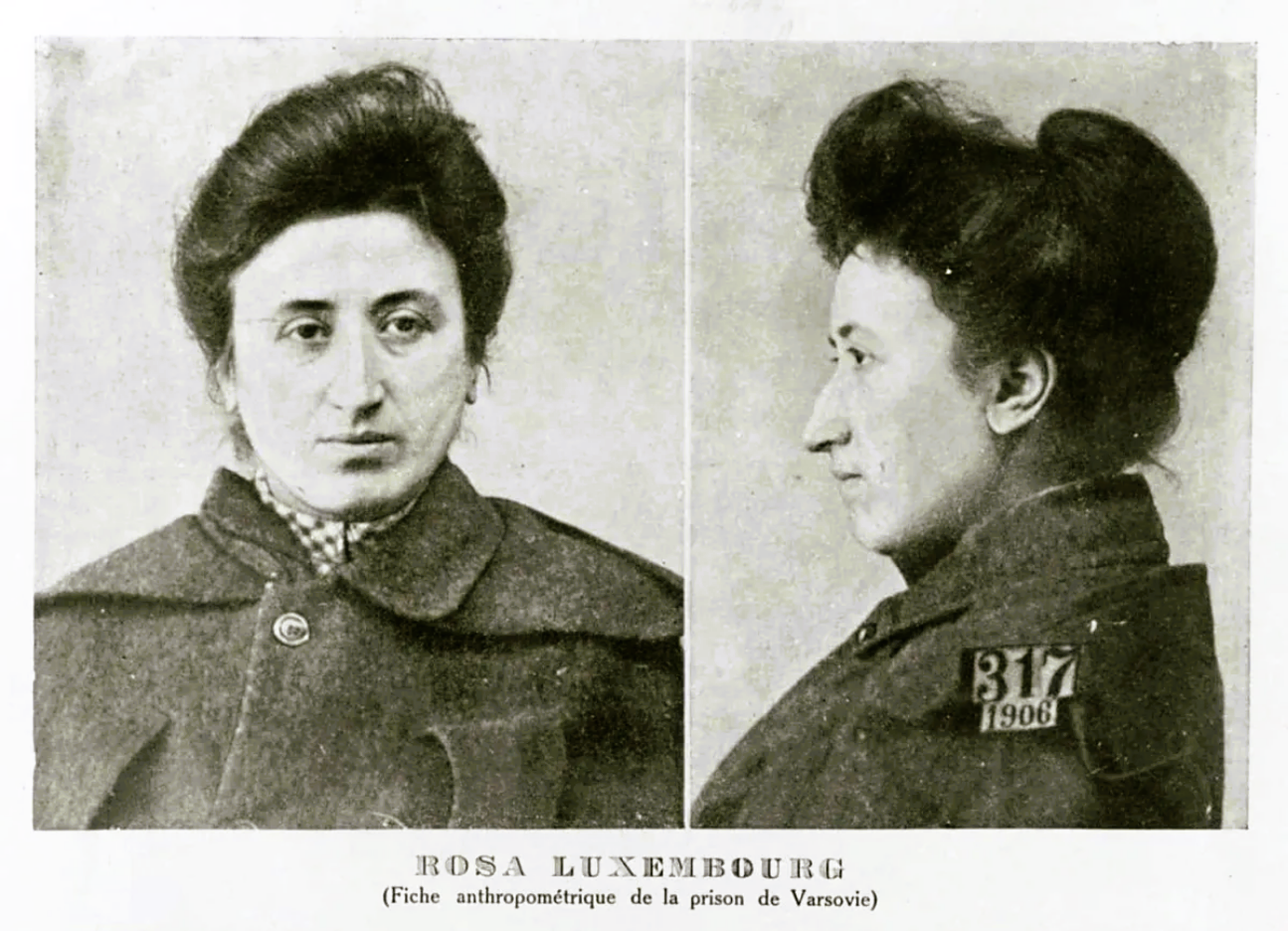
Rosa Luxemburg writes to Luise and Karl Kautsky in March, 1906 to say she has been arrested in Warsaw during the events of the Russian Revolution. Evocatively describing her conditions of imprisonment, she asks for help with tasks while she is locked up, and requests that Karl take over her role as Polish representative in the International’s bureau.
‘Letter from Warsaw City Jail’ (1906) from Letters to Karl and Luise Kautsky from 1896 to 1918 by Rosa Luxemburg. Edited by Luise Kautsky, Translated by Louis Lochner. Robert M. McBride and Company, New York. 1925.
Undated; received 13.3.06.
My best beloved:
On Sunday, the 4th, in the evening, my fate overtook me: I was arrested. My pass had already been visaed for the return and I was at the point of leaving. Well, it will have to do this way too. I hope you won’t take the matter too much to heart. Long live the Re * * *! together with everything connected with it. In some respects I even prefer sitting here to * * * arguing with Peus. I was found in a pretty untoward position. But let’s forget about that. I am sitting here in the city hall, where ‘’politicals,” ordinary culprits and mentally unbalanced are all crowded together. My cell, which is a jewel with its present trimmings (an ordinary single cell for one person in normal times) contains 14 guests, fortunately all of them politicals. Next door to us, on either side, is a large double cell. In each of them about 30 persons, all mixed. I am told that these are really conditions approaching paradise, for formerly 60 sat together in one cell and slept in shifts, a few hours each, during the night, while the rest “went walking.” Now we are all sleeping like kings on boards, on top of each other, next to each other, packed like herrings, and we manage nicely — unless indeed extra music is furnished us, as for instance yesterday, when we received a new colleague, an insane Jewess, who kept us breathless for 24 hours with her lamentations and with her running about in all the cells, and who made a number of politicals cry hysterically. Today we are finally rid of her and there are only three quiet “myschuggene” (1) with us.

Such a thing as a constitutional out in the courtyard is unknown here, instead the cells are open all day long and one is permitted to walk about in the corridor throughout the day, in order to mingle with the prostitutes, to hear their beautiful little songs and verses and to enjoy the odors of the likewise wide-open. — All this, however, merely by way of characterizing the conditions, and not my own spirits, which are always excellent. For the present a veil is drawn over me, but I suppose it won’t last long; they won’t believe me. Taken by and large, the matter is serious, but we are living in times of commotion, when “everything that exists is worth perishing.” That’s why I don’t believe at all in long-term notes and obligations. So be of good cheer and don’t care a hang. On the whole everything went excellently during my lifetime. I am proud of it; it was the only oasis in all Russia, where despite pressure and oppression the work and the fight progressed so briskly and lustily and with as good results as at a time of the freest of “constitutions.” The idea of obstruction, which will be a model for other times in the whole of Russia, is, among other things, our work. My health is quite all right. I suppose I shall soon be transferred to another prison, since my case is serious. I shall then send you news soon.
How are you, my dearest? How are you and the boys and Granny and Hans? Give Friend Franciscus my best regards. I hope things are going well again with the “V.,” thanks to the firm Block. (2) And now some requests of you, Luiserl: 1. Pay my rent, I shall pay back every¬ thing promptly and with many thanks. 2. Send an order for 2000 Austrian crowns at once to Mr. Alexander Ripper in the printing establishment of Theodorczuk, Cracow, Ulicia Zeilona No. 7, giving as the name of the sender that of Mr. Adam Pendzichowski. Leave all further possible demands from that quarter unheeded. 3. Likewise an order to Janiszewsky, Printery at Berlin, Elisabethufer 29, from Adam, for 500. — M. 4. Pay out no money besides this without an order from me, unless possibly from the separate, though never from the main account. Possibly upon demand of Karski, (3) otherwise not. Not from the account with Hans, either. 5. Ask for our share from the Old Folks and from Huysmans, and deposit with the main account.
Dear Karl, you must for the time being take over the representation of the Social Democracy of Poland and Lithuania in the Bureau. Send formal word there to this effect; possible travel to sessions will be refunded you. 7. My arrest may not be published until the complete unveiling. After that, however — I’ll let you know when — make a noise, so that the people here may get a scare.
I must close. Thousand kisses and greetings. Write me direct to my address: Mrs. Anna Matscbke, (4) City Hall Jail, Warsaw. Remember, I am an associate editor of the “Neue Zeit.” But of course, write decently. Once more: greetings. The cell is being locked. I embrace you most heartily.
Your Anna.
Notes.
1. Yiddish for crazy. — Transl.
2. Hans Block, who had been called to the “Vorwarts.” — L. K.
3. Marchlewski’s pen name. — L. K.
4. Rosa’s pass to Poland was made out in the name of Comrade Anna Matschke.
Letters to Karl and Luise Kautsky from 1896 to 1918 by Rosa Luxemburg. Edited by Luise Kautsky, Translated by Louis Lochner. Robert M. McBride and Company, New York. 1925.
Contents: Introduction by Luise Kautsky, Beginnings, 1896-1899, Incipient Friendship1900-1904, From the Imprisonment at Zwickau to the First Russian Revolution, The First Russian Revolution 1905-06, Up to the World War 1907-1914, Letters from Prison During the War 1915-1918, Postscript by Luise Kautsky, Appendix: Biography of Karl Kautsky. 238 pages.
PDF of book: https://www.marxists.org/archive/luxemburg/posthumous/lettersofrosaluxemburg-1922.pdf
 Revolution's Newsstand