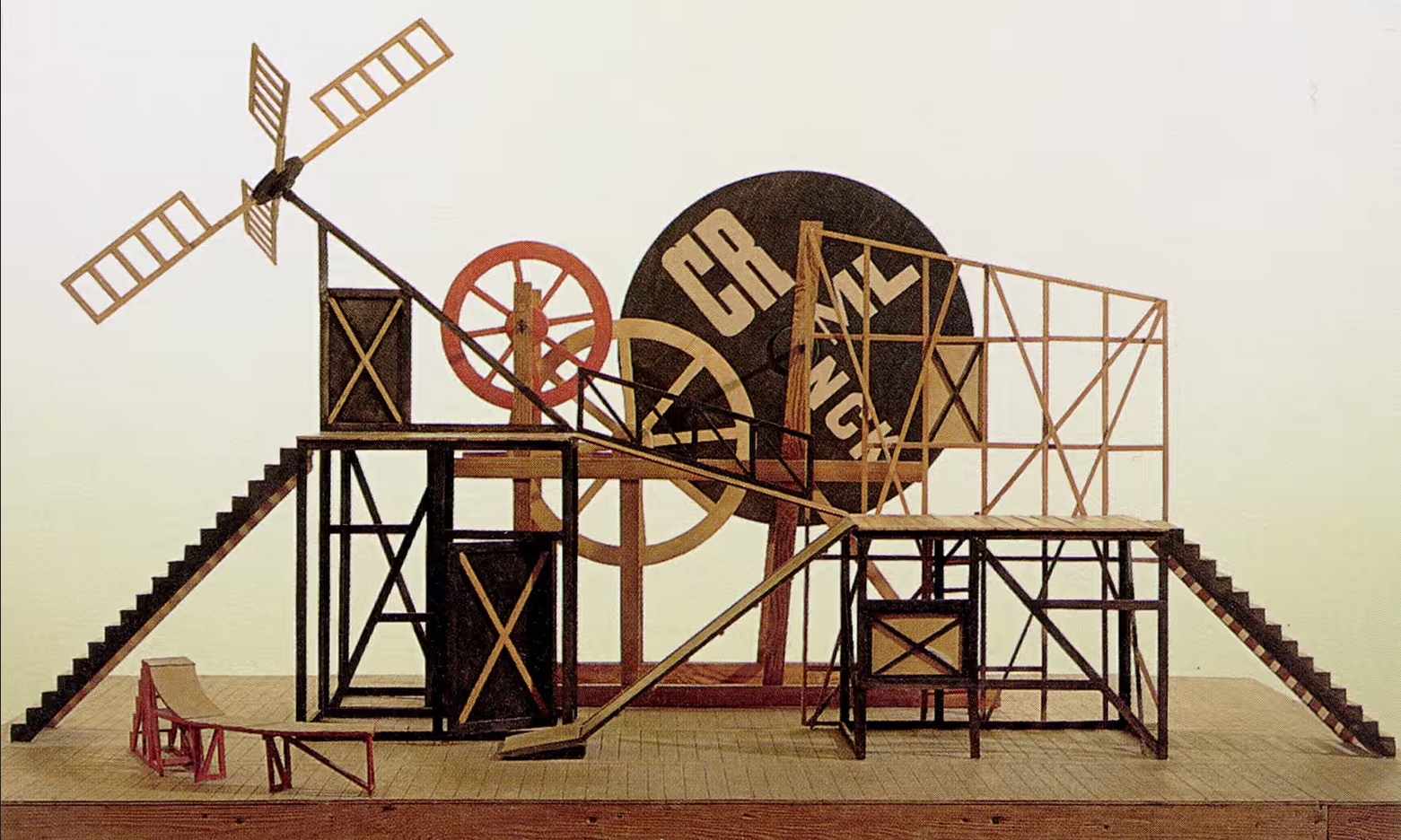
A wonderful glimpse into the explosion of theaters in the former Tzarist Empire after the Russian Revolution.
‘The Socialist Theatre in Soviet Russia’ by Alexander Chramoff from The Liberator. Vol. 6 No. April, 1923.
THE Great Soviet Revolution stirred Russia to its very depths. It conceived new forms in economics, ethics and culture. And it is clear that as outworn forms of human existence fell under the knife of the revolutionary masses, Russian art and the Russian theater could not escape being immersed in the waves of its “October Days” (significant days in the history of Russian freedom). In other words, the social change in Russia gave the conquering class full control not only in politics, economics and education but also in art.
Those opposed to “class art” on general principles will naturally ask: Is it possible to subject art to the same problems which the struggling proletariat subjects itself to? Can class control in art be realized in actual practice? The experience of the first five years of the Russian Revolution gives explicit answer to this. Yes, it is possible and can be realized fully in the following ways: the nationalization of theatres, the socialization of the repertoire and the training and fashioning of the actors of the new times in the shops of Proletcult.
The nationalization of theatres was brought about in Russia in the first period of the Revolution. In Moscow and Central Russia the largest and most important art centers were nationalized, while in the Ukraine more than 500 theatres were taken over under the nationalization law.
At this time the political and economic trend of the period favored the realization of these measures. The Russian theatre spiritually and materially lived through a deep crisis and a downfall. The wave of patriotism which spread over the land in 1914, was replaced in 1917-1918 by a great revolutionary protest. The broad masses of workers and peasants under the leadership of the communists declared war on war. On the decomposed corpse of Russian Imperialism the Proletariat began to initiate the Soviet order. The Russian theatre did not feel at once the stress of the times. The European war threw it from the field of real art into that of serving and popularizing the war. Until 1914 the Russian stage; was chiefly given to artistic repertoire. After 1914 this repertoire began to change to please the new audience which was composed of speculators and war-profiteers, the newly rich. The dying bourgeois culture strangled the dramatists and actors, and made it impossible for them to create anything new. The search for the new stopped. Interesting events on the Russian stage became more and more rare. Plays like the American Potash and Pearlmutter became the favorite spiritual food of the war audiences.

The more prominent directors and more intelligent actors began to reflect. They created theories about an intimate, individualistic, aristocratic art. Some of them, like the famous critic Aikhenvald, began to doubt the significance of the theatre. It became evident that if this state of affairs were to continue a little longer, Russian art would go to pieces.
It is necessary then to show that drastic measures had to be taken to change this situation. The workers and peasants in their recently acquired power lent a helping hand to the Russian theatre which was in a state of agony. Having nationalized the industries, having nationalized export and import trade, having nationalized state education, Soviet Russia also nationalized Russian art and the theatres.
What did the nationalization of theatres consist of? In what actual forms did it express itself?
The government put at the head of the theatres active and trustworthy communists along with the theatrical specialists who were connected with the old regime. Their duties were to keep the theatre in touch with the current culture and education of the day, cleaning it of the refuse of bourgeois culture and using it to the fullest extent for the education of the masses in communism.
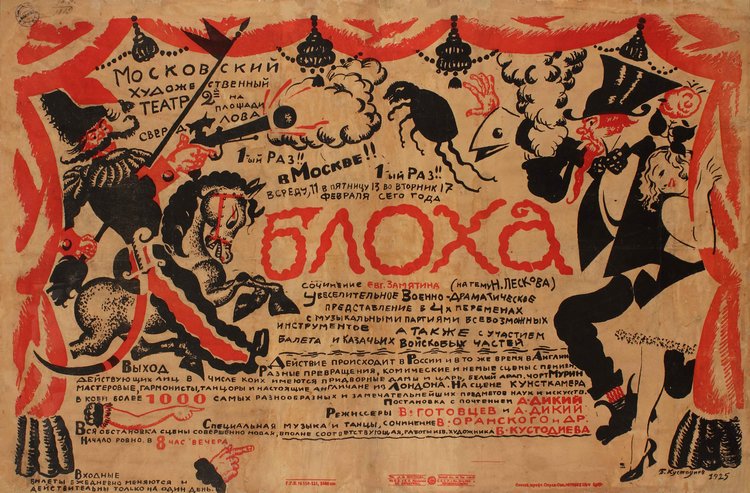
The latter was especially important. Experience showed that an artistically written and artistically presented play reflecting the contemporary situation was worth from a practical angle, ten speeches of first class party speakers.
In Moscow, as well as in the centres of the separate soviet republics affiliated with the R.S.F.S.R., there were organized groups which gradually became the dictators of the state theatres. In the management there were many committees which consisted of specialists and party workers. The most important among them were committees to handle repertoire, history of the theatre, management, professionals, the social well being of those engaged in the theatre, and to keep in touch with the provinces.
Emerging out of the nationalization situation, the committee established sole rights on repertoires. This meant that in each instance the theatre had to obtain a special permit to stage plays or it could choose them from the catalogues which were given out periodically by the Repertoire Committee.
For the Russian theatre such measures had added significance. It was absolutely necessary to correct, in the provinces which could not free themselves from the remaining influences of the war, the tendencies towards light opera and vaudeville.
Then the Central Committees took the right to send companies of the best actors to provinces and workers’ colonies. With the help of easily movable scenery, systematic staging, as well as special theatre trains, automobiles and other means of transportation, these companies visited factories, shops and small villages-places that never had dared to dream of seeing a decent play.

In this way, the Art Theatre with its extraordinary studios, the Kamerni Theatre and the former Imperial Theatre, and many other first class operatic and dramatic theatres, became accessible to the workers and peasants.
Although the nationalization of the theatre brought a great deficit to the state, tickets were sold at minimum or given away gratis. In order to fill the halls with workers, peasants and soldiers, the tickets were sent every evening to the presidium of each trade union and to the military commanders for an equal distribution among the working masses.
Little by little, practice pointed out three conditions which could make possible the success of the nationalization of the theatres.
1. Centralization in selection of the repertoire.
2. Centralization in the management of the theatre and direct supervision of those engaged in the theatre.
3. Centralization in the assignment of places in the theatres and symphony concerts.
I know that many reading these lines will exclaim- “Indeed this is real slavery! You may cover it, in alluring garb and call it beautiful names, but it remains slavery and no free soul will reconcile itself with it.” Perhaps so, but experience proved differently. Russian actors and directors took the idea of the nationalization of the theatre very enthusiastically. And for the seeming outer enslavement, the Russian actor was compensated by an inner freedom and the possibility of expressing his talent.

Under bourgeois conditions of life, in the capitalist countries of Europe and America, the actor is thrice a slave. He is forced to carry out the dictatorship of the producer, the cruel rule of the directing manager and, most important of all, his catering to a low-bred, overfed, and smug audience.
Which of these two conditions the intelligent actor will choose, I leave to the reader to judge.
ROMAIN Rolland maintains that happiness, strength and knowledge are the three basic requisites of the people’s, theatre. In the first place the theatre should serve as a place for physical and mental recreation for the worker after a strenuous day of toil. Secondly, it serves as a place for imbibing energy. The theatre should avoid everything which tends to pacify and humble the audience. The theatre should give strength and courage to the spirit. Third and last, the theatre should serve as a medium for the development of the human mind.
The management of the state theatres in arranging the repertoire for the theatres in their control, unquestionably took into consideration the foregoing conditions. In contrast. to the workshops of Proletcult they did not attempt to create a new revolutionary play or a new actor for it.

“To create new art” says Lunacharsky, “is extremely difficult in the very embryo of the revolution, when the active bearers of the new world are struggling and fighting. For creativeness not only fighting is necessary but also meditation and peace. Epochs of great upheaval are recognized philosophically and artistically after the close of the revolutionary stress, or in neighboring countries which are not caught in the maelstrom of revolution”.
From a different angle, the revolutionary stream through which the land was going as well as her arisen people, demanded not only the optimistic repertoire as proposed by Romain Rolland, but also a dynamic agitational repertoire.
Of course, the demand for dynamic repertoire did not at all mean that they wanted political speeches, instead of theatrical performances. “God save him who would attempt to give a five act play on the merits of the Short Work Day or even on the freedom of the press”, remarked Lunacharsky, not without wit.
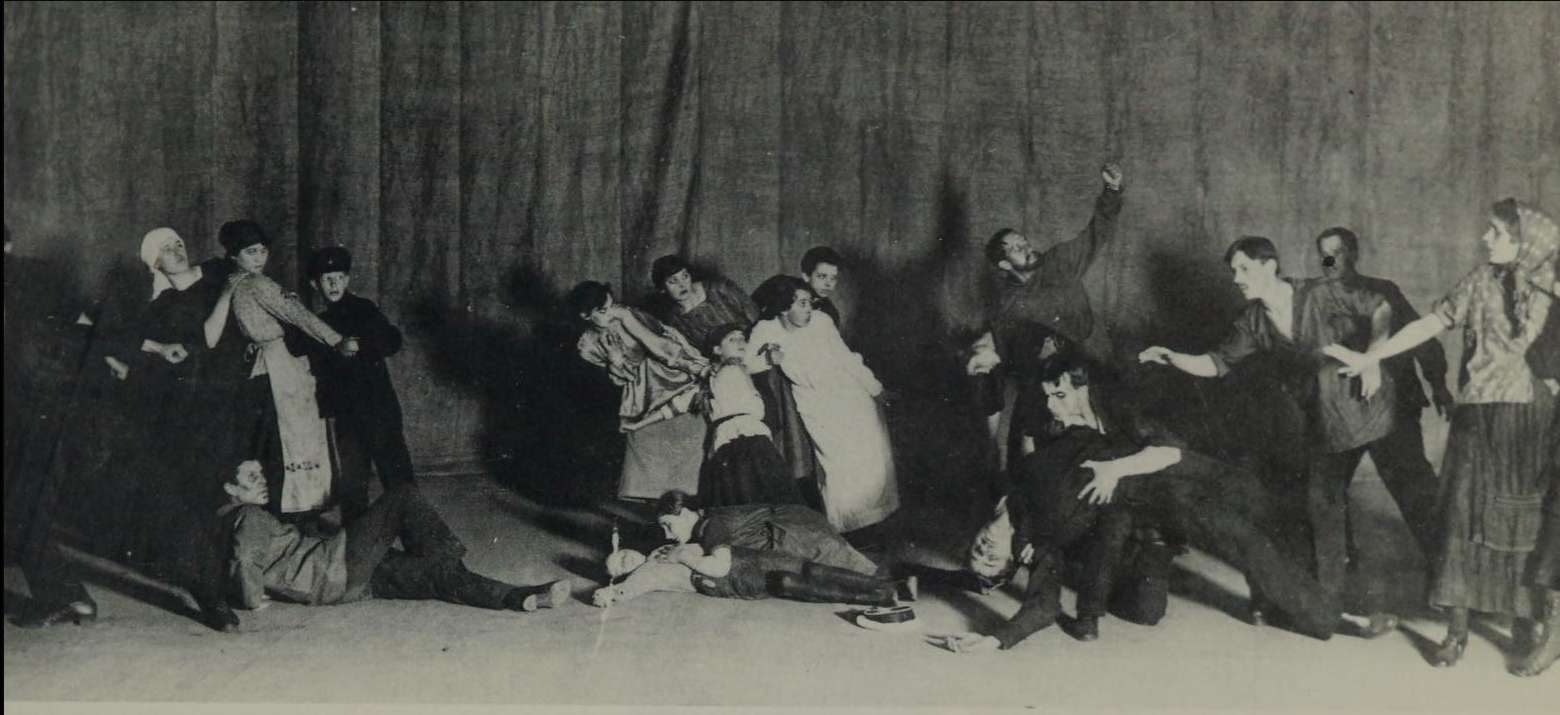
And for this reason it was necessary to dust off those plays which according to their contents were the by-products of the times. How then did the comrades of the repertoire committee criticize these plays? First and foremost, plays had to be artistic and answer to the laws of beauty. Then the thought and content of the play was considered.
Plays were chosen which dealt with the class struggle; devoted to pictures of exploitation of man by man—portrayals of the life and existence of the workers and peasants and illustrations of how man conquers the gigantic forces of nature. Such plays should call to life, to fighting for a better future, to faith in the victory of the struggling workers over the exploiters and capitalists.
For the staging of plays in the state theatres productions were recommended which gave pictures of the future of the socialist state, illustrations of the regeneration of man’s thoughts in the field of knowledge and technique, and finally historic pictures showing the parallel between the past and present state of things.

Here is a short list of plays recommended and played. Many of them received tremendous applause and appreciation from the audiences of workers and peasants. Verhaern’s The Dawn; The Weavers by Hauptman; Last Hope by Hermans; Catastrophe by del Gracio. The Wolves, The Capture of the Bastille, Danton, by Romain Rolland. The Green Cockatoo by Schnitzler. The Robbers and Wilhelm Tell by Schiller. Fuento Ovejuno and the Gardener’s Dog by Lopez da Vega. Mysteries by Buf Mayakowsky, Paul theFirst by Merezkowsky; The Lower Depths, The Enemies by Gorki. The Epidemic by Bumaznek. Satires by Octave Mirbeau. The Devil’s Disciple, Mrs. Warren’s Profession, Arms and the Man by Bernard Shaw. The Brave Prince, by Calderon. Le Bourgeois Gerntilhomme, by Moliere.
Beside the plays mentioned above, the following novels served as material for production: The novels of Uelsa, The Gadfly, by Voinich; Pelle the Conqueror, by Nexo, Germinal, by Emile Zola. The novels from the life of the French Revolution by Pierre, The Field of War, White Terror and Terror. Frank Norris’, The Octopus and The Pit. Short stories and sketches by Jack London and Upton Sinclair.
As a protest to religious superstition they produced Sava by Leonid Andreiev and finally they produced plays on the history of Revolution in Europe as well as in Russia. For instance, in Petrograd they gave a play called The First Days of the Revolution, in which many thousands participated not only as onlookers but as actual participants.

I mention the last in order to show the tendency of the Russian, theatre towards mass action in which not only the actors take part but also the public.
In working out the inner forms of the socialist theatre the communist directors like to produce plays which give possibilities of removing the barriers between the audience and the stage. The soul of the theatre goer should move in unison with the soul of the actor. That is the formula which is the most popular in contemporary theatrical Russia. I am reminded of a performance in the Kiev-Solovchovsky Theatre. The theatre was crowded with workers and red guards. Director Mardzanov was producing the Spanish Lopez da Vega’s Fuento Ovejuno.
In the course of producing the play he was confronted with the difficult problem of how to stimulate the audience to an immediate interest and understanding of what the actors live through. Although the play was written more than two hundred years ago, it represents wonderfully the present spirit and one looks on with breathless interest.
In a village called Fuento Ovejuno the owner, a typical Medieval tyrant, annoys one of the popular girls of the village with his attentions. The cup of patience of the freedom-loving Spaniards is filled to overflowing. A revolution breaks out and the tyrant is killed. The population of Fuento Ovejuno takes a unanimous oath not to give away those who killed him to the Punitive Expedition.

The fourth act is a scene of torment. Children, aged men and pregnant women are tortured and asked who killed the commander. Almost in an unconscious state they firmly and bravely exclaim: “Fuento Ovejuno! the whole village is guilty of the. murder but no individual”.
I carefully watched the audience. Real indignation was written on the faces of the excited onlookers. Their eyes flashed fire. They were electrified and every minute it seemed as if they would throw themselves on the stage to save the unfortunates. With every new torture, with every new act of the gendarmes, there was a deep, sullen murmur through the hall. And when the maddened and enraged head of the gendarmes turned to the audience and asked, “Tell us then, who in the· village killed the commander?”, the audience spontaneously like one man jumped up from its seats and cried: “Fuento Ovejuno! Fuento Ovejuno!” A young soldier sitting alongside of me, added in a self satisfied voice: “And you will never find out”. In the end the gendarmes rode off and the triumphant villagers and onlookers joined in a mighty inspiring hymn- The International.
The Liberator was published monthly from 1918, first established by Max Eastman and his sister Crystal Eastman continuing The Masses, was shut down by the US Government during World War One. Like The Masses, The Liberator contained some of the best radical journalism of its, or any, day. It combined political coverage with the arts, culture, and a commitment to revolutionary politics. Increasingly, The Liberator oriented to the Communist movement and by late 1922 was a de facto publication of the Party. In 1924, The Liberator merged with Labor Herald and Soviet Russia Pictorial into Workers Monthly. An essential magazine of the US left.
PDF of full issue: https://www.marxists.org/history/usa/culture/pubs/liberator/1923/04/v6n04-w60-apr-1923-liberator-hr.pdf
 Revolution's Newsstand